
From Toronto to Boston
How ‘American Gothic’ Crew Transformed Toronto Into Boston
By Liam Martin
 Home from “American Gothic” (CBS)
TORONTO (CBS) — If the house and the neighborhood at the center of the new CBS thriller “American Gothic” looks like they could be found on Chestnut Hill, that’s by design.
“Well, that’s encouraging to hear,” Tim Owen told WBZ’s Liam Martin with a laugh.
Owen is the location manager of the murder mystery, and he was speaking to Liam in Toronto, not Boston — despite the fact the show is set in the Hub.
“We all kind of develop a kind of checklist of what makes Boston what it is when we see it visually,” Owen said.
He has had to turn to that checklist for this project, finding the parts of Toronto that can fit.
CIRKLON3 (17 Years)
Jaws At Linda Mar
Great White Shark spotted off Pacifica beach
By Aaron Pero
PACIFICA (KRON) — As temperatures begin to climb and people expected to hit the coast this weekend to beat the heat, police are warning beachgoers about a possible shark roaming in the waters off Pacifica.
According to police, a white shark was spotted at around 10 a.m. off of Linda Mar Beach. A surfer in Pacifica said he was only 20 feet away from a great white shark this morning.
“While shark sightings are not frequently reported, we do realize the Pacific Coast is part of the natural habitat for white sharks,” police said.
‘Focus: The Secret, Sexy, Sometimes Sordid World of Fashion Photographers’ by Michael Gross
Group sex, a speed addiction and an affair with 18-year-old Anjelica Huston: The weird world of photographer Terry Richardson’s dad revealed in shocking new book
 Dad: Terry Richardson is now a father himself, having had two kids – Rex and Roman – with girlfriend Alex Bolotow (left)
Terry Richardson is the bad boy of fashion photography: his sexually explicit, in-your-face shoots – sometimes involving real sex acts – have earned him a following that includes Lady Gaga, Marc Jacobs and Yves Saint Laurent.
He’s also been accused of pressuring models into sex by Danish model Rie Rasmussen, a claim he denies. But as controversial as his own career has been, it can’t hold a candle to his father’s.
An amphetamine-addicted schizophrenic, Bob Richardson turned the world upside down for the fashion industry – and for young Terry, who was drawn into his disturbing world of group sex, hard drugs and violent outbursts.
The startling story was revealed by the NY Post Saturday in an excerpt from ‘Focus: The Secret, Sexy, Sometimes Sordid World of Fashion Photographers’ by Michael Gross.
Born in 1928 to a Catholic family in Long Island, New York, Richardson – initially a graphic designer – didn’t pick up a camera until 1963, when he was 35.
But when he did, he went at the job hard, telling himself he had to become a ‘legend’ in the industry and injecting himself with amphetamine-laced vitamin supplements that would let him for for days at a time without sleeping.
Fractious, arrogant, brilliant and driven, Richardson was infamous in the 1960s for causing a ruckus on sets, ruining clothing, going into tremendous outbursts and infuriating his clients.
‘I’m told you’re a genius, but I don’t see it,’ Charles Revson, owner of Revlon, told him one time.
‘Get your eyes examined,’ Richardson barked at him.
His arms bruised by needle tracks from self-administered amphetamine shots, Richardson shot glamorous models for Paris Vogue and Harper’s Bazaar, bringing a gritty rock ‘n’ roll ethos that was revolutionary at the time.
But he pushed himself too far, working day and night in the grip of an ever-growing drug dependency.
Bill Cunningham Gone
Bill Cunningham, Legendary Times Fashion Photographer, Dies at 87
By
 First Thought Films/Zeitgeist Films
Bill Cunningham, who turned fashion photography into his own branch of cultural anthropology on the streets of New York, chronicling an era’s ever-changing social scene for The New York Times by training his busily observant lens on what people wore — stylishly, flamboyantly or just plain sensibly — died on Saturday in Manhattan. He was 87.
His death was confirmed by The Times. He had been hospitalized recently after having a stroke.
Mr. Cunningham was such a singular presence in the city that, in 2009, he was designated a living landmark. And he was an easy one to spot, riding his bicycle through Midtown, where he did most of his field work: his bony-thin frame draped in his utilitarian blue French worker’s jacket, khaki pants and black sneakers (he himself was no one’s idea of a fashion plate), with his 35-millimeter camera slung around his neck, ever at the ready for the next fashion statement to come around the corner.
Nothing escaped his notice: not the fanny packs, not the Birkin bags, not the gingham shirts, not the fluorescent biker shorts.
In his nearly 40 years working for The Times, Mr. Cunningham snapped away at changing dress habits to chart the broader shift away from formality and toward something more diffuse and individualistic.
At the Pierre hotel on the East Side of Manhattan, he pointed his camera at tweed-wearing blue-blood New Yorkers with names like Rockefeller and Vanderbilt. Downtown, by the piers, he clicked away at crop-top-wearing Voguers. Up in Harlem, he jumped off his bicycle — he rode more than 30 over the years, replacing one after another as they were wrecked or stolen — for B-boys in low-slung jeans.
In the process, he turned into something of a celebrity himself.
Jeff Russo on Scoring ‘American Gothic’
from Billboard
Tonic’s Jeff Russo on Scoring ‘American Gothic,’ ‘Fargo’ & Marvel’s ‘Legion,’ Plus the 20th Anniversary of ‘Lemon Parade’
by
 Jeff Russo, the composer for new CBS series, “American Gothic.” / JUSTINE UNGARO
It’s nearly impossible to turn on the TV and not hear music by Jeff Russo. The Fargocomposer, who is also a guitarist with the Grammy-nominated band Tonic, scores a staggering six television series either currently airing or in production.
His newest, American Gothic, co-produced by Steven Spielberg’s Amblin Television, debuts Wednesday on CBS. The 13-episode drama, starring Virginia Madsen, Juliet Rylance and Justin Chatwin, revolves around a prominent Boston family whose patriarch may be involved in an series of unsolved murders.
“It’s just super thrilling to have the word ‘Amblin’ associated with anything I’m working on,” Russo, 46, says. “I’m thrilled to be under the same fold as someone as great as Steven Spielberg and John Williams, who is probably my favorite composer of all time.”
In addition to Season 3 of FX’s Fargo, for which he earned an Emmy nod for best original dramatic score in 2014, Russo is also working on Fargo producer Noah Hawley’s new Marvel series Legion, the third season of Starz’s 50 Cent-produced drama Power, upcoming HBO limited series The Night Of, and ABC’s Kevin Williamson-helmed 2017 show Time After Time.
Russo talked to Billboard about each series, as well as the 20th anniversary of Tonic’s debut album, 1996’s Lemon Parade, best known for the Mainstream Rock Songs chart-topper “If You Could Only See.”
American Gothic, CBS (June 22)
“We do the show with a small orchestra, about 16 strings and five woodwinds, but it is understated. The idea was we didn’t want to be heavy-handed with the music because when you do that, all of a sudden, you’re melodrama. This show is left of center — like the grandson who’s a little weird — and that was part of the choice to lean toward the oddity of it. We’re trying to give the show a more cinematic and cable feel. A lot of times on network television, you have wall-to-wall music and shows tend to lean on music to help build the narrative, whereas in movies and cable, we have a way of allowing the dialogue to do what it’s going to do, allowing the emotion to land and then play. We’re trying to score it less and let the score be more meaningful. We’re definitely not playing the emotion or the drama on the nose.”
BTK SBK
‘American Gothic’ hits close to home for BTK’s daughter
BY ROY WENZL
“I think it’s important to remember that there are actual people who died, 10 people who lost their lives and 8 families – that’s including mine – that were destroyed and forever separated by my dad’s actions,” said Kerri Rawson, Dennis Rader’s daughter. Travis Heying File photo
“American Gothic,” a new CBS show this summer, is about a serial killer “S.B.K.” and possibly the killer’s family. It looks as though it was inspired or at least informed by a serial killer familiar to Wichitans.
Corinne Brinkerhoff, the show’s creator, (a writer on “The Good Wife), said in “Entertainment Weekly,” that “Gothic” “reminds” her of a case she grew up knowing in Kansas, about a church deacon and Boy Scout mentor who turned out to be a serial killer, unbeknownst to his own family.
That sounds much like the story of Dennis Rader of Park City, who in 2005 was arrested and identified as the serial killer BTK, who operated in Wichita from 1974 to 2005. Rader killed 10 people in and around Wichita, and for 31 years until his capture taunted police and the public by sending cryptic (and badly spelled) clues.
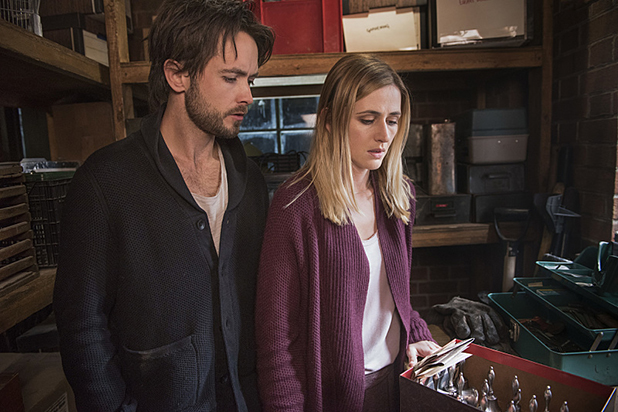
In the “Gothic” episode that ran Wednesday evening, it was clear that the show is about not only a serial killer but the dysfunctional and varied Hawthorne family of Boston. Two family members, snooping through the basement, find an Ikea box filled with silver bells, which look a lot like the little silver bells the killer S.B.K (Silver Bells Killer) leaves with his victims.
A Massive Game Of Clue
‘American Gothic’ Showrunner on Why the Set Is Like a ‘Massive Game of Clue’
By
 CBS
CBS
“The fun of shooting is that they can all kind of look at each other with suspicion,” Corinne Brinkerhoff tells TheWrap about keeping the mystery going even for the cast
Coming off of light-hearted dramedy “Jane The Virgin,” CBS’ serial killer drama “American Gothic” seemed like a swerve for writer/producer Corinne Brinkerhoff, but the first-time showrunner tells TheWrap that the two have more in common than you might think.
“Believe it or not there’s actually quite a bit of comedy in ‘American Gothic,’” she said. “I know it sounds illogical, but I think one of the ways people deal with traumatic situations is with gallows humor. It’s certainly what I do, and I love that.”
The CBS summer series is about a prominent Boston family that discovers its newly deceased patriarch (Jamey Sheridan) may have been a notorious serial killer, and that his widow (Virginia Madsen) or one of his four adult children may have been his longtime accomplice.
Below, Brinkerhoff describes her first outing as a showrunner, how she ended up being an executive producer on two shows at once, and how the mystery of “American Gothic” remains elusive, even for the cast.
ACE Mozart
Mamma Mia! listening to Mozart lowers blood pressure…but ABBA has no impact
By
 Mozart’s Symphony No 40 in g minor lowered blood pressure
Relaxing to a soothing Mozart symphony can lower the blood pressure as much as cutting salt from the diet or exercising, a new study has shown.
But for people concerned about their heart, it might be wise to stay clear of ABBA, which has no impact at all.
Scientists in Germany played Mozart’s Symphony No 40 in g minor, dances by Johann Strauss and songs by ABBA to 60 volunteers, monitoring their blood pressure before and after the experiment.
They found that Mozart lowered systolic blood pressure (the pressure in blood vessels when the heart beats) by 4.7 mm Hg, Strauss 3.7 mm Hg but the Swedish pop group made no significant difference.
Diastolic blood pressure (when the heart rests between beats) also fell by 2.1 mm Hg for Mozart and 2.9 mm Hg for Strauss.
Bassnectar – Reaching Out – Insanely Good
A Visual Nod To The Masters
‘American Gothic’ goes arty with a visual nod to masters
By Robert Rorke
 Virginia Madsen (above) strikes a pose similar to Whistler’s mother (below).Photo: Christos Kalohoridis/CBS
One doesn’t expect to see great American works of art referenced in a new television series. But Corinne Brinkerhoff, executive producer of “American Gothic,” is determined to change that.
Her new show, which takes its title from the painting by Grant Wood, is about a wealthy Boston family trying to cover up a scandal when police suspect one of its members may be the “Silver Bells Killer.” Each of the 13 episodes is named after a famous painting.
The titles are well chosen, as Brinkerhoff and her team of eight writers have made the paintings “organically part of the episode.” For example, Wednesday’s premiere is called “Arrangement in Grey and Black” (more commonly known as “Whistler’s Mother”), and based on the 1871 painting by James McNeill Whistler. In the final scene actress Virginia Madsen, who plays devious matriarch Madeline Hawthorne, is posed, with some modifications, as the figure in the painting: seated and seen in profile, against a gray backdrop with one framed work of art on the wall.
“We matched some of our favorite paintings to what is going to happen in each episode,” says Brinkerhoff (“The Good Wife”), who spoke to The Post about how some of the renowned canvases will be captured this season.
Screaming Women Cool.
INTRODUCING RAGE-ERCISE New fitness trend sweeping the UK sees women screaming and popping balloons bearing their angry words
Ladies also jump up and down on bubble wrap and pummel pillows with baseball bats in the Tantrum Club classes
BY JOSIE GRIFFITHS
 ‘We are a bunch of women who believe that we operate differently to men when it comes to emotions’
IN a world where we are taught to restrain ourselves and hold our emotions in, it can be a bit of a relief to finally let it all out.
Introducing Tantrum Club, the rage-ercise workshops where women are encouraged to scream, shout and pummel their way to inner peace.
Club founder Adele Theron wanted to create a space for stressed mums and city workers to stop suppressing and really let go of all those negative emotions.
Clutching baseball bats carrying the ‘it’s tantrum time’ slogan and wearing goggles, the ladies prepare to lay into a pile of pillows as part of the self empowerment and anger management classes.
Female participants are also urged to yell as loudly as they can, jump up and down on rolls of bubble wrap, and write their ANGRIEST thoughts on balloons – before popping them.
Earth’s Quasi-moon
Surprise! Newfound Asteroid Is ‘Quasi-Moon’ of Earth
By
 The newfound asteroid 2016 HO3 has an orbit around the sun that keeps it as a constant companion of Earth. Credit: NASA/JPL-Caltech
It seems the moon is not Earth’s only cosmic companion.
The newly discovered asteroid 2016 HO3 orbits the sun in such a way that the space rock never strays too far from Earth, making it a “quasi-satellite” of our planet, scientists say.
“One other asteroid — 2003 YN107 — followed a similar orbital pattern for a while over 10 years ago, but it has since departed our vicinity,” Paul Chodas, manager of NASA’s Center for Near-Earth Object Studies at the Jet Propulsion Laboratory in Pasadena, California, said in a statement Wednesday (June 15).
“This new asteroid is much more locked onto us,” Chodas added. “Our calculations indicate 2016 HO3 has been a stable quasi-satellite of Earth for almost a century, and it will continue to follow this pattern as Earth’s companion for centuries to come.”
Indeed, 2016 HO3 is the best example of an Earth quasi-satellite ever found, scientists said.
Rocka-Rolla-Coasta
The world’s most terrifying roller coasters
 Photo by evyuangga
Japanese thrill-freaks jaded by high-tech, high-speed coasters and flumes strap in for Zen-like thrills in the city of Okayama.
A Brazil-themed amusement park there, appropriately called Brazilian Park Washuzan Highland, boasts an attraction called SkyCycle that requires riders to provide the power. Pedaling tandem bikes and controlling their own destiny, they move along on frighteningly narrow tracks, without the benefit of visible barriers, and rise 50 feet in the air. Parachutes are not provided.
A water-torture of a thrill ride, SkyCycle ramps up the fright factor with a no-tech approach: There’s nothing to prevent bikes from rear-ending one another, tight turns add to the adventure and safety precautions appear minimal. Riders gingerly pedal up a roller coaster-style track with seemingly little to stop them from plummeting 50 feet to the ground.
According to the Daily Mail, it is one of the amusement park’s top attractions and ranks among the world’s scariest rides.
The Story Of My Best Friend
A New Origin Story for Dogs
The first domesticated animals may have been tamed twice.
by ED YONG
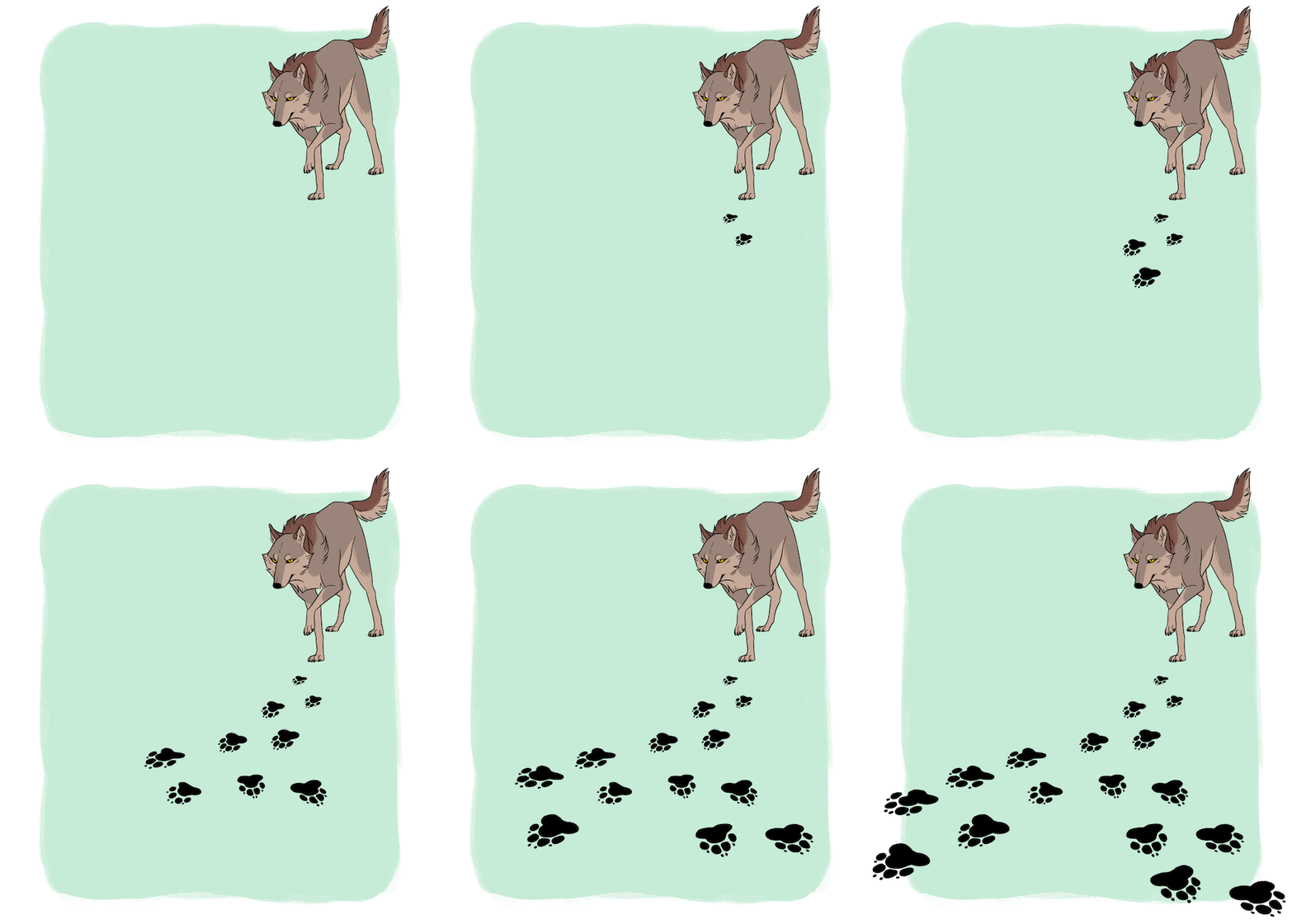
Tens of thousands of years ago, before the internet, before the Industrial Revolution, before literature and mathematics, bronze and iron, before the advent of agriculture, early humans formed an unlikely partnership with another animal—the grey wolf. The fates of our two species became braided together. The wolves changed in body and temperament. Their skulls, teeth, and paws shrank. Their ears flopped. They gained a docile disposition, becoming both less frightening and less fearful. They learned to read the complex expressions that ripple across human faces. They turned into dogs.
Today, dogs are such familiar parts of our lives—our reputed best friends and subject of many a meme—that it’s easy to take them, and what they represent, for granted. Dogs were the first domesticated animals, and their barks heralded the Anthropocene. We raised puppies well before we raised kittens or chickens; before we herded cows, goats, pigs, and sheep; before we planted rice, wheat, barley, and corn; before we remade the world.
“Remove domestication from the human species, and there’s probably a couple of million of us on the planet, max,” says archaeologist and geneticist Greger Larson. “Instead, what do we have? Seven billion people, climate change, travel, innovation and everything. Domestication has influenced the entire earth. And dogs were the first.” For most of human history, “we’re not dissimilar to any other wild primate. We’re manipulating our environments, but not on a scale bigger than, say, a herd of African elephants. And then, we go into partnership with this group of wolves. They altered our relationship with the natural world.”
Larson wants to pin down their origins. He wants to know when, where, and how they were domesticated from wolves. But after decades of dogged effort, he and his fellow scientists are still arguing about the answers. They agree that all dogs, from low-slung corgis to towering mastiffs, are the tame descendants of wild ancestral wolves. But everything else is up for grabs.
Some say wolves were domesticated around 10,000 years ago, while others say 30,000. Some claim it happened in Europe, others in the Middle East, or East Asia. Some think early human hunter-gatherers actively tamed and bred wolves. Others say wolves domesticated themselves, by scavenging the carcasses left by human hunters, or loitering around campfires, growing tamer with each generation until they became permanent companions.
Fast Times Forever
Why high school stays with us forever
 Sometimes, conformity can lead to cringeworthy moments – bad hairstyles among them. John Philip Green/flickr, CC BY
For better or worse, many of us never forget high school: the unrequited romantic crushes, chronic embarrassment, desperate struggles for popularity, sexual awakening, parental pressure and, above all else, competition – social, athletic, academic.
There’s even an entire genre of entertainment that revolves around high school. “Beverly Hills 90210,” “Mean Girls,” “Heathers,” “The Breakfast Club” and “Fast Times at Ridgemont High” all revisit the conflict and angst of these years.
What is it about this period of our lives that makes it seem more meaningful and memorable than any other?
My research experience as an evolutionary psychologist leads me to believe that many factors interact to make our teenage memories so vivid. But the main driver is the collision between the hardwiring of our brains that took place across several million of years of evolution and the odd social bubble created by high school, which poses an unprecedented social challenge to our prehistoric minds.
In other words, the world that we evolved to be successful in (a small, stable group of interrelated people of various ages) is very different from the holding pen full of teenagers brimming with hormones that populate our world during the high school years.
AMERICAN GOTHIC Publicity Stills
Promo images for American Gothic premiere episode – ‘Arrangement in Grey and Black’

Following last week’s promo [watch it here], CBS has released a batch of images from the first episode of the upcoming mystery drama series American Gothic, entitled ‘Arrangement in Grey and Black’; check them out [click]…
Camry Gone Crazy
NASA Doesn’t Know
How Big Are Those Killer Asteroids? A Critic Says NASA Doesn’t Know.

More than 14,000 known asteroids zip through Earth’s neighborhood. They will all miss Earth in the coming decades.
But hundreds of thousands more have not yet been discovered, and whether any of those are on course to slam into our planet, no one knows. So finding and tracking all the asteroids that could cross Earth’s path would allow officials to issue warnings and potentially provide time to deflect dangerous ones.
The community of scientists contemplating such doomsday possibilities is small and usually cordial — at least until Nathan P. Myhrvold barged in. Once the chief technologist at Microsoft, Dr. Myhrvold moved on to other endeavors like a six-volume, 2,438-page compendium of cooking knowledge that has been celebrated by chefs. (A sequel, about baking, is in the works.)
He has also become a statistics scold of scientists.
His latest target is NASA, in a squabble over data from the Wide-field Infrared Survey Explorer spacecraft.
WISE, launched in 2009, snapped images of three-quarters of a billion stars, galaxies and other celestial objects, including the heat emissions of asteroids.
An offshoot called Neowise used the heat data to calculate the size and reflectivity of 158,000 asteroids.
Dr. Myhrvold contends that the Neowise analysis is deeply flawed. “The bad news is it’s all basically wrong,” he said. “Unfortunately for a lot of it, it’s never going to be as accurate as they had hoped.”
He submitted his own analysis of the Neowise results to the journal Icarus.
Crazy.
The Awesome Story Behind the Song of the Year
Ruth B’s ‘Lost Boy’ And The Story Behind The Year’s Strangest Hot 100 Hit
by Elias Leight
Ruth B’s “Lost Boy” is easily the most unusual song on the Hot 100: when it cracked the top 50 earlier this month, it was the only unadorned piano ballad on the chart’s top half, no small feat. It’s also the only song on the chart inspired by a more than century-old play.
That play is Peter Pan, first staged in 1904 and currently enjoying something of a moment in pop music. Last summer, an album with the same theme was released to accompany the musical Finding Neverland, but despite contributions from Nick Jonas, Jennifer Lopez, and Zendaya, nothing cracked the Hot 100. But Ruth B’s out-of-nowhere success — she was an unknown without a record deal before “Lost Boy” — suggests that the problem was with the execution rather than the concept. And Peter Pan’s appeal transcends genres: while “Lost Boy” climbs the charts, country listeners are warming to Kelsea Ballerini’s “Peter Pan,” No. 28 and climbing on the Hot Country Songs chart.
That secret other world has spawned a thousand spinoffs, and the Peter Pan character in the TV show Once Upon A Time is the one who inspired Ruth B to write her hit. After watching an episode, she headed downstairs to her keyboard. “I was in a Peter Pan headspace,” she remembers. “I sang that first line out of nowhere.”
Ruth is a fan of the app Vine — especially after a spontaneous decision to post a loop of her singing the chorus to Drake’s “Hold On We’re Going Home,” which led to a large increase in followers. She’d never written a song before the first line of “Lost Boy,” though, so she was hesitant to promote it on the app. “I initially didn’t even want to post it because it was a little bit cheesy,” she says. “But it kept ringing through my head.”
She eventually posted it, and the reaction was immediate: people wanted more. She started to add lines in Vine-able increments. “I would finish studying, come down stairs, and add a line to the chorus,” she explains. “In a week, I had a chorus, so I decided I should turn this into a full song and take it to YouTube.”
The result, built six seconds at a time, is a beatless piano ballad. Chords hang in the air, never pressing on top of each other. Ruth occasionally climbs into falsetto, but the track doesn’t have much movement or drama. Although it’s about finding friends, Ruth sings alone, and this isolation is emphasized by an echo effect. Her Neverland is a place of complete liberty — “lost boys like me are free” — and the singer avoids taking sides in the frequently violent squabbles that divide the island’s characters in the original story: “Peter Pan, Tinker Bell, Wendy darling, even Captain Hook/ You are my perfect storybook.”
But a perfect story, even one with the long term resonance of Peter Pan, doesn’t guarantee a national hit. That’s where major label radio promotion comes in handy. The tale of “Lost Boy” seesaws between old and new media — while there’s a nostalgia inherent in the idea of not wanting to grow up, the most up-to-date technology played a crucial role in the track’s formation; though Vine helped “Lost Boy” bubble up, old-school radio power gave it a key boost.
The radio clout was corralled in part by Lee Leipsner, EVP and head of promotion at Columbia Records. He has been at Sony music for 22 years; before that, he spent five years at Mercury records. On the phone, he has the enthusiasm and fervor of a lifelong salesman, and an arsenal of statistics to support his points. “It never gets old breaking records,” he tells me.
Wow. Never in America.
Stop Dissing Neanderthals.
Neanderthals Built Mystery Cave Rings 175,000 Years Ago
Surprise! Neanderthals weren’t just more sophisticated than you thought. They also built structures deep inside caves.
 Etienne FABRE – SSAC
They painted magnificent cave paintings. They mastered fire and used tools. And now we know they constructed complex buildings deep within subterranean caves, and they did it more than 175,000 years ago. No, we’re not talking about early humans. Neanderthals did all this.
A team of archaeologists led by Jacques Jaubert at the University of Bordeaux in France has just completed an archaeological examination of a mysterious find: the rubble of two ancient Neanderthal-made buildings meticulously crafted from stalagmites. The site is located 1,000 feet into a dark, twisting cave 30 miles outside what is now Toulouse in southwestern France. The discovery is the first of its kind and, the researchers say, radically alters the understanding of Neanderthal culture. Jaubert’s team outlines their exploration today in a paper in the journal Nature.
“Because Neanderthals were the only [human-related primate] group present in western Europe at that time, the discovery provides the first directly dated evidence for Neanderthals’ construction abilities. It also shows that Neanderthals explored underground,” writes Marie Soressi, archaeologist at Leiden University in the Netherlands (not involved in Jaubert’s archaeological examination), in an essay accompanying the study.
John Wayne Reaches Critical Mass
Giants Amongst Us
The Ancient Giants of Nevada and The Mystery of Lovelock Cave

Reid was unable to begin digging himself but news spread and soon, Lovelock cave was attracting attention. Unfortunately, the attention was profit-driven as guano deposits were discovered inside. A company started by miners David Pugh and James Hart began excavating the precious resource in 1911 and had soon shipped more than 250 tons to a fertilizer company in San Francisco. Any artifacts that might have been discovered were probably neglected or lost.
After the surface layer of guano had been mined, strange objects started to surface. This led to an official excavation being performed in 1912 by the University of California and another one took place in 1924. Reports told about thousands of artifacts being recovered, some of them being truly unusual.
Eduarda Henklein Baterista
Aliens, Charred Human Remains Found in Sydney
Aliens on the streets of Sydney! Eerie photos from the set of Prometheus sequel Alien: Covenant show humanoid lifeforms frozen in agony at the moment of their death
By JO SCRIMSHIRE
 Haunting: One heart-stopping image from the set of Alien: Covenant taken at an undisclosed quarry in Sydney, Australia shows around two dozen ashen human forms eerily frozen in moments of panic and horror as they desperately clamber up a set of steps
These are the incredible photos taken from the set of upcoming sci-fi blockbuster Alien: Covenant, which is being filmed at an undisclosed location in Sydney, Australia.
The pictures were snapped at a quarry in the New South Wales capital on Thursday and show dramatic scenes of scorched human bodies twisted in despair and some being attacked by extra-terrestrial beings, similar to those from the Alien film series.
Directed by Oscar-nominated Sir Ridley Scott, the long-awaited sequel to 2012’s Prometheus appeared to be coming along nicely Down Under as production staff were shown against the backdrop of a grand, otherworldly set piece featuring huge blocks of charred stone and mysterious hieroglyphs.
Reflecting a haunting dystopia or end-of-civilisation scenario, several huge monuments appear toppled and strewn across the dry landscape and a tremendously large stone structure of a man’s face is left cracked and half-decapitated.
Juxtaposed next to the modern film machinery – including a large red and white crane, barricade tape and several work vehicles – the unfamiliar set and perfectly still human forms look disturbing and out-of-place.
Superdog
Predator X
Real sea monsters: The hunt for predator X
By
 (Image: Christian Darkin/Science Photo Library)
EACH summer, a team from the University of Oslo in Norway go hunting for monsters on the island of Spitsbergen. They carry guns in case they get menaced by the world’s largest living land carnivore, the polar bear. But it is not bears they are after. They are searching for much bigger quarry, the most formidable predators that ever lived.
Step back 150 million years and Spitsbergen was covered by a cool, shallow sea swarming with marine reptiles. The creatures died out and their fossils became part of an island stuffed full of bones. Nowhere else in the world are so many marine reptiles found in one place.
For a few short weeks the sun never sets and temperatures soar to just above freezing. Knowing that before long the ground will be frozen solid, the researchers dig like crazy. “It’s like a gold rush, there are so many fossils waiting to be found,” says team leader Jørn Hurum. “The site is densely packed with skeletons. As we speak there are probably more than 1000 skeletons weathering out.”
Hurum’s Arctic discoveries are part of a remarkable renaissance in interest in the marine reptiles of the Mesozoic era, 251 to 65 million years ago – including this week’s announcement of a colossal new marine reptile from the “Jurassic coast” of Dorset in southern England. We now know more about this group of creatures than ever before.
Marine reptiles were among the first vertebrate fossils known to science and were key to the development of the theory of evolution. In the late 18th century the massive jaws of a lizard-like beast were found in a mine in Maastricht in the Netherlands. Later named Mosasaurus, the creature helped convince scientists that animals could become extinct, a radical concept in its day. In the early 19th century, ichthyosaurs and plesiosaurs discovered by legendary fossil hunter Mary Anning around Lyme Bay in south-west England helped establish the science of palaeontology. Marine reptiles were among the best-understood extinct creatures of the first half of the 19th century and played a major role in the intellectual debate nurturing Darwin’s theory of evolution.
Yet they faded from view as their terrestrial relatives moved to centre stage. It took nearly a century for marine reptile research to emerge from the shadow cast by the dinosaurs. “Scientists thought they knew all there was to know,” says plesiosaur expert Leslie Noè of the Thinktank museum in Birmingham, UK. “The idea was that they weren’t worth studying. Nobody would say that now. Our understanding of marine reptiles is phenomenally greater now than it was even 10 years ago.”