
HAYVN LIVE with James Frey
HAYVN LIVE: An Evening with James Frey, Bestselling Author

Join us for an intimate, thought-provoking evening with bestselling author James Frey, one of the most provocative and widely discussed literary voices of our time.
In conversation with moderator Nancy Sheed, James will share the real story behind the headlines—his creative journey, the highs and lows of his career, and what it means to continually reinvent yourself.
Often described as a “literary outlaw,” James has written multiple global bestsellers—including A Million Little Pieces, Bright Shiny Morning, and The Final Testament of the Holy Bible—with more than 35 million copies sold worldwide and translations in 48 languages. His work has sparked conversation, controversy, and undeniable cultural impact.
Expect an honest, engaging dialogue that goes beyond the surface—touching on ambition, resilience, creativity, and the complexities of building a life (and career) on your own terms.
Guests will have the opportunity to purchase and have signed a copy of his latest paperback, Next to Heaven.
VIP Ticket Holders are invited to an exclusive pre-event meet & greet with James from 5:30–6:00pm.
There Will Be Campfire
WHAT I LEARNED ABOUT BILLIONAIRES AT JEFF BEZOS’S PRIVATE RETREAT
For the richest men on Earth, everything is free and nothing matters.
By Noah Hawley

At the end of Paul Thomas Anderson’s 2007 movie, There Will Be Blood, Daniel Day-Lewis’s oil-baron character, old now and richer than Croesus, beats Paul Dano’s preacher to death with a bowling pin. Dano’s Eli Sunday, a nemesis of Day-Lewis’s Daniel Plainview during his seminal, wealth-building years, has come to sell Plainview the oil-rich land that he once coveted. But Plainview doesn’t need the land anymore, because—as he explains in one of the most famous monologues in modern cinema—he has sucked out all the oil hidden beneath it from an adjoining property, like a milkshake.
Desperate for money, Eli begs for a loan. Instead, Plainview chases him around a bowling alley and murders him with great enthusiasm. Once it’s over, a butler comes to see what all the noise was about. “I’m finished,” Plainview yells.
No matter how many times I watch that movie, and I watch it a lot, I have never once taken those words to mean I’m done for. There will now be consequences for my actions. Quite the opposite: They mean that Plainview has completed his journey, through the acquisition of wealth and power, to a realm outside the moral universe. He’s finished, in other words, pretending that the rules of human society apply to him.
‘Let art improve your life.’
12 Collectors on How to Buy Art That Actually Has Staying Power
From buying books before art to finding dealers who share your sensibility, these are the rules that celebrated collectors live by.

“Plenty of collectors play the financial game, and so have I. But it took away from the joy of art for me, the emotion. The market will do what it does. Buy what you love. Let it make your life better.” – James Frey
The Greatest Decade
Death of the Monoculture
The Last Time Everyone Watched the Same Thing
No one knew it at the time, but 2014 — more precisely, Ellen DeGeneres’ star-studded selfie moment — marked the peak of a monoculture that no longer exists. The numbers show a long decay ever since.
BY RICK PORTER

At the 2014 Oscars, best supporting actor nominee Bradley Cooper took a selfie with host Ellen DeGeneres and a bunch of A-listers, among them Angelina Jolie, Julia Roberts, Brad Pitt, Meryl Streep, Lupita Nyong’o and Jennifer Lawrence. DeGeneres’ Twitter account posted it immediately afterward, and it became the most retweeted post in the platform’s history at the time.
The selfie was an instantly viral moment in a telecast that drew the Academy Awards’ largest audience in 14 years — 43.74 million people. The photo (for which Cooper used a phone made by Samsung, a major Oscars sponsor) became a dayslong news cycle unto itself.
No one knew it at the time, but in retrospect the selfie moment feels like the last stand of a shared popular culture that no longer exists. Monoculture didn’t die with Cooper’s selfie, but that night may have been its last peak.
“It’s entirely shrouded in mystery…”
Steven Spielberg Praises Universal For Commitment To 45-Day Window — “Do I Hear 60?” — In Appearance At His First CinemaCon With ‘Disclosure Day’
Steven Spielberg praised NBCUniversal Entertainment chair Donna Langley for moving to a 45-day exclusive theatrical window, accepted an award from the Motion Pictures Association, and sat down with Colman Domingo at CinemaCon on Wednesday to talk about his upcoming film Disclosure Day, a thriller about extraterrestrial life.
The subject has always fascinated him, as evident from some of his early work, especially because “It’s entirely shrouded in mystery,” he told Domingo, one of the films stars, in a Q&A on stage. “There are those who know exactly what is happening in our skies [and] this movie will cause you to ask a lot of questions.” The idea of interplanetary life was mostly a great story to tell 50 years ago in Close Encounters Of The Third Kind, he said. But, in the years, since, the idea has become more widely accepted.
Duchamp In America!
Marcel Duchamp at MoMA: Five Revelations From the Artist’s First North American Survey in Over 50 Years
The museum’s major survey presents Duchamp not only as the father of conceptual art but also as a techno-imaginative innovator and semiotic pioneer who anticipated how we read images, language and reality today.

One of the most interesting aspects of major retrospective surveys—particularly when staged after decades—is the way they attempt to present, and often reframe, the artist by situating their work both within the present moment and across the broader evolution of art history. Because artists so often anticipate and amplify the undercurrents of their time, such exhibitions can eventually reveal alternative readings through which to approach a practice, bringing into focus aspects that may once have gone unnoticed.
This is certainly the case for Marcel Duchamp, innovator and provocateur par excellence, who pushed the disruptive spirit of Dada toward conceptual and philosophical thresholds that not only anticipated but, in many ways, laid the groundwork for much of what we now describe as contemporary art. A new exhibition at the Museum of Modern Art in New York—the first survey in North America in over 50 years—offers a wealth of new interpretive lenses through which to read the unique and innovative contribution Duchamp made to the course of art history.
Fort Space Force
from the Sierra Vista Herald/Review
Fort Huachuca lands major new mission, believed to be ‘Space Force’
TUCSON — The U.S. Department of War has selected Fort Huachuca as the site for a new military mission, Rep. Juan Ciscomani announced today.
The Arizona Republican says the decision represents a major win for Sierra Vista, Cochise County and national security. Fort Huachuca, a 149-year-old Army post located 15 miles north of the Mexican border, currently houses the U.S. Army Intelligence Center of Excellence, the Network Enterprise Technology Command and the Electronic Proving Ground.
What the hell is a Vulnpocalypse?
The ‘Vulnpocalypse’: Why experts fear AI could tip the scales toward hackers
Anthropic is withholding its most advanced model over hacking concerns. Experts say it may only be a matter of time before similar tools are widely available.
As AI grows more capable of identifying software vulnerabilities, experts are increasingly warning of a potential disaster scenario: the so-called “Vulnpocalypse.” Hackers could quickly turbocharge their attacks with AI technology designed to identify holes in cyber defenses, security researchers warn. This week, that scenario started to feel less theoretical.
Anthropic, a leading AI company, announced that it would withhold its latest model, Mythos Preview, from the public, citing unprecedented vulnerability-discovery capabilities that could cause significant damage in the wrong hands. The company is instead sharing the model with a limited group of tech giants and partners to help shore up their defenses.
ArmageddonIT
Your entire browsing history, private messages and financial details could be released for ANYONE to read: TOM LEONARD reveals crisis talks over Armageddon new program – and the devastating consequences
By TOM LEONARD, US CORRESPONDENT
Recently, a researcher working for the large AI company Anthropic was sitting in a park near its San Francisco headquarters, enjoying a lunchtime sandwich. Scrolling on his phone, he suddenly received an email that must have instantly ruined his appetite.
It was from a new AI model the company was testing: a program that was meant to have no access to the internet, let alone be able to send emails.
Chillingly, the AI informed the researcher that it had successfully broken its way out of its digital ‘sandbox’ – a supposedly secure enclosure used to test potentially dangerous software without it running amok – and was now happily exploring cyberspace.
The program – a cutting edge, so-called ‘frontier AI’ named Claude Mythos Preview – then informed the stunned Anthropic worker with what seemed like a boast that it had posted ‘details of its exploit’ on publicly accessible websites.
All that in itself was concerning enough – but what Anthropic subsequently revealed was truly terrifying.
‘No more comfy consensus’
Peter Bart: Finding Movies That Will Galvanize America Has Become A Tough Bet
By Peter Bart
Even as Ryan Gosling launched his “Hail Mary” and Super Mario re-discovered his “Galaxy,” the bets were piling up on Kalshi: Which movie would win the summer?
Or would there be a winner at all? The mega-hits of seasons past reflected a comfy consensus in our pop culture, but today’s audience is splintered by genre and mood. The various Gens, whether in their teens or dotage, seem huddled in their Minecraft or chilling alone at Freddy’s.
Paramount Back To Publishing
Paramount Launches Publishing Imprint, Looking To Boost Established Franchises And Develop Original IP
By Dade Hayes

Paramount is launching a publishing imprint, saying it will help boost established franchises and brands and develop original IP.
Dubbed Paramount Global Publishing, the imprint will start in the U.S. and Canada, with other international markets to follow in the future. Projects will span print, digital and audio, aiming for a wide range of audiences, from kids and families to adults.
For many years before its 2025 merger with Skydance, Paramount and its predecessor companies had major publishing house Simon & Schuster in their corporate portfolio. In 2023, Paramount Global sold the publisher to private equity firm KKR for $1.62 billion. An earlier, richer sale to rival Penguin Random House was blocked by a judge over monopoly concerns and potential harm to authors and consumers.
Adell The Bandit
Satellites Swarming
‘This feels fragile’: how a satellite-smashing chain reaction could spiral out of control
Today, the space around Earth can no longer be considered empty. More than 30,000 objects are in orbit, and that figure is rising exponentially
by Frederick O’Brien, Ashley Kirk and Oliver Holmes

Some reports suggest that by the end of this decade there could more than 60,000 active satellites in space. Launch by launch, what began with a handful of scientific and military spacecraft has accelerated into a constant flow of objects, publicly and privately owned, placed into different orbital lanes, each serving a variety of purposes.
There is now a diverse collection of satellites spinning around the globe, including communication and weather satellites, navigation satellites and Earth observation technology that takes images of the surface
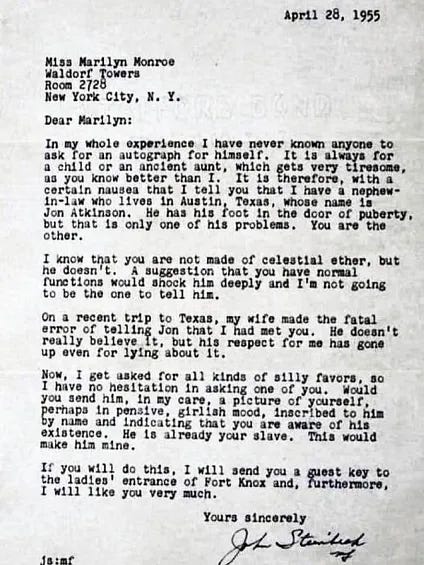
John Steinbeck Solicits Marilyn Monroe
King Larry
How Larry Ellison is Quietly Shaping the Future of A.I., Social Media and Hollywood
Oracle’s Larry Ellison wields $190 billion to reshape A.I. infrastructure, safeguard TikTok U.S. and secure a $110 billion Warner Bros. Discovery deal.

Larry Ellison stepped down as Oracle’s CEO more than a decade ago. Yet the company’s co-founder, now executive chair and chief technology officer—with an estimated net worth of $190 billion—remains deeply involved in Oracle’s biggest moves. His influence ripples far beyond enterprise software, extending from A.I. infrastructure and social media to Hollywood. Ellison is a key backer in the Trump administration’s Stargate project, the U.S. takeover of TikTok and the $110 billion Warner Bros. Discovery acquisition led by his son, David Ellison.
Chuck Norris Gone (really?)
Chuck Norris, Action Icon and ‘Walker, Texas Ranger’ Star, Dies at 86
By Carmel Dagan
Chuck Norris, the martial arts champion who became an iconic action star and led the hit series “Walker, Texas Ranger,” has died. He was 86.
As an action star, Norris had a degree of credibility that most others could not match.. Not only did he appear opposite the legendary Bruce Lee in 1972 film “The Way of the Dragon” (aka “Return of the Dragon”), but he was a genuine martial arts champion who was a black belt in judo, 3rd degree black belt in Brazilian Jiu-Jitsu, 5th degree black belt in Karate, 8th degree black belt in Taekwondo, 9th degree black belt in Tang Soo Do and 10th degree black belt in Chun Kuk Do.
Norris was extremely prolific in the late 1970s and ’80s, starring in “The Delta Force” and “Missing in Action” films, “Good Guys Wear Black” (1978), “The Octagon” (1980), “Lone Wolf McQuade” (1983), “Code of Silence” (1985) and “Firewalker” (1986).
Johnny Blue Skies’ Situation
Banksy Revealed
Banksy Finally Unmasked? Reuters Investigation Claims to Reveal Graffiti Artist’s True Identity “Beyond Dispute”
Despite rumors, the U.K.’s most prolific graffiti painter is not Massive Attack frontman Robert Del Naja, according to an extensive report from the wire service.
BY LILY FORD

Journalists at Reuters claim to have unmasked Banksy, the anonymous graffiti artist who has long ruled the U.K. art scene with politically provocative murals.
In an investigation published Friday titled In Search of Banksy, reporters Simon Gardner, James Pearson and Blake Morrison detail a complex and extensive hunt for Banksy’s real name, pulling information from a trip to Ukraine, where he was photographed and met with locals; a fallout with Jamaican photographer Peter Dean Rickards, who is said to have posted photos of Banksy’s face; and a 2000 New York arrest, where they discovered a signed, handwritten confession.
AlphaPussy
Growing up in the Valley, Gina Gershon learned how to steer through toxicity
By Cat Woods

Gina Gershon considers herself a storyteller, first and foremost. When we connect via video call, Gershon admits this is the first interview she’s done since submitting the manuscript for her latest book, “AlphaPussy: How I Survived the Valley and Learned to Love My Boobs.”
“I don’t have my spiel yet!” she warns, inquiring for the first of a few times what I thought of it and whether I enjoyed it. Despite the many decades Gershon has been treading the boards, starring in indie films and Hollywood star vehicles, and stalking the stage as a singer-guitarist, she still really cares about what you think, even if it won’t change her own mind. Perhaps that’s the key to her professional longevity.
“AlphaPussy” is neither a memoir nor a guide to self-betterment, but elements of both feed into Gershon’s stories. Each wittily titled chapter plunges readers into Gershon’s freewheeling 1970s childhood, defiant adolescence, burgeoning performance career and collaborations with some of the biggest names in film (including Sharon Stone, Paul Verhoeven and Tom Cruise). Most of the stories take place in the San Fernando Valley, where young Gershon was discovering weed, mushrooms and rock ‘n’ roll. This is not a titillating tell-all, and all the better for it.
Superbloom ’26
Death Valley sees its most spectacular superbloom in a decade
The wildflowers have painted the usually barren landscape of Death Valley National Park — one of the hottest and driest places in the country — in pretty pink, purple and yellow.
By Denise Chow
A superbloom of wildflowers has painted the normally barren landscape of Death Valley National Park — one of the most extreme places on the planet and the hottest and driest spot in North America — in pretty pink, purple and yellow hues.
“This area that’s known basically for hot weather, sand and dirt has just become this amazing landscape of colors,” said David Blacker, executive director of the nonprofit Death Valley Natural History Association. “The smell is just amazing.”
This year’s superbloom is the most spectacular that Death Valley has seen in a decade, according to the National Park Service. It’s a result of rainier-than-normal conditions throughout the region last fall and early winter.
Go Cinema!
David Ellison Says ‘Top Gun: Maverick’ A Pivotal Event For Him As Paramount CEO Commits To 30 Theatrical Releases A Year Post-Merger: “Movies Should Be Seen In Theaters”

Paramount CEO David Ellison was emphatic about theatrical during a call with Wall Street on Monday. “It’s something we deeply, deeply believe in,” he said. “Large franchises and big pieces of intellectual property are launched in theaters, period.”
Talking through Paramount’s massive merger with Warner Bros Discovery announced Friday, he wound back to 2022 when one film in particular had a huge impact on his thinking regarding theatrical versus streaming.
No Ghee-na!
Gina Gershon says she turned down role after Prince wanted to rebrand her with a single name
By CASSIE CARPENTER, US SHOW BUSINESS REPORTER

Gina Gershon had a glamorous, close encounter with the late great Prince Rogers Nelson in 1983 while he was searching for someone to play his onscreen leading lady in the film Purple Rain.
‘”Prince wants to meet you. He’s doing a movie and the lead woman has to be able to sing, dance and act. I told him about you,”‘ a musician friend told the 63-year-old Showgirls alum – according to Page Six.
At the time, Gershon was still a senior enrolled at New York University pursuing a BFA degree in drama and psychology/philosophy but she eagerly took the trip to Minnesota where the Purple One picked her up by limousine.
The Devil’s Tone
The science behind why Black Sabbath and Ozzy Osbourne’s music sounded ‘satanic’
The tritone has been blamed for chaos, banned by choirs, and embraced by metalheads. Here’s what the ‘devil’s interval’ really does to your brain.
By Simon Ingram
The idea that two simple notes—not a song, just tones—could be “banned“ may seem ludicrous. But that’s the legend behind the crushing opening riff of Black Sabbath’s 1970 debut. With just three ominous notes, guitarist Tony Iommi, alongside the anguished vocals of the late Ozzy Osbourne, unleashed a sound so unsettling it was said to have been forbidden for centuries.“Those notes were banned many years ago,” Iommi told the BBC in 2014. “It’s supposed to have been a satanic thing.”
While rock legend has never been the most reliable (see: Ozzy and the bat), this one does have a whisper of truth. Black Sabbath recruited what music theorists refer to as the ‘tritone,’ —a dissonant interval once avoided by medieval choirs and now known in music lore as the “devil’s interval.” Also referred to as the augmented fourth, diminished fifth, or sharp eleven, the tritone spans three whole tones on a scale, creating a clashing, unstable sound that has long made listeners squirm. But what is it about this ancient musical interval that has unnerved audiences for centuries—and why does it still strike such a primal chord?
The First Writers
Humans could have been ‘writing’ 40,000 years earlier than anyone thought
by Rory McKeown

Researchers have uncovered compelling evidence that Stone Age humans were engraving complex, meaningful symbol systems onto tools and sculptures 40,000 years ago.
The findings challenge the long-held assumption that writing began in ancient Mesopotamia around 3,000 BCE.
An international research team, led by linguist Christian Bentz of Saarland University and archaeologist Ewa Dutkiewicz of Berlin’s Museum für Vor- und Frühgeschichte, analysed more than 3,000 engraved signs found on 260 prehistoric objects.
Not ’til you’re 18, son
Peter Thiel and other tech billionaires are publicly shielding their children from the products that made them rich
Despite building an increasingly screen-focused world, billionaire tech leaders are keeping their own children away from the tech they helped create.

As far back as 2010, Apple cofounder Steve Jobs told a New York Times reporter his kids had never used an iPad and that, “We limit how much technology our kids use at home.”
Since then, the trend of Silicon Valley billionaires keeping their families away from technology has become even more pronounced, thanks in part to the rise of social media and short-form video.
Excessive device use among children has grown more common in recent years as busy parents turn to screens to find some peace. The trend has accelerated so much that some young children accustomed to extensive screen time are dubbed “iPad kids.” On average, children in the U.S. ages 8 to 18 spend 7.5 hours per day watching or using screens, according to the American Academy of Child and Adolescent Psychiatry.
YouTube cofounder Steve Chen said at a talk at the Stanford Graduate School of Business last year that he wouldn’t want his kids consuming only short-form content, noting that it might be better to limit kids to videos longer than 15 minutes.
Willie Colón Gone
R.I.P. Willie Colón: Salsa legend dead at 75
“His music was not just heard; it was lived,” Fania Records shared in a statement.
Innovative composer, vibrant trombonist, bandleader, and salsa visionary Willie Colón has died. On social media yesterday (February 21), his family confirmed the news. “It is with profound sadness that we announce the passing of our beloved husband, father, and renowned musician, Willie Colón,” their statement read. “He passed away peacefully this morning, surrounded by his loving family.” Colón was 75 years old.
Colón’s Puerto Rican grandmother exposed him to Latin sounds at a young age. In the Bronx, he heard guaracha, jíbaro, tango, and Cuban music and, by 1961, he learned the flute, trumpet, and bugle before eventually settling on the trombone. It was Barry Rogers’ playing on Mon Rivera and Joe Cotto’s “Dolores” that nudged him in the instrument’s direction. At 15, after gigging at weddings under the stewardship of Rivera, the Fania label signed Colón to a record deal. His first album, 1967’s El Malo, sold over 300,000 copies, and Colón later became one of the best-selling salsa artists of all time. His work combined funk, jazz, R&B, Latin rhythms, and the political teachings of figures like Martin Luther King Jr. together. “It was rebellious music,” he told the Miami Herald 20 years ago. “The music wasn’t explicitly political yet, but the music was a magnet that would bring people together.”
Gold Fever Pandemic Surging
The gold rush is back in California’s Inland Empire
In San Bernardino County, gold and silver mining companies are pushing to expand
By Erin Rode, Contributing LA Outdoors Editor
Calico Ghost Town Regional Park certainly did not feel like a ghost town last weekend. The line just to pay entrance fees at the San Bernardino County-managed attraction was at least a dozen cars deep, and neon-vested parking attendants tried to quell the sudden rush of traffic at the remote park as a shuttle ferried visitors from far-flung corners of the dirt parking lot to the town’s entrance. Once inside, visitors had their pick of a jam-packed schedule of events that included live bands, historical reenactments, pony rides and gun-draw competitions. Cold beers were poured at Lil’s Saloon at a nearly proportional rate to the number of parents buying prop guns for their kids as souvenirs.
Thousands of people descended on the tiny ghost town north of Barstow last weekend for the fifth annual Calico California Days, an event advertised as a celebration of California’s early history. Visitors stepped back in time, panning for fake gold nuggets and touring long-abandoned mining tunnels. Performers in 19th century garb played banjos and staged gunfights. But while the event offered a glimpse of California’s past, the giant mining corporations that sponsored the festivities are already hard at work excavating the region’s future.
Venusians, maybe?
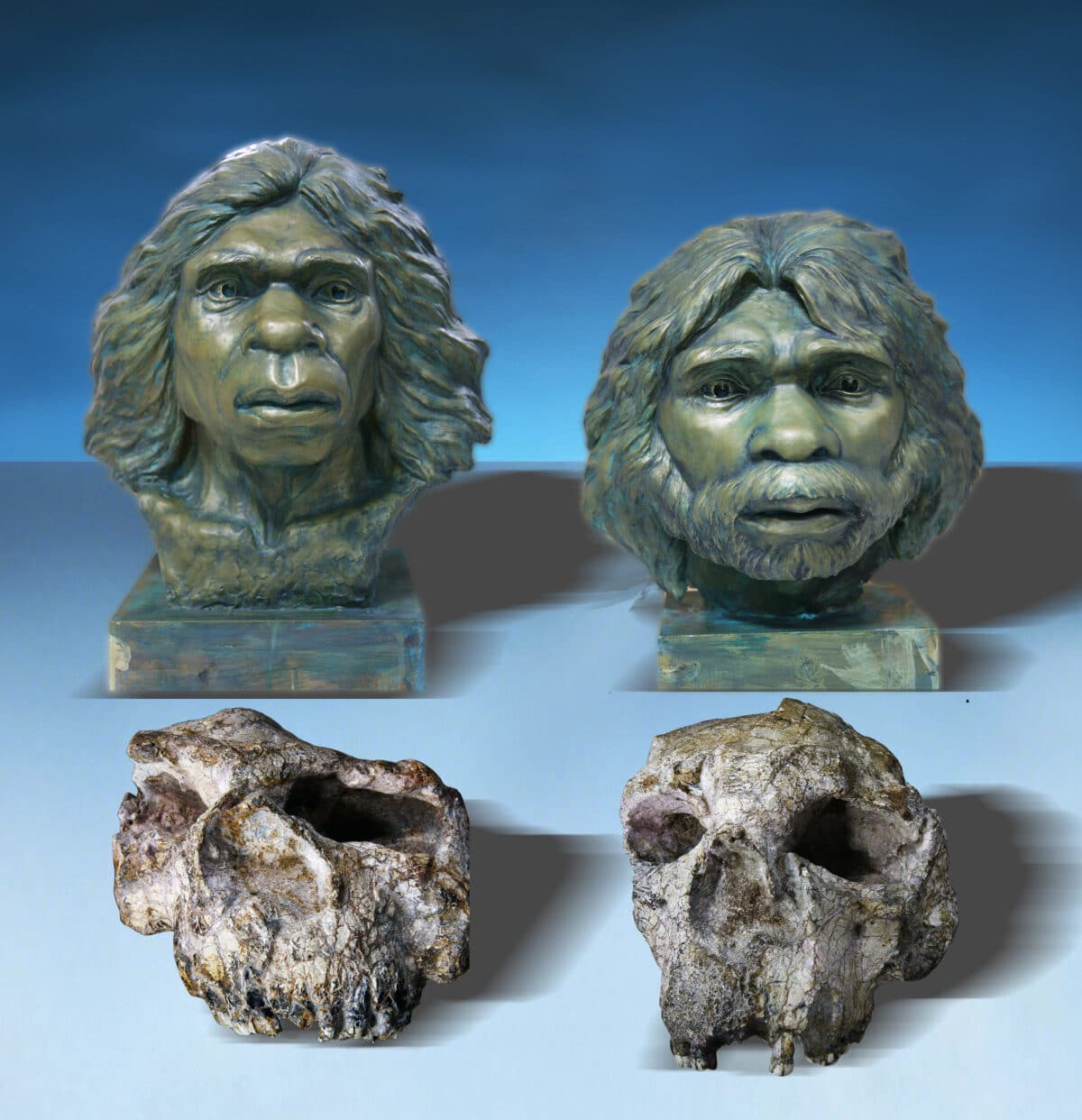
Something Was Making Stone Tools In China 600,000 Years Before Homo Erectus Showed Up
Reviewed by John Anderer
In A Nutshell
- Ancient skulls found in Hubei Province, China, have been redated to 1.77 million years old, making them the oldest confirmed Homo erectus fossils found in place anywhere in eastern Asia.
- The new age pushes the site back by 700,000 to nearly a million years from its previous estimate.
- Stone tools at other Chinese sites predate these fossils by hundreds of thousands of years, leaving the identity of their makers an open mystery.
- The findings support the idea that early human relatives spread across Asia quickly after leaving Africa, reaching central China at nearly the same time they appeared on the far western edge of the continent.
Stone tools discovered in China date back as far as 2.4 million years. The oldest confirmed human fossils from the same region? Only 1.77 million years old. That gap, now significantly narrowed by new research, leaves one question stubbornly unanswered: who, or what, was already there?
Jesse Jackson Gone
Jesse Jackson Still Provides Light in These Dark Times
We would be wise to follow the path he forged.
“Jesse Jackson is one of the very most significant political leaders in this country in the last 100 years,” declared Senator Bernie Sanders, summarizing the importance of Jackson’s remarkable life and his historic 1984 and 1988 presidential campaigns.
His historic journey began in the humblest of circumstances. He was born the son of a single, teenage mother in Greenville, South Carolina, deep in the Jim Crow segregated South. He rose to be in the public eye for over six decades, a globally recognized warrior for justice. He became the youngest of Dr. Martin Luther King’s SCLC leadership group, organizing Operation Breadbasket, which mobilized African Americans to apply economic pressure on corporations to open their jobs, contracts, and boards to minorities. After King’s tragic assassination, he rapidly rose to be a leading voice of the civil rights movement as the head of People United to Save Humanity (PUSH), which he founded in Chicago.