
No.
The End of Verse?
A recent NEA report finds fiction reading on the rise, while readership of poetry has dropped significantly. Is an art form dying?
Marc Bain
Newsweek Web Exclusive

In January, the National Endowment for the Arts released a report titled “Reading on the Rise,” announcing that the number of American adults reading fiction had increased for the first time since the NEA began tracking reading habits in 1982. According to the report, 50.2 percent of adults had read a work of fiction in the previous year, compared with just 46.7 percent in 2002. The results were greeted with a mixture of excitement and caution by education experts. Some saw them as the long-awaited reversal of the trend toward a dumber, TV-obsessed United States; others, more wary, called them a statistical blip. Almost as an afterthought, the report also noted that the number of adults reading poetry had continued to decline, bringing poetry’s readership to its lowest point in at least 16 years.
The dismal poetry findings stand in sharp contrast not only to the rise in general fiction reading, but also to the efforts of the country’s many poetry-advocacy organizations, which for the past dozen years have been creating programs to attract larger audiences. These programs are at least in part a response to the growing sense that poetry is being forgotten in the U.S.
The Hazards Of Snorkeling
Dynamite fishermen accidentally kill diver
by EVAN T. ALLARD @ CDNN – CYBER DIVER News Network
|
PHU CU, Vietnam (24 Mar 2009) — Police arrested four fishermen who accidentally killed a diver with explosives.
The fishermen told police they saw bubbles and movement under the surface and thought it was a large fish. One of the fishermen tossed dynamite into the water and after it exploded the group jumped into the water but instead of finding a fish, they found the body of the dead diver. Dynamite fishing, which severely damages coral reefs, is illegal in Vietnam but a common practice. Nguyen Ngoc Liem, head of the Phu Cu District police department, said the fishermen would be charged with killing the diver and destroying aquatic resources with the illegal use of explosives. |

Thieves!
from The Associated Press via NewsMax
|
Yale Sues to Keep Van Gogh’s ‘The Night Cafe’ |
|||
|
|
|||
|
NEW HAVEN, Conn. — Yale University is suing to hang onto one of Vincent Van Gogh’s most famous works.
The Ivy League university sued Tuesday in federal court in Connecticut to assert its ownership rights over “The Night Cafe.” It also seeks to block a descendant of the original owner from claiming it. Pierre Konowaloff of France says he is the great-grandson of industrialist and aristocrat Ivan Morozov, who owned the painting in 1918. Russia nationalized Morozov’s property during the Communist revolution. The painting now hangs in the Yale University Art Gallery. The school says it wants to remove any cloud over its ownership.
© 2009 Associated Press. All Rights Reserved. This material may not be published, broadcast, rewritten or redistributed. |
|||

Let Pissing Dogs Plot
“Señora, you’ve earned a spot in heaven.”
Outpost of literature feeds the body and the mind

Stefano Paltera, For The Times
Sandra Romero of Mama’s Hot Tamales offered space to Librería Hispanoamérica in hopes that they can help one another survive the economic downturn.
Hector Tobar, March 24, 2009
Somewhere up in poet heaven, Roque Dalton is a happy man.
Just across the street from MacArthur Park, the town square of Central American immigrants in Los Angeles, a tiny storefront has an entire shelf dedicated to the works of the Salvadoran writer, who died in 1975.
Dalton’s poems celebrate the tenacity of Salvadorans and their diaspora across the Americas. If his books had eyes, they could look through the store’s glass window and see his countrymen hawking snow cones and tacos outside.
The Chilean poet Pablo Neruda lives inside the Librería Hispanoamérica too. His “Twenty Love Poems and a Song of Despair” is a popular item there, as is the work of another Nobel laureate, the Guatemalan novelist Miguel Angel Asturias.
Spotting great literature in the shadow of the park’s aging palm trees, in a corner of the city once infamous for the sale of crack cocaine and sex, felt at first like stumbling upon a mirage.
One of the local alcoholics thought so too. First, he wandered over from the park’s lawns and skeptically inspected the freshly swept sidewalks in front of the bookstore. Then, persuaded they were real, he stepped inside.
“Señora, you’ve earned a spot in heaven,” he told owner Aura Quezada. “Because in this place where everyone opens liquor stores, you have opened a bookstore.”
“Their weapons are their canes…”
Cane-Fu fighting
,
ZEPHYRHILLS, Fla. – Pay no mind to the groans that come with stretching, to hair that is gray or gone altogether. Ignore the cautiousness of their steps and the canes in their hands.
These seniors are ready to fight.

A rainbow of martial arts belts dangles above the mirror along one wall of this small dojo; swords, nunchuks and sickles hang near the front. Punching bags and torso targets line the room, but they’ll need none of these. Their weapons are their canes.
At the helm of the class is one of the country’s most recognized cane fighters, Mark Shuey, a slight man who, at 62, has hair and skin starting to show signs of age. He has traveled from Lake Tahoe, Nev., to teach this group of 16 how to protect themselves from attackers.
He calls it Cane-Fu.
Cane fighting classes have popped up all over the country, in part due to the influence of Cane Masters, the company Shuey founded that sells wood canes made of harder, thicker wood, to sustain wear and wider crooks to fit around an attacker’s neck. Now, it’s being offered at dojos and increasingly in senior centers and retirement communities.
“You don’t have to be powerful, you don’t have to be fast,” said Gary Hernandez, who runs the dojo here northeast of Tampa where the session was held and where he teaches cane fighting classes himself. “It’s a piece of hard wood. It hurts.”
The Amazing Somchai
|
Thai ‘Spider-Man’ to the rescue |
An unusual disguise has helped a Bangkok fireman rescue an eight-year-old boy who had climbed on to a third-floor window ledge, Thai police say.
The firefighter dressed up as the comic book superhero Spider-Man in order to coax the boy, who is autistic, from his dangerous perch.
 Police said teachers had alerted the fire station after the boy began crying and climbed out of a classroom window.
It was reportedly his first day at the special needs school.
Efforts by the teachers to persuade the pupil to come back inside had failed.
But a remark by his mother about his passion for comic superheroes prompted fireman Somchai Yoosabai to rush back to the station, where he kept a Spider-Man costume in his locker.
The sight of Mr Somchai dressed as Spider-Man and holding a glass of juice for him, brought a big smile to the boy’s face, and he promptly threw himself into the arms of his “superhero”, police said.
T.J. Clark Has A Go At Pablo
Shades of Meaning at First Blush
Sunday, March 22, 2009; E06
To watch a great art thinker’s mind at work, we asked T.J. Clark to have a go at a Picasso that he hadn’t known before, an untitled still life from 1918. It hangs in the East Building of the National Gallery, just two floors up from where Clark’s Mellon lectures will begin today.

THE BLACK
Clark had never really thought about Picasso’s still life until we put him face to face with it. In reproductions that he’s glimpsed, he’s found the whole thing “terribly jolly.” Not praise, coming from Clark. Standing in front of it, he’s immediately struck by the “extraordinary black border” that wraps around three sides. That makes the whole scene graver, he says, noting how Picasso’s black border creates a special tension between the “lighthearted bric-a-brac” that fills the painting’s table and a sense of “grim confinement.”
Coming very close to the painting, Clark points out how the dark paint actually covers areas in its bottom half that were once the same lively turquoise found on the painting’s vase and cards. (The earlier paint peeks through cracks in the darker tones laid overtop.) Picasso, standing before his half-finished picture, seems to have had the same concerns about its “jolliness” as Clark.
Once Picasso had revised and completed the picture, Clark notes, he laid down a blood-red signature that crosses over between dark border and bright scene, laying claim to both.
— THE SPACE
Clark is interested in the confined spaces and interiors you get in Picasso. Even when a picture’s so kaleidoscopic that you can’t make out the objects in it, he says, Picasso almost always gives a sense of the domestic space they’re in. And, of course, you get just such a space in this picture’s view into the corner of a room. Picasso, the great hater of abstraction, was always committed to delivering “something solid and felt,” says Clar
Stepping far back from the picture, Clark shows how well Picasso has achieved his end: What had looked like cubist complexities from up close resolve into a clear sense of a cluttered table standing in a corner with a chair. However close a Picasso painting comes to abstract pattern, says Clark, it has to “relate to some particular situation” in the real world.
Rather than dwelling on making each distinct object clear and visible, that is, Picasso “wants to show us the way things in a certain world fit together.” Picasso asks himself: “How imperiously can I play with these particular identities and still have them contribute to an overall interior?”
— THE PAST
For all its radically modern look, says Clark, the enclosed world seen in Picasso’s pictures is essentially nostalgic. They depict the cozy world of a 19th-century bourgeois. For Picasso, Clark says, the bourgeoisie is a social force that is “both confining and wonderful”: His interiors register that confinement, but they also revel in the comforts and objects that they gather into “the familiar space of the room.”
Picasso had painted such old-fashioned rooms even when he was living in the mess of his unheated studio at the Bateau Lavoir. By 1918, when he’s actually achieved the comforts of the bourgeoisie, he seems to step back from them — to frame them in black and hold them up to sight.
— THE OBJECTS
Picasso depicts the “stock properties” of bohemian sociability: guitar, sheet music, cards, fruit bowl, even maybe an absinthe spoon and glass at the front edge of the table. They are, says Clark, “utterly banal and familiar things — they stand for the sufficiency of the bohemian world.”
That world is “a mixture of the celebratory and the down-at-heels,” says Clark. “Never was a carpet less luxurious — or the stuffing in a chair.” Although, in a typically Picassoid oxymoron, that down-at-heels carpet is also the one place in the painting where the artist resorts to showy brushwork.
By 1918, however, this very successful painter barely had a foot left in bohemia: His still life is looking back at something the artist has lost. The longer we look at the painting, Clark says, the more clearly it seems to be about “its stock properties being stock.” Its vase and playing cards are cartoons of themselves, the fruit in its fruit bowl become four black-edged blobs of pink. “Never has fruit been more vestigial.”
— THE MOMENT
1918 wasn’t a good year for Europe, exhausted by a four-year war. If the painting wears black, that could be why.
Yet Clark insists that the picture is not portentous or histrionically doom-laden. Clark could imagine someone asking, “How dare a painter paint cards and a guitar in 1918 — how can this painting be other than trivial?” And that’s the question Picasso answers, in a painting of “tremendous gravity.” Picasso, says Clark, wants us to “enter its world of familiar delights, but full of a sense of that world being something to struggle for.”
— THE ARTIST
The great achievements of cubism were over when this still life was painted, and there was a real risk that the movement was becoming empty style. “He knows that the moves are becoming too preestablished,” Clark says. This last moment of cubism has the “terminal flavor” of “a language tremendously conscious of itself as a language, on the verge of just sedimenting up.” The airless, lightless scene in this 1918 still life, says Clark, “is on the verge of not being vivid.”
Clark wonders if Picasso uses the black border on this picture to show that he’s aware of this. His border presents the scene as a work of art, as a framed picture, rather than as an unmediated view into a real portion of real space. That is, the painter is letting us know that he knows that his moves are starting to be more about painting than about the vivid world that they once showed.
Whereas earlier, fully cubist pictures, which tended to trail off into open blankness at their sides, had simply let us sense their space, without all the editorializing.
In this still life, then, Picasso’s sense of space has started to register as a particular sense of confinement — the confinement of a painter who feels trapped in an artistic style, too far from reality and truth.
— Blake Gopnik
“10 kids in a cadillac…”
|
New watch ‘tells the future’ |
Swiss watch-makers have teamed up with Indian fortune tellers to design a watch that claims to predict the future.

The watch features a bedpan-shaped section which turns brown when “the s*** is about to hit the fan”, claim the makers.
Swiss makers Borgeaud say the bedpan turns brown when dark astral forces are about to strike and will not clear until the bad omens have passed.
The watchmakers say it will warn anyone when misfortune is about to strike.
And they are predicting the limited edition watches – there are 500 for women and 150 for men which cost more than £1,500 each – will prove a hit with celebrities and even politicians.
Chihuahua Named Pebbles Saves Hot Dwarf In Dense Forest From Hypothermia
3ft 8ins woman saved by chihuahua
A 3ft 8ins tall woman who got lost while walking in Snowdonia only survived because her pet chihuahua kept her warm, rescuers said.
 Beverley Burkitt, 45, who has dwarfism, became lost in dense forest while walking with her tiny dog Pebbles on Sunday.
The alarm was raised but she had not been found when night fell, so she lay on the floor and cuddled the dog to keep herself warm.
A search party found her the next morning and rescuers said the dog had saved her from getting hypothermia.
Mum-of-one Beverley said: “Pebbles lay across my legs overnight and kept me warm.
Beverley and her daughter, 15, were staying at a pony trekking centre at Dolwyddelan, North Wales, when she went missing.
She told rescuers that she strayed into woodland and then dropped her mobile phone.
A helicopter with heat-seeking cameras was launched and search parties on the ground scoured the area.
Asthma sufferer Beverley, of Colwyn Bay, North Wales, was found still snuggling up to the long-haired black and white chihuahua.
A True Revival
“West Side Story” and “God of Carnage” on Broadway.
by John LahrMARCH 30, 2009
Gangs of New York: Karen Olivo, Josefina Scaglione, and Matt Cavenaugh star in Arthur Laurents’s bold revival.

West Side Story” (at the Palace, under the sure-handed direction of Arthur Laurents, who wrote the musical’s original book) is so exciting it makes you ache with pleasure. All the defining forces of the American fifties—velocity, mobility, confidence—are condensed into this superb retelling of the Romeo and Juliet legend, which plays out against the background of Latino-versus-Anglo gang violence. Like the tail fins on fifties American cars or the parabolic shapes of Populuxe furniture, “West Side Story” incarnates the dream of momentum in the golden age of the twentieth century. Everything about the show is streamlined: the fluid jolt of Jerome Robbins’s choreography; the exhilarating syncopation of Leonard Bernstein’s symphonic score; the bravura concision of Stephen Sondheim’s lyrics; the swiftness of Laurents’s storytelling—the book is one of the shortest in the history of the musical. The début of the show, in 1957—a production I saw—also marked the moment when the musical asserted its right to treat just about any subject (murder, rape, bigotry) as grist for popular entertainment. “West Side Story” is somehow both airborne and transcendent.
THE ELEMENTS OF STYLE is 50 Years Old
 The Elements of Style
William Strunk, Jr.
Asserting that one must first know the rules to break them, this classic reference book is a must-have for any student and conscientious writer. Intended for use in which the practice of composition is combined with the study of literature, it gives in brief space the principal requirements of plain English style and concentrates attention on the rules of usage and principles of composition most commonly violated.
Sylvia Plath’s Son Commits Suicide
Nicholas Hughes, Sylvia Plath’s son commits suicide

Mo Gabba Gabba
London cab driver linked to more than 200 passenger rapes
Saturday, March 14th 2009, 9:24 PM
 A London cabbie convicted of luring women into his black taxi, addling them with a date-rape drug and raping them may have attacked more than 200 victims.
Officially, cops have linked John Worboys to 85 assaults between 2002 and 2008, but investigators say he’s responsible for at least twice as many.
“He is probably the most prolific sex offender caught in the U.K. to date,” a police source told the London Sun. “It’s safe to say he has claimed at least 200 victims.”
A former stripper and porn actor, Worboys stalked clubs, offering party girls champagne to celebrate a bogus lottery win. The bubbly was spiked and would knock them unconscious.
After the 51-year-old was arrested in 2007, he was released on bail and attacked three dozen more women, the paper reported. He was convicted last week on 19 charges.
13 Most Beautiful
The Art Of The Wait
Waiting tables is an art: 4 veteran L.A. servers who know
Seasoned pros take a craftsmanlike approach to their jobs at landmark L.A. restaurants.
By Betty Hallock5:01 PM PDT, March 17, 2009
Good waiters — no, they haven’t disappeared, no matter how it might seem to anyone who has felt like just another check average.
 Meet old school: Vladimir Bezak, Manny Felix, Sergio Guerra and Pablo Zelaya. Among them, they have provided more than 100 years of service to countless diners across Los Angeles, their days measured in ice-cold dry martinis and perfectly cooked medium-rare steaks. Wars (including those against calories and carbohydrates) have been waged, presidents (and chefs) have come and gone, and meanwhile, they’ve looked after their customers down to the last detail, special requests indulged, cups of coffee refilled.”
Good service is a craft,” Guerra says. “This is my profession, it’s my living.”
They are, in Los Angeles, a rare breed — career waiters, veteran career waiters. While at many restaurants it can be hard to get your server’s attention when you don’t have a spoon for your soup or you may have to suffer the yadda-yadda-yadda of introductions and upselling and instructions, these are consummate waiters who, always gracious, know exactly how to make you feel taken care of, without being oppressed.
Beethoven in Double D Major
introMusical Bra
The Musical Bra plays music when touched!
 Tools needed:
– Conductive Fabric (strechable fabric)
– Fusible Interfacing (double and single sided – check your local fabric store)
– small nickel plated sew snaps
– conductive thread
– foam or thick felt
– regular thread/ needles
– a cheap/used toy with multiple buttons such as a keyboard (I used a keyboard from a thrift store for $1.00)
– velcro
– neoprene (or other sturdy, strechy fabric)
– a bra (preferably a bra that snaps in the front – unlike this sports bra used in this project, a front snap bra will make the bra easier to take on and off – this sports bra is not stretchy enough after sewing in the interfacing (I learned afterwards the importance of strechy conductive fabric and interfacing) You could also cut the front of a sports bra and introduce a velcro piece)
– multiple color wires
– soldering iron
– solder
– hot glue
– iron
Bizkit The Sleepwalking Dog
Cigarettes Kill
Man, 87, dies on bike after clothes burst in flames

Friday, March 13th 2009, 2:46 AM
An 87-year-old died when his clothes burst into flames while he was riding his bicycle on Long Island Thursday.
Joseph Rusin was likely smoking a cigarette before he became engulfed in flames while cycling down Burkhardt Ave. in Bethpage, officials said.
A passing motorist saw Rusin rolling on the ground and used a fire extinguisher to douse the flames. Nassau County Detective Sgt. Les Meister said the fire was not suspicious. County Fire Marshal spokesman Vincent McManus said it’s likely that the cigarette ignited Rusin’s nylon jacket.
Death Monk
from Boing Boing
Hmmm….
How art killed our culture
All the shallowness of modern mass culture began in avant-garde art 40 years ago
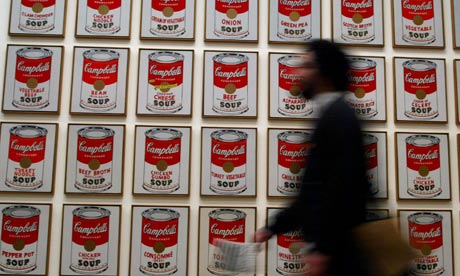
A spectator walks past Andy Warhol’s Campbells Soup Cans (1962) at the Tate Modern, London. Photograph: Sion Touhig/Getty Images
No sphere of high culture is implicated in the fall of the affluent society in the same way art is. Yesterday I commented on the resistance to melancholy, the flight from reality, that enabled art in our time to promote the fantasy of an unlimited market. Some have called the system that has now fallen “offshore capitalism”; perhaps another description is “post-modern capitalism”. In post-modern capitalism, secondary markets created a counter-reality that was unfettered by production. The economy was run like a theme park. It’s obvious how deeply involved in that daydream was the art of the last 20 years, which so gleefully rejected anything that might tie it to the slow, patient, tedious stuff of real creativity.
Drama, the novel, even cinema have all kept a safer distance from the booming monster of modern capitalism than artists did. What I want to ask now is – why? What happened? How did art become the mirror of fraud? It is not a story that starts with Damien Hirst’s diamond skull but one that goes back to the very origins of the consumer society.
After the second world war artists were steeped in history and introspection. Art has never been more serious in its view of life than it was in the era of Mark Rothko and Francis Bacon. But even as modern painting reached such heights and depths, western society was going through an epochal transformation. The power of the capitalist economies in the postwar era was unprecedented in world history. An entirely new lifestyle, that of “consumerism”, was born.
Herbed pork chops with tomatoes, potatoes and spinach

Use #2,963 For One’s Makarov
The Batting Stance Guy
Meet Gar Ryness, the Batting Stance Guy

Ann Johansson for The New York Times
Gar Ryness has become a YouTube star for his imitations of major leaguers’ batting stances. Which three players is he imitating? Answers below.
Gar Ryness said he had the least marketable skill in the United States.
So when he and two friends took a hand-held camcorder into the backyard of his Los Angeles home last year, he hardly expected he would soon become a YouTube celebrity known as Batting Stance Guy.
Ryness has a singular talent: an ability to perform comically dead-on impressions of major league baseball hitters upon request. Little Leaguers have been known to try to imitate their favorite ballplayers. Ryness, 35, a married father of two, can do the starting lineups of all 30 teams.
Views of his YouTube videos number more than a million, and he appeared last year on several teams’ pregame shows. Sony also hired him to perform his impressions while wearing movement-tracking electrodes, helping programmers make the company’s MLB 2009: The Show video game look more realistic. Most recently, Ryness has made appearances on MLB Network’s team preview shows, displaying his encyclopedic knowledge of batters past and present. He has archived his body of work on a Web site, battingstanceguy.com.
Ryness never misses a habitual fidget or gesture, like David Wright’s ritual of wedging his bat in his armpit while adjusting his batting gloves. He does iconic stances, positioning his derrière the way Ken Griffey Jr. does before mimicking Griffey’s graceful swing and follow-through. Ryness even does impressions of batters taking pitches, like Derek Jeter’s way of sticking his head out and nearly stepping across home plate as he looks an outside pitch into the catcher’s glove.
1934 BMW R7

Federal Judge Rules It’s Okay For Americans To Play With Model Rockets Again
| APCP not an explosive, rules Judge Reggie B. Walton |
| Industry News by Planet News | |
| MONDAY, MARCH 16, 2009 | |
|
Walton’s order granted a summary judgment motion in favor of the plaintiffs TRA and NAR, denied the summary judgment motion of BATFE, and vacated the classification of Ammonium Perchlorate Composite Propellant (APCP) as an explosive.
[ click to continue reading judicial order at RocketryPlanet.com ] |
 WASHINGTON, District of Columbia USA — District Court Judge Reggie B. Walton for the District of Columbia today issued an order finding in favor of the Tripoli Rocketry Association and National Association of Rocketry vs. The U.S. Bureau of Alcohol, Tobacco, Firearms and Explosives. The decision followed a status hearing this past Friday in Washington.
Derivative Cool on Charcoal Gray

Death Is Punk
This Band Was Punk Before Punk Was Punk
Winooski, Vt.

ON an evening in late February at a club here called the Monkey House, there was a family reunion of sorts. As the band Rough Francis roared through a set of anthemic punk rock, Bobby Hackney leaned against the bar and beamed. Three of his sons — Bobby Jr., Julian and Urian — are in Rough Francis, but his smile wasn’t just about parental pride. It was about authorship too. Most of the songs Rough Francis played were written by Bobby Sr. and his brothers David and Dannis during their days in the mid-1970s as a Detroit power trio called Death.
The group’s music has been almost completely unheard since the band stopped performing more than three decades ago. But after all the years of silence, Death’s moment has finally arrived. It comes, however, nearly a decade too late for its founder and leader, David Hackney, who died of lung cancer in 2000. “David was convinced more than any of us that we were doing something totally revolutionary,” said Bobby Sr., 52.
Forgotten except by the most fervent punk rock record collectors — the band’s self-released 1976 single recently traded hands for the equivalent of $800 — Death would likely have remained lost in obscurity if not for the discovery last year of a 1974 demo tape in Bobby Sr.’s attic. Released last month by Drag City Records as “… For the Whole World to See,” Death’s newly unearthed recordings reveal a remarkable missing link between the high-energy hard rock of Detroit bands like the Stooges and MC5 from the late 1960s and early ’70s and the high-velocity assault of punk from its breakthrough years of 1976 and ’77. Death’s songs “Politicians in My Eyes,” “Keep On Knocking” and “Freakin Out” are scorching blasts of feral ur-punk, making the brothers unwitting artistic kin to their punk-pioneer contemporaries the Ramones, in New York; Rocket From the Tombs, in Cleveland; and the Saints, in Brisbane, Australia. They also preceded Bad Brains, the most celebrated African-American punk band, by almost five years.
Jack White of the White Stripes, who was raised in Detroit, said in an e-mail message: “The first time the stereo played ‘Politicians in My Eyes,’ I couldn’t believe what I was hearing. When I was told the history of the band and what year they recorded this music, it just didn’t make sense. Ahead of punk, and ahead of their time.”
Conjugating Banana
Ron Silver Gone
| RON SILVER DEAD
By DAVID K. LI
“He had been fighting esophageal cancer for two years and his family is making arrangements for a private service.” Friends of Silver first told Post columnist Cindy Adams of the native New Yorker’s death. The steely-eyed, blunt-talking Silver, 62, enjoyed a long career on the stage, TV and in movies, and most recently hosted a public affairs talk show on Sirius satellite radio. Silver might be best known for playing legal scholar Alan Dershowitz in “Reversal of Fortune,” about the successful appeal of Claus von Bulow’s conviction for putting his socialite wife into a permanent coma. |
 “Ron Silver died peacefully in his sleep with his family around him this morning,” said Robin Bronk, executive director of the Creative Coalition, which Silver helped create.