
Heaven Can Wait (Beck & Charlotte Gainsbourg)
Producer-provocateur Joe Papp and the theatrical ruckus that ensued
‘Free for All’ by Kenneth Turan and Joseph Papp
Joe Papp brought theater to the masses, earning people’s awe and fury.
By Wendy Smith
The apt title of this juicy oral history, based on more than 160 interviews, simultaneously expresses a principle that guided producer-provocateur Joe Papp and the theatrical ruckus that ensued.
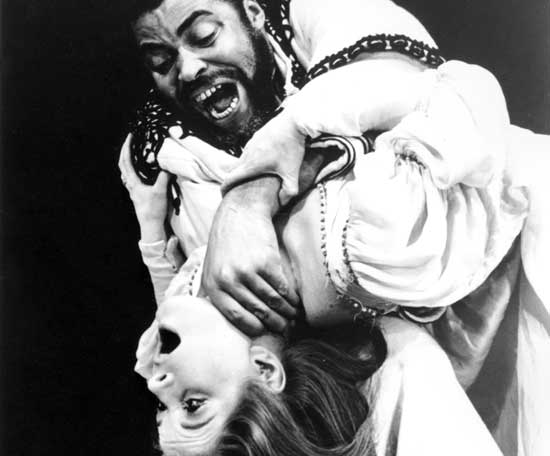
“Free for All” is how Papp presented Shakespeare in Central Park and in mobile units that toured some of New York City’s poorest, toughest neighborhoods. A free-for-all was the kind of battle he engaged in with anyone he thought stood in the way of making theater accessible to everyone.
And a free-for-all, the voices skillfully assembled in Kenneth Turan’s text reveal, was frequently the atmosphere created by Papp’s burning sense of mission and his intensely personal relationships with the artists he nurtured and infuriated during such groundbreaking productions as “Hair,” “No Place to Be Somebody,” “Short Eyes,” “A Chorus Line,” “for colored girls . . .” and “Runaways.”
Revenge For A Penny
Listen up, Guys – this is John Wayne… from Texas. And there ain’t no gunslingers in Texas.
‘Out West’ at the Autry examines the history of homosexuals and transgender people in the Old West
Museum officials say the series may be the first of its kind.
 One-Eyed Charlie was a driver for the California Stage Co. After his death, he was discovered to be a woman. (Wells Fargo / December 14, 2009)
Say the words “gay cowboy” and chances are the conversation will turn to “Brokeback Mountain,” the 2005 film starring Heath Ledger and Jake Gyllenhaal, and based on the Annie Proulx short story.
The Oscar-winning drama, which is set in the 1960s to ’80s, highlighted a long-submerged facet of frontier culture. But as a new series at the Autry National Center shows, the presence of homosexuals and transgender individuals in the American West is much older than the movie might lead you to think. It is, in fact, almost as old as the West itself.
Take for instance the tale of One-Eyed Charlie.
A stagecoach driver known for his hard drinking and itchy trigger finger, Charlie worked for the California Stage Co., where he earned his reputation as one of the best drivers in the wild West. He traveled between Oregon and California and, the story goes, got his nickname when he lost an eye while attempting to shoe a horse.
But Charlie kept a secret that was revealed only after his death in 1879. When his body was being prepared, a coroner discovered that One-Eyed Charlie was actually a woman.
It turns out that Charlie, nee Charlotte Darkey Parkhurst, had passed much of her adult life as a man. The discovery of her true gender became a local sensation. And her story still fascinates U.S. historians, some of whom believe that she was the first woman to have voted in a presidential election, long before the ratification of the 19th Amendment in 1920.
Lady Gaga In The Womb
Dan O’Bannon Gone
Dan O’Bannon dies at 63; screenwriter of ‘Alien’
By Dennis McLellan
Dan O’Bannon, the acclaimed science fiction/horror film screenwriter who was best known for writing the blockbuster hit “Alien” and who also directed and wrote the zombie fest “The Return of the Living Dead,” has died. He was 63.

O’Bannon, whose credits include co-writing “Blue Thunder” and “Total Recall,” died Thursday at St. John’s Health Center in Santa Monica after losing his 30-year battle with Crohn’s disease, said his wife, Diane.
His career began with the low-budget 1974 sci-fi film “Dark Star,” a dark comedy directed by John Carpenter that began as a USC student project and was co-written by O’Bannon and Carpenter from their original story. (O’Bannon played what has been described as a “reluctant, flunky astronaut.”)
“Dan was enormously talented. He was acerbically funny and, I think, quite underappreciated,” Carpenter, who first met O’Bannon in film school at USC, told The Times on Friday. “I think Dan had more talent than he was allowed to show in the movie business. He was multitalented: a production designer, editor, director, writer.
“One of the things that endeared him to me was his rebellion against all authority, including myself, the studios, anybody who was above him. He said he kicks up, not down.”
“I have one thing to say to polar bears – Evolve!”
Microwave Squash Noodles With Bacon & Parmesan
Squash Noodles With Bacon and Parmesan

1 1/2 pounds spaghetti squash
8 slices bacon
1/2 cup grated Parmesan cheese
Cut squash in half across the middle, then in half lengthwise. Remove and discard seeds. Place squash pieces cut side down in a microwave-safe pan and loosely cover with plastic wrap. Microwave on high power until tender, 5 to 9 minutes. Meanwhile, cook bacon in a skillet over medium-high heat until crisp. Drain on paper towels and set aside. (Do not drain bacon grease.)
Homeless Creep on a $2700 Taylor Acoustic
All I Want For Kurisumasu
Akira Kurosawa in a Box, Including Early Rareties

Courtesy of the Criterion Collection
Kenichi Enomoto, left, and Denjiro Okochi in “The Men Who Tread on the Tiger’s Tail,” one of the films from the beginning of Kurosawa’s career, previously unavailable in the United States.
THE most imposing DVD gift set of this holiday season is “AK 100: 25 Films by Akira Kurosawa,” which, in commemoration of Kurosawa’s coming centennial, the Criterion Collection has released at the equally imposing retail price of $399.
Elegantly packaged in a shoebox-size container covered in red and black linen, it contains 25 of the 30-odd features directed by Kurosawa, the Japanese filmmaker most famous for “Rashomon” (1950) and “Seven Samurai” (1954). For the most part these are titles that have already been issued by Criterion in stand-alone editions; they’ve been remastered here with a new menu design but without the extensive supplementary features for which Criterion has become justly famous. This time around it’s just the movies, though the set comes with an abundantly illustrated 96-page book with an introductory essay and notes on each film by the Kurosawa scholar Stephen Prince, as well as a personal reminiscence by Donald Richie, who was among the first critics to present Kurosawa to Western audiences.
With surprisingly few exceptions Japanese movies were virtually unknown outside of Japan until “Rashomon” won the Golden Lion at the 1951 Venice Film Festival, touching off a vogue for Japanese cinema that lasted through the decade. Kurosawa, who died in 1998, was never forgiven for his early success by the Western critics who came to prefer the more stylistically refined films of Kenji Mizoguchi, Yasujiro Ozu and other directors whose work was discovered in Kurosawa’s wake, or by the Japanese critics who considered Kurosawa too Western in his cultural references and aesthetic choices.
Today these debates seem provincial and pointless. As the great French critic André Bazin wrote in a letter to his pupil François Truffaut, “Unquestionably anyone who prefers Kurosawa must be incurably blind, but anyone who loves only Mizoguchi is one-eyed.” There is no denying the surging vitality of a “Seven Samurai” or a “Yojimbo” (1961), just as there is no denying the blunt thematic statements and stylistic jumble of films like “Ikiru” (1952) and “I Live in Fear” (1955). And we now know that Mizoguchi and Ozu were influenced just as much by Western films as by Kurosawa, if not more so, with no apparent cost to their Japaneseness, itself a concept rendered suspicious by our postmodern distrust of essentialism.
But how could breasts cause blood to go to my penis?
Insane Opinion
Opinion
All the lonely people
Researchers argue that far from being a personal issue, mass loneliness threatens our public health.
Gregory Rodriguez
What’s a good way to keep from getting lonely in this high holy season of togetherness? Stay away from lonely people.

It’s brutal but true, and it’s the cutting-edge finding of researchers whose mission it is to discover the causes of loneliness so that we can combat it with full force.
Think this is just a scholarly version of a “Dr. Phil” episode? Think again.
The lead researcher on this project — with UC San Diego’s James H. Fowler and Harvard’s Nicholas A. Christakis — is University of Chicago neuroscientist John T. Cacioppo, who last year co-wrote a groundbreaking book arguing that far from being a personal issue, mass loneliness threatens our public health. This new study, published in the latest issue of the Journal of Personality and Social Psychology, seeks to map the geography of loneliness. Who feels it? And what is the connection of these Eleanor Rigbys to the rest of us?
What the authors find is that, like a virus, loneliness is contagious. People become lonely because of who they know as much as who they don’t know. It makes sense, really. When people are lonely, they tend to be less trusting and even irritable toward others. This type of behavior can easily make those on the receiving end feel a sense of isolation and loneliness themselves. In other words, lonely people pass on their loneliness. Before alienated people check into a cave, they alienate others, thereby continuing the chain. As the researchers put it, this means that loneliness is “both a cause and consequence of becoming disconnected.”
Goodness, I taste delicious.
Bugaboo Dad
Controversial Author James Frey Designs Stroller for Charity

James Frey and the stroller he designed for Bugaboo. Credit: Bugaboo
In honor of World AIDS Day, author James Frey created a custom Bugaboo Cameleon Stroller that’s being auctioned on eBay.
The auction is “to generate money for the Global Fund which finances AIDS grants in Africa, the region hardest hit with this pandemic,” according to a press release.
When he’s not writing, Frey and his wife keep busy with their 5-year-old daughter and 2-year-old son. We spoke to Frey about the auction and his family life.
ParentDish: How did you get involved with this charity?
James Frey: A friend of mine, who works in PR for Bugaboo and was doing work with Bugaboo and (RED), contacted me.
PD: Tell me about your design.
JF: You know, they sent me a stroller. (Laughs.) And they were like, do something cool with it. I’m a father to two young children and we’re constantly reading books and learning our letters and saying the ABCs. And I’m a writer who literally makes his living using letters. I wanted to do something that I thought would be cool looking and appropriate to what I do. So I came up with the idea of just plastering letters of different colors and sizes and fonts all over the stroller.
PD: There was an article in Vanity Fair about you being a “PTA dad” at your kids’ school. Do parents ever want to talk to you about your career?
JF: Occasionally. Most of the time I’m just a dad. There are other well-known parents at our children’s school [and] we’re there as the parents of our children, not as whoever we are in our professional lives. I love doing stuff at my kids’ school. They go to a great school and I’m happy to be a part of it. I’m the school tour guide, I was Class Dad twice. I think it’s important to be involved with your kids’ lives and I’m lucky that I have the opportunity to.
PD: Were you one of the only dads to be a class parent?
JF: Yeah. The Class Moms all liked to tease me and make fun of me.
Tiger Confesses, “I admit, back then, I got woodies pretty much at the drop of a hat.”
Exclusive: Tiger Speaks
by Tiger
December 9, 2009, 3:00 pm

I like to eat bread and chewing gum off the sidewalk. If I find a stray snot-rag, I will eat that, too. And if I come across any other dog’s pee, I will cover it with my own, thus ensuring my dominance in the neighborhood.
I never thought I would be writing for a major Web site. But then again, until recently, I didn’t have much to write about, since things were going pretty normal.
I usually wake up around 7. Then I stretch. I like to hit the outdoors before I have my breakfast.
More Six-Word Memoirs
from Robin Slick’s “In Her Own Write” blog
Like, there’s this new book coming out, published by HarperCollins:

Here’s the synopsis over at their website:
“It All Changed in an Instant
More Six-Word Memoirs by Writers Famous & Obscure
By Larry Smith, Rachel Fershleiser
Price: $12.00
On Sale: 1/5/2010 PRE-ORDER HERE!
“A perfect distraction and inspiration, and a collection that begs to be shared. Be warned, though. If you plan to lend out your copy, start out with two. Once it leaves your hands you’ll never see it again.”
—Denver Post (on Not Quite What I Was Planning)
The editors of the New York Times bestseller Not Quite What I Was Planning are back with its much-anticipated sequel, It All Changed in an Instant. With contributions from acclaimed authors likeMalcolm Gladwell, Frank McCourt, Wally Lamb, Isabel Allende, Junot Diaz, Amy Tan, and James Frey, and celebrities like Sarah Silverman, Suze Orman, Marlee Matlin, Neil Patrick Harris, Ann Coulter, and Chelsea Handler, It All Changed in an Instant presents a thousand more glimpses of humanity. . . six words at a time. In the vein of the popular Post Secret books, It All Changed in an Instant, in the words of Vanity Fair, “will thrill minimalists and inspire maximalists.”
Book Donations Down this Year
from the San Jose Mercury News
Fisher: Book donations way down this year
Blame the economy. Or technology. Maybe the problem is that books, the kind made from trees, are losing their appeal in the age of electronic readers and video games.

Whatever the reason, the Gift of Reading program is in trouble this year. And that’s bad news for all of us.
We know it’s important that children learn to love reading, so they can excel in school and in the workplace. We know that a kid who knows the joy of curling up on a grown-up’s lap and listening to “Goodnight Moon” is more likely to get hooked on Harry Potter and a lifetime of heroes and villains. Lots of parents start reading to their children even before they can sit up. But all too many kids don’t have books at home, and all too many classrooms don’t have enough to go around. That’s why, for 22 years, the Mercury News has sponsored the Gift of Reading, an annual drive that promotes literacy by putting new or gently used books in the hands of disadvantaged children. Thousands of kids have owned their first book thanks to the generosity of this community. Donations of books to schools inspired teachers to build libraries without digging into their own pockets.
A dip in donations
Last year, the program donated 70,000 books to elementary and preschools and nonprofits in Santa Cruz, Santa Clara and Alameda counties. That’s a lot of kids hooked on reading. But so far this year, only 16,500 books have been collected….
Unbelievable – Editor & Publisher Gone
Editor & Publisher closing after 108 years
Dec 10 01:14 PM US/Eastern

NEW YORK (AP) – The journalism trade journal Editor & Publisher is shutting down after 108 years of publication.
Editor & Publisher is being closed as its parent company, the Nielsen Co., sells several of its other business publications such as The Hollywood Reporter and Billboard.
Suck On This, Reverend Rufus Griswold
from the San Jose Mercury News
Poe’s first book goes for record $662,500
Associated Press
 NEW YORK — A rare copy of Edgar Allan Poe’s first book has sold for $662,500, smashing the previous record price for American literature.
The copy of “Tamerlane and Other Poems” had been estimated to sell Friday for between $500,000 and $700,000 at Christie’s auction house in New York City.
The 40-page collection of poems was published in 1827. Poe wrote the book shortly after moving to Boston to launch his literary career.
No more than 40 or 50 copies of “Tamerlane” were printed, and only 12 remain.
McCarthy’s Olivetti
Cormac McCarthy’s Typewriter Brings $254,500 at Auction
By RANDY KENNEDY
The little typewriter that clacked out about 5 million fairly renowned words over 50 years — with the able assistance of the novelist Cormac McCarthy — ended up being worth a lot more than anyone expected.
A heavily weathered, light blue, Lettera 32 Olivetti manual machine that Mr. McCarthy said he bought in 1963 for $50 and used to type all his novels, including a couple that won a Pulitzer Prize and a National Book Award, sold Friday at Christie’s to an unidentified American collector for $254,500, more than 10 times its high estimate of $20,000. (The price includes Christie’s commission.) The proceeds will be donated to the Santa Fe Institute, a nonprofit interdisciplinary scientific research organization.
Glenn Horowitz, a rare-book dealer who handled the auction for Mr. McCarthy, told The New York Times earlier this week: “When I grasped that some of the most complex, almost otherworldly fiction of the postwar era was composed on such a simple, functional, frail-looking machine, it conferred a sort of talismanic quality to Cormac’s typewriter. It’s as if Mount Rushmore was carved with a Swiss Army knife.”
Eric Woolfson Gone
Eric Woolfson
Eric Woolfson, who has died aged 64, helped to create the best-selling Seventies rock concept band The Alan Parsons Project (APP) which released 10 albums and sold some 45 million copies.

Woolfson (left) with Alan Parsons Photo: Michael Ochs/Getty
Never a conventional band, the APP was designed to make records in the way that Kubrick or Hitchcock made films, with production values rather than star names always paramount. Woolfson and Alan Parsons himself were the permanent core partnership, with countless guest musicians coming and going during recording sessions – the APP never played live.
The multi-talented Woolfson was lead singer, songwriter and lyricist, executive producer and pianist, but – with a modesty not often found in the industry – was adamant the band should not bear his name.
Cruel And Unusual Punishment. Torture even.
Who Shot Emiliano Zapata
Zapata photo shrouded in mystery
For years it was thought that German-born Hugo Brehme took the famous shot of the Mexican revolutionary with crisscrossed bandoleers. But technology has pointed historians in another direction.
By Ken Ellingwood

“It’s an emblematic image in the history of Mexico,” says Mayra Mendoza, deputy director of the government’s photographic collection in the central state of Hidalgo. “Who gave us this photo?” (Associated Press) |
|
Reporting from Pachuca, Mexico – The famous rebel poses in full regalia, his right hand gripping an Old West carbine, his left steadying a sword that dangles from the waist. You recognize the bushy mustache, broad sombrero, crisscrossed bandoleers.
It’s an icon of Mexican history: a black-and-white photograph of Emiliano Zapata believed taken in 1911, a year after the outbreak of the Mexican Revolution.
Published in a Mexican newspaper two years later and reproduced since then in history textbooks and on postcards, T-shirts and shopping bags, the Zapata image is almost as famous as that of the Virgin of Guadalupe.
With so much exposure, you’d think the photograph had little left to reveal to the world. Yet an intriguing question hovers: Who took the picture?
Michael’s Secret
Japan’s Island of Art
Exploring Naoshima, Japan’s island of art
By Glenn Kessler
The easiest way to make our three children groan has always been suggesting a visit to an art museum.
 So it was with some trepidation that on a recent family vacation to Japan, my wife and I decided to schedule a two-day visit to an island that’s almost entirely devoted to contemporary art. The stopover would be a splurge, since the cost of rooms and meals on this arty isle is over-the-top even by Japan’s inflated standards. But we hoped the total-immersion tactic might finally put an end to the griping about touring art museums.
Naoshima, in Japan’s Seto Inland Sea, is barely 10 square miles in area, but it has become one of the world’s leading centers of modern art. In 1992 the Benesse Corp., a Japanese publishing and educational company that owns Berlitz, established the first museum, Benesse House, to display artworks it had acquired. Now, internationally renowned artists compete to display their work all over the island. There is also a second museum, featuring Claude Monet’s water lily paintings; a series of striking art installations amid the houses of one village; outdoor art scattered along the coast; and a third museum under construction.
Not only that, but the main museum is also the hotel. After the day-trippers have left the island, a handful of guests have free rein at Benesse House, able to wander the halls at their leisure examining pieces by Jackson Pollock, Jasper Johns, Frank Stella and other greats in a strikingly modern space designed by Tadao Ando, one of Japan’s most famous architects. The museum is completely integrated with the sea and the sky, so a vivid Jean-Michel Basquiat canvas looms over you as you eat breakfast in the morning while gazing at the horizon.
Riski
James Frey and His Son Leo Siddhartha Frey
James Frey shares his devastation over losing his son
This World Aids Day, author James Frey shares his devastation over losing his son and asks us to help all of the chidren who still have a chance.
On July 3rd, 2008, as my wife held him in her arms and I held his hand, my son, Leo Siddhartha Frey, died. We were in a small room in a hospital in New York, a room that was, and is, part of the NICU, a room where families who knew their children were going to die went to spend their last moments together privately and in some kind of peace, though I would never describe the time as peaceful. As we watched him, and told him we loved him, and cried, Leo took a final breath and his heart stopped beating and he passed, and part of me passed with him.
It was, and still is, an unimaginably horrific experience. Whatever loss or pain or sorrow I have ever felt or known pales in comparison. I wept, literally, for weeks. To this day I cannot look at pictures of Leo, and cannot talk about him without breaking down. I have never written about him, never spoken publicly about him, and after this, may never do so again. He was my son. I wanted the world for him. I would have given him anything and had so many dreams for him, though I truly wanted him to have the opportunity to find his own. Every day he was in the hospital I got down on my knees and begged God to save him, to spare him, to let him live, to let him grow up and know love and happiness and find his way. I said take me, take me and grant him what I have known. Take whatever time I have left and give to him. I begged and pleaded and cried. It made no difference. Leo got sicker, and weaker, and he died. In many ways, I will never recover from it.
When I think of (RED), I think of Leo, and I think of the children who are dying. I think of the pain and misery their families will feel when they are gone. I think of what my wife and I have felt and lived with and experienced and I never want anyone else to have to experience the same things. I think of the fact, and it is a fact, that many of these children could be helped and saved and given life. They can find their dreams and pursue them. They can know joy and beauty and love. They can take their first steps and learn their first words and go to school and have their first dates. My son never got to do any of those things. Nothing we, or any doctor on earth, could have changed it. But we, you and I and our families and our friends and our coworkers, can change it for the children in Africa who are living with AIDS. We can give them the gift that we have been given, and that so many of us take for granted.
They need our help. They need money to purchase drugs. They need doctors who can help them learn to live with their disease. They need hope and to believe that they will see tomorrow. Give them that chance. As someone who knows the pain of losing child, knows the personal apocalypse of losing a child, knows the emotional devastation that I felt and will always feel because my child is gone, I beg you to help. Anything you can afford will make a difference. For them, their parents, their families. It will make a difference. For our world, which is so full of violence and horror and poverty and hopelessness and despair, it will make difference. – James Frey

(RED) saves lives. So please choose (RED), get involved and make a difference in this world. In celebration of World Aids Day, James Frey created a one of a kind hand painted Bugaboo Cameleon stroller – inspired by his children and love of letters. The auction commences today and runs for ten days. Please visit ebay.com to place a bid and help save lives.
For those pre-dawn runs to the mailbox when you’re just not sure it’s really safe out there.
Borders UK Gone

Administrators begin ‘closing down’ sales at Borders UK
30.11.09 Benedicte Page
Borders UK launched a closing down sale this weekend, with all 45 branded Borders and Books Etc stores across the UK affected. The news will fuel concern among both publishers and rivals that the chain could be set to launch a fire-sale of stock.
It also came as a shock to staff who had not been told before the news emerged late on Friday (27th). According to one insider, stores were delivered the new POS on Saturday morning, which included huge ‘Store closing!’ banners, and discount POS up to 90%. Stores are currently selling stock with between 20% and 50% discounts.
Largest Finger Painting Ever
Giant Finger Painting Sets World Record

HONG KONG — As American children were celebrating Thanksgiving on Thursday, around 3,300 students were setting a Guinness World Record in China. The children created a giant finger painting carrying the anti-drug slogan, “Not Now, Not Ever, Say No to Drugs.”
Measuring nearly 23,000 square feet, the oversized painting is part of a series of large-scale anti-drug publicity and education activities launched by theWestern Police District, the Narcotics Division and the Action Committee Against Narcotics (ACAN).
The kids received a Guinness World Record Certificate and made a pledge to continue their commitment to fighting drug abuse.