
“Whatever else you can say about Frey… writing matters to him in a ferocious, palpable way.”
Is James Frey the Most Important Writer in America?
By Stephen Marche [more from this author]

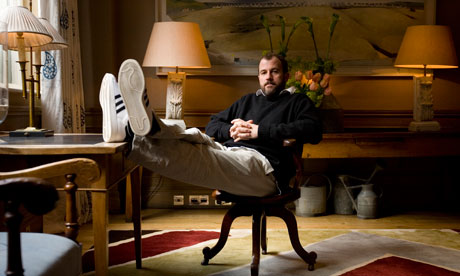
Antonio Zazueta Olmos
The author of A Million Little Pieces and other works of fiction.
Today is an uplifting, degrading, and all-around confusing time to be a writer in America. Even as creative-writing departments proliferate like bedbugs and each year brings a fresh (and deserving) claimant to the title of Great American Novel (The Emperor’s Children, Netherland, Freedom, all great books), content farms are herding the young and determined literati into anonymous sweatshops run by all-seeing, unforgiving masters of metrics. More people want to be writers even as continual technological breakthroughs — Blogspot, Twitter, and tablets of every shape and size — make the future of writing less solid and predictable. The old orders are falling and the new ones have not yet emerged, and worst of all, nobody, it seems, knows how to write about sex anymore. We are in a moment of literary in-betweenness, and into this world of upheaval, to everybody’s surprise, has stepped James Frey, a refugee from the great decade of American fraud, pointing the way up and out like a deranged false prophet. The man has plans.

John Bramley/DreamWorks
I Am Number Four, a story about a good-looking teenage alien and his struggle to survive.
It’s hard to believe that it’s been five years since Oprah humiliated Frey on national television. And though he proceeded (sensibly) to make himself scarce for a while, you are going to be reading a lot about him this year, even if you’re not really meaning to. His upcoming novel, The Final Testament of the Holy Bible, follows a man who may or may not be Christ through twenty-first-century Manhattan, and the film version of the best-selling book I Am Number Four will be released in February. The latter is the first fruit of Frey’s publishing venture, Full Fathom Five, the setup of which has caused a minor scandal. Frey finds young writers to “coproduce” commercial young-adult fiction: They write it, he controls it, they can tell their friends and parents that they’ve written a book, and he takes up to 70 percent of the royalties. Frey, at least according to some, trolls the M.F.A. programs in New York rather the way pimps in movies troll Penn Station for farmers’ daughters, but I hesitate to judge his plan. The truth is that anyone who spends $40,000 a year to be taught how to write by writers who cannot make a living by writing, or who imagines that fairness and common sense have anything to do with the publishing industry, could probably use a lesson in how life really works.

(Hemingway) Archivo Castillo Puche/EFE/Corbis; (Mailer) Interfoto/Alamy
Hemingway and Mailer are among Frey’s idols.
Which leads me to the only thing I really like about Frey: his arrogance. He unblushingly compares himself to some of the greats (Hemingway, Mailer) and believes that his new young-adult production scheme is like the work of Jeff Koons or Ai Weiwei, who both hire workers to produce their oversized art. We haven’t heard this kind of boldness from a writer, this claim to an inheritance of a grand tradition, since Norman Mailer died. The best writers now are humble to the point of insanity. Before he went on his Freedom book tour, Jonathan Franzen told Terry Gross on NPR that he just hoped to hand-sell a few copies at local bookstores. (He ended up on the cover of Time.) The younger generation, meanwhile, seems to come in two flavors: the earnestly meek (Jonathan Safran Foer, Dave Eggers, Jonathan Lethem) and the ironically meek (Gary Shteyngart, Sam Lipsyte, Joshua Ferris). The danger of all this — and it is a real danger — is that their meekness will be taken seriously, and that writing will then be accepted as the natural domain for losers. The world today is filled with graying men who became writers so they could follow in the swaggering footsteps of Mailer, Bellow, and the other giant egos of postwar American letters. But how many young men today read, say, Jonathan Safran Foer’s dollhouse fiction and say, That’s what I want to do with my life?
Why It’s So Hard To Find A Date on Wikipedia
Define Gender Gap? Look Up Wikipedia’s Contributor List
By NOAM COHEN

In 10 short years, Wikipedia has accomplished some remarkable goals. More than 3.5 million articles in English? Done. More than 250 languages? Sure.
But another number has proved to be an intractable obstacle for the online encyclopedia: surveys suggest that less than 15 percent of its hundreds of thousands of contributors are women.
About a year ago, the Wikimedia Foundation, the organization that runs Wikipedia, collaborated on a study of Wikipedia’s contributor base and discovered that it was barely 13 percent women; the average age of a contributor was in the mid-20s, according to the study by a joint center of the United Nations University and Maastricht University.
Sue Gardner, the executive director of the foundation, has set a goal to raise the share of female contributors to 25 percent by 2015, but she is running up against the traditions of the computer world and an obsessive fact-loving realm that is dominated by men and, some say, uncomfortable for women.
I AM NUMBER FOUR B-rolls
George Condo @ The New Museum
Kanye Hugged: A Little Moment With Mr. West at the George Condo Opening
By Nate Freeman
 We were standing in front of the titan of pop music at a party last night to celebrate artist George Condo’s first retrospective, Mental States, which opens today at The New Museum. Condo is known for painting his subjects as wild-eyed gaping clown faces, cheeks and foreheads flushed with spiky brushstrokes that intimate explosion, and always featuring distinctive askew-splayed bucked teeth. The most famous of these subjects is Kanye West, whom Condo depicted in flagrante delicto on the cover of his album My Beautiful Dark Twisted Fantasy (another Condo was used as the official album art, however, after Kanye tweeted that the more racy choice had been “banned” by someone).
“I don’t talk to the fuckin’ press!” Kanye West told The Observer.
With that we walked off, thinking incorrectly that we would not speak to Kanye West again that night.
Others at the party were more chatty than the hip-hop star. We ran into a be-stubbled James Frey coming down the extra-slim white hallway that took the art patrons to the main exhibition room. Marc Jacobs sauntered around pecking everyone on the cheek, allowing the stray whiskers of his fuchsia and aquamarine fur scarf to nuzzle against their noses.
Exhibition a

William Gibson’s History of Digital Vandalism
25 Years of Digital Vandalism
By WILLIAM GIBSON
 IN January 1986, Basit and Amjad Alvi, sibling programmers living near the main train station in Lahore, Pakistan, wrote a piece of code to safeguard the latest version of their heart-monitoring software from piracy. They called it Brain, and it was basically a wheel-clamp for PCs. Computers that ran their program, plus this new bit of code, would stop working after a year, though they cheerfully provided three telephone numbers, against the day. If you were a legitimate user, and could prove it, they’d unlock you.
But in the way of all emergent technologies, something entirely unintended happened. The Alvis’ wheel-clamp was soon copied by a certain stripe of computer hobbyist, who began to distribute it, concealed within various digital documents that people might be expected to want to open. Because almost all these booby-trapped files went out on floppy disks, the virus spread at a pre-Internet snail’s pace.
Still, it did wreak a certain amount of low-grade havoc, freezing computers across the world. The hobbyists did it because they could, or to proudly demonstrate that they could, or to see what would happen, or simply because they thought it was neat.
NUMBER FOUR “Next”
Number Four Scripters Do Charlie’s Angels
‘NUMBER FOUR’ WRITERS BRINGING ‘CHARLIE’S ANGELS’ BACK TO TV
 The names Alfred Gough and Miles Millar might not be familiar to you, but the projects they’ve worked on probably are. They created the TV show “Smallville” and wrote the movies “Lethal Weapon 4″ and “Spider-Man 2.” They’ve also written a new movie that hits theaters on February 18, “I Am Number Four.”
Their next project will undoubtedly be familiar to you, too. They’re working on a TV reboot of the iconic ’70s series, “Charlie’s Angels” (which, of course, spun off a couple of hit movies with Drew Barrymore, Cameron Diaz, and Lucy Liu a decade ago). ABC has already ordered a pilot, and while there will certainly be similarities to the original series, Gough and Millar told us there will be some different twists, as well.
Dianna Agron on NUMBER FOUR Book vs. Screenplay
Dianna Agron on “Differences Between [I Am Number Four] Book and Screenplay”
It happens with every book-to-movie adaptation. Earlier this week, new details emerged about the seventh and final ‘Harry Potter’ film, specifically that the location where the death of a major character takes place will be different in the film than the book. The question becomes, can fans of the book accept a movie that’s not 100% true to the book?
It’s funny that people keep saying Sarah was a cheerleader because it never is really addressed in this script,” she told us when we were on the set of the movie last summer in Pittsburgh. “I know it is in the book — it’s more that she had friends that were kind of the popular kids and her boyfriend is a football player and she’s just kind of done conforming to what other people thinks she should be like. There’s quite a few differences between the book and screenplay, but both are very action-packed.”
The Birth of Tibor de Nagy
When Art Dallied With Poetry on 53rd Street
I don’t believe in golden ages, but I do believe in golden moments. Culturally speaking, New York City has had its share, and one began at the end of 1950 when Tibor de Nagy Gallery opened on 53rd Street near Third Avenue in Manhattan.

To the casual passer-by the undertaking couldn’t have looked auspicious. The gallery was in a dumpy tenement several blocks from the glamorous art hub of 57th Street and Fifth Avenue. Most of its artists were young unknowns. And who was Tibor de Nagy? A refugee banker from Hungary with a fancy pedigree but little cash, and a single New York accomplishment: he was a founder — along with a bulky, Buffalo-born leprechaun of a puppeteer and art fanatic named John Bernard Myers — of a children’s marionette theater.
The new gallery with his name had other curious features. It was showing modest portraits and still lifes at a time when abstract painting, the bigger the better, was considered the advanced style. It had female artists on its roster, quite a few. Most eccentrically, the owners, de Nagy (pronounced de NAHJ) and Myers, seemed as interested in new poetry as they were in new art, and were producing a line of books combining the two.
Parachuting The Game Ball In to 109,000 Screaming Fans
Journal of Universal Rejection
by Caleb Emmons at Pacific University

About the Journal
The founding principle of the Journal of Universal Rejection (JofUR) is rejection. Universal rejection. That is to say, all submissions, regardless of quality, will be rejected. Despite that apparent drawback, here are a number of reasons you may choose to submit to the JofUR:
- You can send your manuscript here without suffering waves of anxiety regarding the eventual fate of your submission. You know with 100% certainty that it will not be accepted for publication.
- There are no page-fees.
- You may claim to have submitted to the most prestigious journal (judged by acceptance rate).
- The JofUR is one-of-a-kind. Merely submitting work to it may be considered a badge of honor.
- You retain complete rights to your work, and are free to resubmit to other journals even before our review process is complete.
- Decisions are often (though not always) rendered within hours of submission.
Instructions for Authors
The JofUR solicits any and all types of manuscript: poetry, prose, visual art, and research articles. You name it, we take it, and reject it. Your manuscript may be formatted however you wish. Frankly, we don’t care.
After submitting your work, the decision process varies. Often the Editor-in-Chief will reject your work out-of-hand, without even reading it! However, he might read it. Probably he’ll skim. At other times your manuscript may be sent to anonymous referees. Unless they are the Editor-in-Chief’s wife or graduate school buddies, it is unlikely that the referees will even understand what is going on. Rejection will follow as swiftly as a bird dropping from a great height after being struck by a stone. At other times, rejection may languish like your email buried in the Editor-in-Chief’s inbox. But it will come, swift or slow, as surely as death. Rejection.
Submissions should be emailed to J.Universal.Rejection@gmail.com. Small files only, please. Why not just send the first couple pages if it is long?
Archives
(empty)
(empty)
(empty)
(empty – because we were on holiday)
(empty)
[ click to visit the Journal of Universal Rejection website ]
I AM NUMBER FOUR App Out There
I AM NUMBER FOUR APP NOW AVAILABLE
 DreamWorks official I AM NUMBER FOUR iPhone/iPod Touch app is now available for FREE download in the iTunes app store! Head on over and check it out!
Number Four has lost his phone! Download this app to help him complete missions, communicate with his friends, and keep the phone out of the Mog’s hands.
Along the way you’ll get inside information about Number Four, his lost planet Lorien and the upcoming release of I AM NUMBER FOUR. Play games and bump phones to unlock exclusive wallpapers, photos, and ringtones from the film. Download the app now and help John evade the enemy.
Don’t miss I AM NUMBER FOUR in theaters and IMAX February 18th, 2011.
THE POWER OF SIX – First look at the cover
Power of Six Jacket is Revealed!
Finally!!! The POWER OF SIX jacket is here for your viewing pleasure!

I know a lot of you have been wondering when POWER OF SIX will be on sale… look for it to invade stores in August 2011. As you can imagine, Pittacus Lore has quite a bit on his plate.
Richard Phillips And The Fame Monsters
The Fame Monsters
With his vivid, technicolor portraits of Robert Pattinson, Taylor Swift, Miley Cyrus, and others, painter Richard Phillips explores the dark recesses of the red carpet moment.

In an age when nearly every major fashion house has a “celebrity services director” pushing photos of starlets and leading men wearing its latest pieces in front of step-and-repeats that further promote the brand, there may be no timelier artist than New York City–based painter Richard Phillips. Over the past decade Phillips has staked out a unique position in the white-hot center of the modern pop-culture nexus where film, music, fine art, and fashion constantly intersect at an endless stream of posh parties and openings. As such, his candy-hued, hyperrealistic portraits (shown at Gagosian Gallery in New York and White Cube in London) have insinuated themselves into a M.A.C campaign and the much-lauded, if fictional, Bass art collection on Gossip Girl.
“It’s probably the most disturbing show I’ve ever done, and there’s no pornography or political emblems in it,” [says] Phillips, referring to two hallmarks of his previous work. “The longer you sit with it, the truly diabolical nature, the real horror of it comes up. The idea of being caught up in ritualized consumption and these stars aren’t offering any alternative to it—they’re reinforcing it.”
Women who are not nursing and would like to get pregnant are encouraged to try it….
Cheaper Dryer Balls

When Kerouac Wrote Brando

Peter Yates Gone
Peter Yates, Filmmaker, Is Dead at 81

Peter Yates, right, on the set of “Bullitt” (1968) with Steve McQueen. Warner Brothers/Seven Arts, via Photofest
By BRUCE WEBER
Peter Yates, a British-born director whose best-known films were well-observed tales of Americana, including the car-chase cop thriller “Bullitt” and the coming-of-age, bike-race comedy “Breaking Away,”died on Sunday in London. He was 81.
Mr. Yates’s reputation probably rests most securely on “Bullitt” (1968), his first American film — and indeed, on one particular scene, an extended car chase that instantly became a classic. The film stars Steve McQueen as a conscience-stricken lone-wolf San Francisco detective, and the chase begins with him behind the wheel of a Ford Mustang in a slow, cat-and-mouse pursuit of killers who were in a Dodge Charger. It escalates into high-speed screeches and thuds on city streets and ends in a fiery blast on a highway.
The chase, often paired in discussion with a New York City counterpart from William Friedkin’s “French Connection”, featured McQueen doing some of his own driving: a camera placed in the car and peering out the windshield registers the violent shifts in the driver’s perspective as the car bounds in chassis-challenging fashion over San Francisco’s famous hills.
The Wrath Of God from Portsmouth

THE GUARDIAN: Final Testament Makes Best Books of 2011
The best books of 2011
Alison Flood anticipates the literary delights of the coming year

Christian-baiting has, of late, become something of a fictional trend. Philip Pullman goaded believers last year with his take on the New Testament, The Good Man Jesus and the Scoundrel Christ, which gave Jesus a manipulative twin brother. And Michel Faber’s novel The Fire Gospel saw Jesus die ignominiously on the cross with the entreaty: “Please, somebody, please finish me.”
But literary aficionados know that if it’s real controversy they’re after, there’s no one better than James Frey. His bestselling 2003 memoir, A Million Little Pieces, contained various fabrications about his life as an alcoholic drug addict; his new novel, The Final Testament of the Holy Bible, is out this spring, and looks likely to prove equally headline-grabbing. The book imagines what might happen if Christ returned to Earth, and was living in 21st-century New York, and having plenty of sex – with both men and women.
The story is written from the perspectives of 13 of his family, friends and followers – including an old rabbi, a young homeless man, and a surgeon. “It’s a serious attempt to write a valid Messiah story,” says Frey. “A book which addresses ideas of God and religion, and what it means if they are valid. I personally believe that if the Messiah were to arrive on Earth, he would not be an intolerant person who condemned people to hell for how they lived or who they loved.”
Frey has consulted an array of real-life religious and secular experts, from rabbis, Catholic priests and evangelical pastors, to neurosurgeons, lawyers and mental health experts. But, however well-researched the book is, its focus on Christ’s sex life will inevitably incite controversy. Why did he think the sex was so important? “Sex is part of love,” Frey says, “so if someone is preaching the gospel of love, then sex has to be a part of it. And I don’t believe that sex would be limited to sex between men and women. Jesus has sex with people he loves. So yes, in my book the Messiah has sex with men and women.”
Frey’s pretty sure that he’s “going to get blasted” for the book. But then, the writer adds, “I get blasted for everything I do.” He insists this wasn’t his motivation, however: “If you set out to enrage people, you’re just going to write a lame book. If you do it because you believe in what you’re writing, you can do something interesting and meaningful. It’s easy just to piss people off.”
The Final Testament of the Holy Bible is published by John Murray in April .
First iPad Album Ever from GORILLAZ

No More Book Stores On Magnificent Mile
Closing of Borders on Mag Mile a sad chapter
January 07, 2011|By Mary Schmich

Heather Charles, Chicago Tribune
By Saturday, Borders’ marquee Chicago store, at 830 N. Michigan Ave., will be closed for good. And — here’s what I think is the real news — the city’s premier shopping street will be without any bookstore for the first time in decades.
By Thursday, the cavernous old Borders was more rummage sale than bookstore.
Yellow tape, the kind ordinarily seen at crime scenes, cordoned off empty shelves, racks and tables that once bore the weight of millions of bound words. All fixtures were for sale.
The shelves near the front door, once occupied by best-sellers, now flaunted such obscure titles as “El Asesor del Presidente,” a Spanish-language biography of former U.S. Attorney General Alberto Gonzales.’
Price: 5 cents. “While Supplies Last,” the sign said. No one was buying.
FindNumberFour.com

Robbins and Barrett Gone

2 Veterans Leave Village Voice
What becomes of New York’s most formidable muckraking paper when two of its greatest muckrakers are gone?
The Village Voice, the granddaddy of alternative weeklies, which enlivened political and investigative journalism in New York through its scrappy, hold-nothing-sacred approach, has lost Wayne Barrett and Tom Robbins, two journalists who helped define the paper’s modern era.
The Voice without either man, some prominent New Yorkers said, is difficult to imagine. And their leaving raises questions about what kind of future the paper has in the city whose politics it fermented and culture it shaped.
“With the loss of Wayne and Tom, they lost Joe DiMaggio and Mickey Mantle,” said Don Forst, who was editor of The Voice from 1996 to 2005 and edited the work of both men
Mr. Forst said their departures left the paper, which had already been downsized considerably in the last decade, greatly diminished. “It was a great institution for what it was,” he said. “It was not The Times. It wasn’t The Post. It was The Village Voice. And I think it was the role model for all folk alternative papers. I don’t know what they have left.”
The Title Treatment Site

Re-writing Twain
Publisher Tinkers With Twain
By JULIE BOSMAN
A new edition of “Adventures of Huckleberry Finn” is missing something.
 Throughout the book — 219 times in all — the word “nigger” is replaced by “slave,” a substitution that was made by NewSouth Books, a publisher based in Alabama, which plans to release the edition in February.Some English teachers were less than thrilled about the idea of cleaning up a classic.
“I’m not offended by anything in ‘Huck Finn,’ ” said Elizabeth Absher, an English teacher at South Mountain High School in Arizona. “I am a big fan of Mark Twain, and I hear a lot worse in the hallway in front of my class.”
Ms. Absher teaches Twain short stories and makes “Huck Finn” available but does not teach it because it is too long — not because of the language.
“I think authors’ language should be left alone,” she said. “If it’s too offensive, it doesn’t belong in school, but if it expresses the way people felt about race or slavery in the context of their time, that’s something I’d talk about in teaching it.”
Like A Shotgun / I Can’t Be Out-done / I’m Your Prostitute / You’re Gonna Get Some
I AM NUMBER FOUR in Super-Psyched Fifty
50 Movies We’re Super-Psyched to See in 2011
By

DreamWorks
‘I Am Number Four’
Release Date: Feb. 18
Starring: Alex Pettyfer, Timothy Olyphant, Dianna Agron
The Scoop: With both “Twilight” and “Harry Potter” nearing their ends, both the movie and book industries are scrambling to find — or create — the next big thing. Their first attempt at genetically engineering a blockbuster franchise, Franksenstein style? “I Am Number Four,” which was simultaneously developed as a book and movie series by writer James Frey and producers Michael Bay and Steven Spielberg. Up-and-coming buzz magnet Alex Petteyfer plays an alien kid marooned on Earth; when the evil galactic overlords who destroyed his home planet come to destroy his new home, he has to harness his new superpowers in order to save the world. And hopefully the film and book industries to boot. | Watch the trailer
If David Ulin Would Like To Submit A Story Idea to Full Fathom Five They’d Probably Take A Look At It
The first fruit of James Frey’s fiction factory
James Frey achieved a strange fame with his bestselling memoir that proved not entirely true, “A Million Little Pieces.” After going on “Oprah” to promote his book, he was brought back to face her displeasure about its exaggerations.
He moved to New York and wrote a big book set in Los Angeles. “Bright Shiny Morning” came out in 2008; David L. Ulin, who was then L.A. Times books editor, wrote it was “a terrible book. One of the worst I’ve ever read.”
But a little literary criticism wasn’t going to slow Frey down. As New York magazine reported in November, Frey has created Full Fathom Five, a company that recruits young MFA students to co-write novels with him — for as little as $500, $250 or even nothing — in hopes of sharing in the profits of their eventual blockbuster sale. The writing duties fell almost completely to the young writers: Frey would provide story ideas, writing guidance or polishing, and the connections to get the work published and in the right hands.
If it sounds suspiciously like a scam, Frey can show it’s not. “I Am Number Four,” co-written by Frey and recent Columbia MFA grad Jobie Hughes, under the pseudonym Pittacus Lore, was published in the fall of 2010. And that’s not all: It was subject to a film-rights bidding war, and the movie is being produced by Michael Bay and Steven Spielberg’s DreamWorks Studios.