
Kurt Perschke’s RedBall On The Run
Whew! I didn’t waste those four years after all.
Tech companies are hiring more liberal-arts majors than you think
 (Mark Lennihan / AP)
Coding isn’t the biggest role for these folks — that is, liberal arts majors who graduated from college between 2010 and 2013 and who lack graduate degrees — but programming is still surprisingly high on the list. According to LinkedIn’s study, it’s the third most popular job.
Most emerging liberal arts majors go into the tech sector after holding one other job first, but a substantial number go straight into the industry, too. Fourteen percent of liberal arts majors from schools in the top-20 wind up at tech companies as their first jobs, for instance.
Old Man in Speedo Beats, Permanently Disfigures Mermaid
Greek Artist Demolishes His Own Work to Avoid Bizarre Government Fine
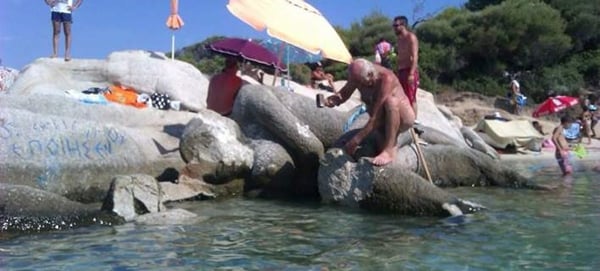
A statue of a mermaid by Greek artist Dionysis Karipidis, which was created in 1997 on the Portokali beach in Chalkidiki, Greece, has been destroyed by the hands of its own maker.
The artist took to his statue with a sledgehammer when he was asked by the area’s tourist authorities to pay a fine for “destroying the natural landscape,” according to the Greek Reporter.
Chalkidiki is known for its three peninsulas that stick out into the Aegean sea like Poseidon’s trident. Famous as a tourist spot, the Greek peninsula is also known as the birthplace of Greek philosopher Aristotle.
The mermaid, which is carved from the natural limestone on the beach, has been a tourist attraction for almost a decade. The issue arose a little over a year ago when the artist, who has largely remained anonymous, received a letter from the local municipality leveling a 533 euro fine for the work. In March 2014, Karipidis responded with his own letter stating that if he was forced to pay the fine, he would destroy his work.
Aspect Ratio F†ckery
Suck on this, salad eaters.
Why salad is so overrated

Minus their greens, left to right: the Caesar Salad With Chicken from the Cheesecake Factory; the Quesadilla Explosion Salad from Chili’s Grill & Bar; the Waldorf Salad from California Pizza Kitchen. (T.J. Kirkpatrick/For The Washington Post)
As the world population grows, we have a pressing need to eat better and farm better, and those of us trying to figure out how to do those things have pointed at lots of different foods as problematic. Almonds, for their water use. Corn, for the monoculture. Beef, for its greenhouse gases. In each of those cases, there’s some truth in the finger-pointing, but none of them is a clear-cut villain.
There’s one food, though, that has almost nothing going for it. It occupies precious crop acreage, requires fossil fuels to be shipped, refrigerated, around the world, and adds nothing but crunch to the plate.
It’s salad, and here are three main reasons why we need to rethink it.
Salad vegetables are pitifully low in nutrition. The biggest thing wrong with salads is lettuce, and the biggest thing wrong with lettuce is that it’s a leafy-green waste of resources.
In July, when I wrote a piece defending corn on the calories-per-acre metric, a number of people wrote to tell me I was ignoring nutrition. Which I was. Not because nutrition isn’t important, but because we get all the nutrition we need in a fraction of our recommended daily calories, and filling in the rest of the day’s food is a job for crops like corn. But if you think nutrition is the most important metric, don’t direct your ire at corn. Turn instead to lettuce.
Coitus Atop Castle Walls Not Recommended
French couple ‘having sex’ on a castle die after plunging 40ft into moat
 Police announce pair were discovered beneath a fort in Chausey
A French couple have fallen to their death while having sex at a historic fortress, it has been reported.
The couple in their early thirties apparently fell into the moat from the walls surrounding the castle at the Vauban Fort on the island of Chausey Archipelago in the English Channel. Reports have said the drop into the moat is 40ft high.
The naked bodies of a man and woman, who were both born in 1984, were found on Thursday morning.
Hallucinatory Collages in Culver City
Object Lesson: Hallucinatory collages tell the story of the U.S.-Mexico border
Cross-border brother artist team Einar and Jamex de la Torre are known for creating wild collages and assemblages that fuse the high and the low, such as this 2014 lenticular piece, “Rites of Passage,” which takes on the U.S.-Mexico border as its subject. (Einar and Jamex de la Torre / Koplin Del Rio)
As far as art forms go, it doesn’t get more lowbrow than lenticulars, the 2-D printed pictures that, with the aid of a rippled, plasticized coating, appear three dimensional, often with animated effects. Think of those thrift store portraits of Jesus that appear to be winking.
Artists Jamex and Einar de la Torre have used this technology — generally reserved for popular religious art and advertising campaigns — to fantastic effect.
In fact, a current show of their work at Koplin Del Rio in Culver City offers a bounty of pieces that employ the device. Among them: a mandala-type design studded with images of skulls, anatomical sketches and religious iconography and a Last Supper-style scene in which the disciples’ faces have been replaced with those of the artists. (I made a Vine of the former, to capture the trippy sense of movement these pieces have when you see them in person.)
Among the most elaborate works are a pair of lenticulars that take on the U.S.-Mexico border as their subject: “Rites of Passage,” shown at top, and “Border Park of Earthly Delights,” both of which were made in 2014. (Unfortunately the images shown here don’t capture the works’ psychedelic effects, which is why it’s best to see them in person.)
The Fate of Ten
See the electrifying trailer for The Fate of Ten, the penultimate I Am Number Four book — exclusive
On Sept. 1, Pittacus Lore’s I Am Number Four series gets nearer to its close, as The Fate of Ten—the series’ second-to-last book—hits shelves everywhere. The Fate of Ten sees the Garde stretched across North America: John is fighting the Mogadorians in New York City, where his human friend Sam has suddenly developed a Legacy; Six, Marina, and Adam are in Mexico where they’ve reached the Sanctuary, but can’t escape. Can they fight this war without destroying each other, and humanity itself?
Check out the electrifying, exclusive trailer above, and read the prologue [here].
Coolest B-ball Court Ever
Kazimir Malevich-Inspired Basketball Court Unveiled in Paris
 The colorful court is squeezed between two apartment buildings. Photo: DeZeen
Who says art and sports don’t mix? Parisian streetwear brand Pigalle teamed up with creative agency Ill-Studio to build a spectacular and colorful basketball court inspired by avant-garde painter Kazimir Malevich.
Nestled between two apartment buildings in Paris’ 9th arrondissement, the court was first launched in 2009 by Pigalle founder Stephane Ashpool. Now, the court has undergone renovation to host the presentation of Pigalle Basketball’s spring/summer 2015 collection.
Wild Flying Grizzly Eagle Kills Drone
Watch: Eagle punches drone out of sky
by
An eagle in Australia knocked a drone out of the sky.
In the footage from Melbourne Aerial Video, a Wedge-Tailed Eagle flies up to the drone and hits it directly. The drone sputters and falls to earth.
The eagle was unharmed, according to a statement on YouTube. “She was massive, and used talon’s to ‘punch’ the drone out of the sky,” the statement said.
However, the drone didn’t fare so well.
Roger Steffens & The Family Acid
Roger Steffens: Reggae Encyclopedist and “Family Acid” Photographer
by Eric Trules

If you know anything about the world of reggae music, you know the name, Roger Steffens, the man who began the first radio broadcast of the “Reggae Beat” on KCRW (along with Hank Holmes) on Oct. 7, 1979. It was the only reggae show in Los Angeles at the time, and it went on to set annual fundraising records for the radio station, L.A.’s local NPR affiliate, which is still going strong.
Eventually “Reggae Beat” was syndicated to 130 stations worldwide. Steffens first guest on the show was Bob Marley, and Steffens spent two weeks on the road with Marley in 1979 on the original “Survival” tour. Since then, Steffens has written six books about Marley and the history of reggae, and he has lectured internationally for the past 31 years on “The Life of Bob Marley,” in a multi-media presentation that has been seen everywhere from the bottom of the Grand Canyon, to the Smithsonian to the outback of Australia. I saw the show twice, once at Steffens reggae exhibition installed on the Queen Mary in Long Beach, a second time, more recently, at USC’ s School of Cinematic Arts. Roger spoke while his wife, Mary, ran the slides and videos.
Steffens’ world-famous reggae archives are housed in a labyrinthine maze below the first floor of his home in Echo Park, filling the entire lower level of seven rooms from floor to ceiling. “We’ve had to move twice just to house the collection,” he told me. “And now we’re about to burst this one too. We need a permanent institutional home, just in case you know of one.”
His Marley collection has been called the most complete in the world, by the very Wailers themselves, Bob’s band members. It’s not just shelves of records, tapes, and CDs pushing out from every corner, but tens of thousands of reggae photographs, 30,000 reggae fliers from all over the world, 2,000 reggae posters (many of them signed by the original artists), 140 cubic feet of alphabetized clippings, and an array of invaluable books and magazines, including the full 48-year run of Rolling Stone. (He bought the first issue the day before he went to Vietnam.)
Yet Steffens is not only a reggae “encyclopedist” and collector. He has also hosted programs of African music, poetry, the Sixties, and a wide-open talk show, called “Offbeat.” He has interviewed countless colorful musicians, and he is the man who turned Paul Simon on the Ladysmith Black Mambazo for his landmark and Grammy-winning 1986 “Graceland” LP. Steffens was the first speaker at the Rock and Roll Hall of Fame and Museum, and the most frequent, nine times. In 2013 he spent the first two months of the year on the road as the Wailers’ opening act on their international “Survival Revival” tour.
Where is the reggae guru from? What’s his story? Well, Steffens, who was born in Brooklyn in the early Forties, likes to begin his story of influence with serving for the last 26 months of the Sixties in the army in Vietnam. He was assigned to Psychological Operations in Saigon, but when the TET Offensive hit the capital, Roger found 52 families living in sewer pipes outside his barracks. He began a refugee campaign that raised over 100 tons of food and clothing, mainly from Racine, where he had read poetry in the school before being drafted. He built villages and brought medical and dental assistance to war victims from the DMZ to the Mekong Delta. For his actions, he was awarded a Bronze Star.
“I’ve always had a Hippie heart,” Steffens says proudly. And after a post-war ‘we gotta get out of this place’ year in Marrakech, Morocco in 1971, he moved to Berkeley, California. He photographed his activities hanging with early Rolling Stone writers, musicians, artists, poets, painters, and fellow actors, as avidly as he had taken photos during the Vietnam War. Since that time, all the slides (1967-1993) and prints (1993-2007) stayed hidden behind closed doors — 100,000 images that virtually no one outside the family had ever seen, except in living room slideshows. (He’s taken another 240,000 digital images since.)
Then, in 2013, Roger’s son, Devon Steffens, spent a year digitizing some 40,000 slides. Next, his daughter, Kate, asked, “Why don’t I start an Instagram site?” Right on cue, Steffens replied, “What’s an Instagram?” After his daughter explained and her dad agreed, she began posting two pictures a day under the rubric “The Family Acid,” so called, she said, because her childhood friends told her that her family was “like the Waltons on Acid.” The fact that Roger and his wife, Mary, met on an acid trip in a pygmy forest in Mendocino under a total eclipse of the moon on Memorial Day, 1975, may have also helped influence the title.
Niantic Sails Solo
Google’s Niantic Labs to become independent company
The developer of mobile game Ingress will go solo as it aims to reach bigger audiences
By Zach Miners / IDG News Service
 Credit: Google
Two days after announcing a sweeping reorganization, Google detailed its first departure. Niantic Labs, an augmented reality unit, will be spun off into an independent company.
The split, which is unusual for Google, means that Niantic Labs won’t be part of Alphabet, the new holding company that is expected to be formed later this year to include Google and other parts of the company.
The move was announced by Niantic Labs in a Google+ post on Wednesday, and confirmed by Winnie King, a Google spokeswoman.
The split would allow Niantic to accelerate its growth, she said, “which will help them align more closely with investors and partners in the entertainment space,” but didn’t provide any more details.
Niantic said it will allow the company to work with new partners while continuing to collaborate with Google.
Ingress has been downloaded more than 12 million times and has attracted more than 250,000 users, the group said in its announcement on Wednesday.
Niantic also developed Field Trip, a mobile discovery app that shows users local places of interest as they pass by them.
More recently, Niantic has been developing a new game called “Endgame: Proving Ground,” which follows the storyline of the novel “Endgame: The Calling.”
Dark Night Of The Perseids
Sky Watch: This year’s Perseid meteor shower should impress
By Mike Lynch

One of the best meteor showers of the year will light up the night sky this week. The Perseid meteor shower will peak Wednesday night and early Thursday morning, but the meteor viewing should be pretty good most of the week.
Last year, the Perseids gave a lousy show because the sky was whitewashed by a full moon. This year, the sky will be a lot darker, thanks to a thin crescent moon rising after midnight.
Even if you’re stuck watching the Perseids from an urban or suburban location, you still should be able to see a decent number of “shooting stars.” But if you can get into the country where there is a dark backdrop, you should be able to see as many as 60 meteors per hour.
Amen, Adam Weinberg
6 Tips for Getting the Most from a Liberal Arts College
by Adam Weinberg – President, Denison University

In just a few weeks, thousands of students will go off to a residential liberal arts college, including two of my own children. So what does success look like at college? Why are the first six weeks so critical? And how do the components of a liberal arts education — academics, co-curricular learning and community — come into play?
Here are six pieces of advice I would offer for getting the most out of your next four years, while setting yourself up to thrive for the rest of your life.
1. Dive into a full range of courses. This is why you are here. An adventurous mixture of courses will teach you more than you can imagine. So lean in. Learn to communicate effectively, especially to write well. Work with numbers and data. Weave disparate ideas into new ways of thinking. Frame questions. Argue. Create. Do research. The true advantage of a liberal arts education is that it will prepare you — and I mean you, as a unique individual — to identify the kind of life you want to lead. It also will help you develop the skills, values, and habits to take on that life and be successful. All of this is built upon a foundation of learning across different disciplines, including some areas of study that will be totally new to you.
Taking a wide range of classes is more important now than ever. It prepares you for just about anything. Professions change. The economy goes up and down. Being a great learner who is unafraid of unfamiliar territory makes you adaptable, creative and entrepreneurial. It helps you do well in life — as a colleague, a parent, a leader, a citizen and a friend. Worry less about matching your major with a profession. Worry more about becoming knowledgeable, discerning, skilled and dependable. That is the job candidate who gets hired.
2. Get to know your professors. Truth is, the most important factor in college is mentorship, and student-faculty interactions are the magic of the liberal arts. So step up, and step into your classes. Build relationships with your professors. Take full advantage of their passion for working with students. The professors who have chosen to teach at a liberal arts college have done so for a reason: you. Liberal arts professors are engaged on the front lines of learning, and they love to see the spark that happens when students get excited about an idea. Seek out faculty who can be your mentors. Say hello before class. Go to their office hours. Invite them out for coffee. And engage them when you are struggling. They are terrific guides through your college experience. I can’t say this enough: don’t be afraid or shy about going to see your professors. They want to help.
3. Bring a passion and develop a new one. Many students select a liberal arts college because they have a particular passion they want to pursue. Maybe it is athletics, or arts or community service. You already know you love it, and liberal arts colleges provide amazing opportunities to keep at it.
Is this a Graffix which I see before me, The chalice toward my hand? Come, let me toke thee.
To Smoke Or Not To Smoke: Scientist Says William Shakespeare Used Marijuana
 A South African researcher says traces of cannabis were found in fragments of clay pipes discovered in William Shakespeare’s garden. (Photo by Hulton Archive/Getty Images)
LONDON (CBSDC) – The man who wrote Hamlet and MacBeth may have been enjoying some Midsummer Night’s Dreams.
South African researchers examined some 17th-Century clay tobacco pipe fragments found in William Shakespeare’s home town of Stratford-upon-Avon, reports Time Magazine.
They examined 24 fragments, including some had been excavated from the site of the Bard’s personal garden.
Using advanced gas chromatography methods, they detected cannabis on eight of the fragments, including four that were confirmed to dome from the garden.
Oliver Sacks’ Heart-wrenching Goodbye
Oliver Sacks: My Periodic Table
 Aidan Koch
I LOOK forward eagerly, almost greedily, to the weekly arrival of journals like Nature and Science, and turn at once to articles on the physical sciences — not, as perhaps I should, to articles on biology and medicine. It was the physical sciences that provided my first enchantment as a boy.
In a recent issue of Nature, there was a thrilling article by the Nobel Prize-winning physicist Frank Wilczek on a new way of calculating the slightly different masses of neutrons and protons. The new calculation confirms that neutrons are very slightly heavier than protons — the ratio of their masses being 939.56563 to 938.27231 — a trivial difference, one might think, but if it were otherwise the universe as we know it could never have developed. The ability to calculate this, Dr. Wilczek wrote, “encourages us to predict a future in which nuclear physics reaches the level of precision and versatility that atomic physics has already achieved” — a revolution that, alas, I will never see.
Francis Crick was convinced that “the hard problem” — understanding how the brain gives rise to consciousness — would be solved by 2030. “You will see it,” he often said to my neuroscientist friend Ralph, “and you may, too, Oliver, if you live to my age.” Crick lived to his late 80s, working and thinking about consciousness till the last. Ralph died prematurely, at age 52, and now I am terminally ill, at the age of 82. I have to say that I am not too exercised by “the hard problem” of consciousness — indeed, I do not see it as a problem at all; but I am sad that I will not see the new nuclear physics that Dr. Wilczek envisages, nor a thousand other breakthroughs in the physical and biological sciences.
A few weeks ago, in the country, far from the lights of the city, I saw the entire sky “powdered with stars” (in Milton’s words); such a sky, I imagined, could be seen only on high, dry plateaus like that of Atacama in Chile (where some of the world’s most powerful telescopes are). It was this celestial splendor that suddenly made me realize how little time, how little life, I had left. My sense of the heavens’ beauty, of eternity, was inseparably mixed for me with a sense of transience — and death.
I told my friends Kate and Allen, “I would like to see such a sky again when I am dying.”
“We’ll wheel you outside,” they said.
World’s Greatest Diver Gone
The Disappearance of the World’s Greatest Free Diver
 Natalia Molchanova, pictured here in 2005, trained like an old-school Soviet athlete, but her voice was full of laughter and even joy. Credit PHOTOGRAPH BY JACQUES MUNCH / AFP / GETTY
It seems clear that the great free diver Natalia Molchanova is dead. She was diving last Saturday off the coast of Spain, giving lessons to a rich Russian, when she made a dive of her own and didn’t return. She was almost surely the greatest diver in the history of her sport, which, as mentioned in The New Yorker in 2009, is sometimes described as the world’s second most dangerous activity, after jumping off skyscrapers with parachutes.
In free diving, men and women descend as deep as they can on a single breath. Not infrequently, when they reach the surface after a deep dive they pass out. In a competition, if they pass out before five seconds after reaching the surface their dive doesn’t count. There are eight disciplines in free diving, three of which take place indoors in a pool and involve holding one’s breath and swimming as far as one can underwater on a single breath. The other five are deep-water disciplines. Two of them, variable weight and no limits, are too dangerous for competitions; a diver can only attempt a record. In variable weight, a diver is pulled down by a metal sled, then swims to the surface. In no limits, the diver also rides a sled but ascends by means of an air bag. In the remaining three disciplines, the divers descend by pulling on a rope, or wearing weights. The most prestigious event is constant weight, in which a diver wearing fins or a monofin, a device that looks like a mermaid’s tail, must return to the surface with the weight he or she wore to the bottom. Molchanova, who held the record for breath holding (nine minutes and two seconds), excelled at this, but she was pretty much better than everyone else at nearly all the tasks. She was challenged from time to time by other women, but never really seriously. She was so consistent that she was sometimes called “The Machine.”
Suicide By Shakespeare
The Suicide of the Liberal Arts
Indoctrinating students isn’t the same as teaching them. Homer and Shakespeare have much to tell us about how to think and how to live.
By John Agresto
 ‘Achilles Slays Hector,’ by Peter Paul Rubens, circa 1630. Photo: Art Resource
I was a few minutes early for class. Father Alexander, my high-school sophomore-homeroom teacher, was standing outside the room, cigarette in his mouth, leaning on the doorjamb. “Morning, Father.”
His response was to put his arm across the door. “Agresto,” he said, “I have a question I’ve been thinking about and maybe you can help me.”
“Sure, what’s up?”
“Do you think a person in this day and age can be called well educated who’s never read the ‘Iliad’?” I hadn’t read the “Iliad,” and am not even sure I had heard of it. “Hmmm. Maybe, I don’t see why not. Maybe if he knows other really good stuff . . .” His response was swift. “OK, Agresto, that proves it. You’re even a bigger damn fool than I thought you were.”
***
I grew up in a fairly poor Brooklyn family that didn’t think that much about education. My father was a day laborer in construction—pouring cement, mostly. He thought I should work on the docks. Start by running sandwiches for the guys, he told me. Join the union. Work your way up. There’s good money on the docks. And you’ll always have a job. He had nothing against school, except that if bad times came, working the docks was safer.
I also grew up in a house almost without books. All I remember is an encyclopedia we got from coupons at the grocery store and a set of the “Book of Knowledge” from my cousin Judy. Once in a while I’d head over to the public library and borrow something—a book on tropical fish, a stamp catalog, a book by someone called Levi on pigeons. It never dawned on me to look at what else there was. Who read that stuff anyway?
So now I’m a professor and former university president who grew up without much real childhood reading until eighth grade, two or three years before the “Iliad” question. Sister Mary Gerald asked me one day if I read outside of class. I told her about the pigeon book and the stamp catalog. No, she asked, had I ever read any literature?
Whereupon she pulled out something called “Penrod and Sam,” by a guy named Booth Tarkington. She said I should read it. I did. I can’t say that “Penrod and Sam” is great literature, but it changed a small bit of my neighborhood. Penrod had a club. So my friends and I put together a club. Penrod’s club had a flag; we had a flag. Penrod would climb trees and spy on the surroundings. We had to be content with climbing on cyclone fences.
Who would have thought there was a new way of having adventures, learned from a book? A book, by the way, of things that had never happened. Something had pierced the predictable regularity of everyday street life. And that something was a work of someone’s imagination.
Another Hero Dog
Service Dog Saves Blind Owner’s Life During House Fire
By David Chang

A service dog is being hailed a hero after she jumped into action and saved her blind owner’s life by alerting authorities to a house fire in Philadelphia Thursday morning.
The fire started inside Maria Colon’s home on the 4300 block of Oakmont Street in the city’s Holmesburg section. The woman was asleep at the time, but awoke at the smell of smoke.
“I said, ‘Oh my God, It’s smoke. And I can’t breathe,'” Colon, a Puerto Rico-native who lost her eyesight in 1992, told NBC10’s George Spencer Friday.
She shouted the word “danger” to her service dog, a golden Labrador named Yolanda, prompting the dog to dial 911 on a specialized phone. Yolanda had been trained to step in and call for help when Colon used the emergency word.
“I hear the phone — tke, tke, tke. And she’s growling. And I said, ‘Oh my lord, she called the police,'” Colon recalled.
Remington Steele Instagrams The Art Market
Are Pierce Brosnan and High-Profile Collectors Really Using Instagram to Buy Art?
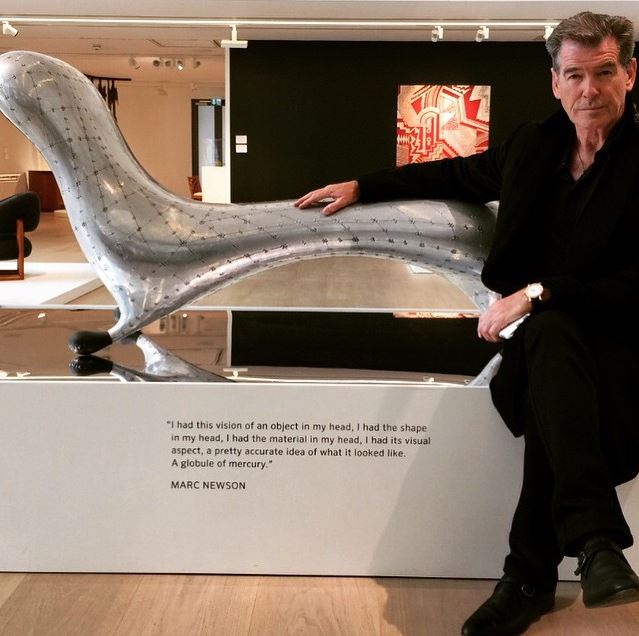 Photo: Instagram/@piercebrosnanofficial.
The New York Times has finally caught on to a little trend we discovered almost two years ago: collectors—many of them high profile—using Instagram to purchase art from galleries and auction houses.
What took the Grey Lady so long to catch on to this wonderfully democratizing trend? We’re unsure, but we do know that it was one Pierce Brosnan who exposed the world of social media sales, which is hidden in plain sight.
In late April, Brosnan visited the showroom of Phillips auction house in London and posed for a quick photo in front of designer Marc Newson’s Lockheed Lounge, which he then posted to his Instagram account along with the caption “let the bidding commence.”
Later that week, the auction house broke the world record for a design object, selling the work for an impressive $3.7 million.
Mobstr vs. Pressure Wash
by Yahoo Makers

Graffiti buffs and street artists battle authorities and clean-up crews all the time, but they’re rarely as long or as good-natured as this one. A London-based street artist who uses the moniker Mobstr played cat and mouse for nearly an entire year with a determined and persistent cleaner. He finally conceded defeat and documented the battle on his site, mobster.org. “I cycled past this wall on the way to work for years,” Mobstr wrote. He noticed that when the surface was tagged in the red area, it was painted over, and when it was tagged on the bare brick, it was pressure washed. This gave way to full on battle that started on July 17th, 2014 and continued until just a few days ago.
Nikki Finke’s Hollywood Dementia
Nikki Finke Is Now Making Up Her Stories (Sort Of)
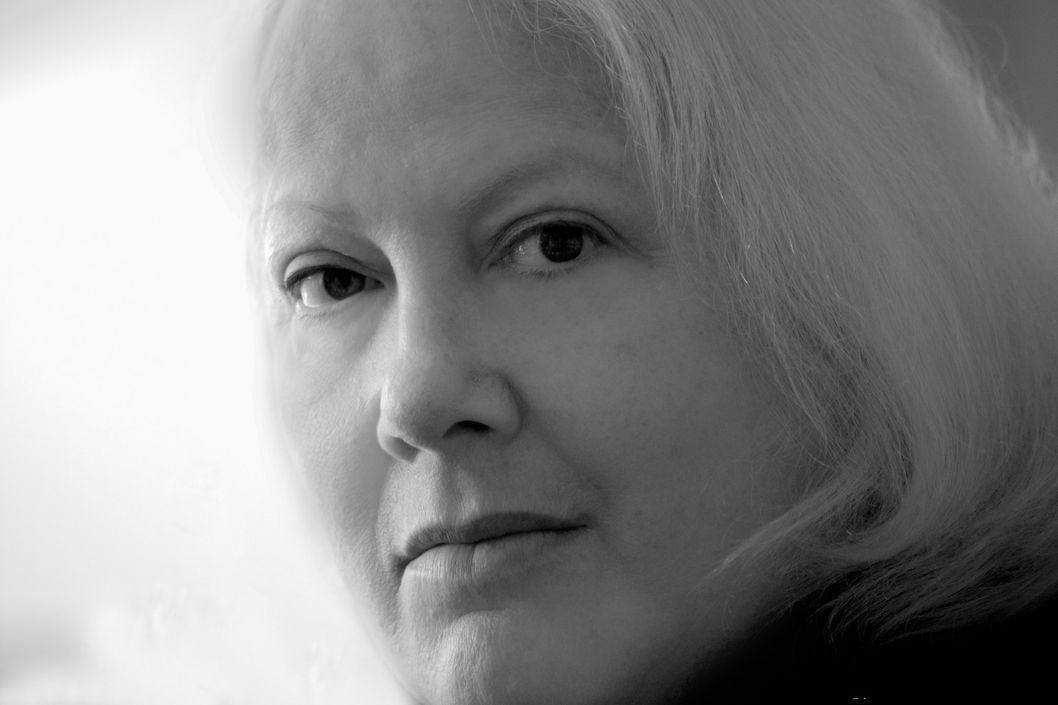 Photo: Jen Rosenstein
For Nikki Finke, fiction was always the enemy. “As a journalist, that was the worst thing you could say about something,” she says. “That’s fiction.”
In the years she spent covering the entertainment industry for the L.A. Times, L.A. Weekly, and her own Deadline website, Finke became famous — and famously feared — for telling the unvarnished (and highly entertaining) truth about everyone in Hollywood, even her own business partner, Jay Penske. “I am a very old-school journalist,” she says throatily over the phone from her home in Los Angeles. “I believe you make the comfortable uncomfortable, and that’s the whole point of doing it. A friend of mine who is in the business always used to say, Why do you always act surprised when people hate you for something you have written? And I said, But it’s the truth! My feeling was always the truth trumps everything. You know, the point is to try and get at that. As uncomfortable and difficult as it is.”
One thing the truth doesn’t trump: non-compete clauses.
Last year, a legal battle with Penske over Deadline resulted in Finke walking away with a reported multi-million-dollar settlement and a sworn promise not to report about the industry for anyone else. For a while, it seemed Penske had done something people in the industry had been trying to do for years: Put Finke out of commission. Under their agreement, Finke couldn’t even go online and expound about the Sony hack — the kind of cataclysmic event that would have had the old Finke, who goes on reporting benders the way studio executives used to go on coke binges, sleepless for days.
Finke clears her throat. (“In 2010, I completely had an operation to remove a parathyroid and they paralyzed one of my vocal cords. I couldn’t talk, I would croak. Of course all the agents would go, ‘That’s so sexy.’”) “The hack presented Hollywood the way it really is,” she says. “It demonstrated what Hollywood insiders have always known.” (She’s being careful, but you can hear it in her voice: TOLDJA!)
Ernest Ranglin Rips It Up
Reggae giant Ernest Ranglin plays rare Seattle gig | Concert review

Guitarist Ernest Ranglin, one of the founders of ska and reggae guitar style, gave a rare performance in Seattle Saturday, Aug. 1.
If ever there was a “once in a blue moon” concert, it was Saturday night’s show at Nectar by Jamaican guitar legend Ernest Ranglin. The club billed the night as Ranglin’s first Seattle appearance, but backstage, the guitarist said he thought he may have played here before — perhaps with a jazz band, perhaps as a reggae artist, or maybe with a world music band.
If, at 83, Ranglin’s memory is a bit hazy, that can be forgiven considering his lengthy, multi-phased career. In an informal interview, he talked about his first records in the fifties, and his own influences, which included jazz great Charlie Christian.
But when Ranglin came onstage, his musical memory was flawless. Over the course of a 90-minute set with Avila, he put on a clinic that touched on jazz, ska and, most certainly, reggae guitar.
Though he’s modest, Ranglin was one of the inventors of reggae and played with Bob Marley and Jimmy Cliff. Saturday he skipped their repertoire, and stuck to reggae classics like “Satta Masa Ghana.”
Mr. Lear Speaks His Mind
TV legend Norman Lear gives 6 strong opinions about American life
by James Hibberd • @JamesHibberd
 (Frederick M. Brown/Getty Images)
Legendary TV producer Norman Lear stopped by the Televisison Critics Association’s press tour in Beverly Hills to promote an upcoming PBS documentary covering his career that’s set to debut next year. But what seemed to most impress reporters was the 93-year-old’s opinionated tangents, covering politics, TV, America and mindfullness. Below are six highlights from a press conference with the creator of hits like All in the Family, The Jeffersons and One Day at a Time:
— On politics: “Everybody knows me to be a progressive or a liberal or lefty or whatever. I think of myself as a bleeding-heart conservative. You will not f— with my Bill of Rights, my Constitution, my guarantees of political justice for all. But does my heart bleed for those who need help and aren’t getting the justice that the country promises them and the equal opportunity the country promises? Yes. I’m a bleeding heart, but I think myself to be a total social conservative. The people who are running just don’t seem to have America on their minds, not the America I think about. When I was a kid we were in love with America. As early as I can remember, there was a civics class in my public school. And I was in love with those things that guaranteed freedom before I learned that there were people who hated me because I was Jewish. I had a Bill of Rights and a Constitution, those words out of the Declaration that protected me. And I knew about that because we had civics in class. We don’t have that much in the country anymore. So before World War II or shortly after, we were in love with America because we understood what it was about and that’s what we were in love with. I believe everybody’s patriotic today. Everybody loves America. But I don’t need their flag plans to prove it. I’d like to go back to civics lessons.”
— On waking up: “I want to wake up feeling as I usually do, loving the day. The title of my book is Even This I Get to Experience, and that’s the way I basically look at life moment to moment. And now I’m looking out at you. I was 93 on Monday. So it took me 93 [years] and five days to get here. It took you every split second of each of your lives to get here for me. So I’m way ahead of you. It took all your lives to get here, so this moment is the moment. Even this we get to experience.”
— On the Golden Age of television: “I think this is the Golden Age. I understand what the Golden Age was when I was coming into television, and it was those years of Playhouse 90 and Philco Playhouse. But there’s great drama and some great comedy on television today. I can’t see it all.”
Blue Moon Rising
Once in a ‘blue moon’ happens Friday
This AP file photo from 2010 shows a blue moon from Nairobi, Kenya. There will be a blue moon Friday. Sayyid Azim AP
Full-moon lovers will get their fill this month, when the earth’s satellite makes its second July appearance on Friday.
Dubbed a blue moon — the special occasion happens only about every two-and-a-half years because the lunar year and calendar year don’t quite match up. The last blue moon was in August 2012 and the next won’t be until January 2018.
“It’s a rare lunar occurrence,” said Barb Yager, an officer with Miami-based Southern Cross Astronomical Society. “People get excited about it.”
The name is deceiving because the moon isn’t actually blue; it appears to have a bluish hue only if there is volcanic ash. In fact, the name has come to mean something that happens only once in a while.
300 Vespa to Yuma
Armie Hammer Feared Death In Arizona Desert On Vespa Adventure
By WENN

Actor Armie Hammer Had No Idea How Close He And His Friends Came To Becoming Stranded In Mexico Last Year (14) After Getting Lost In The Arizona Desert While On A Cross-country Vespa Roadtrip.
The Social Network star embarked on the ambitious journey across America, known as 4k to Hardway, last year (14), shunning luxury hotels to camp in the wilderness, while taking in the scenery as they travelled off the beaten path from California to Florida.
However, Hammer admits they worried they had taken on more than they could handle on numerous occasions, especially when they thought they might actually die in the desert.
He explains, “Things got weird. I mean, you’ve got a group of guys crossing the country, staying in the middle of nowhere.
“We had some close calls… like, at one point, we stayed outside of Yuma, Arizona and we were like, ‘OK, we’ve got to get from Yuma to Phoenix, but there’s no main roads, except for an interstate (highway)…’ Everyone pulls out Google maps (on their phones)… and they go, ‘You know, it looks like all desert from here to Phoenix, but it looks like there are roads. It doesn’t say roads (sic), but it looks like there’s trails. I think we can make it.’
“We get off the pavement and it’s like a dirt road, it’s hardpacked… Everyone’s like, ‘Yeah, this is the adventure, we’re owning this…!’ Then all of a sudden, the road gets so soft, you can’t sit on (your bike), you have to walk, next to your Vespa, as you’re pushing it up a dune…”
Ingress All Around
The digital story that surrounds you right now: Ingress
In our current Innovation Issue, we listed augmented reality gaming, and specifically Ingress, as an area with the potential to change the way brands approach their audiences. Here, mobile technology expert Lars Cosh-Ishii explains why the platform has such big implications.
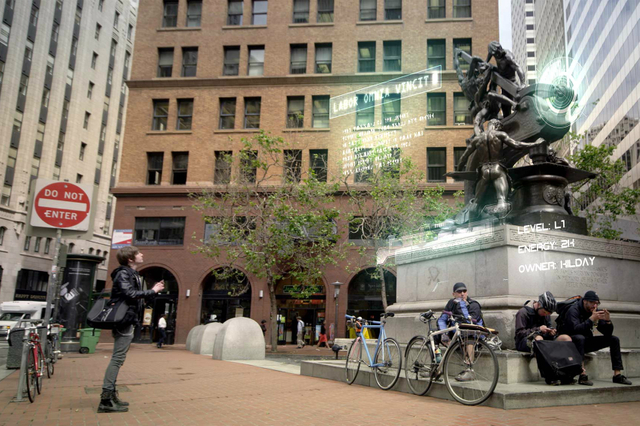 Ingress merges the physical and digital worlds through large-scale gaming events
The Ingress platform by Niantic Labs, operating as a startup within Google, has managed to place a graphic skin over the physical world in multiple compelling ways: it’s dynamic, immersive and fun.
Founded in 2010 and led by John Hanke, who spent six-years building and running Google Earth and StreetView, the product opened for general release in December 2013. His team has secured a passionate global following and checks key boxes from user-generated content via mobile to location-based profile data capture and community engagement.
With over 8 million downloads reported as of late last year, the platform is clearly gaining traction. One might say this is where Second Life meets Real Life, and the canvas of potential is both infinite and relevant.
Perhaps as a result of living in Japan for many years, where the past and future are always present, it’s fairly obvious to me that Ingress will ultimately enable a turnkey solution—platform as a service—for clients to create their own branded portals. Actually, the next steps along that path seem well underway with the new Endgame project, based on a book by James Frey and Nils Johnson-Shelton, the Ancient Societies universe. Expect amazing mixed-reality experiences ahead.
LOCAL AUTHOR FESTIVAL: James Frey to give free talk at Avon Public Library on Thursday, July 30, from 6 to 8 p.m.
Local Literary Events Include Author James Frey, Twain Summer Program
Author James Frey, who gained fame and notoriety from his 2003 memoir “A Million Little Pieces,” will give a free talk at Avon Public Library on Thursday, July 30, from 6 to 8 p.m. as part of the library’s Local Author Festival that runs through Aug. 24. (Bebeto Matthews / Associated Press)
Avon Local Author Festival
The Avon Free Public Library‘s free Local Author Festival will run through Aug. 24 at the library, 281 Country Club Road.
Children’s Night is Tuesday, July 28, at 7 p.m., with Donna LeBlanc, author of “Explorations of Commander Josh: Book One — In Space” (SDP Publishing, $14.95); Shannon Mazurick, author of “Gemma: The Search For The Gem” (AuthorHouse, $15); J. C. Phillipps, author of “The Simples Love a Picnic” (HMH Books for Young Readers, $16.99); and Martha Ritter, author of “The Nearly Calamitous Taming of PZ” (Bradley Street Press, $13.99).
Author James Frey, who gained fame and notoriety from his 2003 memoir “A Million Little Pieces,” will give a free talk at the library on Thursday, July 30, from 6 to 8 p.m. Frey also is co-author with Nils Johnson-Shelton of “The Calling” (HarperCollins, $10.99).
Local authors will sell and sign books at the library’s Farmers Market from 4 to 7 p.m. on Mondays. Glenn Maynard, author of “Desert Son” (Black Rose, $15.95) and Nan Arnstein, author of “Rocky Shores” (CreateSpace, $16) will sign on Monday, July 27.
In addition, the library is offering a free Story Walk on its grounds during July and August based on the children’s book “Market Maze,” by Roxie Munro, a story about collecting things to take to a farmers market. Visitors can solve the maze and find objects hidden in pictures.
Information: 860-673-9712, ext. 235.
Gertrude Stein Remembered
The Inimitable Style of Gertrude Stein
By Carl Cannon
 Image from France Culture
Sixty-nine years ago today, as the first crop of baby boomers was being born, iconic American expatriate Gertrude Stein died in Paris. Her life partner, Alice B. Toklas, was at her deathbed.
In one of their last conversations, Toklas later wrote in her autobiography, Stein asked about the meaning of life: “What is the answer?” she inquired.
When Toklas failed to reply, Stein laughed and said, “In that case, what is the question?”
Born in Pennsylvania in 1874, Stein had lived in Paris as a girl before her parents brought her back to the United States. She lived in San Francisco and across the bay in Oakland as a young woman before gravitating to Baltimore, where she had relatives, and then to France after the turn of the century.
It was in Paris that she made her reputation. A famed wit, hostess, and avant-garde writer, she collected artists more than art. Pablo Picasso and Henri Matisse were friends and frequent visitors, and after World War I, she and Alice Toklas expanded their salon-type dinners to include a cohort of restless young American writers that included Ernest Hemingway, F. Scott Fitzgerald, and John Dos Passos.
It was to Hemingway, supposedly, that Stein said, “You are all a lost generation.”
Other than the “lost generation” line, Gertrude Stein’s most famous quote is probably her put-down of a teeming California city. Many decades before Jerry Brown resuscitated his political career by becoming mayor of Oakland, Stein dismissed the place by saying simply: “There is no there there.”
Actually, that five-word description — and three of them are the same word — come at the end of a longer, punctuation-less sentence. These days, one must type it carefully, or the spellcheck function on the computer will correct it for you — the consecutive “theres” being confusing to an intelligence of the artificial kind.
Gertrude Stein’s brainpower was the opposite of artificial. Her deathbed conversation with Alice B. Toklas? She was witty that way all the time.
Oakland wasn’t the only place subject to the Stein wit. She was dismissive of entire regions of the U.S., notably the Midwest. Referring to her pal Ernest Hemingway, she once said, “Anyone who marries three girls from St. Louis hasn’t learned much.” (For the record, Hadley Richardson and Martha Gellhorn were both St. Louis natives, but Pauline Pfeiffer, his second wife, was Iowa-born. But you get the point).
As for that lack of a comma in the Oakland put-down, it wasn’t an accident, either. That was Stein’s signature style.
The Kings of YA
‘Paper Towns’ Producers on Keeping Up With ‘Twilight’ Stars and Making John Green Cry
by Rebecca Ford
 Wyck Godfrey (left) and Marty Bowen / Hussein Katz
Temple Hill’s Marty Bowen and Wyck Godfrey went from Hollywood roommates to kings of YA movies after producing the ‘Twilight’ series. Now, as they follow ‘The Fault in Our Stars,’ they explain how they discover unknown actors and how much power they give authors.
Marty Bowen and Wyck Godfrey were 27-year-old acquaintances climbing the Hollywood ladder when they moved into a house together on Temple Hill Drive in Beachwood Canyon. Perhaps because they met during their formative years, the roommates turned best friends have kept their production company young at heart, with a focus on low- to midbudget films aimed at teens, young adults and women (the occasional Nerf war in the hall helps).
Bowen, a former UTA partner, and Godfrey, a veteran producer, founded Temple Hill in 2006 and hit paydirt with the Twilight franchise, producing five films in three years that went on to earn a collective $3.34 billion worldwide. They found YA gold again in 2014 by adapting John Green‘s book The Fault in Our Stars into a $12 million Fox film that earned $307.2 million. Bowen and Godfrey, both 47, moved quickly to adapt Green’s Paper Towns (out July 24) and next will take on the author’s debut novel, Looking for Alaska, at Paramount. In the process, they have made stars of such unproven talents as Kristen Stewart and Robert Pattinson, Shailene Woodley and, they now hope, Cara Delevingne and Nat Wolff of Towns.
With books-to-film as its backbone, the 10-employee Temple Hill has juggled multiple projects at once, producing Nicholas Sparks adaptations (Dear John and The Longest Ride) and the Maze Runner franchise (the second installment, The Scorch Trials, is set to open Sept. 18) while also working in TV on the upcoming Fox series Rosewood. The duo also signed to produce a Power Rangers reboot and James Frey‘s Endgame. And they’re expanding into publishing, teaming with HarperCollins to develop emerging authors. Bowen, a married father of 3-year-old twins and a newborn, and Godfrey, a married dad of three teen boys, sat down with THR to discuss Green’s allure, how they find stars and female voices in Hollywood.