
Joanna Newsom’s DIVERS
Joanna Newsom: Divers Review By Mack Hayden
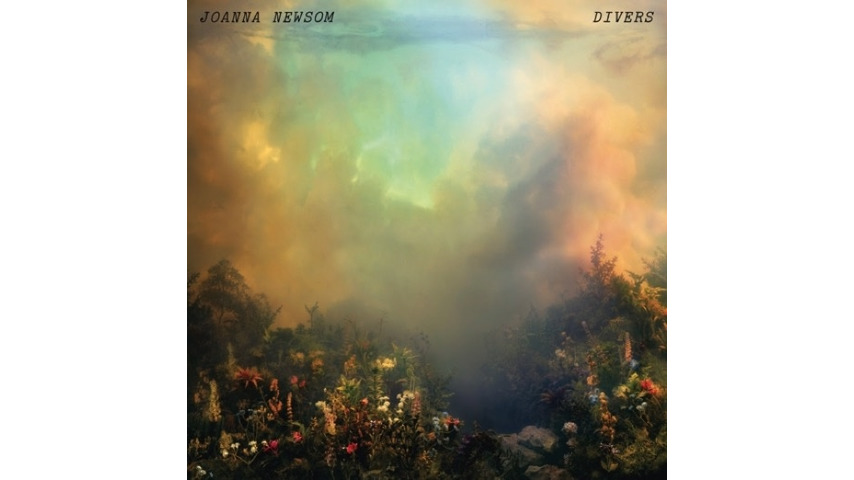
I was a non-believer for a pretty long time. Joanna Newsom was an artist I just didn’t “get.” I was too busy being pretentious about Pavement in my younger years to really give her quirky, baroque complexities and off-kilter vocal style a chance. Hell, I even came around on liking Swans before her stuff clicked for me. Hopefully, my initial disinterest and naiveté may convince another skeptical listener to give Newsom’s new album, Divers, a shot.
Newsom definitely requires some patience of her listeners, not to mention a palate accustomed to outside-the-norm instrumentation. She’s long been upheld as an indie goddess, but her music exists far from the label’s general conventions. There are barely any guitars and, when there are, they’re in the background. The drums are spare, and she’ll always go for a traditional piano over a synth. She plays a harp, her voice indulges in nuances unique enough to almost go beyond the realm of mimicry, and her previous record, 2010’s Have One On Me, went a few minutes past two hours in length.
In other words, if you put her on a mix CD for someone whose only experience of “indie” up to that point was Death Cab for Cutie, they’d probably snap it in half or you’d at least get a “what the hell is this?” text. But, like so many other at-first-difficult artists or bands, once her stuff clicks with you, it sticks forever. She’s got the musical ingenuity to go from being a frustration to a favorite in one second’s worth of enlightening epiphany.
Mr. Richardson’s First Monograph
TERRY RICHARDSON RELEASES HIS FIRST MONOGRAPH
By

Terry Richardson, an image maker renowned for his often provocative, bold and striking portraits is releasing a new tome with Rizzoli. The self titled, Terry Richardson, features 600 of the photographer’s works from over the past 20 years, including his most iconic shots and never-before-seen images that encompass the breadth of his career. The tome is divided into two volumes: portraits and fashion photography.
Saving The Accidental Sea
Why Don’t Californians Care About Saving The Salton Sea?
by
 The Salton Sea is critical wildlife habitat | Photo: David Prasad/Flickr/Creative Commons License
It looks as though the state of California is starting to take the dying Salton Sea seriously. After years of relative inaction, both the Legislature and the Governor’s office are taking actual steps to halt what could become one of California’s biggest environmental and public health nightmares.
There’s a new Salton Sea Czar to oversee restoration of the Sea’s wetland habitats, a new resolve from the Brown administration to restore thousands of acres of wetlands around the shore, and a new, pressing deadline set by the Legislature to get those restoration projects lined up. After 15 years of warnings from environmental analysts, good government advocates, and regional leaders, California’s government may finally be ready to roll up its sleeves to do something about the Sea’s accelerating decline.
And that’s a good thing, because doing nothing means losing crucial wildlife habitat, consigning some of California’s least-affluent residents to chronic illnesses, and lowering Southern California property values by the billions. So why don’t most Californians care?
The Salton Sea, formed 110 years ago by an engineering accident that diverted the Colorado River’s flow into the Imperial and Coachella Valleys, has been fed in the intervening century by runoff from agricultural irrigation. In that time the Sea has become crucial habitat for migrating birds and other wildlife. That’s especially important given that our use of the Colorado River’s water has starved the formerly lush Colorado Delta, diverting the water that once supported lush wetlands and riparian forests. Now, the Salton Sea is often the only suitable stopover habitat in the region for birds migrating along the Pacific Flyway.
That’s about to change. In 2018 the Salton Sea will likely begin shrinking dramatically, the result of drastically reduced flows into the inland sea. The nearby IID has been deliberately sustaining the Sea by releasing so-called “mitigation water” into the Sea, but that “mitigation water” will dry up at the end of 2017, when IID reaches the end of its legal obligation to supply that mitigation water.
This Man Is To Blame
Max Martin: the Swedish svengali with a formula for the new pop age
How the legendary producer’s hit factory works
by John Harris
 © C Flanigan/WireImage for KAABOO Del Mar via imageSPACE
Popular music was changed forever when a Swedish producer’s in-car cassette machine broke, and he found himself unable to listen to anything other than a song called “All That She Wants.”
It was 1992. The producer’s name was Dag Krister Volle. Some people knew him as “Dagge,” but he went about his musical business under the name of Denniz PoP. He apparently had a “childlike wonder” about him, and loathed music that was in any way anodyne or boring. As he saw it, “every note, word and beat had to have a purpose, or be fun.” The song that got stuck in his tape deck was an early version of the eventual breakthrough hit for a quartet called Ace Of Base, who were led by a musician named Ulf Ekberg. At that stage, it was called “Mr Ace,” and its creators obviously knew it lacked a certain something. Having heard what Denniz PoP had achieved with a minor Swedish hit entitled “Another Mother,” they had sent it to him in the hope that he might help.
At first, Denniz PoP was not impressed at all. But as he drove his car each day and listened repeatedly, familiarity began to melt his scepticism and suggest that something could be done. Having met the group, he then took out half the instruments on the recording, and moved the whistled melody that closed the song to its introduction. Denniz PoP also pushed Ekberg to add more lyrics.
What resulted was seemingly gauche, clunky and devoid of much sense. The reggae-ish music sounded synthentic and flimsy; the vocals were so treated with effects that they seemed almost inhuman. Ekberg later claimed that Ace of Base had an advantage in not being native English speakers, because he and his colleagues were able to treat the language “very respectless [sic], and just look for the word that sounded good with the melody.” But even on that basis, the stuff they came up with was pretty awful:
When she woke up late in the morning light
And the day had just begun
She opened up her eyes and thought
Oh what a morning
It’s not a day for work
It’s a day for catching tan
Just laying on the beach and having fun
She’s going to get you
The chorus was even worse: it was built around a refrain of “all that she wants, is another baby,” which suggested the condition medical professionals know as secondary infertility, but was actually meant to refer to a quest for a lover. To rock snobs like me, this was the kind of fleeting hit that one occasionally hears on European holidays, safe in the knowledge that such tripe could never be successful back home. What I chose to ignore was the fact that the song lodged itself even in my self-denying brain for keeps after a single hearing.
“All That She Wants” went to number one in 10 countries, including the UK. In the United States, it reached number two on the Billboard charts, and was certified platinum, denoting sales of one million copies. Denniz PoP and some of his Swedish associates were suddenly in demand, and about to push music somewhere new. If the cultural period running from the mid-1960s to the early 1990s was the rock age, we now live in the era of pop, and “All That She Wants” is the song that began it.
Gymkhana Cop
Men Are Worms.
Male brain is programmed to seek out sex over food
By Sarah Knapton, Science Editor
 An amorous couple Photo: ALAMY
It is said that the way to a man’s heart is through his stomach, but a new study suggests that when it comes to sex, food is the last thing on his mind.
Researchers have found that the male brain is hardwired to seek out sex, even at the expense of a good meal, with specific neurons firing up to over-ride the desire to eat.
The worm species used in the study, Caenorhabditis elegans, has two sexes: males and hermaphrodites.
These hermaphrodites are essentially modified females that carry their own sperm and do not need to have sex in order to reproduce.
Scientists conditioned the worms so that when salt was present they realised that they would be starved. Over time, the worms moved away from the salt. However when the salt was present at the same time as a mate, the male worm still moved towards the mate. In contrast, hermaphrodites moved away from the salt even when a mate was present.
It indicated that for males the sex trigger was stronger than the salt.
“Those MotherF†ckers!”
Street-Racing Arab Playboys Tear Up L.A.
by M.L. Nestel
 Photo Illustration by Emil Lendof/The Daily Beast
The Qatari sheikh who staged an illegal street race through Beverly Hills is just one of a cohort of rich, car-obsessed Arabs who are eyeing L.A. as their new favorite vacation spot.
The speed-freak Qatari sheikh who fled the U.S. after running into trouble with cops—for allegedly staging a private Grand Prix in Beverly Hills—was living the high life in California, renting a palatial abode for $55,000 a month, The Daily Beast has learned.
Cops suspect that Sheikh Khalid bin Hamad al-Thani was behind the wheel of an unregistered Giallo Modena yellow Ferrari LaFerrari that street-raced another driver (in a Porsche GT3) for over 30 minutes on September 12, and “almost killed someone” as throngs of neighborhood kids gawked on the sidewalks.
Meanwhile, a source who had been shadowing al-Thani said that his brother arrived in L.A. also sporting multimillion-dollar wheels—a satin white LaFerrari—and that his car magically “had a California plate on it within a day of arrival.”
Several kids in the neighborhood claimed to have seen the race. “I was by the house and watched as they sped by my house and they woke up my parents, who were sleeping,” said one 10-year-old. “Next day, [the sheikh’s family] were gone.”
Another 10-year-old boy was revved up over the Ferrari festivities. “It was really loud,” he said, smiling, as his mother looked on disapprovingly. “I was playing in the alley and the car started smoking,” he said. (The smoking, a source with knowledge of autos said, “was caused by dumb driving… [the sheikh] drove the car when it was cold and the oil wasn’t properly warmed up.”)
The mother of the boy admitted the illegal event “was exciting for the kids” but she remains “really pissed.”
“They think they can come here and do whatever they want,” she said. After the roadsters roared by the family’s home multiple times, she said her husband shouted: “Those motherfuckers.”
Other neighbors (most of them parents) had seen the cars go by before but on this particular weekend, one mother said, “they let it rip.”
Unusually High-velocity Halloween asteroid, hmmmm?
Asteroid making surprise flyby at an ‘unusually high’ velocity
by Steve Dent

A newly discovered asteroid (not pictured) will make Halloween more thrilling by passing within 1.3 lunar distances (310,000 miles) of Earth. The object, which measures between 300 and 600 meters (1,000 and 2,000 feet) across, was discovered last week by the asteroid-hunting Pan-STARRS observatory in Hawaii, according to NASA. It’ll streak by on October 31st at an “unusually” high encounter velocity of 35 km/s, or around 78,000 mph. By contrast, the Russian meteorite caught by vehicle cameras in 2013 was 17 meters (55 feet) across and traveled at a top speed of 19 km/s, while the one that flattened a Russian forest in 1908 measured 40 meters (130 feet).
Movie One-sheets Re-imagined
The Underground Movie Poster Scene Booming on Social Media
Tired of the celebrity-centric posters that dominate the industry, artists are reimagining the medium
By
 Robocop by Van Orton Design, to be featured in Alternative Movie Posters II: More Film Art From the Underground. (Photo: Van Orton Design)
Gorgeous, eye-popping movie posters are still out there—they just aren’t being made in Hollywood anymore.
A vast, growing network of artists designing some of the most innovative movie posters in decades—completely independent from Hollywood studios.
Author Matthew Chojnacki documented the artwork of the movement in his 2013 book Alternative Movie Posters: Film Art from the Underground, and a sequel book—Alternative Movie Posters II: More Film Art From the Underground—is published in November.
According to Mr. Chojnacki, who works in finance by day and is an author in his spare time (his first book, Put the Needle on the Record, was about vinyl album art from the 1980s), the popularity of artist-designed posters grew organically through social media.
“It’s a great way [for artists] to get their art noticed,” he told the Observer.
Skateboard Assassin
Billy The Kid Captured
Billy the Kid photo bought for $2 could be sold for $5 million
By Barney Henderson, New York
 The photograph of Billy the Kid whch was purchased for $2 at a Fresno junk shop in 2010, could sell for millions at auction. Photo: Kagin’s
Billy the Kid, the Wild West gunslinger, is usually associated with a Colt single action 44, not the genteel English elegance of a varnished oak croquet mallet.
However an extremely rare photograph of the legendary outlaw leaning on a croquet mallet has emerged – only the second known photo of “The Kid”, whose real name is Henry McCarty, thought to exist.
The photo shows McCarty playing croquet with his gang of Lincoln County Regulators in late summer 1878.
It was bought by collector Randy Guijarro for $2 from a Californian junk shop in 2010 and will now be sold by Kagin’s auctioneers for an estimated $5 million.
“When we first saw the photograph, we were understandably sceptical — an original Billy the Kid photo is the holy grail of Western Americana,” said Kagin’s David McCarthy.
Alien Megastructure, Egad!
‘Alien megastructure’ could surround giant star baffling scientists looking for new planets
BY KIRSTIE MCCRUM
A series of mysterious objects surrounding a giant star millions of miles away could be an alien megastructure, experts believe.
Planet spotters examining data from the Kepler Space Telescope were startled by an unusual light pattern orbiting a star called KIC 8462852.
When they studied the star, which sits some 1,480 light years from Earth, they noticed a swarm of objects surrounding it in an usual pattern.
At first it was thought to be comets, shrapnel from an asteroid impact or even a mistake in the data.
But astronomer Jason Wright from Penn State University offered a more science fiction explanation.
He believes it could be an ‘alien megastructure’ designed to harness energy from the star.
He said: “Aliens should always be the very last hypothesis you consider, but this looked like something you would expect an alien civilization to build.”
Spielberg & Frey Do AMERICAN GOTHIC on CBS
Steven Spielberg, James Frey Murder Mystery ‘American Gothic’ Gets Series Order From CBS
By
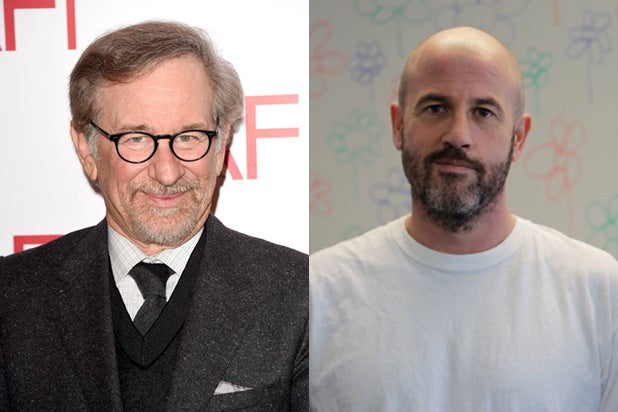
CBS has given a straight-to-series order for 13 episodes of “American Gothic,” a new one-hour murder mystery from Steven Spielberg‘s Amblin Television and author James Frey‘s Full Fathom Five, TheWrap has learned.
The series, which will be broadcast during summer 2016, centers on a prominent Boston family that is attempting to redefine itself in the wake of a discovery that links their recently deceased patriarch to a string of murders spanning decades, and amid the mounting suspicion that one of them may have been his accomplice.
“American Gothic” is produced by CBS Television Studios in association with Amblin Television. Justin Falvey and Darryl Frank of Amblin Television, James Frey of Full Fathom Five and “The Good Wife’s” Corinne Brinkerhoff, who is writing the script, will serve as executive producers.
Emilia Clarke Game of Sexy
‘Game of Thrones’ star Emilia Clarke named Esquire’s 2015 ‘Sexiest Woman Alive’

Emilia Clarke is the Mother of All Dragons on “Game of Thrones,” and now she has a new title: Esquire’s Sexiest Woman Alive.
“Half pal, half dominatrix. Half kid sister, half sexy queen,” the magazine’s cover story gushed about the star.
The magazine chose Clarke for her “gorgeous balance” of sexy siren and girl next door. But the 28-year-old said when she was a drama student, she wasn’t anyone’s “favorite.”
“I was a keen bean,” she described her studious younger self.
But Clarke was transformed into a sex symbol after landing the role of Daenerys Targaryen on the hit HBO series.
The actress said that she got the part even though she didn’t fit the description of the dragon queen from George R. R. Martin’s books.
ENDGAME Gold Won – Congratulations to Froylan Moreno del Rio!
Claiming Gold
By Robin Leach

The first puzzle in the “Endgame: The Calling” high-stakes apocalyptic book trilogy brought to life by bestselling authors James Frey and Nils Johnson-Shelton was solved just 24 hours before today’s deadline.
To win “Endgame,” the winner had to solve an interactive puzzle comprised of clues leading to a real-life $500,000 cash prize. Froyal Moreno del Rio solved the puzzle and this afternoon unlocked the gold vault at Caesars Palace for the big payoff.
Book 2, “Sky Key: An Endgame” was published Tuesday. The New York Times bestselling authors were on hand at Caesars to autograph copies of both books. No word yet on the title of Book 3 or its publication date, but more puzzles and cash prizes await.
Algorithming Alzheimer’s
Memory loss breakthrough: New implant can reverse Alzheimer’s damage
By ANIL DAWAR
 GETTY
GETTY
Scientists have developed an electronic implant to help brains damaged by Alzheimer’s retain memories.
They hope it will be used to take over certain areas of diseased brains to help “translate” a short-term memory into a permanent one.
The project is funded by the US military as a way of helping injured soldiers overcome memory loss.
But researchers say the astonishing technology could also help to treat brain diseases such as Alzheimer’s.
Alzheimer’s causes the brain to degenerate and the damage interferes with the formation of new long-term memories while old ones survive.
The new US technology has already been tested on nine people with epilepsy who had electrodes implanted in their brains to treat chronic seizures.
Researchers read the electrical signals created in the patients’ brains as they conducted simple tasks.
The results were then used to create a computer program which could predict with 90 per cent accuracy how the signals would be translated.
Coding The Mind From Scratch
Thought process: Building an artificial brain
Paul Allen’s $500 million quest to dissect the mind and code a new one from scratch

Paul Allen has been waiting for the emergence of intelligent machines for a very long time. As a young boy, Allen spent much of his time in the library reading science-fiction novels in which robots manage our homes, perform surgery and fly around saving lives like superheroes. In his imagination, these beings would live among us, serving as our advisers, companions and friends.Now 62 and worth an estimated $17.7 billion, the Microsoft co-founder is using his wealth to back two separate philanthropic research efforts at the intersection of neuroscience and artificial intelligence that he hopes will hasten that future.
The first project is to build an artificial brain from scratch that can pass a high school science test. It sounds simple enough, but trying to teach a machine not only to respond but also to reason is one of the hardest software-engineering endeavors attempted — far more complex than building his former company’s breakthrough Windows operating system, said to have 50 million lines of code.
The second project aims to understand intelligence by coming at it from the opposite direction — by starting with nature and deconstructing and analyzing the pieces. It’s an attempt to reverse-engineer the human brain by slicing it up — literally — modeling it and running simulations.
Made up of 100 billion neurons, each one connected to as many as 10,000 others, the human brain is the most complex biological system in existence. When you see, hear, touch, taste or think, neurons fire with an electrochemical signal that travels across the synapses between neurons, where information is exchanged.
Somewhere within this snarl are patterns and connections that make a person who he is — his memories, preferences, habits, skills and emotions.
Building on the work that Allen accelerated through his philanthropy, governments around the world have launched their own brain initiatives in recent years. The European Commission’s Human Brain Project, which began in 2013 with about $61 million in initial funding, aims to create an artificial model of the human brain within a decade. President Obama announced the United States’ own BRAIN (Brain Research through Advancing Innovative Neurotechnologies) effort in 2014 to great fanfare, comparing it to the Human Genome Project that led to the current genetic revolution. BRAIN was launched with initial funding of $110 million.
Some futurists even believe that the brain, not the body, may be the key to immortality — that at some point we’ll be able to download our brains to a computer or another body and live on long after the bodies we were born in have decayed.
Allen’s own interest in the brain began with his love of tinkering.
He always has been interested in how things were put together, from steam engines to phones, and as he grew older he became fascinated with the brain.
“Computers are really basically computing elements and a lot of memory,” he said. “They are pretty easy to understand, as compared to the brain, which was designed by evolution.”
But it wasn’t until his mother, Faye, a former elementary school teacher, became ill with Alzheimer’s that Allen’s brain philanthropy took shape.
Aliens could ‘conquer and colonise’ our planet, warns Stephen Hawking – whilst assuring us he’s not one of them.
Advanced aliens could ‘conquer and colonise’ our planet, warns Stephen Hawking
BY JEFF PARSONS
 Stephen Hawking believes that aliens visiting Earth might not turn out well for us
Stephen Hawking has tackled the mysteries of the universe his entire life.
Now the world-renowned scientist has some new things to say about a potential alien invasion .
“If aliens visit us, the outcome could be much like when Columbus landed in America, which didn’t turn out well for the Native Americans,” Professor Hawking told El País .
“Such advanced aliens would perhaps become nomads, looking to conquer and colonize whatever planets they can reach,” he said.
The physicist, who has suffered from motor neurone disease since his twenties, explained that the existence of aliens is beyond doubt.
Three-fer for Frey
Author James Frey Sells Three TV Projects (Exclusive)
As CEO of Full Fathom Five, Frey reupped his UCP deal and sold projects to E!, Syfy and NBC.
by Lacey Rose
 AP Images
James Frey is nothing if not prolific.
His Full Fathom Five, the 5-year-old outfit behind best-sellers I Am Number Four and Endgame: The Calling as well as Frey’s just-published Endgame sequel, Sky Key, has sold three TV projects through its newly extended Universal Cable Productions deal.
There’s KissnTell, originally an e-book from the transmedia company’s digital imprint, which began releasing a book a week last fall. The Marc Halsey-penned comedy, now set up at E!, follows two young women who start an anonymous gossip blog. Before long, they find themselves living double lives — average single girls by day, life-of-the-party scenesters at night
At Syfy, FFF sold Haunted from Noga Landau, about the four adult children of self-proclaimed paranormal experts who are reunited following their parents’ sudden and mysterious deaths. Together under one roof for the first time in years, they must overcome their issues with each other in order to solve the mystery of what happened to their parents and ultimately survive the literal ghosts from their past. Dan Halsted and Nate Miller of Manage-ment are on board as producers.
Finally, NBC bought FFF’s Michael Golamco-written supernatural kung fu drama Middle Kingdom, which is set in San Francisco, the “Middle Kingdom” between Asia and America, East and West, heaven and hell.
Post-apocalyptic ‘beaver’ cool.
Post-apocalyptic ‘beaver’ thrived after dinosaurs died
By Will Dunham

WASHINGTON (Reuters) – The world had been wrecked. An asteroid impact in Mexico compounded by colossal volcanism in India 66 million years ago had killed about three-quarters of Earth’s species including the dinosaurs.
But relatively soon afterward, a plucky critter that looked like a beaver was thriving, exemplifying the resilience of the mammals that would arise from the margins of the animal kingdom to become Earth’s dominant land creatures.
Scientists on Monday announced the discovery in northwestern New Mexico’s badlands of the fossil remains of Kimbetopsalis simmonsae, a plant-eating, rodent-like mammal boasting buck-toothed incisors like a beaver that lived just a few hundred thousand years after the mass extinction, a blink of the eye in geological time.
Kimbetopsalis, estimated at 3 feet long (1 meter), would have been covered in fur and possessed large molar teeth with rows of cusps used to grind down plants.
Asked what someone’s impression of Kimbetopsalis might be, New Mexico Museum of Natural History and Science curator of paleontology Thomas Williamson said, “They would probably think something like, ‘Hey, look at that little beaver!”
ENDGAME: SKY KEY (Second novel in Endgame Series – Available Today!)
 Courtesy of Harper Collins
Bustle’s Alien 8
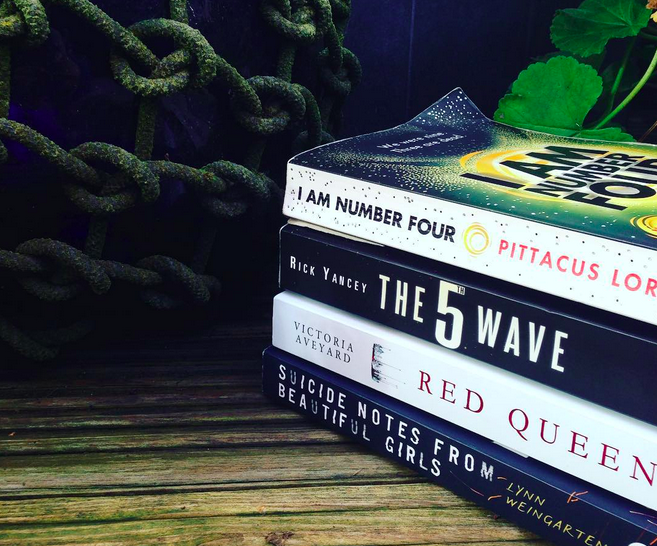
8 Awesome Books About Aliens To Celebrate The Discovery Of Water On Mars
Our world may have just turned into a science fiction novel because Monday morning NASA announced that it found water on Mars. This major scientific announcement was teased Thursday when NASA sent out a press release stating “Mars Mystery Solved” using information from the NASA’s Mars Reconnaissance Orbiter. This isn’t the first time scientists have found water on Mars — ice has been found at the poles — but it is the first time liquid water has been discovered. It marks a turning point in the study of the planet and whether it could be hospitable to life.
“Our quest on Mars has been to ‘follow the water,’ in our search for life in the universe, and now we have convincing science that validates what we’ve long suspected,” said John Grunsfeld, astronaut and associate administrator of NASA’s Science Mission Directorate, in the NASA announcement. “This is a significant development, as it appears to confirm that water — albeit briny — is flowing today on the surface of Mars.”
I Am Number Four by Pittacus Lore
Rather than through the eyes of space explorers or humans on Earth, I Am Number Four is told by an alien. Teenage John Smith and eight other Loric aliens have sought refuge on Earth, hiding from their enemies of the Mogadorian aliens. But one by one, the Loric aliens are being picked off. And now John, the fourth person on the list, seems to be up next. He’s awaiting his emerging magical powers, which he’ll need to use to fight against his enemies to save himself, his alien friends, and the entire human race on Earth.
La Boom
On Sunday Nights, New York’s Busboys Become Cowboys
Mexican immigrants flock to La Boom, in Queens, once a week to dance to songs of the outlaw life.
 Kirsten Luce for The New York Times>
On a Sunday evening, just after dark, hundreds of cowboys are lined up outside a nightclub called La Boom in Woodside, Queens. They are not usually dressed like this; they are Mexican immigrants, waiters, cooks, dishwashers, deli workers, gardeners, handymen. But on this night they wear hats and pointy boots. Their shirts are tucked in, to show belt buckles in the shapes of cow skulls and roses. The women wear short dresses, leather vests and high-heeled boots.
Sundays nights are Mexican Nights at La Boom. “So many of them work in restaurants,” said Pedro Zamora, the club’s owner and a Latin music promoter. “They rest on Mondays.” The bands go on around midnight, so fans can come after their shifts end.
On this summer Sunday, two popular bands are playing. For weeks, posters have hung in Mexican shops around the region, and by midnight about 2,000 people have climbed the stairs to the cavernous space.
When the lights swivel over the room, it looks like a barn dance. And when the 16-piece group Banda Los Recoditos appears onstage, it looks like an old-fashioned beer hall band, with trumpets, trombones and a tuba. But as they begin to play, the lead singers slap the air like rappers. And the lyrics are hardly pastoral: “Pour some cocaine and a shot of Buchanan’s on me” — name-checking the whiskey that is the unofficial drink of this scene.
In the V.I.P. section, men in silk blazers and cowboy hats nuzzle women in tube dresses. They pull on hookahs and pour shots of, yes, Buchanan’s.
Deflecting Didymoon
Plan to save the world from Armageddon
Space mission will deflect asteroid in practice to avoid doomsday destruction

SCIENTISTS are planning a space mission to nudge an asteroid out of its orbit in a practice run for saving the world.
IN a project reminiscent of 1998 movie Armageddon, the joint European-US Asteroid Deflection and Assessment mission will crash a probe into the space rock to test a possible doomsday-stopping scenario.
Nasa and the European Space Agency plan to plough a device into the 525ft Didymoon to test the principle that a much larger asteroid threatening the Earth could be deflected.
Two spacecraft, one to smack into the rock and the other to monitor the effects of the impact, will launch in October 2020.
They are due to get to Didymoon and its 2,460ft-wide partner Didymos in May 2022.
Dr Patrick Michel, lead investigator for the European Space Agency, said: “To protect Earth from potentially hazardous impacts, we need to understand asteroids much better.
Changing The Subject
‘Changing the Subject,’ by Sven Birkerts
By
 Photo by MARA PARKS
Sven Birkerts is an anxious man. By turns he is frightened, terrified, alarmed, filled with dread. On one occasion he shudders in his core; mostly he is just plain worried. What concerns him, a concern he is eager to transmit to us, is the rapid spread of computer, Internet and telephone technologies and more specifically what those technologies are doing to our minds. Forever glued to screens of one kind or another, clicking compulsively on the links others provide for us, we are losing the ability to concentrate, growing more itchy and agitated by the day, allowing our consciousness to be fragmented and dispersed. Our very selfhood is under threat as we are invited to think of achievement as a collective, rather than individual goal, a contribution to Wikipedia rather than a distinctive personal statement. At every step the Internet or GPS navigator puts us at a remove from the world and from our fellow human beings, deprives us of the agency we enjoyed when we had to go out and find things for ourselves rather than have them suggested to us. “Rewired,” as neuroscientists have now demonstrated, to adapt to the fitful back and forth of the web, our brains are no longer fit for the sustained attention that literature requires. Fewer young people are choosing to study the humanities. Fewer great works of art are being produced. There is a real risk of individuality being submerged in system. To make matters worse, a vast majority of people seem entirely happy with this state of affairs, to the point that anyone questioning the value of the new technologies is immediately deemed a Luddite if not a dinosaur.
The Master Strikes!
Exceedingly Ballsy 200-MPH Wingsuit Racing
The Excruciating, 200-MPH World of Wingsuit Racing
by ALEX DAVIES
 Photo by TRAVIS MICKLE
JOE RIDLER HAS jumped out of an airplane nearly 700 times in his life, but when he makes the leap later today, the goal will be about more than reaching the ground safely. It will be to fly through the air faster, farther, and for longer than anyone else in the sky.
Ridler’s competing in the National Championships of Wingsuit Flying in Chicago, also known as wingsuit racing.
Ridler’s loved the idea of flying since he was a kid in northwest Minnesota, looking for a way to get away. Barred from a commercial or military flight career by eye problems, he was intrigued by BASE jumping, but abandoned the idea as too dangerous. So now he jumps out of planes and races through the sky at 200 mph.
Ridler’s first wingsuit flight was two years ago. It would have been sooner, but the US Parachute Association requires you complete 200 skydives before allowing you to exit a plane dressed like an amped up flying squirrel. “The one thing I was the most nervous about,” he says, was “strapping myself into a straight jacket and throwing myself out of a plane.”
The championships, hosted by the US Parachute Association, test competitors on three disciplines, each measured in a window between 3,000 and 2,000 meters of altitude: average speed, distance covered, and time spent aloft. Each flyer gets three jumps in each category, and is tracked via a GPS module on their helmet. They’re rated on a curve—whoever goes fastest, farthest, or stays in the window the longest gets a 100, everyone else a percentage of that—and scores are averaged to find an overall winner.
Ai’s And Anish’s Digits

Two artists. Three fingers. News: Weiwei and I join hands to walk. We will walk out of London. We will each carry a single blanket. A symbol of the need that faces 60 million refugees in our world today. We welcome those who wish to walk with us. Bring your blanket. We will repeat this action in cities worldwide over the coming months. At 10am on Thursday 17th September we will walk from The Royal Academy of Arts we will walk east out of London. Route details will be announced. #AnishKapoor
#Aiweiwei
#RoyalAcademy
#AnishAndWeiweiWalk
@aiww
@dirty_corner
Mr. Amazon Robot
Amazon Prime Acquires USA’s ‘Mr. Robot’
by
 Virginia Sherwood/USA Network
USA’s hacker drama Mr. Robot is headed to Amazon.
The company has acquired Universal Cable Production’s first-year critical darling, it was announced Friday.
Under the pact, Amazon Prime will become the exclusive subscription streaming home for Mr. Robot beginning this spring. All 10 episodes of the series will be available for Amazon Prime members in the U.S., U.K., Germany, Austria and Japan.
From creator Sam Esmail, Mr. Robot stars Rami Malek as an antisocial hacker hoping to overthrow society and Christian Slater as the leader of the hacker group hoping to help him to do just that.
“Mr. Robot is one the most compelling new dramas on television,” said Amazon vp digital video content acquisition Brad Beale in a statement. “Rami Malek delivers a mesmerizing performance and leads a great cast with an intriguing story full of dark twists. Prime members are going to love binging on this awesome show.”
This marks the latest deal between UCP and Amazon Prime, which is also home to Syfy’s Defiance and Warehouse 13 as well as USA’s own Suits.
Extra Super Double Armageddon Blood Moon Tonight
‘Blood Moon’ seen as sign of end times by some Mormons

SALT LAKE CITY (AP) — A rare confluence of a lunar eclipse and a supermoon set to happen this weekend has prompted such widespread fear of an impending apocalypse that the Mormon Church was compelled to issue a statement cautioning the faithful to not get caught up in speculation about a major calamity.
Sunday night’s “blood moon” and recent natural disasters and political unrest around the world have led to a rise in sales at emergency preparedness retailers. Apocalyptic statements by a Mormon author have only heightened fears among a small number of Mormon followers about the looming end of time. The eclipse will give the moon a red tint and make it look larger than usual. It won’t happen again for 18 years.
It’s unclear how many Latter-day Saints buy the theory, but Mormon leaders were worried enough that they took the rare step this week of issuing a public statement cautioning the faithful not to get carried away with visions of the apocalypse.
Leaders of The Church of Jesus Christ of Latter-day Saints told its 15 million worldwide members that they should be “spiritually and physically prepared for life’s ups and downs,” but urged them not to take speculation from individual church members as doctrine and “avoid being caught up in extreme efforts to anticipate catastrophic events.”
The Mormons preparing to hunker down Sunday night aren’t alone. Some from other religions also fear a doomsday scenario. A Christian pastor in Texas has written a book predicting a world-shaking event.
Storing away enough food and water in case of disaster, job loss or something worse is part of the fundamental teachings of the religion. Many homes in Utah are equipped with special shelving for cans of beans, rice and wheat. The belief that regular history will someday end, bringing a second coming of Jesus, is embedded in the minds of Mormons and the church’s official name.