
Candida Royalle Gone
Former porn star turned director Candida Royalle dies aged 64
By Elizabeth Vanmetre

The actress — whose real name is Candice Vadala — performed in more than two dozen adult films, but was best known for her work as a director, a first in the male-dominated industry.
Royalle studied dance and music at New York’s High School of Art and Design, Parsons School of Design as well as the City University of New York.
They’re Coming.
A Meteor Exploded Over Bangkok on Monday Morning
by
Citizens of the Thai capital Bangkok witnessed a huge fireball descending on the horizon this morning, and thanks to the dashcams in their cars, we can admire the celestial visitor from several different angles.
The meteor entered Earth’s atmosphere around 8.45am local time, and burnt up in a huge fireball after striking down from the sky. The meteor was big and bright, but definitely smaller than the infamous Chelyabinsk meteor which exploded over Russia in 2013, damaging 7,200 buildings in six cities in the southern Ural region. There are no reports of any damage from Bangkok so far.
Nobody knows how bicycles work.
How does a bicycle stay upright?
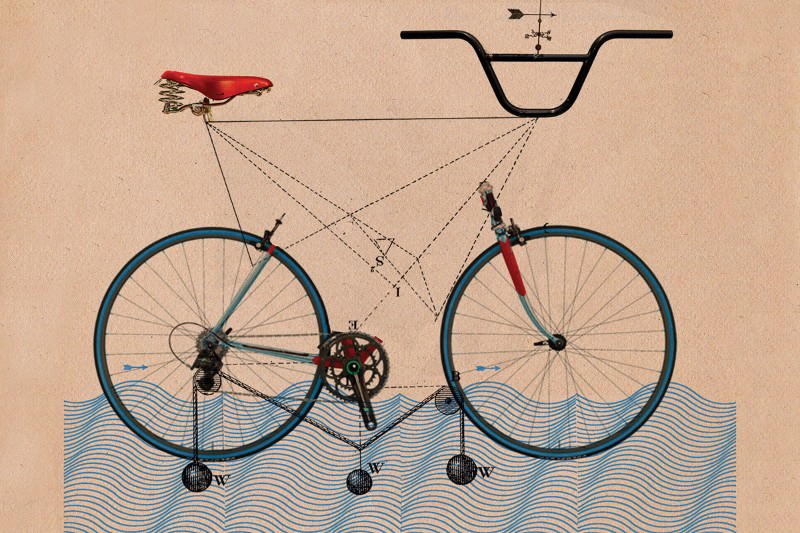 (Image: Matthew Richardson)
We thought we knew the maths behind cycling. We were wrong – and our efforts to figure it out are leading to some weird and wonderful new bike designs
In 2011, an international team of bi-pedal enthusiasts dropped the bombshell that, despite 150 years of analysis, no one knows how a bicycle stays upright. Across the world, riders dismounted and stared at their bikes in disbelief. What they had been doing for years was a feat inexplicable by science.
Well, sort of. “What we don’t know are the simple, necessary or sufficient conditions for a bicycle to be self-stable,” says Andy Ruina, an engineer at Cornell University in Ithaca, New York.
We have relied on trial-and-error engineering to construct stable bikes that aren’t prone to toppling while in motion. Explaining how they work mathematically requires around 25 variables, such as the angle of the front forks relative to the road, weight distribution and wheel size.
You Ain’t No Picasso
This algorithm can create a new Van Gogh or Picasso in just an hour
 The algorithm was given this photo of buildings, left, and a copy of Vincent Van Gogh’s “The Starry Night.” In about an hour it taught itself to mimic Van Gogh’s style, and apply it to the photo of the buildings. (University of Tuebingen)
For great artists, creating a masterpiece is the culmination of a career. Years of practice, creative musings and experimentation with styles build up to the genesis of something truly original and timeless.
A story is often told about Pablo Picasso charging an enormous sum for a portrait. The physical act of drawing it took only a few moments, so the subject complained to Picasso. He is said to have responded, “Madame, it took me my entire life.”
While the great art of yesteryear was an exhaustive process to create, today the style of those masters can be mimicked in minutes. Last week German researchers released a paper detailing how a computer algorithm could be used to pump out images borrowing the styles of the world’s greatest artists.
Keith Richards Disses Black Sabbath
Keith Richards Is Wrong—Heavy Metal Is Not a ‘Great Joke’
By
 Keith Richards protecting the black magic that keeps him alive. (Photo: Flikr Creative Commons)
By dismissing Black Sabbath and Metallica, a Rolling Stone reveals his distinct rock and roll philosophy
This past week in an interview with Jim Farber for the Daily News, Keith Richards made some ornery, old-guy cranky statements about the Beatles, Rap, and Heavy Metal. First of all, there’s no reason to waste any ink discussing what he said about Rap. His comments echo the thoughts of any senior citizen in a cop bar in Staten Island, and can be explained by indifference, lack of familiarity with the genre and generational confusion. No big deal. Seriously, I would assume any 72-year-old guy who claimed to “get” rap was just lying.
However, Richards’ comments about Black Sabbath and Metallica being “great jokes” are worth (far) deeper examination. This two-word slur is both completely unsurprising yet remarkably revealing.
To parse Richards’ comment, we have to go back to the dawn of British rock, and it’s spiral into diversity (and differing interpretations) in the 1960s and early 1970s.
Obviously, The Rolling Stones were a blues-based band. The Stones, the arguably superior Pretty Things, and John Mayall’s Bluesbreakers (to name three) personify one branch of the early Britrock leviathan; this limb was almost completely devoted to interpreting Chicago and Delta blues in an amped up and English-accented fashion. Let’s call this Group A.
The other branch is, well, characterized by the more simplistic gory glory of the Kinks, the Who, and the Troggs. These groups certainly shared some of the same basic influences as Group A, but inflected it with lusty teenage primitivism fueled by barre chords. Significantly, although these Group B bands drew from Chicago blues and the straightforward I/IV/V forms of Chuck Berry, they did not draw from the Delta in any real way, which is why you virtually never hear an open-tuned slide part on records by any Group B band. To put it a little more simply, all these bands—the Stones faction and the Kinks faction—listened to Bo Diddley, but only the Group A branch integrated Robert Johnson and Elmore James into their work. This was on your SATs, right?
More Dr. Sacks (b/c he was such a damn genius)
The Fully Immersive Mind of Oliver Sacks
by Steve Silberman
 photo by John Midgley
Pioneering neurologist and author Oliver Sacks died Sunday, August 30 at age 82. In his writings about patients’ sometimes bizarre case studies—which he would call “neurological novels”—Sacks was able to draw out the humanity in pathology. Steve Silberman wrote about Sacks’ own case study in 2002.
The thermite bomb was the second of two delivered to Mapesbury Road during the war. The first, a 1,000-pound monster, landed next door, but failed to explode. Sacks remembered both scenes vividly while writing the memoir he published last October, Uncle Tungsten: Memories of a Chemical Boyhood. After the book was published, however, the neurologist and author learned that his memory had deceived him, as memories made unreliable by disorders of the brain had played tricks on the minds of the subjects of his books. His brother Michael told him that, on the night the thermite bomb fell, in fact, they were both away at boarding school.
“I told him, ‘But I can see it now in my mind. Why?’” Sacks recalled last November. Michael explained that it was because their brother David had written them a dramatic letter about the incident. Even after Sacks accepted this as fact, a visual image of the second bomb still burned in his memory. Looking more deeply, however, he noticed a curious difference between his memories of the two bombs. “After the first one fell”—the bomb that didn’t explode—“Michael and I went down the road at night in our pajamas, not knowing what would happen. In that memory, I can feel myself into the body of that little boy. And in the second memory”—the thermite bomb—“it’s as if I’m seeing a brilliantly illuminated scene from a film: I cannot locate myself anywhere in the scene.”
Sacks has been turning his analytical gaze inward more often these days, after four decades of studying the minds of those with such disorders as autism, Tourette’s syndrome, loss of proprioception, and the sudden onset of color blindness. His tales from the borderlands of the mind, translated into 21 languages, have earned Sacks a worldwide readership. This month, he will be awarded the Lewis Thomas Prize by Rockefeller University, given to scientists who have made a significant achievement in literature, and his insights have been ported to a broader range of media than those of any other contemporary medical author. His 1973 book, Awakenings, inspired both a play by Harold Pinter and a 1990 film starring Robin Williams and Robert De Niro. Two years ago, a chapter from An Anthropologist on Mars also got the Hollywood treatment in a movie called At First Sight. His first best-seller, The Man Who Mistook His Wife for a Hat (published in 1985), has been turned into a one-act play, an opera, and a theatrical production in French staged by Peter Brook.
King Tut was no mere boy pharaoh, he was a man pharaoh!
Tutankhamun’s penis was fully ERECT when he was mummified so he would look like a god in afterlife
 Archaeologist Howard Carter examining the third mummy-shaped sarcophagus, 1922, vintage photograph/ Getty
The world’s most famous mummy, Tutankhamun, was buried with his penis standing at a 90 degree angle, it has been claimed.
An expert in Egyptology believes the everlasting erection was made to make King Tut look like Osiris, the god of the afterlife.
Why? You ask.
According to Egyptologist Salima Ikram, professor at the American University in Cairo, it was to counter efforts by his father King Akjenaten to establish a religion of one god.
Akhenaten wanted to focus on the worship of Aten, the sun disc, and destroyed images of other gods.
King Tut had, however, worked to reverse his father’s ideology and return Egypt to the traditional worship of many gods.
Professor Ikram believes he was buried with his erect manhood in a bit to continue his endeavour even in death.
She believes the upright penis broke off after the discovery of the tomb, despite speculation that it was stolen.
Professor Ikram told LiveScience: “As far as I know, no other mummy has been found thus far with an erect penis.”
Noah Davis Gone
Noah Davis, 32, Artist and Founder of Underground Museum in Los Angeles, Dies
 Noah Davis, in an undated photo, founded the Underground Museum in Los Angeles. Credit Ed Templeton
Noah Davis, a painter and installation artist who founded the Underground Museum, an exhibition space in a working-class neighborhood of Los Angeles that provides free art shows, died on Saturday at his home in Ojai, Calif. He was 32.
He learned he had cancer a few years ago, his family said in confirming the death.
Mr. Davis’s paintings were mostly figurative works depicting blacks in surreal landscapes, sometimes with their features distorted or smeared in a manner reminiscent of Francis Bacon. He drew inspiration from sources as varied as Richard Brautigan’s 1968 novella “In Watermelon Sugar” and “The Jerry Springer Show.”
“The palette is very moody and evocative, and he has an extraordinary ability to convey emotional effect,” Helen Molesworth, the chief curator of the Museum of Contemporary Art in Los Angeles, said by telephone Tuesday.
Mr. Davis founded the Underground Museum with his wife, the artist Karon Davis, in 2012 (they had married in 2008) in a row of storefronts in the Arlington Heights neighborhood of Los Angeles. Mr. Davis organized eclectic shows there like “The Oracle,” which combined sculptures by Henry Taylor, 19th-century carvings from Sudan and a video installation by his brother, the video artist Kahlil Joseph. The work, titled “m.A.A.d,” is a 15-minute paean to the Compton neighborhood of Los Angeles set to the music of Kendrick Lamar.
“The Kicks” Sophia Mitri Schloss in indie Lane 1974
‘Ray Donovan’ Actress Katherine Moennig Joins ‘Lane 1974’ (Exclusive)
by Rebecca Ford
 Katherine Moennig – AP Images/Invision
The indie follows a 13-year-old living within the confines of her mother’s bizarrely rigid counter culture philosophies in Northern California.
The L Word and Ray Donovan actress Katherine Moennig is joining newcomer Sophia Mitri Schloss in indie Lane 1974.
The indie, directed by S.J. Chiro, is based on Clane Hayward’s memoir, The Hypocrisy of Disco. It follows a 13-year-old (Schloss) who attempts to live within the confines of her mother’s (Moennig) bizarrely rigid counter culture philosophies in a commune in Northern California.
Chiro, who grew up on two communes in the ‘70s, is making her directorial debut with the project.
Schloss has guest starred in TNT’s The Librarians, the NBC series Grimm and has a series regular role on Amazon Studio’s upcoming show The Kicks. She’s repped by Koopman Management.
Wes Craven Gone
Wes Craven, Creator of the Nightmare on Elm Street Movies, Dies Aged 76
by Rishi Iyengar
Acclaimed Hollywood horror maestro Wes Craven, director of classics like the Nightmare on Elm Street and Scream movie series, died on Sunday in his Los Angeles home.
The 76-year-old director passed away after a lengthy battle with brain cancer, according to The Hollywood Reporter.
Craven is best known for creating the iconic character Freddy Kruger, one of the best-recognized horror villains ever, in his five Nightmare on Elm Street movies — which he said were inspired by a cemetery opposite his childhood home on Elm Street in suburban Cleveland.
Dr. Oliver Sacks Gone
Oliver Sacks, the Doctor

PHOTOGRAPH BY CHRISTOPHER ANDERSON / MAGNUM
Oliver Sacks, a dear colleague of mine at The New Yorker and in the world of medicine, was an inspiration to me and to countless physicians. A great deal will be said in the coming days about Oliver’s unique literary output—masterful books including “An Anthropologist on Mars,” “Awakenings,” and “The Man Who Mistook His Wife for a Hat.” But we should remember that he also embodied in his medical practice a kind of ideal approach—creative, sensitive, and large-hearted—to his many patients. He was an extraordinary and exemplary doctor.
Neurology is often depicted as a discipline of great detachment. Sacks, who was eighty-two when he died, trained in the field before the advent of the CT scan and the MRI. He learned to observe his patients in extreme detail, calling on his professional training and uncanny perception to make meticulous analyses of motor strength, reflexes, sensation, and mental status; in doing so, he arrived at a diagnosis that might locate a lesion within the anatomy of the brain or spinal cord. And yet, because medical technology had only gone so far in those days, once this intellectual exercise was completed, there was often very little that could be done to ameliorate most neurological maladies.
Sacks showed that it was possible to overcome this limited perspective. He questioned absolutist categories of normal and abnormal, healthy and debilitated. He did not ignore or romanticize the suffering of the individual. He sought to locate not just the affliction but a core of creative possibility and a reservoir of potential that was untapped in the patient. There was the case history, for instance, of a color-blind painter who lost all perception of color but discovered that he could capture the nuances of forms and shapes in hues of black and gray with great mastery.
Leptons Decaying At Different Rates, Oh My.
Subatomic particles that appear to defy Standard Model points to undiscovered forces
By Hannah Osborne | International Business Times

Subatomic particles have been found that appear to defy the Standard Model of particle physics. The team working at Cern‘s Large Hadron Collider have found evidence of leptons decaying at different rates, which could possibly point to some undiscovered forces.
Publishing their findings in the journal Physical Review Letters, the team from the University of Maryland had been searching for conditions and behaviours that do not fit with the Standard Model. The model explains most known behaviours and interactions of fundamental subatomic particles, but it is incomplete – for example it does not adequately explain gravity, dark matter and neutrino masses.
Researchers say the discovery of the non-conforming leptons could provide a big lead in the search for non-standard phenomenon. The Standard Model concept of lepton universality assumes leptons are treated equally by fundamental forces.
Kurt Perschke’s RedBall On The Run
Whew! I didn’t waste those four years after all.
Tech companies are hiring more liberal-arts majors than you think
 (Mark Lennihan / AP)
Coding isn’t the biggest role for these folks — that is, liberal arts majors who graduated from college between 2010 and 2013 and who lack graduate degrees — but programming is still surprisingly high on the list. According to LinkedIn’s study, it’s the third most popular job.
Most emerging liberal arts majors go into the tech sector after holding one other job first, but a substantial number go straight into the industry, too. Fourteen percent of liberal arts majors from schools in the top-20 wind up at tech companies as their first jobs, for instance.
Old Man in Speedo Beats, Permanently Disfigures Mermaid
Greek Artist Demolishes His Own Work to Avoid Bizarre Government Fine
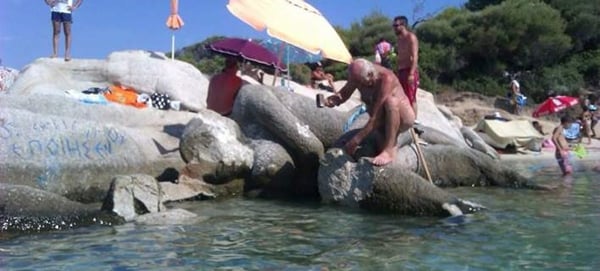
A statue of a mermaid by Greek artist Dionysis Karipidis, which was created in 1997 on the Portokali beach in Chalkidiki, Greece, has been destroyed by the hands of its own maker.
The artist took to his statue with a sledgehammer when he was asked by the area’s tourist authorities to pay a fine for “destroying the natural landscape,” according to the Greek Reporter.
Chalkidiki is known for its three peninsulas that stick out into the Aegean sea like Poseidon’s trident. Famous as a tourist spot, the Greek peninsula is also known as the birthplace of Greek philosopher Aristotle.
The mermaid, which is carved from the natural limestone on the beach, has been a tourist attraction for almost a decade. The issue arose a little over a year ago when the artist, who has largely remained anonymous, received a letter from the local municipality leveling a 533 euro fine for the work. In March 2014, Karipidis responded with his own letter stating that if he was forced to pay the fine, he would destroy his work.
Aspect Ratio F†ckery
Suck on this, salad eaters.
Why salad is so overrated

Minus their greens, left to right: the Caesar Salad With Chicken from the Cheesecake Factory; the Quesadilla Explosion Salad from Chili’s Grill & Bar; the Waldorf Salad from California Pizza Kitchen. (T.J. Kirkpatrick/For The Washington Post)
As the world population grows, we have a pressing need to eat better and farm better, and those of us trying to figure out how to do those things have pointed at lots of different foods as problematic. Almonds, for their water use. Corn, for the monoculture. Beef, for its greenhouse gases. In each of those cases, there’s some truth in the finger-pointing, but none of them is a clear-cut villain.
There’s one food, though, that has almost nothing going for it. It occupies precious crop acreage, requires fossil fuels to be shipped, refrigerated, around the world, and adds nothing but crunch to the plate.
It’s salad, and here are three main reasons why we need to rethink it.
Salad vegetables are pitifully low in nutrition. The biggest thing wrong with salads is lettuce, and the biggest thing wrong with lettuce is that it’s a leafy-green waste of resources.
In July, when I wrote a piece defending corn on the calories-per-acre metric, a number of people wrote to tell me I was ignoring nutrition. Which I was. Not because nutrition isn’t important, but because we get all the nutrition we need in a fraction of our recommended daily calories, and filling in the rest of the day’s food is a job for crops like corn. But if you think nutrition is the most important metric, don’t direct your ire at corn. Turn instead to lettuce.
Coitus Atop Castle Walls Not Recommended
French couple ‘having sex’ on a castle die after plunging 40ft into moat
 Police announce pair were discovered beneath a fort in Chausey
A French couple have fallen to their death while having sex at a historic fortress, it has been reported.
The couple in their early thirties apparently fell into the moat from the walls surrounding the castle at the Vauban Fort on the island of Chausey Archipelago in the English Channel. Reports have said the drop into the moat is 40ft high.
The naked bodies of a man and woman, who were both born in 1984, were found on Thursday morning.
Hallucinatory Collages in Culver City
Object Lesson: Hallucinatory collages tell the story of the U.S.-Mexico border
Cross-border brother artist team Einar and Jamex de la Torre are known for creating wild collages and assemblages that fuse the high and the low, such as this 2014 lenticular piece, “Rites of Passage,” which takes on the U.S.-Mexico border as its subject. (Einar and Jamex de la Torre / Koplin Del Rio)
As far as art forms go, it doesn’t get more lowbrow than lenticulars, the 2-D printed pictures that, with the aid of a rippled, plasticized coating, appear three dimensional, often with animated effects. Think of those thrift store portraits of Jesus that appear to be winking.
Artists Jamex and Einar de la Torre have used this technology — generally reserved for popular religious art and advertising campaigns — to fantastic effect.
In fact, a current show of their work at Koplin Del Rio in Culver City offers a bounty of pieces that employ the device. Among them: a mandala-type design studded with images of skulls, anatomical sketches and religious iconography and a Last Supper-style scene in which the disciples’ faces have been replaced with those of the artists. (I made a Vine of the former, to capture the trippy sense of movement these pieces have when you see them in person.)
Among the most elaborate works are a pair of lenticulars that take on the U.S.-Mexico border as their subject: “Rites of Passage,” shown at top, and “Border Park of Earthly Delights,” both of which were made in 2014. (Unfortunately the images shown here don’t capture the works’ psychedelic effects, which is why it’s best to see them in person.)
The Fate of Ten
See the electrifying trailer for The Fate of Ten, the penultimate I Am Number Four book — exclusive
On Sept. 1, Pittacus Lore’s I Am Number Four series gets nearer to its close, as The Fate of Ten—the series’ second-to-last book—hits shelves everywhere. The Fate of Ten sees the Garde stretched across North America: John is fighting the Mogadorians in New York City, where his human friend Sam has suddenly developed a Legacy; Six, Marina, and Adam are in Mexico where they’ve reached the Sanctuary, but can’t escape. Can they fight this war without destroying each other, and humanity itself?
Check out the electrifying, exclusive trailer above, and read the prologue [here].
Coolest B-ball Court Ever
Kazimir Malevich-Inspired Basketball Court Unveiled in Paris
 The colorful court is squeezed between two apartment buildings. Photo: DeZeen
Who says art and sports don’t mix? Parisian streetwear brand Pigalle teamed up with creative agency Ill-Studio to build a spectacular and colorful basketball court inspired by avant-garde painter Kazimir Malevich.
Nestled between two apartment buildings in Paris’ 9th arrondissement, the court was first launched in 2009 by Pigalle founder Stephane Ashpool. Now, the court has undergone renovation to host the presentation of Pigalle Basketball’s spring/summer 2015 collection.
Wild Flying Grizzly Eagle Kills Drone
Watch: Eagle punches drone out of sky
by
An eagle in Australia knocked a drone out of the sky.
In the footage from Melbourne Aerial Video, a Wedge-Tailed Eagle flies up to the drone and hits it directly. The drone sputters and falls to earth.
The eagle was unharmed, according to a statement on YouTube. “She was massive, and used talon’s to ‘punch’ the drone out of the sky,” the statement said.
However, the drone didn’t fare so well.
Roger Steffens & The Family Acid
Roger Steffens: Reggae Encyclopedist and “Family Acid” Photographer
by Eric Trules

If you know anything about the world of reggae music, you know the name, Roger Steffens, the man who began the first radio broadcast of the “Reggae Beat” on KCRW (along with Hank Holmes) on Oct. 7, 1979. It was the only reggae show in Los Angeles at the time, and it went on to set annual fundraising records for the radio station, L.A.’s local NPR affiliate, which is still going strong.
Eventually “Reggae Beat” was syndicated to 130 stations worldwide. Steffens first guest on the show was Bob Marley, and Steffens spent two weeks on the road with Marley in 1979 on the original “Survival” tour. Since then, Steffens has written six books about Marley and the history of reggae, and he has lectured internationally for the past 31 years on “The Life of Bob Marley,” in a multi-media presentation that has been seen everywhere from the bottom of the Grand Canyon, to the Smithsonian to the outback of Australia. I saw the show twice, once at Steffens reggae exhibition installed on the Queen Mary in Long Beach, a second time, more recently, at USC’ s School of Cinematic Arts. Roger spoke while his wife, Mary, ran the slides and videos.
Steffens’ world-famous reggae archives are housed in a labyrinthine maze below the first floor of his home in Echo Park, filling the entire lower level of seven rooms from floor to ceiling. “We’ve had to move twice just to house the collection,” he told me. “And now we’re about to burst this one too. We need a permanent institutional home, just in case you know of one.”
His Marley collection has been called the most complete in the world, by the very Wailers themselves, Bob’s band members. It’s not just shelves of records, tapes, and CDs pushing out from every corner, but tens of thousands of reggae photographs, 30,000 reggae fliers from all over the world, 2,000 reggae posters (many of them signed by the original artists), 140 cubic feet of alphabetized clippings, and an array of invaluable books and magazines, including the full 48-year run of Rolling Stone. (He bought the first issue the day before he went to Vietnam.)
Yet Steffens is not only a reggae “encyclopedist” and collector. He has also hosted programs of African music, poetry, the Sixties, and a wide-open talk show, called “Offbeat.” He has interviewed countless colorful musicians, and he is the man who turned Paul Simon on the Ladysmith Black Mambazo for his landmark and Grammy-winning 1986 “Graceland” LP. Steffens was the first speaker at the Rock and Roll Hall of Fame and Museum, and the most frequent, nine times. In 2013 he spent the first two months of the year on the road as the Wailers’ opening act on their international “Survival Revival” tour.
Where is the reggae guru from? What’s his story? Well, Steffens, who was born in Brooklyn in the early Forties, likes to begin his story of influence with serving for the last 26 months of the Sixties in the army in Vietnam. He was assigned to Psychological Operations in Saigon, but when the TET Offensive hit the capital, Roger found 52 families living in sewer pipes outside his barracks. He began a refugee campaign that raised over 100 tons of food and clothing, mainly from Racine, where he had read poetry in the school before being drafted. He built villages and brought medical and dental assistance to war victims from the DMZ to the Mekong Delta. For his actions, he was awarded a Bronze Star.
“I’ve always had a Hippie heart,” Steffens says proudly. And after a post-war ‘we gotta get out of this place’ year in Marrakech, Morocco in 1971, he moved to Berkeley, California. He photographed his activities hanging with early Rolling Stone writers, musicians, artists, poets, painters, and fellow actors, as avidly as he had taken photos during the Vietnam War. Since that time, all the slides (1967-1993) and prints (1993-2007) stayed hidden behind closed doors — 100,000 images that virtually no one outside the family had ever seen, except in living room slideshows. (He’s taken another 240,000 digital images since.)
Then, in 2013, Roger’s son, Devon Steffens, spent a year digitizing some 40,000 slides. Next, his daughter, Kate, asked, “Why don’t I start an Instagram site?” Right on cue, Steffens replied, “What’s an Instagram?” After his daughter explained and her dad agreed, she began posting two pictures a day under the rubric “The Family Acid,” so called, she said, because her childhood friends told her that her family was “like the Waltons on Acid.” The fact that Roger and his wife, Mary, met on an acid trip in a pygmy forest in Mendocino under a total eclipse of the moon on Memorial Day, 1975, may have also helped influence the title.
Niantic Sails Solo
Google’s Niantic Labs to become independent company
The developer of mobile game Ingress will go solo as it aims to reach bigger audiences
By Zach Miners / IDG News Service
 Credit: Google
Two days after announcing a sweeping reorganization, Google detailed its first departure. Niantic Labs, an augmented reality unit, will be spun off into an independent company.
The split, which is unusual for Google, means that Niantic Labs won’t be part of Alphabet, the new holding company that is expected to be formed later this year to include Google and other parts of the company.
The move was announced by Niantic Labs in a Google+ post on Wednesday, and confirmed by Winnie King, a Google spokeswoman.
The split would allow Niantic to accelerate its growth, she said, “which will help them align more closely with investors and partners in the entertainment space,” but didn’t provide any more details.
Niantic said it will allow the company to work with new partners while continuing to collaborate with Google.
Ingress has been downloaded more than 12 million times and has attracted more than 250,000 users, the group said in its announcement on Wednesday.
Niantic also developed Field Trip, a mobile discovery app that shows users local places of interest as they pass by them.
More recently, Niantic has been developing a new game called “Endgame: Proving Ground,” which follows the storyline of the novel “Endgame: The Calling.”
Dark Night Of The Perseids
Sky Watch: This year’s Perseid meteor shower should impress
By Mike Lynch

One of the best meteor showers of the year will light up the night sky this week. The Perseid meteor shower will peak Wednesday night and early Thursday morning, but the meteor viewing should be pretty good most of the week.
Last year, the Perseids gave a lousy show because the sky was whitewashed by a full moon. This year, the sky will be a lot darker, thanks to a thin crescent moon rising after midnight.
Even if you’re stuck watching the Perseids from an urban or suburban location, you still should be able to see a decent number of “shooting stars.” But if you can get into the country where there is a dark backdrop, you should be able to see as many as 60 meteors per hour.
Amen, Adam Weinberg
6 Tips for Getting the Most from a Liberal Arts College
by Adam Weinberg – President, Denison University

In just a few weeks, thousands of students will go off to a residential liberal arts college, including two of my own children. So what does success look like at college? Why are the first six weeks so critical? And how do the components of a liberal arts education — academics, co-curricular learning and community — come into play?
Here are six pieces of advice I would offer for getting the most out of your next four years, while setting yourself up to thrive for the rest of your life.
1. Dive into a full range of courses. This is why you are here. An adventurous mixture of courses will teach you more than you can imagine. So lean in. Learn to communicate effectively, especially to write well. Work with numbers and data. Weave disparate ideas into new ways of thinking. Frame questions. Argue. Create. Do research. The true advantage of a liberal arts education is that it will prepare you — and I mean you, as a unique individual — to identify the kind of life you want to lead. It also will help you develop the skills, values, and habits to take on that life and be successful. All of this is built upon a foundation of learning across different disciplines, including some areas of study that will be totally new to you.
Taking a wide range of classes is more important now than ever. It prepares you for just about anything. Professions change. The economy goes up and down. Being a great learner who is unafraid of unfamiliar territory makes you adaptable, creative and entrepreneurial. It helps you do well in life — as a colleague, a parent, a leader, a citizen and a friend. Worry less about matching your major with a profession. Worry more about becoming knowledgeable, discerning, skilled and dependable. That is the job candidate who gets hired.
2. Get to know your professors. Truth is, the most important factor in college is mentorship, and student-faculty interactions are the magic of the liberal arts. So step up, and step into your classes. Build relationships with your professors. Take full advantage of their passion for working with students. The professors who have chosen to teach at a liberal arts college have done so for a reason: you. Liberal arts professors are engaged on the front lines of learning, and they love to see the spark that happens when students get excited about an idea. Seek out faculty who can be your mentors. Say hello before class. Go to their office hours. Invite them out for coffee. And engage them when you are struggling. They are terrific guides through your college experience. I can’t say this enough: don’t be afraid or shy about going to see your professors. They want to help.
3. Bring a passion and develop a new one. Many students select a liberal arts college because they have a particular passion they want to pursue. Maybe it is athletics, or arts or community service. You already know you love it, and liberal arts colleges provide amazing opportunities to keep at it.
Is this a Graffix which I see before me, The chalice toward my hand? Come, let me toke thee.
To Smoke Or Not To Smoke: Scientist Says William Shakespeare Used Marijuana
 A South African researcher says traces of cannabis were found in fragments of clay pipes discovered in William Shakespeare’s garden. (Photo by Hulton Archive/Getty Images)
LONDON (CBSDC) – The man who wrote Hamlet and MacBeth may have been enjoying some Midsummer Night’s Dreams.
South African researchers examined some 17th-Century clay tobacco pipe fragments found in William Shakespeare’s home town of Stratford-upon-Avon, reports Time Magazine.
They examined 24 fragments, including some had been excavated from the site of the Bard’s personal garden.
Using advanced gas chromatography methods, they detected cannabis on eight of the fragments, including four that were confirmed to dome from the garden.
Oliver Sacks’ Heart-wrenching Goodbye
Oliver Sacks: My Periodic Table
 Aidan Koch
I LOOK forward eagerly, almost greedily, to the weekly arrival of journals like Nature and Science, and turn at once to articles on the physical sciences — not, as perhaps I should, to articles on biology and medicine. It was the physical sciences that provided my first enchantment as a boy.
In a recent issue of Nature, there was a thrilling article by the Nobel Prize-winning physicist Frank Wilczek on a new way of calculating the slightly different masses of neutrons and protons. The new calculation confirms that neutrons are very slightly heavier than protons — the ratio of their masses being 939.56563 to 938.27231 — a trivial difference, one might think, but if it were otherwise the universe as we know it could never have developed. The ability to calculate this, Dr. Wilczek wrote, “encourages us to predict a future in which nuclear physics reaches the level of precision and versatility that atomic physics has already achieved” — a revolution that, alas, I will never see.
Francis Crick was convinced that “the hard problem” — understanding how the brain gives rise to consciousness — would be solved by 2030. “You will see it,” he often said to my neuroscientist friend Ralph, “and you may, too, Oliver, if you live to my age.” Crick lived to his late 80s, working and thinking about consciousness till the last. Ralph died prematurely, at age 52, and now I am terminally ill, at the age of 82. I have to say that I am not too exercised by “the hard problem” of consciousness — indeed, I do not see it as a problem at all; but I am sad that I will not see the new nuclear physics that Dr. Wilczek envisages, nor a thousand other breakthroughs in the physical and biological sciences.
A few weeks ago, in the country, far from the lights of the city, I saw the entire sky “powdered with stars” (in Milton’s words); such a sky, I imagined, could be seen only on high, dry plateaus like that of Atacama in Chile (where some of the world’s most powerful telescopes are). It was this celestial splendor that suddenly made me realize how little time, how little life, I had left. My sense of the heavens’ beauty, of eternity, was inseparably mixed for me with a sense of transience — and death.
I told my friends Kate and Allen, “I would like to see such a sky again when I am dying.”
“We’ll wheel you outside,” they said.
World’s Greatest Diver Gone
The Disappearance of the World’s Greatest Free Diver
 Natalia Molchanova, pictured here in 2005, trained like an old-school Soviet athlete, but her voice was full of laughter and even joy. Credit PHOTOGRAPH BY JACQUES MUNCH / AFP / GETTY
It seems clear that the great free diver Natalia Molchanova is dead. She was diving last Saturday off the coast of Spain, giving lessons to a rich Russian, when she made a dive of her own and didn’t return. She was almost surely the greatest diver in the history of her sport, which, as mentioned in The New Yorker in 2009, is sometimes described as the world’s second most dangerous activity, after jumping off skyscrapers with parachutes.
In free diving, men and women descend as deep as they can on a single breath. Not infrequently, when they reach the surface after a deep dive they pass out. In a competition, if they pass out before five seconds after reaching the surface their dive doesn’t count. There are eight disciplines in free diving, three of which take place indoors in a pool and involve holding one’s breath and swimming as far as one can underwater on a single breath. The other five are deep-water disciplines. Two of them, variable weight and no limits, are too dangerous for competitions; a diver can only attempt a record. In variable weight, a diver is pulled down by a metal sled, then swims to the surface. In no limits, the diver also rides a sled but ascends by means of an air bag. In the remaining three disciplines, the divers descend by pulling on a rope, or wearing weights. The most prestigious event is constant weight, in which a diver wearing fins or a monofin, a device that looks like a mermaid’s tail, must return to the surface with the weight he or she wore to the bottom. Molchanova, who held the record for breath holding (nine minutes and two seconds), excelled at this, but she was pretty much better than everyone else at nearly all the tasks. She was challenged from time to time by other women, but never really seriously. She was so consistent that she was sometimes called “The Machine.”
Suicide By Shakespeare
The Suicide of the Liberal Arts
Indoctrinating students isn’t the same as teaching them. Homer and Shakespeare have much to tell us about how to think and how to live.
By John Agresto
 ‘Achilles Slays Hector,’ by Peter Paul Rubens, circa 1630. Photo: Art Resource
I was a few minutes early for class. Father Alexander, my high-school sophomore-homeroom teacher, was standing outside the room, cigarette in his mouth, leaning on the doorjamb. “Morning, Father.”
His response was to put his arm across the door. “Agresto,” he said, “I have a question I’ve been thinking about and maybe you can help me.”
“Sure, what’s up?”
“Do you think a person in this day and age can be called well educated who’s never read the ‘Iliad’?” I hadn’t read the “Iliad,” and am not even sure I had heard of it. “Hmmm. Maybe, I don’t see why not. Maybe if he knows other really good stuff . . .” His response was swift. “OK, Agresto, that proves it. You’re even a bigger damn fool than I thought you were.”
***
I grew up in a fairly poor Brooklyn family that didn’t think that much about education. My father was a day laborer in construction—pouring cement, mostly. He thought I should work on the docks. Start by running sandwiches for the guys, he told me. Join the union. Work your way up. There’s good money on the docks. And you’ll always have a job. He had nothing against school, except that if bad times came, working the docks was safer.
I also grew up in a house almost without books. All I remember is an encyclopedia we got from coupons at the grocery store and a set of the “Book of Knowledge” from my cousin Judy. Once in a while I’d head over to the public library and borrow something—a book on tropical fish, a stamp catalog, a book by someone called Levi on pigeons. It never dawned on me to look at what else there was. Who read that stuff anyway?
So now I’m a professor and former university president who grew up without much real childhood reading until eighth grade, two or three years before the “Iliad” question. Sister Mary Gerald asked me one day if I read outside of class. I told her about the pigeon book and the stamp catalog. No, she asked, had I ever read any literature?
Whereupon she pulled out something called “Penrod and Sam,” by a guy named Booth Tarkington. She said I should read it. I did. I can’t say that “Penrod and Sam” is great literature, but it changed a small bit of my neighborhood. Penrod had a club. So my friends and I put together a club. Penrod’s club had a flag; we had a flag. Penrod would climb trees and spy on the surroundings. We had to be content with climbing on cyclone fences.
Who would have thought there was a new way of having adventures, learned from a book? A book, by the way, of things that had never happened. Something had pierced the predictable regularity of everyday street life. And that something was a work of someone’s imagination.