
The Matrix Is Real
Tech billionaires convinced we live in the Matrix are secretly funding scientists to help break us out of it
Many of the world’s richest and most powerful people, including Elon Musk and Bank of America, think that we live in a simulation of the real world
Some of the world’s richest and most powerful people are convinced that we are living in a computer simulation. And now they’re trying to do something about it.
At least two of Silicon Valley’s tech billionaires are pouring money into efforts to break humans out of the simulation that they believe that it is living in, according to a new report.
Philosophers have long been concerned about how we can know that our world isn’t just a very believable simulation of a real one. But concern about that has become ever more active in recent years, as computers and artificial intelligence have advanced.
That has led some tech billionaires to speculate that the chances we are not living in such a simulation is “billions to one”. Even Bank of America analysts wrote last month that the chances we are living in a Matrix-style fictional world is as high as 50 per cent.
Alien MegaStructure Update
‘Alien Megastructure’ Star Keeps Getting Stranger
By
 Artist’s illustration showing a cloud of comet fragments blocking light from a star — one of the possible explanations for the strange, occasional dimming of KIC 8462852, also known as “Tabby’s Star.”
Credit: NASA/JPL-Caltech
The more scientists learn about “Tabby’s Star,” the more mysterious the bizarre object gets.
Newly analyzed observations by NASA’s planet-hunting Kepler space telescope show that the star KIC 8462852 — whose occasional, dramatic dips in brightness still have astronomers scratching their heads — has also dimmed overall during the last few years.
“The steady brightness change in KIC 8462852 is pretty astounding,” study lead author Ben Montet, of the California Institute of Technology in Pasadena, said in a statement. [13 Ways to Hunt Intelligent Alien Life]
“Our highly accurate measurements over four years demonstrate that the star really is getting fainter with time,” Montet added. “It is unprecedented for this type of star to slowly fade for years, and we don’t see anything else like it in the Kepler data.”
KIC 8462852 hit the headlines last September, when a team of astronomers led by Tabetha Boyajian of Yale University announced that the star had dimmed dramatically several times over the past few years — in one case, by a whopping 22 percent.
Sabbath’s BORN AGAIN Demos (sans the cheesy keyboards and sound effects)
World’s Most Mysterious Book
Tiny Spanish publisher clones world’s most mysterious book
 Voynich, is one of the world’s most mysterious books, a centuries-old manuscript written in an unknown or coded language that no one — not even the best cryptographers — has cracked (AFP Photo/Cesar Manso)
Burgos (Spain) (AFP) – It’s one of the world’s most mysterious books, a centuries-old manuscript written in an unknown or coded language that no one — not even the best cryptographers — has cracked.
Scholars have spent their lives puzzling over the Voynich Manuscript, whose intriguing mix of elegant writing and drawings of strange plants and naked women has some believing it holds magical powers.
The weathered book is locked away in a vault at Yale University’s Beinecke Library, emerging only occasionally.
But after a ten-year quest for access, Siloe, a small publishing house nestled deep in northern Spain, has secured the right to clone the document — to the delight of its director.
“Touching the Voynich is an experience,” says Juan Jose Garcia, sitting on the top floor of a book museum in the quaint centre of Burgos where Siloe’s office is, a few paved streets away from the city’s famed Gothic cathedral.
“It’s a book that has such an aura of mystery that when you see it for the first time… it fills you with an emotion that is very hard to describe.”
Morphic Resonance TEDx
Society’s Fears In Words
What the List of Most Banned Books Says About Our Society’s Fears
by Sarah Begley
Censors are increasingly focusing on books that represent diverse points of view
For as long as humans have printed books, censors have argued over their content and tried to limit some books’ distribution. But the reasons for challenging literature change over time, and as Banned Book Week begins on Sept. 25, it’s clear that public discomfort with particular ideas has evolved rapidly even in the last 20 years.
When the American Library Association started keeping a database of challenged books in the early ’90s, the reasons cited were fairly straightforward, according to James LaRue, director of the ALA Office for Intellectual Freedom. “‘Don’t like the language,’ or ‘There’s too much sex’—they’d tend to fall into those two categories,” he says. Some books are still challenged for those reasons—Fifty Shades of Grey is a common example. But there’s been a shift toward seeking to ban books “focused on issues of diversity—things that are by or about people of color, or LGBT, or disabilities, or religious and cultural minorities,” LaRue says. “It seems like that shift is very clear.”
They’re Still Coming…
‘Huge meteor’ crashes to earth as flash of light is spotted in sky and houses start to shake
BY LAURA CONNOR
A ‘ meteor ‘ crashed into earth causing tremors and a huge “flash of light” in the sky, it has been reported.
The fireball was spotted at Turkey Beach and Emerald in Queensland, Australia, as hundreds of locals took the social media to report their houses shaking and a “burning light” in the sky.
Police received a number of calls from concerned residents in the Gladstone area, reporting tremors in what was initially believed to be an earthquake.
Geoscience Australia has since officially ruled out an earthquake and Higgins Storm Chasing crew said a “meteorite impacted somewhere offshore”.
In a Facebook post , the group said: “The light was seen as far south as Hervey Bay and as far north as Yepoon with a tremor being felt upon impact over the general Gladstone area and Boyne Island.
Witnesses took to social media to describe a “ball of flame falling from the sky” and a “brilliant meteor flash overhead and disappear over the sea”.
Pornography Explained
MAKING SENSE OF MODERN PORNOGRAPHY
While the Internet has made porn ubiquitous, it has also thrown the industry into severe decline.
 A new study of the porn industry tries to sidestep ideological battles, with a neutral, fact-driven approach. PHOTO ILLUSTRATION BY SARA CWYNAR
If you watch pornography, it’s likely that you do so on the Internet. The days when consuming pornography meant buying or borrowing a pinup magazine or watching a film loop in a peepshow booth are long gone, as are those of tracking down adult-video stores in faraway neighborhoods. Most porn is viewed on easily accessible “tube sites,” such as YouPorn, RedTube, XVideos, and Pornhub. These work on the same model as YouTube: they are free, and steer users to amateur videos, snippets uploaded by commercial producers, and pirated material. Watching pornography no longer requires leaving the privacy of your home, though that doesn’t mean you necessarily do it there: according to a recent CNBC report, seventy per cent of American online-porn access occurs during the nine-to-five workday.
Pornography has changed unrecognizably from its so-called golden age—the period, in the sixties and seventies, when adult movies had theatrical releases and seemed in step with the wider moment of sexual liberation, and before V.H.S. drove down production quality, in the eighties. Today’s films are often short and nearly always hard-core; that is, they show penetrative sex. Among the most popular search terms in 2015 were “anal,” “amateur,” “teen,” and—one that would surely have made Freud smile—“mom and son.” Viewing figures are on a scale that golden-age moguls never dreamed of: in 2014, Pornhub alone had seventy-eight billion page views, and XVideos is the fifty-sixth most popular Web site in the world. Some porn sites get more traffic than news sites like CNN, and less only than platforms such as Google, Facebook, Amazon, and PayPal. The twenty-first-century porn kings aren’t flamboyant magazine owners like Larry Flynt, whose taboo-breaking Hustler first published labial “pink shots,” in the mid-seventies, but faceless tech executives. The majority of the world’s tube sites are effectively a monopoly—owned by a company called MindGeek, whose bandwidth use exceeds that of Amazon or Facebook. Its C.E.O. until recently was a German named Fabian Thylmann, who earned a reported annual income of a hundred million dollars; he sold the company while being investigated for tax evasion.
The millions of people using these sites probably don’t care much about who produces their content. But those who work in porn in the United States tend to draw a firm line between the “amateur” porn that now proliferates online and the legal adult-film industry that took shape after the California Supreme Court ruled, in California v. Freeman (1989), that filmed sex did not count as prostitution. Since then, the industry has been based in Los Angeles County’s San Fernando Valley, where its professional norms and regulations have mimicked its more respectable Hollywood neighbors. In “The Pornography Industry: What Everyone Needs to Know” (Oxford), Shira Tarrant explains how that industry works in the new age of Internet porn, and sets out to provide neutral, “even-handed” information about its production and consumption.
Huge-ass Fungus
This 84-Year-Old Retiree Wants ‘the Internet’ to See a Massive Mushroom He Found
Don Smith is proud.

You may not be able to tell from the photo, but, as his granddaughter wrote on Facebook, Don Smith is a very happy man. That’s a mushroom he’s got on his lap, a 15-pound mushroom, which he found on his 100-acre property in North Dorchester, Ontario, about 90 miles southwest of Toronto.
“I look for them once in awhile because I know a few people who like them,” Smith explained to the CBC. “I don’t like them myself, but I give them to my friends.”
The Rise and Fall of Tower Records
THE RISE AND FALL OF TOWER RECORDS AND HOW THE MUSIC INDUSTRY SCREWED THE POOCH IN THE LATE ‘90S
by Christopher Bickel
I just finished watching Colin Hanks’ impressive documentary on the rise and fall of Tower Records, titled All Things Must Pass.
While I’d recommend the film to anyone who was ever a frequent Tower shopper, I’d say it’s a must-see for anyone who has ever worked music retail, particularly those who worked during the late ‘90s to early ‘2000s, which saw the decline of physical media sales.
The film centers on Russ Solomon who founded Tower Records in Sacramento, California in 1960, and traces the path he took in building the Tower brand from a single “supermarket of music” to a worldwide mega-chain. The documentary does a fair job at assessing the “perfect storm” that caused the ultimate collapse of the chain, culminating with the closing of their last company-owned store in 2006.
Interviews with David Geffen, Elton John, Bruce Springsteen, and the obligatory Dave Grohl documentary appearance (is there some rule that says Grohl has to appear in EVERY music-related documentary?) give some insight to Tower’s cultural significance, rounding out the insider interviews with Tower’s top brass who detail the company’s rise and fall.
The Best Year Of Her Life… in pictures.
Naked Man Photobombs Student’s Senior Photos

EUGENE, Ore. — A South Eugene High School student is getting a lot of attention for her unique, if somewhat disturbing, senior photos.
Jillian Henry tweeted one of the pictures out this weekend and now it’s been retweeted 24,000 times and has 74,000 likes.
The extra attention is due to the completely unexpected naked photo-bombers in the picture; a naked man and his dog.
Jillian and a friend were down at the river, snapping shots for the yearbook, when a man in the buff wandered down to the opposite river bank.
“His dog was running around and I was like, ‘He’s naked!’” Jillian said. “And I was like, ‘He has to see us. He has to know we have a camera.’”
“The power of an ellipsis…”
from The Times Literary Supplement
Byron burning
CORIN THROSBY
 A sketch from The Wonderful History of Lord Byron & His Dog by E. B. Pigot, 1807 © Harry Ransom Center, The University of Texas at Austin
Byron knew, more than any author before him, the power of an ellipsis. Foreshadowing twentieth-century theorists such as Wolfgang Iser, who posited that it is primarily the reader who creates a poem’s meaning by navigating gaps in the text, Byron filled his work with tantalizing omissions to fire the imagination. One of his bestselling poems, The Giaour, a classically Byronic tale of a brooding hero avenging his murdered beloved, was subtitled “A Fragment” to create an illusion that the full story lay elsewhere. The poem is riddled with asterisks that mark supposedly lost sections. “An outline is the best,” Byron wrote in his final epic Don Juan, “– a lively reader’s fancy does the rest”.
The poet invited conjecture not only about his work but also about his personal life. Readers were quick to see a link between Byron’s melancholic aristocratic heroes and the poet himself. In his preface to the work that made him famous in 1814, Childe Harold’s Pilgrimage, Byron insisted that his character was not based on a “real personage”, but purely “the child of imagination”. Yet he continually gave his heroes the same dark hair and pale brow that readers were seeing in reproduced portraits of the poet that hung in countless print shop windows, and he often dropped in teasing autobiographical references to ancestral homes and heroic acts abroad. Readers looked for coded messages that they felt revealed the real Byron amid the gossip, and the Byronic hero was just ambiguous enough for them to see in him whatever suited them.
It is a wonderful dramatic irony, then, that Byron’s memoirs – which might have finally provided the “truth” about his life – were destroyed soon after his death. The story goes that three of his closest friends (his publisher, John Murray; his fellow celebrity poet, Thomas Moore; and his companion since his Cambridge days, John Cam Hobhouse), together with lawyers representing Byron’s half-sister and his widow, decided that the manuscript was so scandalous, so unsuitable for public consumption, that it would ruin Byron’s reputation forever. Gathered in Murray’s drawing room in Albemarle Street, they ripped up the pages and tossed them into the fire. The incident is often described as the greatest crime in literary history. It has certainly served to fuel curiosity and conjecture about Byron’s personal life for another couple of centuries. What was the damning secret his friends needed to protect? Domestic abuse? Sodomy? Incest? Probably all three, we imagine.
[ click to continue reading at The Times Literary Supplement ]
Crow Dance. Wild.
Massive Banksy Attack
Is Massive Attack Founder Robert Del Naja the Real Banksy?
Would that blow your mind?
by Brian Boucher
 Robert “3D” del Naja, right, and Grantley “Daddy G” Marshall of British trip-hop band Massive Attack during a visit to the Burj al-Barajneh camp for Palestinian refugees, south of the Lebanese capital Beirut, on July 28, 2014. Photo Maya Hautefeuille/AFP/Getty Images.
What if one of the biggest stars of the trip hop genre were also the most famous street artist of our day?
Journalist Craig Williams says he’s got compelling evidence that Robert “3D” Del Naja is also the anonymous street artist Banksy, known for his cheeky stencil work and other street art projects worldwide, reports the Daily Mail.
Related: Yet Another Banksy Mural Destroyed by Clueless Construction Workers
Again and again, Williams claims, murals pop up in cities where Massive Attack has staged concerts, shortly after the performances take place. Not only that, but Del Naja was a graffiti artist in the 1980s and professes to be friendly with Banksy.
Massive Attack, which Del Naja co-founded in Bristol along with Grant “Daddy G” Marshall, debuted with the album Blue Lines in 1991; that LP and 1998’s Mezzanine are cited in Rolling Stone’s list of the 500 greatest albums of all time. The band has sold more than 11 million records.
Related: Is Banksy’s Iconic ‘Spy Booth’ Mural Lost Forever?
To support his theory, Williams offers the following: Massive Attack appeared in San Francisco in late April 2010; a half-dozen Banksy murals appeared May 1. Just days later, the band played in Toronto and Banksy murals popped up in that city. The band took to the stage at the Hollywood Bowl in 2006; Banksy’s “Barely Legal” exhibition took place a week later.
AMC Gothic
AMC gets Gothic with CBS
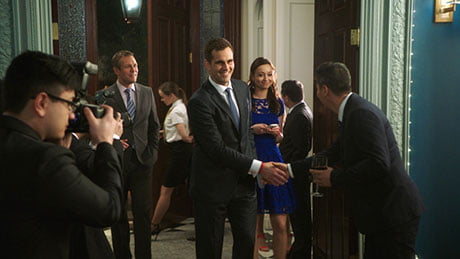 American Gothic is produced by CBS Television Studios
AMC Networks International Iberia has picked up CBS drama American Gothic after striking a deal with distributor CBS Studios International.
The 13-part show, which will air on the AMC-owned network in Spain and Portugal from October, centres on a prominent Boston family reeling in the wake of the chilling discovery that someone in their midst is linked to an infamous string of murders.
It is produced by CBS Television Studios, with Corinne Brinkerhoff, Justin Falvey, Darryl Frank, James Frey and Todd Cohen attached as executive producers. Juliet Rylance and Virginia Madsen star.
Cum Face
CUM FACE: PORTRAITS OF WOMEN REACHING ORGASM

Laura.
Photographer Albert Pocej set himself an unusual challenge. He wanted “to capture the moment of women reaching the highest point of physical pleasure.”
How did he come (ahem) up with this idea? In his wildest dreams, of course.
I simply woke up and I knew I just had to do it. So I tried to explore the female orgasm through a photography experiment.
At first I thought it would be impossible. Finding the models was the most difficult part. I started to write to everybody I know without any boundaries since all the women are so different. The answers I got were mostly two kinds: “I don’t have enough courage”, and just the silence, which is also pretty obvious as an answer. When I finally found 20 women that were ready to take part in this project, some of them refused to continue when I told them that it will not be acting, and some of them weren’t able to relax already while shooting. So at the end there were only 15 left.
According to Albert—all of the participating models “experienced real orgasms” during their photographic session. To achieve the “best results” Albert used time lapse to help the models relax. Some of them didn’t need it and were happy to enjoy themselves in front of the photographer.
Hunter Returns Hemingway’s Horns
Hunter S. Thompson’s wife returns antlers he stole from Ernest Hemingway’s house
An interior view of the house formerly owned by Ernest Hemingway outside Ketchum, Id., in 2007. (Ted S. Warren / AP)
A young Hunter S. Thompson went to Idaho to write about Ernest Hemingway and decided to take a piece of his hero home with him — a set of trophy elk antlers.More than half a century later, the gonzo journalist’s wife returned the antlers to Hemingway’s house in the mountain town of Ketchum.
“He was embarrassed that he took them,” Anita Thompson said Thursday, noting the deep respect her husband had for Hemingway’s work. “He wished he hadn’t taken them. He was young, it was 1964, and he got caught up in the moment.
“He talked about it several times, about taking a road trip and returning them,” she said.
She gave back the antlers Aug. 5 to Ketchum Community Library, which helps catalog and preserve items in the residence where the author took his own life. It’s now owned by the Nature Conservancy.
In 1964, Hunter Thompson, then 27, came to Ketchum when he was still a conventional journalist. He had not yet developed his signature style, dubbed gonzo journalism, that involved inserting himself, often outrageously, into his reporting and that propelled him into a larger-than-life figure.
Thompson was writing a story for the National Observer about why the globe-trotting Hemingway shot and killed himself at his home three years earlier at age 61. Thompson attributed the suicide in part to rapid changes in the world that led to upheavals in places Hemingway loved most — Africa and Cuba.
More Evidence Cats Are Evil
Cuddling kittens can kill you, warn scientists
by
 Scientists found the scope and impact of a potentially deadly cat-borne disease was wider than they thought CREDIT: BETTINA STRENSKE / ALAMY STOCK PHOTO
Cuddling a kitten may always make you feel better – but it could be dangerous to your health, according to experts.
Doctors from Centers for Disease Control and Prevention in the US conducted a large-scale survey of the cat-borne bacterial disease cat scratch fever.
They found the scope and impact of the potentially deadly disease was larger than they thought.
The disease causes fever, pustules and in extreme cases, the complications from the illness can cause death.
THE HAUNTED Goes to SyFy
Syfy Orders Pilots For AI Drama ‘The Machine’, ‘Haunted’ & ‘Happy!’ Adaptation

Syfy is stepping up its development efforts with three pilot orders to artificial intelligence drama The Machine, based on the 2013 cult hit film; supernatural horror-drama Haunted; and Happy! based on Grant Morrison and Darick Robertson’s graphic novel. All three hail from sibling Universal Cable Prods.
After several straight-to-series orders, Syfy returned to pilot development this year with the pilot greenlights of Prototype in February and Superman prequel Krypton in May. The former was filmed and not going forward, while the latter is currently casting. Today’s pickups mark the largest batch of pilot orders for Syfy in a while as the network had been going through a creative revamp.
The Haunted is a supernatural horror-drama about four siblings who reunite following their parents’ deaths. As they try to overcome their fractured personal relationships they find that they must also face the literal ghosts from their past in order to survive. Noga Landau (Tau, The Magicians) wrote the pilot and is also a co-executive producer. Author James Frey and Todd Cohen of Full Fathom Five will executive produce.
A Pack Of Wolves Runs Through It
Edward Albee Gone
Playwright Edward Albee, 3-time Pulitzer winner and ‘Who’s Afraid of Virginia Woolf?’ author, dead at 88
by Associated Press
Three-time Pulitzer Prize-winning playwright Edward Albee has died in suburban New York City at age 88. (Jennifer S. Altman/For The Times)
Three-time Pulitzer Prize-winning playwright Edward Albee has died in suburban New York City at age 88.
Albee challenged theatrical convention in masterworks such as “Who’s Afraid of Virginia Woolf?” and “A Delicate Balance.”
Albee assistant Jackob Holder says the playwright died Friday at his home on Long Island. No cause of death has been given.
Albee had been arguably America’s greatest living playwright after the deaths of Arthur Miller and August Wilson in 2005.
Sharp-tongued humor and dark themes were the hallmarks of Albee’s style. In more than 25 plays Albee skewered such mainstays of American culture as marriage, child-rearing, religion and upper-class comforts.
Nina Hagen Diddles
OSIRIS-REx – Asteroid Hunter
from The Christian Science Monitor
NASA greenlights OSIRIS-REx for asteroid hunt
On September 8, OSIRIS-REx is scheduled to be launched toward the asteroid Bennu to collect samples to send back to Earth. The asteroid may provide hints about the formation of planets and the origins of life on Earth.
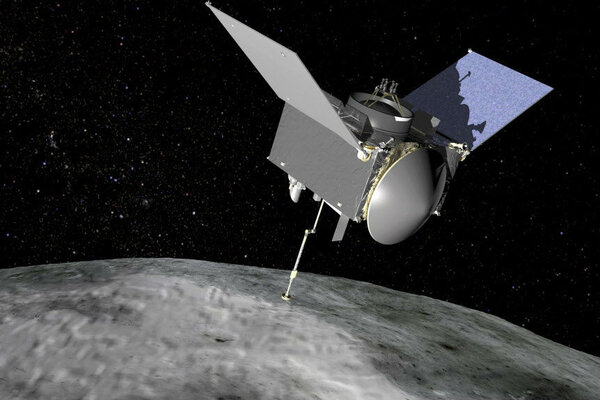 NASA//Reuters
On September 8 at 7:05 a.m. Eastern time, NASA plans to launch a historic probe to rendezvous with a nearby asteroid.
For the first time, a NASA probe will send pieces of an asteroid back home for study on Earth.
So far, everything seems to be a go for the mission. NASA confirmed details about the probe, the Origins-Spectral Interpretation-Resource Identification-Security-Regolith Explorer or OSIRIS-REx, Wednesday in a press release.
According to NASA, the probe will carry a camera system, multiple types of spectrometers, and a laser altimeter to map the shape of the asteroid Bennu.
Watching Pitch Drip
The Pitch Drop Experiment
Begun 82 years ago, this science experiment keeps on going, ever so slowly.
 University of Queensland Physics Museum
Begun in 1927 by Professor Thomas Parnell, this experiment was meant to reveal the surprising properties of an everyday material: pitch. Pitch is the name of a number of hard tar-like substances and in this case bitumen was used. Though at room temperature pitch appears to be a solid and can be shattered by a hammer, it is in fact a very high-viscosity liquid, and Professor Parnell wanted to prove it.
Just getting ready to perform the experiment took years. First the Professor heated a sample of pitch and poured it into a sealed funnel. Then, he waited. For three years Parnell let the pitch settle in the funnel, until in 1930, when he felt the pitch was settled enough, he cut the bottom of the funnel, freeing the pitch to begin its mind-bogglingly slow downward escape.
Professor Parnell lived long enough to record only two drips—the first in 1938, eight years after the opening of the funnel – and the second, nine years later in 1947.
Curiously, because it only drips every 8 to 9 years, no one has ever actually seen a drop fall. A webcam was setup in 2000, but due to technical problems it missed the drip. The last drip was nine years ago, so the pitch is due to drop any day now. The webcam is currently set up and one can try their luck, and patience, here.
Michelangelo Pranks The Pope
from International Business Times
Michelangelo secretly painted symbols of female anatomy on Sistine Chapel ceiling
Michelangelo may have hidden symbols as dissection of human body was banned by Catholic Church.
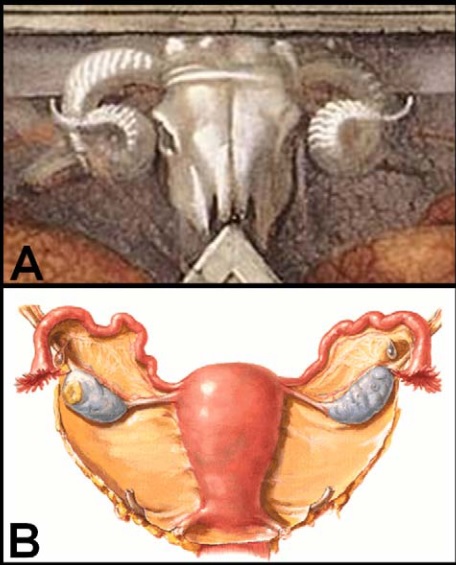 Close-up of the ram skull with female anatomy diagramDeivis de Campos et at/Wiley/ Clinical Anatomy
Michelangelo secretly painted symbols of the female anatomy on the ceiling of the Sistine Chapel, a team of researchers have said. In analysing the central fresco, The Creation of Eve, a team led by Deivis de Campos of the UFCSPA in Brazil claims there are several representations of female anatomy the artist likely concealed, potentially as a subversive act and to hide his knowledge of anatomy through dissection.
In their study, published in the journal Clinical Anatomy, the team notes that much Renaissance art contains an inner meaning – including animals depicted, positions of characters and juxtapositions. Michelangelo, as an anatomist, may have felt the need to conceal elements of his paintings via symbols.
The team used imaging software to analyse the ceiling of the Sistine Chapel to look for representations of human anatomy. Depictions of female anatomy are normally associated with a downward pointing triangle, while those for males would be upwards pointing.
They found the position of Eve’s arm and forearm “clearly resembles the shape of an inverted triangle … thus, in the exact centre of the Sistine Chapel’s ceiling … Michelangelo may have placed a notorious pagan female symbol”.
Dissected Graces
The Brief, Mystical Reign of the Wax Cadaver
Early medical models of human anatomy shrouded death in feminine beauty.
BY JOANNA EBENSTEIN
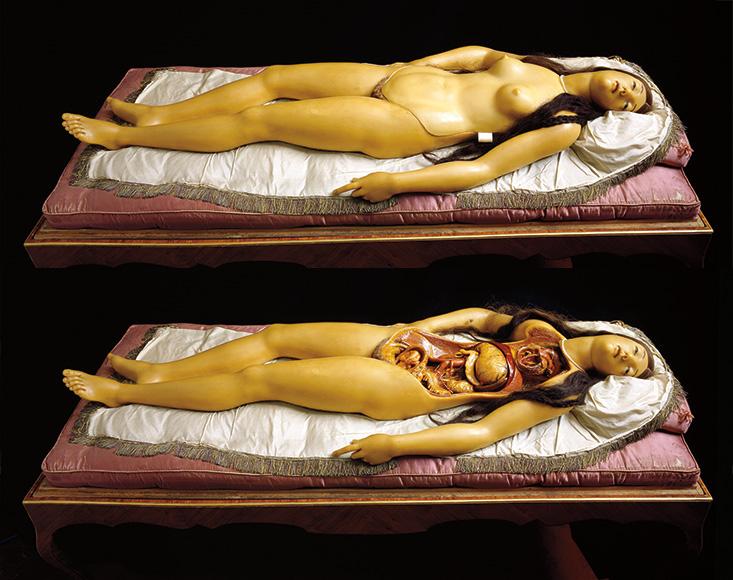 Image courtesy of Museo Della Specola, Florence, Italy / Bridgeman Images
Toward the end of the 18th century, in a wax workshop in Florence, a life-sized, anatomically correct, dissectible goddess of colored wax was created. Artist Clemente Susini took the idealized feminine beauty for which Italian artists had long been renowned in an ambitious new direction, and to hyper-realistic lengths. The result—an Anatomical Venus—is the perfect object: one whose luxuriously bizarre existence challenges belief. It—or better, she—was conceived as a means of teaching human anatomy without the need for constant dissection, which was messy, ethically fraught, and reliant on scarce cadavers. The Anatomical Venus also tacitly communicated the relationship between the human body and a divinely created cosmos, between art and science, and between nature and mankind, as it was then understood.
Often referred to as the “Medici Venus,” this life-sized, dissectible wax woman with gleaming glass eyes and human hair can still be viewed in her original Venetian glass and rosewood case. She can be disassembled into seven anatomically correct layers, revealing at the final remove a tranquil fetus curled in her womb. She and her sisters, wax women in fixed states of anatomical undress sometimes referred to as Slashed Beauties or Dissected Graces, can still be found in a handful of European museums. Supine in their glass boxes, they beckon with a gentle smile or an ecstatic downcast gaze. One idly toys with a plait of real golden human hair; another clutches at the plush, moth-eaten satin cushions of her case as her torso erupts in a spontaneous, bloodless auto-dissection; another is crowned with a golden tiara, while one further wears a silk ribbon tied in a bow around a dangling entrail.
Ring Guy
Aliens Underneath
Ocean worlds: The search for life in the solar system’s other seas
Our best chance to find alien life lies in the vast oceans inside the icy moons of Saturn and Jupiter – and we don’t have to leave Earth to start looking
By
 Valerii Ilnitskii
SUDDENLY, out of darkness, a ghostly city of gnarled white towers looms over the submersible. As the sub approaches to scrape a sample from them, crew-member Kevin Hand spots something otherworldly: a translucent, spaceship-like creature, its iridescent cilia pulsing gently as it passes through the rover’s headlights.
This is not a dispatch from an alien world, but it could be. Hand is a planetary scientist at NASA’s Jet Propulsion Lab in Pasadena, California, and one of a select few to have visited the carbonate chimneys of the Lost City at the bottom of the Atlantic Ocean. It is the site of an extraordinary ecosystem – one that Hand suspects might be replicated on icy moons orbiting distant gas giants. “In my head, I was saying to myself: this is what it might look like,” he says.
Never-Repeating Patterns
The Math Behind Never-Repeating Patterns
 Penrose tiling. PrzemekMajewski, CC BY-SA
Remember the graph paper you used at school, the kind that’s covered with tiny squares? It’s the perfect illustration of what mathematicians call a “periodic tiling of space”, with shapes covering an entire area with no overlap or gap. If we moved the whole pattern by the length of a tile (translated it) or rotated it by 90 degrees, we will get the same pattern. That’s because in this case, the whole tiling has the same symmetry as a single tile. But imagine tiling a bathroom with pentagons instead of squares – it’s impossible, because the pentagons won’t fit together without leaving gaps or overlapping one another.
Patterns (made up of tiles) and crystals (made up of atoms or molecules) are typically periodic like a sheet of graph paper and have related symmetries. Among all possible arrangements, these regular arrangements are preferred in nature because they are associated with the least amount of energy required to assemble them. In fact we’ve only known that non-periodic tiling, which creates never-repeating patterns, can exist in crystals for a couple of decades. Now my colleagues and I have made a model that can help understand how this is expressed.