
$1 Million Worth of Hot Wheels
SO THAT’S WHAT A $1 MILLION HOT WHEELS COLLECTION LOOKS LIKE
Got a Pink VW Bus in the attic? Call your banker.
BY EVAN BLEIER
From Michael Jordan rookie cards to first-run issues of Teenage Mutant Ninja Turtles, we’ve all heard horror stories of parents tossing out valuable collectibles during impromptu attic cleanses.
For Bruce Pascal, a real-estate agent who started collecting Hot Wheels in 1968 when he was seven, that was never an issue. You see, his folks also collect car-related items — in fact, they’ve got about 10,000 of ‘em.
Their love of cars allowed Pascal’s own love of Mattel miniatures to flourish, and he now has a Hot Wheels collection that numbers more than 5,000 pieces and is valued at more than $1 million.
Slushee Discovered On Pluto
Underground ocean found on Pluto, likely slushy with ice
By Irene Klotz
 NASA/Handout via REUTERS
HOUSTON (Reuters) – Scientists have found evidence that tiny, distant Pluto harbors a hidden ocean beneath the frozen surface of its heart-shaped central plain containing as much water as all of Earth’s seas.
The finding, reported on Wednesday in two research papers published in the journal Nature, adds Pluto to a growing list of worlds in the solar system beyond Earth believed to have underground oceans, some of which potentially could be habitats for life.
Pluto’s ocean, which is likely slushy with ice, lies 93 to 124 miles (150 to 200 km) beneath the dwarf planet’s icy surface and is about 62 miles (100 km) deep, planetary scientist Francis Nimmo of the University of California, Santa Cruz said in an interview.
With its ocean covered by so much ice, Pluto is not a prime candidate for life, added Massachusetts Institute of Technology planetary scientist Richard Binzel, another of the researchers. But Binzel added that “one is careful to never say the word impossible.”
Liquid water is considered one of the essential ingredients for life.
Monkey Tools
Monkeys create stone tools forcing scientists to rethink human evolution
By
 Capuchin stone on stone percussion: an active hammerstone fragmenting during use CREDIT: M.HASLAM
The path of human evolution may need to be rewritten after archaeologists discovered that monkeys also produce ‘tool-like flakes’ that were thought to be uniquely man-made.In a discovery that calls into question decades of research, a band of wild bearded capuchin monkeys in Brazil were seen hammering rocks to extract minerals, causing large flakes to fly off.
Previously archaeologists believed the flakes were only made by humans through a process called ‘stone-knapping’ where a larger rock is hammered with another stone to produce sharp blade-like slivers which can be used for arrows, spears or knives.
The flakes were thought to represent a turning point in human evolution because they demonstrated a level of planning, cognition and hand manipulation that could not be achieved by other animals.
But the new research suggests that flakes can be made without any such foresight. In fact they can simply be made by accident.
#ThisIsEndgame

Black Metal
Photos That Perfectly Capture the Brutality of Extreme Norwegian Music
By Oliver Lunn, Photos: Jonas Bendiksen
 Aleksander Ilievski from Imagination and Empty. Norway, 2016. (Copyright: Jonas Bendiksen / Magnum Photos)
The most Norwegian thing ever is black metal. Just hearing someone say “Norway” conjures up the image of a man-troll screaming in a dark cave and the ear-bleeding sound of double-kick drumming at hyper-speed. Which is hardly surprising, given that black metal is Norway’s largest musical export.
When I hear “Norway” I think of bands like Mayhem, Burzum, and Darkthrone; of the 1993 murder of Mayhem guitarist Euronymous by Burzum’s Varg Vikernes; and of the series of church burnings in which some of the bands were caught up. It’s been over 20 years since all that happened, and now black metal is more mainstream than ever.
That enduring association – between Norway and black metal – is what interested Magnum photographer Jonas Bendiksen, a Norwegian himself. For his new series “Singing Norwegian Singers”, commissioned by Leica, Bendiksen rounded up a bunch of local black metal singers and photographed them screaming directly into his lens. The shots are uncomfortably close: nostrils flare; saliva glistens on their tongues, everything captured in the cold glow of the camera flash.
The hedonists. The provocateur. The phenom.
SEX, DRUGS, AND BESTSELLERS: THE LEGEND OF THE LITERARY BRAT PACK
 Bret Easton Ellis, Gary Fisketjon, and Jay McInerney in June 1987 / Patrick McMullan
The hedonists. The provocateur. The phenom. The forgotten talent. In the decadent 1980s, the media shipped novelists Jay McInerney, Bret Easton Ellis, Tama Janowitz, Donna Tartt and Jill Eisenstadt into a loose-knit group known as the “literary brat pack.” One member would go on to win a Pulitzer; one would become better known for controversy than fiction; another would exemplify the excessive highs and very public lows of the decade; and another would slowly fade from view.
A generation of readers loved them. Critics largely despised them. And for a time, they were celebrated for their youth as much as their work. But they also helped change the course of American literature—and looked great doing it. “I think we made fiction fun again,” says McInerney.
Tugging The Salmon
Masturbation – Les expressions hilarantes des différents pays
Si en France on possède déjà de nombreuses expressions très imagées et subtiles pour désigner la masturbation masculine, je vous propose de découvrir quels sont les doux euphémismes utilisés dans les différents pays à travers le monde : Frapper le cyclope, cirer le salami ou serrer la main au président !
 Tirailler le saumon
Leonard Cohen Gone
Singer-Songwriter Leonard Cohen Dies at 82
 DAVID ROWLAND/REX/SHUTTERSTOCK
Leonard Cohen, the Canadian poet and novelist who became a singular international presence as a singer-songwriter, has died. He was 82.
A statement on his official Facebook page read, “It is with profound sorrow we report that legendary poet, songwriter and artist, Leonard Cohen has passed away. We have lost one of music’s most revered and prolific visionaries. A memorial will take place in Los Angeles at a later date. The family requests privacy during their time of grief.”
Only last month, Cohen released his final album, “You Want It Darker,” a deeply introspective work that focused thematically on mortality.
His elegantly penned songs, authored during a musical career that spanned six decades, won him comparison with such other songwriters of his era as Bob Dylan and Paul Simon. His best-known song, “Hallelujah,” has been recorded more than 200 times. Cohen never recorded a chart single and didn’t place an album in the top 10 until he was in his 70s, but his ardent fans and musical peers viewed him as a musical craftsman with few equals.
As a songwriter, his themes encompassed love in all its manifestations, religion, faith and the tenuous state of the world. Like “Hallelujah,” many of his tunes — his breakthrough composition “Suzanne,” “Bird on the Wire,” “Tower of Song” — became much-covered keystones of the popular songbook. His longtime accompanist Jennifer Warnes recorded several of his best-known works on her 1987 Cohen recital “Famous Blue Raincoat.”
Like his art, his life evidenced a dynamic tension between sexuality and spirituality. He was a well-known womanizer whose many romantic partners included fellow Canadian musician Joni Mitchell and actress Rebecca De Mornay. Yet he would famously reject the world of the flesh: Torn by depression and doubt about his life and career, he withdrew to spend more than five years in a Buddhist monastery; he later studied at a Hindu ashram in Mumbai.
Secret global conspiracy to enslave humanity
Conspiracy theorists claim plan to create Asgardia ‘space nation’ in orbit above earth is secret Illuminati plot to take over the world
BY SAM WEBB

PLANS for a ‘space nation’ that will orbit the earth are secretly part of a global conspiracy to enslave humanity – if conspiracy theorists are to be believed.
Scientists and astronomers have revealed plans to set up a new nation in space called Asgardia.
Anyone can apply to be a citizen in the cosmic country, which will be based around one or more satellites orbiting the Earth.
But conspiracy theorists claim a glowing symbol on a computer mock-up of the space station is actually the Eye of Horus, an ancient Egyptian emblem they say is linked to Freemasons and the Illuminati.
The Illuminati, they claim, is a secret society that seeks to wield shadowy power over the fate of humanity.
Why this cabal of plotters who go to every length to keep their existence unknown would slap their symbol on the side of a huge space station is anyone’s guess.
Internet conspiracy theorist DAHBOO777 said: “You’ve got to see the Illuminati symbolism hiding in plain sight – right in your face.”
Hackman The Assman
On the 30th Anniversary of Hoosiers, the Movie’s Director Recalls What a Pain Gene Hackman Was
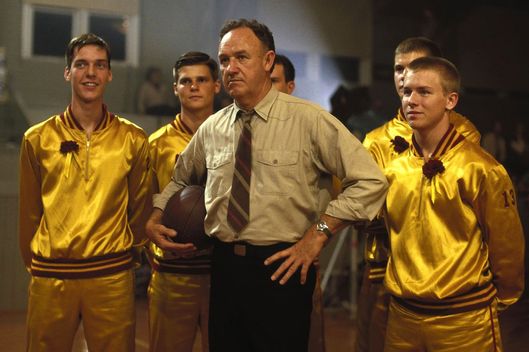 Gene Hackman in “Hoosiers” Photo: Metro-Goldwyn-Mayer
The success and long afterlife of Hoosiers — released almost exactly 30 years ago and new on Hulu this month — may not be quite as improbable as the events depicted in the movie, but it’s in the same long-shot realm as Hickory High’s run to the Indiana state basketball title. You had a director, David Anspaugh, making his feature-film debut; you had a co-star, Dennis Hopper, who played the troubled assistant coach Shooter Flatch, still working his way back from a solid decade in the show-business wilderness; and you had a subject, basketball, that up to that point, didn’t exactly have a sterling cinematic history. Oh, and Gene Hackman, who starred as coach Norman Dale, drove Anspaugh to the brink of a nervous breakdown.
Yet those problems resulted in beloved film, one that earned Academy Award nominations for Dennis Hopper’s supporting role and composer Jerry Goldsmith’s score. In 2001, the movie was selected by preservation by the National Film Registry and has been honored by the American Film Institute. As far as sports films go, Hoosiers, despite criticism from the likes of Spike Lee, is in the pantheon.
Speaking on the phone from Bloomington, Indiana, where he moved in 2014 to teach film at Indiana University, Anspaugh, who also directed the football classic Rudy, talked about his movie’s legacy, butting heads with Hackman, an obsessive celebrity fan, race, and what Jack Nicholson said would’ve happened if he’d been the star.
“It’s the single greatest aviation mystery of the 20th century.”
What Happened to Eastern Airlines Flight 980?

On New Year’s Day in 1985, Eastern Air Lines Flight 980 was carrying 29 passengers and a hell of a lot of contraband when it crashed into the side of a 21,112-foot mountain in Bolivia. For decades conspiracy theories abounded as the wreckage remained inaccessible, the bodies unrecovered, the black box missing. Then two friends from Boston organized an expedition that would blow the case wide open.
By the time it crashed, Eastern Air Lines Flight 980 would have been just about ready to land. Beverage carts stowed, seat backs upright, tray tables locked. The 29 people on board would have just heard the engines change pitch and felt the nose dip slightly, seat belts tugging at their stomachs.
One imagines a focused cockpit. Pilot Larry Campbell was responsible for the safety of everyone on the flight, and this was just his second landing in the Bolivian city of La Paz. Copilot Ken Rhodes was a straightforward military man. No foolishness, especially when descending through a mountain valley in bad weather. Sitting behind both, flight engineer Mark Bird was a retired fighter jock. In the Air Force, he was known for buzzing the tower and other hijinks, but he’d joined Miami-based Eastern only a few months before, and during a tricky approach in the middle of a thunderstorm would not have been the moment to chime in.
On January 1, 1985, the mostly empty Boeing 727 was headed from Asunción, Paraguay, to Miami, with stopovers in Bolivia and Ecuador. Landing in La Paz was always difficult. Ground controllers there had no radar—and what navigational equipment they did have was spotty—so they relied on the cockpit crew to track their own position.
At 13,325 feet, El Alto International, which serves La Paz, is the highest international airport in the world. The air is so thin that planes land at 200 miles per hour because they would fall out of the sky at the usual 140. Air brakes find less purchase here, so the runway is more than twice the normal length. The airport is so high that, as the plane dropped toward La Paz, the pilots would have worn oxygen masks until they reached the gate, per FAA regulations. Passengers would have felt the altitude’s effects as the cabin depressurized: increased heart rate, deeper breaths, fuzzy thoughts.
The last anyone heard from the jet was at 8:38 P.M. Eastern time. According to ground controllers, the flight was about 30 miles from the airport and cruising on track at roughly 20,000 feet. It was cleared to descend to 18,000 feet when it plowed straight into a mountain.
Brown Sabbath
Earworms Explained
What Lady Gaga’s ‘Bad Romance’ and Other Earworm Songs Have in Common
By
You should stop reading this now. No really, just don’t. You’re still reading. O.K., you asked for it:
“Rah rah ah-ah-ah!/ Ro mah ro-mah-mah!/ Gaga ooh-la-la!”
There’s your “Bad Romance.” Like the “ugly” “disease” Lady Gaga sings about wanting in this song, an earworm has likely just lodged itself deep inside the auditory cortex of your brain. There it will sit, sucking up your precious brain energy, for the next hour, day, month or even a whole year. ( I had Hall and Oates’ “Maneater” in my head for most of 2005.)
You are not alone.
“That’s all I can really think about right now,” said Kelly Jakubowski, a music psychologist at Durham University in Britain, about “Bad Romance.” In a study published Thursday in Psychology of Aesthetics, Creativity and the Arts, she and her colleagues compiled lists of earworms from around 3,000 participants to see why some pop songs wiggle their way into people’s heads and stay there. The Lady Gaga hit, which is always at the top of people’s lists, has been developing its own toxic relationship inside the mind of Dr. Jakubowski, who hasn’t heard it in months: “It’s been persisting for two days straight,” she said.
Proxima Centauri
The World Next Door
By Seth Shostak
 Parkes Observatory, New South Wales, Australia credit: Ian Sutton
If it’s for real, it’s the closest planet beyond our solar system. The closest planet in outer space.
Astronomers using a telescope at the European Southern Observatory in Chile have announced the discovery of a world around the star Proxima Centauri, the nearest star to us other than the Sun. They base this on very slight stellar wobbles – a convincing claim resting on more than a dozen years of accumulated data.
Proxima Centauri’s paltry distance (4.2 light-years) is matched by its paltry size: It’s a dim bulb, a red dwarf that’s only one-seventh the Sun’s diameter. The newly discovered planet orbits this star in only 11 Earth days. This cheek-by-jowl relationship ensures that, despite Proxima Centauri’s meager energy output, there’s enough sunlight hitting the planet to sustain large bodies of liquid water. There could be oceans covering at least some of this world, and where there’s water, there might be life.
But is there? It’s a question as obvious as the Matterhorn. Unfortunately, it’s hard to get an answer.
Someone’s Knocking At The Door
Signal from sun-like star likely of Earthling variety

Apologies to the Tin Foil Hat Clan, but that mysterious signal emanating from a star in the constellation Hercules? Yeah, probably not an alien.
If E.T. didn’t phone home, what happened, you ask? It appears Earthlings are responsible, though scientists haven’t explained exactly how.
Telescope researcher Yulia Sotnikova issued a statement Wednesday via the Russian Academy of Sciences Special Astrophysical Observatory saying analysis had “revealed (the signal’s) most probable terrestrial origin,” and that astronomers across the world continued to look for additional signals.
“It can be said with confidence that no sought-for signal has been detected yet,” the statement said.
Van Halen Pranks
VAN HALEN WANTED TO CRUSH A VOLKSWAGEN BEETLE WITH A TANK IN 1979… JUST TO PISS OFF AEROSMITH

Today’s rock and roll history lesson comes courtesy of David Lee Roth’s highly entertaining 2000 autobiography Crazy From the Heat in which DLR recalls the detailsabout the time VH rented a Sherman tank so they could destroy a vintage VW Bug—all to spite Aerosmith. According to Roth the occasion would mark the last time that he would ever speak to Steven Tyler, Joe Perry and the rest of the boys in Aerosmith. Say what you want about Aerosmith but if you’ve got Boston blood flowing through your veins then you also know how to hold a wicked long-term grudge, pal.
The story goes that back in 1979 were a part of the CaliFFornia World Music Festival held at the LA Coliseum and on the second night of the two-day festival Van Halen was co-headlining the gig with Aerosmith—who would to on to temporarly implode six-months later after the release of their sixth record Night in the Ruts (or as we called it back in the day in Boston “Right in the Nuts”). In an effort to one-up Aerosmith, the troublemakers in Van Halen cooked up a plan that involved renting a Sherman tank from a local Hollywood prop shop and the purchase of a couple of yellow VW Beetles. The idea was that announcements made over the Coliseum’s PA system would lay the groundwork for folks to think that one of the members of Aerosmith parked the Bug illegally and were asking for it to be moved. The “punchline” in all this excessive craziness was that the tank would roll out just as Van Halen took the stage, crushing the Bug to bits.
Robot Brothels Cool
Robot brothels could soon become reality in UK as nation’s booming sex trade undergoes revolution
BY RACHEL BISHOP
 A high-end sex doll in an industrial suburb of Beijing
Sex robot brothels similar to those seen in Channel’s 4’s eerie cyborg drama Humans could soon become a reality in the UK, it has been claimed.
Rapidly-improving technology could herald a revolution in the UK’s sex industry which could result in reduced risk of sexually transmitted diseases and safer lives for I working girls, clients and pimps.
NUI Galway Law professor John Danaher, who has conducted research into human enhancement and artificial intelligence, said sex robots could be a good substitute for human prostitutes.
He told the Daily Star : “The cyborgs can cater for desire for sexual variety, freedom from constraint and complication and fear of lack of sexual success.
“Technology may become better at developing emotional bonds with their clients.
“They won’t need to ‘fake it’ the same way as human prostitutes.”
‘World’s most expensive’ sex dolls shown being put together in striking images
Mr Danaher said the “completely legal” practice could even even stamp out sexual slavery and trafficking as the robot’s would be cheaper than human prostitutes
TIME Magazine Promotes Consumption of Hallucinogenic Drugs
LSD Might Make You More Creative
A small study of the illegal drug has found eye- and mind-opening results
Lysergic acid dyethylamide, which you probably know as LSD, has been put to various uses since its discovery in the 1930s: scientists have tried to treat mental illness; the CIA attempted to control minds; and recreational users, well, trip out. But the Controlled Substances Act of 1970 officially prohibited LSD, and scientific inquiries into its capabilities all but disappeared. Until recently.
While studies into LSD still face stigmas, in the past several years, scientists have found potential small-scale, fascinating effects on perplexing regions of health, including addiction, depression and terminal cancer. Studies have also taken on the drug’s cognitive repercussions; “You don’t recognize yourself as a separate being from the universe,” as one study’s co-author told TIME in 2015.\
LSD TV
Future of TV could be pills that make people hallucinate television shows, Netflix boss says
It might be a blue pill that makes you hallucinate in an entertaining way – and then another white pill that brings you back to normality, Reed Hastings said
The future of TV might everyone taking hallucinogenic drugs, according to the head of Netflix.
The threats to the streaming TV company might not be Amazon or other streaming services, but instead “pharmacological” ways of entertaining people, Reed Hastings has said.
And just as films and TV shows are a supposedly improved version of other entertainments, those same things might eventually become defunct, he said. In the same way that the cinema and TV screen made “the opera and the novel” much smaller, something else might be on the way to do the same thing, the Netflix boss said at a Wall Street Journal event.
Those challenges could come from anywhere, he said. They might not be another form of screen: “Is it VR, is it gaming, is it pharmacological?” Mr Hastings asked the event.
He went on to say that it might be possible that in the coming years someone will develop a drug that will make people get the same experiences that at the moment come from streaming services like Netflix. Apparently making reference to The Matrix, he said that we might be able to take one pill to escape into a hallucination and then another to come back.
Laurel Canyon Legacy
An Oral History of Laurel Canyon, the 60s and 70s Music Mecca
They made music together, took drugs together, formed bands together, slept together. But none of the legends of the Laurel Canyon scene that flowered in L.A. in the late 60s and early 70s—Joni Mitchell, David Crosby, Linda Ronstadt, and others—remember it quite the same way.
 Stephen Stills and Peter Tork in Stills’s Rolls-Royce, 1968. Digital Colorization by Lorna Clark; © Nurit Wilde.
Some say the Laurel Canyon music scene began when Frank Zappa moved to the corner of Lookout Mountain and Laurel Canyon Boulevard in the late 1960s. Former Byrds bassist Chris Hillman recalls writing “So You Want to Be a Rock ‘n’ Roll Star” in Laurel Canyon in 1966 in his house, on a steep winding street with a name he doesn’t remember. The Doors’ lead singer Jim Morrison reportedly wrote “Love Street” while living behind the Laurel Canyon Country Store. Michelle Phillips lived with John Phillips on Lookout Mountain in 1965 during the Mamas and the Papas’ heyday. Books and documentaries have mythologized and romanticized this woodsy canyon nestled behind Sunset Boulevard in the Hollywood Hills. Still, misconceptions continue.
For a start, the scene was more metaphorical than geographical. Nearly everyone who was there was, at one time or another, stoned; nobody remembers everything the same way. What is undeniably true is that from the mid-1960s to the early 1970s some of the most melodic, atmospheric, and subtly political American popular music was written by residents of, or those associated with, Laurel Canyon—including Joni Mitchell, Neil Young, David Crosby, Stephen Stills, Graham Nash, Chris Hillman, Roger McGuinn, J. D. Souther, Judee Sill, the Mamas and the Papas, Carole King, the Eagles, Richie Furay (in Buffalo Springfield and Poco), and many more. They made music together, played songs for one another with acoustic guitars in all-night jam sessions in each other’s houses. Many of those houses were cottages with stained-glass windows, and fireplaces that warmed the living rooms in the chilly L.A. nights. They took drugs together, formed bands together, broke up those bands, and formed other bands. Many of them slept with each other. The music was mislabeled “soft rock” or “folk rock,” especially in the Northeast, where critics panned it as granola-infused hippie music—too “mellow” and too white. But in truth, it was an amalgam of influences that included blues, rock and roll, jazz, Latin, country and western, psychedelia, bluegrass, and folk. It certainly was a forerunner of today’s “Americana.”
Greatest Goat Gag Ever
How a Three-Year-Long Prank Landed Me a Job at ‘South Park’
By Sanjay Shah
 Not Mickey the Goat. Photo via Wikimedia Commons
I had just gotten a job writing for a sitcom, so when my agent Mickey got married I felt a lot of pressure to give him a “funny” gift. I got him a goat—specifically, I paid Oxfam International about $40 to donate a goat to a village in the developing world, on Mickey’s behalf. If you’re wondering how a goat is funny, it’s not.
Mickey did his best to politely thank me for this gesture. But I knew the truth: Nobody likes a donation as a gift. They just want the pizza wheel that they put on their wedding registry. I asked Mickey if his wife liked the gift. After a long pause, he said, “Yeah, I haven’t told her about it yet, but I’m sure she will.”
He fucking hated it, which was perfect—because the goat wasn’t the real gift.
About a month later, Mickey received a letter in the mail, post-marked from South Africa, from the recipient of the goat. The guy explained that he asked Oxfam for Mickey’s address in order to personally thank him for the goat: “Thank you so much! We haven’t had a goat in a long time. We even named the goat after you. The kids are drinking Mickey’s milk right now!”
I got a call from my agent after he got the letter. He was over the moon: “I’m really making a difference in these people’s lives!” He thanked me, and I was so happy—mostly because he didn’t realize I wrote that letter. I’d emailed the text of the letter to a college friend who was working in South Africa, who hand-wrote it onto South African air mail. It was totally convincing.
I sent letters to Mickey this way for the next three years.
The second letter arrived about six months later. The recipient of the goat told Mickey he was writing to “check in” and update him on the goat’s welfare. “Everything is fine,” he wrote. “The goat kind of ran away. But don’t worry! I found it and gave it the beating of its life. It will never run away again. Your investment is safe!”
New Life, New Civilizations
Brave new worlds – New discoveries, intelligent devices and irrepressible dreamers are once again making space exciting

IT MAY turn out to be a bare and barren rock. The fact that liquid water could be flowing across the surface of the planet just discovered orbiting Proxima Centauri, the nearest star to the sun, does not mean that any actually is—nor for that matter that it has an atmosphere. The fact that water and air, if present, could make this new world habitable does not mean that it is, in fact, a home to alien life.
But it might be.
What is exciting about this new world is not what is known—which, so far, is almost nothing (see article). It is what is unknown and the possibilities it may contain. It is the chance that there is life beneath that turbulent red sun, and that humans might be able to recognise it from 40 trillion kilometres away. In the immense distances of space that is close enough to mean that, some day, perhaps, someone might send probes to visit it and in so doing glimpse a totally different form of life. In the thrill of such possibilities sits all that is most promising about the exploration of space.
All our yesterdays
Next year will mark the 60th anniversary of the first satellite, Sputnik. The intervening decades have brought wonders. Men have looked back on the beauty of the Earth from the bright-lit Moon—and returned safely home. The satellites of America’s Global Positioning System (GPS) have created a world in which no one need ever be lost again—changing the human experience of place rather as the wristwatch changed the experience of time. Robots have trundled across the plains of Mars and swooped through the rings of Saturn. The Hubble space telescope has revealed that wherever you look, if you look hard enough you will find galaxies scattered like grains of sand across the deep.
Even so, space has of late become a bit dull. No man has ventured beyond low Earth orbit in more than four decades (no woman has done so ever). Astronauts and cosmonauts commute to an International Space Station that has little purpose beyond providing a destination for their capsules, whose design would have been familiar in the 1960s. All the solar system’s planets have been visited by probes. The hard graft of teasing out their secrets now offers less immediate spectacle.
Fantasy Experts
How the Experts Win at Fantasy Football
by Will Levith
 Antonio Brown #84 of the Pittsburgh Steelers makes a touchdown catch in front of Greg Toler #28 of the Indianapolis Colts during at 2014 game at Heinz Field. (Joe Robbins/Getty Images)
Every year, it’s the same old thing. You buy the fantasy preview magazine. You do the research. You get the ESPN alerts on your phone. You don the Manning jersey and fly to Vegas. When the time comes for you to make your first pick of the year at the big draft, you freeze. Anxiety sets in, as do the cold sweats. You second-guess yourself. Did I do enough? Do I really know what I’m doing?
Hopefully, this isn’t you, but the fantasy yips are something every football team owner has faced at one point or another throughout his or her career. Whether you take part in a snake draft or auction league or another derivation, nobody’s immune to draft day failure. That is, unless you listen to your friends at RealClearLife.
With the biggest weekend for fantasy drafts fast-approaching—Aug. 26-28—we’ve got you covered going into the big night and beyond. We’ve gone ahead and done the heavy lifting, tracking down some of the top experts in the fantasy football world and getting the inside scoop from them.
Our panel includes Rick Wolf, president of FantasyAlarm (he also hosts a popular fantasy sports–related show on Sirius XM radio); Will Carroll, managing editor of FanDuel; and Stacie Stern, general manager of Head2Head Sports. (RealClearLife staff writer Will Levith also threw in his decades worth of fantasy sports knowledge, which has led to at least one title, a runner-up, and a whole lot of losing.)
Eyeball Planets
Forget “Earth-Like”—We’ll First Find Aliens on Eyeball Planets
BY SEAN RAYMOND
 A planet that is tidally “locked” to its star. As the planet orbits the star along the dotted line, the same side of the planet always faces toward the star. The stick figure is standing at the substellar point, where the star is always directly overhead.
Imagine a habitable planet orbiting a distant star. You’re probably picturing a variation of Earth. Maybe it’s a little cloudier, or covered in oceans. Maybe the mountains are a little higher. Maybe the trees are red instead of green. Maybe there are scantily clad natives … OK, let’s stop there.
That image may very well be completely off-base. There is good reason to think that the first potentially life-bearing worlds that are now being detected around other stars (see here for example) probably look very different than Earth. Rather, these planets are more likely to look like giant eyeballs whose gaze is forever fixed on their host stars (which is not something I recommend doing with your own eyeballs).
Let’s take a step back. The easiest planets to find are those that orbit close to their stars. The sweet spot for finding a habitable planet—with the same temperature as Earth—is on a much smaller orbit than Earth’s around a star much fainter than the Sun. But there are consequences of having a smaller orbit. A planet close to its star feels strong tides from its star, like the tides Earth feels from the Moon, but much stronger. Strong tides change how a planet spins. Tides drive the planet’s obliquityto zero, meaning that the planet’s equator is perfectly aligned with its orbit. The planet will also be “tidally locked”: It always shows the same side to the star.
If you were standing on the surface of a planet like this, the Sun would remain fixed in one spot on the sky. The hemisphere facing the star is in constant daylight and the far hemisphere in constant darkness. In between lies a ring of eternal sunset, quite possibly the most romantic place in the Universe. The hottest part of the planet is the location where the star is directly overhead (the “substellar point” in astro-speak). The hottest part of Earth is spread out across the tropics, depending on the time and the season. But on a tidally locked planet the Sun stays in the same place in the sky and the hot spot never moves. This creates visible differences across the planet’s surface; the relatively small hot spot is the “pupil” of an eyeball planet.
Rh Negative Aliens
Humans with blood type Rh Negative belong to an Extraterrestrial lineage according to new theory
by Ivan

Humans have possible four general blood types: A, B, AB and O; this classification is derived, according to scientists from proteins which are found on the surface of cells which are designed to fight off bacteria and viruses in the human body. The vast majority of humans beings on this planet have these proteins which means they are Rh positive. But a minor group, the Rh Negative lacks these proteins. So how is this crucial difference explained scientifically? And why does it even exist? Throughout the years, several scientific studies have searched for this answer.
Now, scientists believe they have found out a fascinating thing in regards of Rh Positive and negative. According to this “scientific” theory, in the distant past, extraterrestrial beings visited the Earth and created, through “genetic manipulation,” the Rh Negative with an intention of creating a race of “slaves”.
The Basque people of Spain and France have the highest percentage of Rh negative blood. About 30% have (rr) Rh negative and about 60% carry one (r) negative gene.
But Aliens… really? According to investigators, this would explain why Rh negative mothers do not tolerate fetuses with RH Positive blood; thus, this radical, hard-to-explain, by most natural laws intolerance could derive from an ancient genetic modification why Rh positive and Rh negative groups tend to “repel” each other instead of merging.
This theory goes back to ancient Sumerian times when a highly advanced “alien” race came from elsewhere in the cosmos; The Anunnaki, building and creating the first human societies.
It is believed that these ancient beings planned and genetically altered primitive human species, creating stronger and more “adequate” beings that were used as slaves in the distant past.
Damon Baehrel
THE MOST EXCLUSIVE RESTAURANT IN AMERICA
Damon Baehrel’s methods are a marvel, and his tables are all booked until 2025. Or are they?
 “He is an unheralded genius,” a food critic said of Damon Baehrel. “He really should be in the upper echelons of the greatest chefs who have ever lived.” ILLUSTRATION BY ELEANOR DAVIS
The first time Jeffrey Merrihue came across the name Damon Baehrel, he was amazed that he hadn’t heard of him. “I didn’t understand how the secret had been kept,” Merrihue said recently. “The people I go around with, it’s hard for us to find something that is genuinely unique and new.” The people Merrihue goes around with are gastronomes, the trophy hunters of haute cuisine, the kind who travel the world to dine at famous, or famously obscure, restaurants. After a trip to Cape Town this spring, to a restaurant called the Test Kitchen, Merrihue, who lives in London and produces promotional videos for restaurants, became, he says, the second person to have eaten at every restaurant on the so-called World’s 50 Best list. He’s also been to eighty of the restaurants to which Michelin has granted three stars.
Around Christmas in 2013, a friend of Merrihue’s alerted him to a Bloomberg News piece about an unranked contender, which Bloomberg called the “most exclusive restaurant in the U.S.” It described a gourmet operation—in Earlton, New York, a half hour south of Albany—in the basement of a woodland home. Once called Damon Baehrel at the Basement Bistro, the place was now simply called Damon Baehrel, after its presiding wizard and host, who served as forager, farmer, butcher, chef, sous-chef, sommelier, waiter, busboy, dishwasher, and mopper. Baehrel derived his ingredients, except meat, fish, and dairy, from his twelve acres of yard, garden, forest, and swamp. He made his oils and flours from acorns, dandelions, and pine; incorporated barks, saps, stems, and lichen, while eschewing sugar, butter, and cream; cured his meats in pine needles; made dozens of cheeses (without rennet); and cooked on wooden planks, soil, and stone. He had christened his approach Native Harvest. The diners who got into the restaurant raved about it online. But at the time it was booked through 2020. “We spend our lives looking for places like this,” Merrihue said.
Undaunted, Merrihue sent an e-mail to the address provided on Baehrel’s Web site. A man who identified himself as Terrance, a friend of the chef’s, wrote that Baehrel had stopped taking reservations. “That wound me up even more,” Merrihue said. “I pride myself on getting into restaurants.” Still, it didn’t look good. “I thought, I might die before I get a chance to eat there.”
We Know When You Diddle
‘Smart’ Dildo Company Sued For Tracking Users’ Habits
We-Vibe’s makers sued after customer finds out they know all about her orgasms (and also her email address).

A woman is suing her dildo manufacturer for knowing too much about when and how she uses it.
A few weeks ago, two researchers told the Defcon hacking convention audience that We-Vibe “smart” sex toys send a lot of data about their users back to the company that makes them. According to Courthouse News, one We-Viber took this news hard. A woman known only as “N.P.” filed a class action civil suit in a federal court in Illinois against Standard Innovation, which makes the We Vibe line of sex toys and corresponding app.
The smartphone app lets users “customize” their We-Vibe experience, unlock app-only “bonus” vibration modes such as the “cha-cha-cha” and the “crest,” and “create unlimited custom playlists,” according to the product’s website. In the suit, N.P. says she bought a We-Vibe in May and used it “several times” until she realized that it was sending data about her usage practices back to Standard Innovation’s servers, including when she used it, which vibration settings she used, and her email address.
BJI Endorses Hillary Clinton for President & Madonna for Secretary of Throatf†cking
Madonna pledges oral sex for Clinton voters
By Judy Kurtz
Madonna is pledging to perform oral sex on voters who cast their ballots for Hillary Clinton.
The pop queen, known for her shocking antics, made the remark Tuesday while opening for comedian Amy Schumer in New York.
“If you vote for Hillary Clinton,” Madonna told the crowd at Madison Square Garden, “I will give you a blow job.”
“And I’m good,” the 58-year-old “Like a Virgin” singer, an outspoken supporter of the Democratic presidential nominee, said to cheers from the audience.
“I’m not a tool. I take my time,” Madonna boasted.
Creepy Field Recordings by Cabaret’s Chris
‘SOULS OF DEAD CHILDREN’ AND OTHER CREEPY FIELD RECORDINGS BY CABARET VOLTAIRE FOUNDER CHRIS WATSON
 Photo by Kate Humble, via chriswatson.net

Chris Watson is the coolest. He’s most famous as one of the three founding members of Cabaret Voltaire. Since leaving the Cabs in ‘81, he’s continued to make experimental music (see, for instance, his wonderful 2005 collaboration with KK Null and Z’EV), but he’s best known for his field recordings. BBC Radio 4 has a whole page dedicated to programs that feature Watson and his work; if you’re not careful, you can lose yourself for hours there listening to stories like “Wildlife sound recordist Chris Watson presents the crested tit.”
Richard H. Kirk is, of course, the longest-lasting (and sole remaining) member of Cabaret Voltaire, but I wonder if it’s significant that Watson’s name got top billing on the back cover of the Cabs’ first two albums. Watson’s attic was the band’s practice space from ‘74 to ‘78, and Kirk credits his distinctive guitar sound on the first records to a fuzzbox Watson, then a phone engineer, built for him. (Check out the Burroughsian news cut-up Watson contributed to a 1981 tape compilation released by Jhonn Balance.)
Dr. Orgasm
Dr Orgasm will see you now: is the O-Shot what women need for better sex?
Dr Charles Runels has been called a miracle-worker by the women whose clitorises he has injected with their own blood. But many medical professionals believe the effects are simply placebo – and question Runels’ methods

Seven years ago, Dr Charles Runels’ lover surprised him at his office, demanding that he inject blood into her clitoris as a Valentine’s Day present. She hiked up her dress, hopped on to the exam table and motioned for Runels to put on his headlamp. She explained that she’d been watching him inject his own penis with blood for about a year, and that while his bigger and stronger erections had been fun, she’d grown tired of the one-sided sexual enhancement. It was her turn. So Runels bowed between her legs, numbed her clitoris with an ice cube and shot her up.
“I don’t know how graphic you can be with this thing,” he said over the phone, pausing mid-story to ask me about the Guardian’s policy on discussing orgasms. “But the next afternoon, she came to see me, and her orgasms came more quickly – very strong, ejaculatory orgasms. The passion, the thunder, the sounds that she was making …”
He sighed at the memory.
“That’s when I thought: I should try this on my patients.”
And just like that, the O-Shot was born.
The non-surgical treatment that aims to facilitate and improve orgasms in women, which Runels trademarked in 2011, can only be performed by him or one of the more than 500 certified practitioners he’s trained over the years. It has two steps: first, he extracts PRP, or platelet-rich plasma, from a woman’s blood (usually taken from her arm). He then re-inserts it into the clitoris and the ceiling of her vagina with a syringe. The infusion of white blood cells, according to Runels, increases lubrication and sensitivity, allowing the patient to reach climax easily.