
More.
The Family Tree of Exoplanets Has Just Divided Into Two Branches
By Elizabeth Howell, Seeker

Scientists have reorganized the exoplanetary tree of life into two distinct branches. Most exoplanets discovered so far are close in size to Earth or either Neptune, according to a new study led by the California Institute of Technology. But astronomers are puzzled as to why there is a gap between these two planetary sizes.
The work, which is based on an analysis of thousands of known exoplanets, shows that planets in our galaxy overwhelmingly fall into two groups. The first includes rocky planets up to 1.75 times the size of Earth, and the second group is made up of gaseous Neptune-like worlds between 2 to 3.5 times the size of Earth. (Neptune, by comparison, is roughly 4 times the size of Earth.)
The work includes data from NASA’s Kepler space telescope, which searches for Earth-like worlds in the habitable zones of their stars, and the W. M. Keck Observatory, which detects planets using the High Resolution Echelle Spectrometer (HIRES) on the Keck I telescope. The researchers attempted to classify these planets similarly to how biologists classify animal species.
They’re coming…
Earth set for an ‘asteroid encounter’ THIS WEEK and 750ft space rock could be ‘potentially hazardous’
Nasa’s eagle-eyed asteroid hunting team have spotted 1803 potentially hazardous asteroids
By Margi Murphy
 This asteroid rotation map shows how close 441987 (2010 NY65) will swoop by the Earth
A ROCK hurtling through space will make a close encounter with Earth on Saturday, according to Nasa.
But don’t cancel the BBQ just yet – it’s unlikely to smash into our planet.
If it did, it could potentially wipe out life as we know it.
So Nasa is keeping an eye on it just in case.
The asteroid – named 441987 (2010 NY65) – is marked as a concern because it’s 230 metres in diameter and travelling just 7.9 lunar distances (that’s about three million km) from us.
Black Coffee In Dread
Psychopaths drink their coffee black, study finds

If you like your coffee black, you may be someone who prefers strong flavours, takes good care of their health, or just wants to drink their coffee the way it’s supposed to be drunk.
Or, you may be a psychopath.
At least, that’s according to a new study published in the journal Appetite, which found a correlation between a love of black coffee and sadist or psychopathic tendencies.
The research surveyed more than 1,000 adults, asking them to give their food and flavour preferences. The participants then took a series of personality tests assessing antisocial personality traits, such as sadism, narcissism and psychopathy.
The study, carried out by researchers at the University of Innsbruck, found that a preference for bitter flavours was linked to psychopathic behaviour.
The closest association was between bitter foods and “everyday sadism” – that is to say, enjoyment of inflicting moderate levels of pain on others.
Space Corps
House Defense Panel Would Create Space Force

A House Armed Services panel intends to create a new fighting force called Space Corps within the Air Force to improve the U.S. military’s ability to address threats in space, according to a summary of the Strategic Forces panel’s forthcoming fiscal 2018 mark.
“There is bipartisan acknowledgement that the strategic advantages we derive from our national security space systems are eroding,” said a joint statement from Mike D. Rogers of Alabama and Jim Cooper of Tennessee, the panel’s chairman and ranking Democrat, respectively. “We are convinced that the Department of Defense is unable to take the measures necessary to address these challenges effectively and decisively, or even recognize the nature and scale of its problems. Thus, Congress has to step in.”
The Space Corps, they added, would be “a separate military service responsible for national security space programs for which the Air Force is today responsible.”
The panel intends to mark up its portion of the sweeping defense policy measure on Thursday.
Its mark also would establish U.S. Space Command as a four-star position under U.S. Strategic Command.
Climate Change Killing Coffee
Coffee under threat
Will it taste worse as the planet warms?
By Nassos Stylianou

Coffee drinkers could face poorer-tasting, higher-priced brews, as a warming climate causes the amount of land suitable for coffee production to shrink, say scientists from London’s Kew Gardens.
Coffee production in Ethiopia, the birthplace of the high quality Arabica coffee bean and Africa’s largest exporter, could be in serious jeopardy over the next century unless action is taken, according to a report, published in Nature Plants today.
“In Ethiopia and all over the world really, if we do nothing there will be less coffee, it will probably taste worse and will cost more,” Dr Aaron Davis, coffee researcher at Kew and one of the report’s authors, told the BBC.
Charming Porno
Charming Pornographic Photographs of French Prostitutes from the 1930s
by MONSIEUR X AND GEOFFREY LE GUILCER

I talked to collector Alexandre Dupouy about a cache of pictures donated by an anonymous photographer.
This article originally appeared on VICE France. Note: This article contains images with full-frontal nudity.
Alexandre Dupouy is a sex archaeologist. The French collector has spent his entire life collecting what he defines as “erotic and pornographic junk.” His shop, the Tears of Eros—now open only by appointment—has been selling pictures, paintings, and sex objects for almost half a century. It’s a sort of small museum that traces the history of sex in France.
In 1975, he received a call from a bookseller friend who said that he had an old gentleman with “something special to show him.” What he had was a luxury car with a trunk full of black-and-white photographs of naked and smiling prostitutes from the 1930s. He explained that he took most of the pictures in a brothel on the Rue Pigalle. Given that he could feel his days were numbered, the old man agreed to part with the pictures as long as he could remain anonymous. That man became known as “Monsieur X.”
Nearly four decades later, Dupouy has decided to reprint some of this impressive collection as a book called Bad Girls (La Manufacture Books, 2014). The book is co-authored by both Dupouy and Monsieur X. Given that the actual photographer is no longer alive, I decided to have a word with Depouy about the book.
Oops.
Male model apologized after allegedly raping wrong roommate
By Shawn Cohen
 Henry Romero / Steven Hirsch
The male model accused of raping a woman in a Hell’s Kitchen apartment was full of apologies moments after the alleged attack — but only because he’d climbed into bed with the wrong roommate.
“He went into my room, thinking it was me!” the alleged victim’s roommate told The Post Wednesday, describing overhearing the ruckus in the bedroom next to hers after a boozy night out with friends.
“I heard her say, ‘Get off me! Get off me!’ and then he said, ‘I’m sorry! I thought you were [your roommate].”
The ear-witness account adds new detail to the alleged attack by male mannequin Henry Romero, 30, on a young woman in March.
Romero had spent the night drinking with both women and a few male friends, the one roomie told The Post, which is withholding both women’s identities.
The woman who spoke to The Post said she was Romero’s date that night, and had even told Romero that he could sleep on her living room floor overnight to avoid the trip back to Astoria.
But she left the gathering early because Romero began acting creepy as they partied at a gay bar in Midtown, she said.
“He said, ‘I want you to dance for me — that’s why I brought you here,’” the roommate recalled to The Post. “The way he said it was just weird.”
Underwood Renaissance
Vintage typewriters gain fans amid ‘digital burnout’
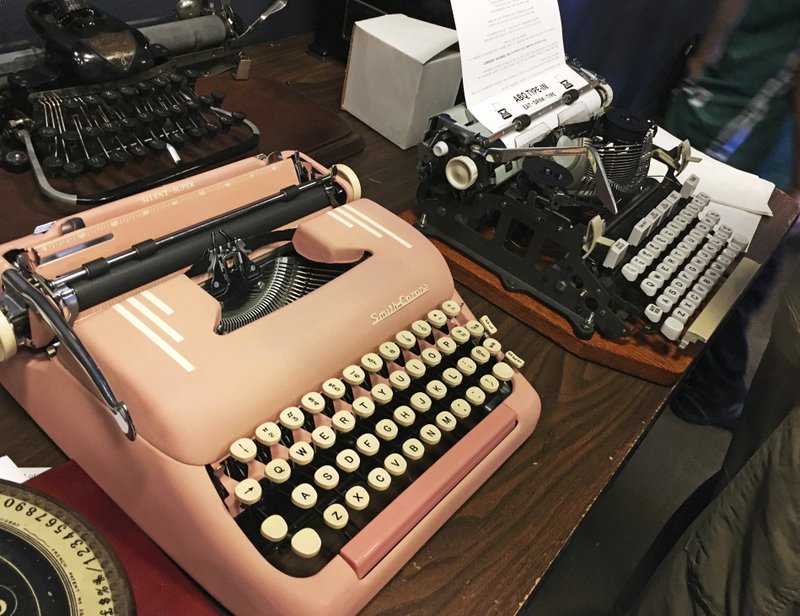 In this April 23, 2017 photo, vintage typewriters are on display at a “type-in” in Albuquerque, N.M. “Type-ins” are social gatherings in public places where typewriter fans test different vintage machines. The vintage typewriter is making a comeback with a new generation of fans gravitating to machines that once gathered dust in attics and basements across the country. (AP Photo/Russell Contreras)
ALBUQUERQUE, N.M. (AP) — Typewriter enthusiasts gather at an Albuquerque restaurant to experiment with vintage Smith Coronas. Fans in Boston kneel in a city square and type stories about their lives during a pro-immigration demonstration. A documentary on typewriters featuring Tom Hanks and musician John Mayer is set for release this summer.
In the age of smartphones, social media and hacking fears, vintage typewriters that once gathered dust in attics and basements are attracting a new generation of fans across the U.S.
From public “type-ins” at bars to street poets selling personalized, typewritten poems on the spot, typewriters have emerged as popular items with aficionados hunting for them in thrift stores, online auction sites and antique shops. Some buy antique Underwoods to add to a growing collection. Others search for a midcentury Royal Quiet De Luxe — like a model author Ernest Hemingway used — to work on that simmering novel.
The rescued machines often need servicing, leading fans to seek out the few remaining typewriter repair shops.
“I haven’t seen business like this in years,” said John Lewis, a typewriter repairman who has operated out of his Albuquerque shop for four decades. “There’s definitely a new interest, and it’s keeping me very busy.”
Being Algorithm’d
News Corp. CEO: The Almighty Algorithm – “fake news” and other consequences of Google, Amazon and Facebook’s relentless focus on quantity over quality
By Robert Thomson

Editor’s note: These remarks were delivered by the chief executive officer of News Corporation, Robert Thomson, during London Tech Week on June 14, 2017.
We are here to pay homage to the almighty algorithm. Algorithmic alchemy is redefining our commercial and social experiences, turning base matter into noble metals. But like the alchemists of old, algorithms are also a charlatan’s charter, allowing claims of pure science when human intervention is clearly doctoring results to suit either commercial imperatives or political agendas.
And there is the enduring contradiction between the claimed sophistication of, say, Google’s ability to target audiences and track tastes for advertisers, and its inability to identify the tasteless, the terroristic, the perverted and the pirated. As the over-alliterative title to this short address suggests, it is profit before provenance and probity. And for journalists, it is penury.
This séance with science is particularly poignant during one of our periodic phases of fascination with AI, artificial intelligence. When is artificial intelligence merely the artifice of intelligence? The most telling recent sign of cerebral superiority was Google’s machine-minded triumph in the board game Go over a Chinese grand master. Chinese call the game weiqi, Japanese call it Go. And so we should turn to the sage Japanese author, Yasunari Kawabata, who presciently wrote The Master of Go sixty-six years ago. He wrote, ”From the Way of Go, the beauty of Japan and the Orient had fled…One conducted the battle only to win, and there was no margin for remembering the dignity and the fragrance of Go as an art.”
Eat Me, Bobby D.
Older female elk ‘virtually bulletproof’ as they learn to avoid hunters

After seven years of studying the movements and behaviours of female elk, University of Alberta researchers discovered they become “virtually bulletproof” as they age.
“Elk learn to become shy as they get older,” said University of Alberta biologist Mark Boyce. “They hunker down in the deep forest and stay in rugged terrain. Those types of behaviours were very effective (for survival) in heavily hunted areas.”
Boyce and two former post-doctoral fellows used radio collars fitted with GPS technology to track elk in southwestern Alberta and southeastern British Columbia between 2007 and 2012.
In their study, published Wednesday, they found female elk learned behaviours that helped them better avoid hunters with each hunting season.
“The bold elk move the most, are the most aggressive and will bolt out into the open. Those elk died at a high rate.” said Boyce. “As they age, they tend to become shy, more savvy, learn to avoid roads.”
While some elk started out shy, most learned to adopt the shy behaviours.
“The magic number is 10,” said Boyce. “After this age threshold, female elk become almost bulletproof, virtually invulnerable to hunting.”
Gaming For Jaguar
JAGUAR IS HIRING GAMERS TO MAKE THE CARS OF THE FUTURE. APPLY WITHIN.
Solve this puzzle. Get fast-tracked. Prosper.
BY SHARI GAB

Getting a job has come a long way since the days of plastic Help Wanted signs hanging in the window.
For their part, Jaguar is keeping up with the times and the changing global culture as we become an even more connected, digitized civilization: The company just announced an intiative to recruit 5,000 new hires from electronics experts to engineers, and since they are targeting the most tech-savvy candidates, the application involves completing several puzzles and games to enter into the running.
To apply: Download their app (of course), study and solve the skill-testing puzzles, including building a rendering of their upcoming I-PACE concept. If you’re an ace, they’ll call you in. That part’s not so different from traditional job hunting.
Bird Butts
Birds use cigarette butts for chemical warfare against ticks
By
Is this a cigarette habit with some benefits? A species of urban bird seems to harness the toxic chemicals in cigarette butts in its fight against nest parasites – although there is a downside to the practice.
Constantino Macías Garcia at the National Autonomous University of Mexico, and his colleagues, have spent several years studying the curious cigarette habit in urban house finches (Carpodacus mexicanus). Initial evidence hinted that nicotine and other chemicals in the butts might help deter insect pests from moving into the nests – nicotine does have anti-parasite properties – but it wasn’t conclusive.
To firm up the conclusion, Macías Garcia and his team experimented with 32 house finch nests. One day after the eggs in the nest had hatched, the researchers removed the natural nest lining and replaced it with artificial felt, to remove any parasites that might have moved in during brooding. They then added live ticks to 10 of the nests, dead ticks to another 10 and left 12 free of ticks.
They found that the adult finches were significantly more likely to add cigarette butt fibres to the nest if it contained ticks. What’s more, the weight of cigarette butt material added to nests containing live ticks was, on average, 40 per cent greater than the weight of cigarette butt material added to nests containing dead ticks.
It really does happen.
Fake cop accused of trying to pull over real police department employee
by Barbara Hijek

All that traffic, so many cars … what are the odds?
When a Hialeah security guard apparently decided to give himself a promotion to police officer, he landed on the wrong side of the bars.
The security guard, Milton Morales-Perez, flashed a badge while trying to pull over a woman talking on the phone who just happened to be a spokeswoman for the Miami Police Department, and was driving an unmarked car and wearing a uniform, according to his arrest affidavit, reports The Miami Herald.
After backup arrived on the scene, the security guard stated he tried to make a traffic stop because it’s dangerous use a phone while driving, records show.
Reminiscing on the Greatest Pitch Ever just for the hell of it…
Hellchange
PHOTO OF THE WEEK: CHINA BUILDS A 20-ROAD INTERCHANGE FROM HELL
by
 Motorists drive on an interchange in Chongqing, China. It has five layers, 20 lanes, and goes in eight different directions. – FRED DUFOUR/GETTY IMAGES
TO A HARRIED motorist, the Huangjuewan flyover is a vision of hell, a mishmash of lanes and ramps that go in eight in directions. But where a driver sees chaos, Fred Dufour sees beauty, even order.
“It’s impressive, all the layers, stacked one by one,” the Getty photographer says. “From above, it’s impressive, too.”
He makes a compelling argument. The Huangjuewan opened last month on the outskirts of Chongqing, a sprawling city in southwest China. The highest of the interchange’s five levels soars 12 stories overhead, and the 20 lanes send cars this way and that. Getting the best view required standing on the roof of a building perched on a nearby hill.
Mahoney
Meet the High Priest of Hollywood Tattoo Artists
by Gary Baum
 Photographed By Brian Bowen Smith
Johnny Depp calls him brother. Adele and Angelina are clients. After 40 years of body ink, Mark Mahoney, whose style now dominates the craft, has become an icon of the Sunset Strip.
A life spent injecting ink into flesh has taken Mark Mahoney, Hollywood’s most influential and respected tattoo artist, across the human experience. He began tattooing drunk Hell’s Angels beneath a swastika flag in a Massachusetts motorcycle club, then made his way for a time to Manhattan, where he set up shop at the bohemian Chelsea Hotel. (Sid Vicious was a client.) Now, with the fully mainstream acceptance of what was an outlaw aesthetic when he started in the business 40 years ago, he finds his booked-six-months-out appointment calendar filled with green-juice-toting “mothers and their daughters from Beverly Hills. I feel like I’m dreaming.”
Also stars: David Beckham is covered in Mahoney’s work, a fine-line style involving solely black-and-gray ink known as “single needle” that he has popularized — and that a coterie of younger practitioners has propagated on increasingly dewier millennial dermis. Other clients include Adele, Angelina Jolie, Rihanna, Jared Leto and Lana Del Rey, who cast him as her muse in two music videos.
In the past, he offered his services to rivals 2Pac and The Notorious B.I.G. — the latter just days before he was killed. (Quincy Jones has joked that musicians thank “God and Mark Mahoney” at the Grammys; awards season in general is particularly busy for him, with extra house calls and visits to the Four Seasons hotel on Doheny Drive.) Longtime patron and friend Mickey Rourke stopped calling to get together after he couldn’t be squeezed in before a boxing match in Russia. “People have told me he’s gettin’ over it,” says Mahoney. “But it breaks my f—in’ heart.”
ROMAINE CALM
Plants can HEAR and use their ‘sense’ to seek out flowing water, scientists discover
By Margi Murphy
PLANTS listen out for the sound of dripping water when they’re thirsty, scientists have discovered.
They can sense water in a flowing pipe – or even a buzzing insect – by detecting the vibrations the water makes, experts claim.
There has long been a question mark over how plants tend to toward water sources.
Evolutionary biologist Monica Gagliano and her colleagues decided to get the bottom of it.
Why Adults Think New Music Sucks
Now THAT was music
One grim day (when youth is over) you find that new music gets on your nerves. But why do our musical tastes freeze over?

Some of us are more susceptible than others, but eventually it happens to us all. You know what I’m talking about: the inability to appreciate new music – or at least, to appreciate new music the way we once did. There’s a lot of disagreement about why exactly this happens, but virtually none about when. Call it a casualty of your 30s, the first sign of a great decline. Recently turned 40, I’ve seen it happen to me – and to a pretty significant extent – but refuse to consider myself defeated until the moment I stop fighting.
I’ve been fighting it for more than 10 years now, with varying degrees of vigour and resolve. Sometimes the fight becomes too much – one tires of the small victories that never break open into anything larger – and the spirit flags. I continually if not consistently stay abreast of what’s deemed the best of the new – particularly in rap and rock and R&B (which I stubbornly and unapologetically refer to, like a true devotee of its 1960s incarnation, as ‘soul’). These ventures into the current and contemporary have reaped dividends so small, they can be recounted – will be recounted – with no trouble at all.
But why should I care? Why should any of us care? Maybe it’s about the fear of becoming what we’ve always loathed: someone reflexively and guiltlessly willing to serve up a load of things-were-better-in-my-day, one of the most facile and benighted of all declarations. If you take pride in regarding yourself as culturally current, always willing to indulge the best of everything wherever it’s found, such taste blockages can be pretty frustrating, even embarrassing. And that hoary old consolation for the erectile dysfunction of the slightly older – ‘It happens to everyone’ – is no consolation at all.
The Original Banksy
The epic rise and disgusting flameout of the artist who ruled 80s New York

In the early 1980s, a series of shadowy street paintings — life-size monsters and cowboys — loomed large over the East Village. Anticipating the works of Banksy by more than a decade, the unsigned figures were created under cover of darkness on buildings and bridges. They weren’t mere graffiti, but painterly works reminiscent of Jackson Pollock. Downtown residents buzzed about who could be behind them.
The art world knew who it was: a soft-spoken Canadian — often clad in a cravat and sunglasses — named Richard Hambleton.
At downtown galleries, his mysterious figures fetched thousands of dollars more than work by his friends Jean-Michel Basquiat and Keith Haring. He attended parties with beautiful women on his arm, and Andy Warhol begged him, in vain, to sit for a portrait.
Hambleton canvased Manhattan with some 450 shadow men — and managed to get a few on the Berlin Wall, too. But by the 1990s, he was largely forgotten, living in a drug den on the Lower East Side. He was so poor that he would shoot himself up with heroin, then use the blood in his needle as paint. At some point, he lost half his nose. (He won’t discuss his health, but he has numerous ailments, including skin cancer.)
But lately, Hambleton, 64, has been emerging from his shadowy existence. Hip galleries have begun showing his work again. He’s recognized as the godfather of street art, and his influence can be seen in the works of painters such as Banksy, Blek le Rat and the Brooklyn duo FAILE. And a documentary about his life and work, “Shadowman,” will debut at the Tribeca Film Festival Friday.
Lonely Cities
Will the high-tech cities of the future be utterly lonely?
by Jessica Brown
 Maciej Bledowski / Alamy Stock Photo
Humans are inherently social animals, and our health suffers if we’re cut off from social ties. So it’s no wonder the so-called loneliness “epidemic” is being called a public health crisis. But as we sit on the cusp of massive technological advances, the near future could exacerbate this growing problem.
Loneliness can happen to anyone. It is indiscriminate of age, country, and social status. In Britain, more than one in eight people say they don’t consider anyone a close friend, and the number of Americans who say they have no close friends has roughly tripled in recent decades. A large proportion of the lonely are young; almost two-thirds of 16- to 24-year-old Brits said they feel lonely at least some of the time, while almost a third are lonely often or all the time.
One pervasive source of our loneliness is technology. While it offers an easy way to keep in contact with friends — and meet new people through dating and friendship apps — technology’s omnipresence encourages shallow conversations that can distract us from meaningful, real-life, interactions. Researchers at the University of Essex found that having a phone nearby, even if we don’t check it, can be detrimental to our attempts at connecting with others. Smartphones have transformed post office lines from a chance for some small-talk with the neighbors to an exercise in email-checking, and sealed the fate of coffee shops as nothing more than places of mutual isolation. And technology will only become more ingrained in our lives.
Mo’ Bartiromo
Buy a dose, get a brain…
First evidence found that LSD produces ‘higher’ level of consciousness, scientists claim
However the increased brain activity detected is not actually ‘better’, according to the researchers
by Ian Johnston
 The cover of the Incredible String Band’s second LP, released in 1967, showed psychedelia’s influence on music and art Jeff Morgan/Alamy
Scientists claim to have found the first evidence that psychedelic drugs create a “higher level of consciousness”.
LSD, the “date rape” drug ketamine and psilocybin, the activeingredient of magic mushrooms, were all found to increase the tiny magnetic fields produced by the brain.
This is used to create a mathematical measure of the complexity of brain activity, with people who are asleep having a lower level than people who are awake.
Professor Anil Seth, co-director of the Sackler Centre for Consciousness Science at Sussex University, said: “This finding shows that the brain-on-psychedelics behaves very differently from normal.
“During the psychedelic state, the electrical activity of the brain is less predictable and less ‘integrated’ than during normal conscious wakefulness – as measured by ‘global signal diversity’.
However the scientists stressed the higher levels seen in people on the psychedelic drugs did not actually equate to something that was “better”.
Asteroid Time Machines
Rocks of ages: How meteorites reveal the solar system’s history
Clever ways to find more space debris, and pinpoint where it came from, will help us rewrite what we know about the solar system’s turbulent youth
By
 Shutterstock
A MAN with a Stetson perched on his head reclines in his chair, an assortment of rocks displayed in front of him. A second man in a fedora browses the collection, pausing over one specimen. The size of a chocolate bar, the silvery rock is inlaid with a mosaic of grainy grey shapes.
“What are you asking for that one?” asks the fedora.
“Oh, somewhere around five thousand,” replies the Stetson.
It’s a routine exchange at the annual Tucson Gem, Mineral & Fossil Showcase in Arizona, a marketplace for international collectors of petrified wood, dinosaur bones, gold and more. Except there’s something special about this rock: it came from space.
Maria Bartiromo Massive Cleavage
Negative Mass Created
Physicists create fluid with ‘negative mass’
“What’s a first here is the exquisite control we have over the nature of this negative mass, without any other complications,” said researcher Michael Forbes.
By Brooks Hays
 Scientists created a liquid with “negative mass.” The experiments could help scientists investigate astrophysical phenomena like black holes and dark matter. Photo by NASA/UPI
April 17 (UPI) — A team of physicists at Washington State University have created a fluid that ignores Isaac Newton‘s Second Law of Motion. The fluid has “negative mass.” When it’s pushed it accelerates backwards.
Almost all matter in the universe obey’s Newton’s second law — matter accelerates in the direction of the force applied to it. The new fluid does the opposite.
“With negative mass, if you push something, it accelerates toward you,” Michael Forbes, an assistant professor of physics and astronomy at Washington State, said in a news release.
The liquid consists of rubidium atoms cooled to a temperature barely greater than absolute zero. The cooled atoms formed a Bose-Einstein condensate, a phase of matter characterized by slow-moving particles that behave like waves. The matter behaves like a superfluid, meaning its particles move in unison without sacrificing energy.
Droppin’ The Gloves
Dream Center Discovered
Scientists identify parts of brain involved in dreaming
Experts say findings are ‘astounding’ and could help understand the purpose of dreams and predict whether people are dreaming
by Nicola Davis
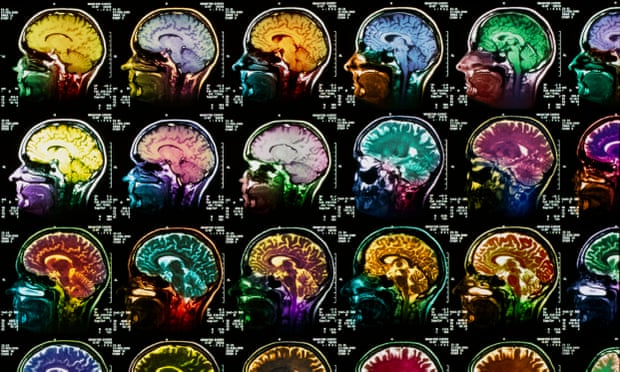 Coloured sagittal MRI scans of the human brain. Changes in brain activity offer clues to what the dream is about. Photograph: Simon Frazer/SPL/Getty Images
Scientists have unpicked the regions of the brain involved in dreaming, in a study with significant implications for our understanding of the purpose of dreams and of consciousness itself. What’s more, changes in brain activity have been found to offer clues as to what the dream is about.
Dreaming had long been thought to occur largely during rapid eye-movement (REM) sleep, a period of slumber involving fast brain activity similar to that when awake, but dreams have also been reported to occur during non-REM sleep, leaving scientists scratching their heads as to the hallmark of dreaming.
“It seemed a mystery that you can have both dreaming and the absence of dreaming in these two different types of stages,” said Francesca Siclari, co-author of the research from the University of Wisconsin-Madison in the US.
Now it seems the puzzle has been solved.
Pink Floyd Killer Shrimp
A Shrimp That Can Kill With Sound Is Named After Pink Floyd
by ROBIN HILTON
 Synalpheus pinkfloydi, which was recently named after the band Pink Floyd, for the distinctive coloration of its claw. Arthur Anker/Courtesy of Sammy De Grave and Oxford University
Legend has it that the band Pink Floyd once played so loudly at a show that the sheer volume had killed all the fish in a nearby pond.
Now there’s a new species of shrimp, named after Pink Floyd, that can kill fish by making a loud noise. Synalpheus pinkfloydi rapidly opens then snaps closed its large claw, generating frequencies up to 210 decibels — louder than a typical rock concert and loud enough to kill small fish nearby.
It turns out, however, that its new name has nothing to do with that urban myth about Pink Floyd’s volume. Dr. Sammy DeGrave, head of research at Oxford University Museum of National History, says the inspiration for the shrimp’s name was really the color of its claw: pink. “The reference is to the line, ‘By the way, which one of you is Pink?’ from the song ‘Have A Cigar’,” DeGrave told NPR when reached over the phone. “The story is when Pink Floyd first went to America, people thought one of the band members was actually named Pink. A reporter asked, ‘Which one of you is pink?” so that’s what stuck in our mind and that’s where [the name] came from.”
Probert’s Ashes Sent To Penalty Box
NHL enforcer Bob Probert’s widow sprinkled his ashes in Red Wings’ penalty box
By Des Bieler
Bob Probert carved out a fearsome reputation as an enforcer, during a lengthy career spent with the Red Wings and Blackhawks, before dying of a heart attack in 2010 at age 45. So with Detroit’s Joe Louis Arena set to host its final game Sunday, Probert’s widow found the perfect way to honor both her husband’s memory and that of the facility in which he performed for nine seasons.
By scattering some of his ashes in the penalty box.
“This is bittersweet for me,” Dani Probert, the widow of 6-foot-3, 230-pound former player, told the Detroit Free Press before Sunday’s game, which featured numerous ceremonies and appearances from several past Red Wings stars. “I have brought some of Bob’s ashes to the game. At Christmas time, I came here with my family and the urn with his ashes and we took a photo of us sitting in the penalty box.”
Enceladus Alive!
Nasa announces one of Saturn’s moons could support alien life in our solar system
Molecular hydrogen, as found on Enceladus, is one of the essential parts of life on Earth
There might be alien life in our own solar system, Nasa has announced.
All of the necessary things to support life have been found on one of the moons that orbits Saturn.
Enceladus has chemicals that when found on Earth tend to indicate life, suggesting that there might be living things might be under its icy shell.
Scientists have long thought of Enceladus as one of the prime candidates for life within our solar system or anywhere else nearby, in large part because it is a planetary body with an ocean that covers its entire surface. But the new research gives the best look yet at that moon, showing that it has a chemical energy source capable of supporting life.