
5,000-year-old Toy Car Found
5,000-Year-Old Version of a Toy Car Found in Archeological Dig in Turkey
It’s not Hot Wheels or Matchbox. In fact, it predates those by several millennia.

Many gearheads grew up playing with toy cars. Loyalties to Hot Wheels or Matchbox were as divisive as those between Ford and Chevy are today. But kids have been fascinated by wheels since long before these companies—or even the car itself—existed. An archeological dig in Turkey has revealed that our fascination with toy wheels goes back at least 5,000 years, reports the International Business Times.
The ongoing excavation of the ancient city of Sogmatar, in modern-day Turkey, has dug up some children’s toys. The big surprise was the discovery of a small earthen carriage toy. Even back in the time of Moses (who is said to have sought refuge in Sogtamar after escaping Egypt), kids played with toy cars—or, at least, the equivalent of them back in the day.
“In one of these tombs, we found a four-wheeled miniature horse carriage, a children’s toy, as well as a rattle with a bird motif,” assistant professor Yusuf Albayrak of Turkey’s Harran University told the International Business Times. “Children’s toys were buried in children’s tombs. We thus know that rattles existed for children 5,000 years ago.”
BOHEMIAN RHAPSODY REVIEW
Ancient Ship Found
World’s oldest intact shipwreck discovered in Black Sea
Archaeologists say the 23-metre vessel has lain undisturbed for more than 2,400 years
 The world’s oldest shipwreck dating from 400BC of ancient Greek origin, most likely a trading vessel. Photograph: Black Sea map
Archaeologists have found what they believe to be the world’s oldest intact shipwreck at the bottom of the Black Sea where it appears to have lain undisturbed for more than 2,400 years.
The 23-metre (75ft) vessel, thought to be ancient Greek, was discovered with its mast, rudders and rowing benches all present and correct just over a mile below the surface. A lack of oxygen at that depth preserved it, the researchers said.
“A ship surviving intact from the classical world, lying in over 2km of water, is something I would never have believed possible,” said Professor Jon Adams, the principal investigator with the Black Sea Maritime Archaeology Project (MAP), the team that made the find. “This will change our understanding of shipbuilding and seafaring in the ancient world.”
The ship is believed to have been a trading vessel of a type that researchers say has only previously been seen “on the side of ancient Greek pottery such as the ‘Siren Vase’ in the British Museum”.
Fascistic Mahler Fans
A concert-goer rustled a bag of gum during a Mahler symphony. A “violent attack” ensued.
By Isaac Stanley-Becker
It is said to represent the composer’s love letter to his new bride. And, like love, the Adagietto transports those who receive it – its atmospheric notes offering release from the grim foreboding and frenetic outbursts of the earlier movements of Gustav Mahler’s 5th Symphony.
But worldly concerns have a way of intruding: an iPhone light, a candy wrapper, one too many trips to the restroom.
The rustling of a gum wrapper at a performance of the symphony last week in the Swedish city of Malmo brought a section of the audience back down to earth, and brought several concertgoers to blows. Mahler’s late Romantic epic became the occasion for an epic clash over candy.
As Andris Nelsons, an eminent Latvian conductor, coaxed the quiet notes from the string section of the Leipzig Gewandhaus Orchestra, a woman in the balcony rustled a bag of gum, the Sydsvenskan newspaper reported. A young man sitting next to her glared a few times and then lost his patience. He snatched the bag from her and threw it onto the floor.
Witnesses told the daily newspaper published in southern Sweden that the woman sat stoically through the rest of the Adagietto, which typically lasts about 10 minutes (“very slow,” Mahler instructed in the score), and the vigorous and triumphant finale. The symphony, composed in 1901 and 1902, has been described as a “large-scale journey,” similar to climbing Mount Everest. Leonard Bernstein conducted the Adagietto at the funeral services for Robert F. Kennedy in 1968.
But as the concert hall vibrated with the final, resounding notes, and as applause rang out, she exacted her revenge….
Signed Copy of KATERINA @ Powell’s

Gulper Eel Awesome
KATERINA on New York Post Must-read List
This week’s must-read books

Katerina
James Frey (Gallery/Scout Press)
Set in 1992 Paris and 2018 Los Angeles, a love story between a young writer and a young model, both on the verge of fame. Twenty-five years later, the writer receives an anonymous message that draws him back to that relationship and all the magic of that earlier time.
Silver Twirler Rules
The Murky Origins Of Money
Conflict reigns over the history and origins of money
Thousands of years ago, money was a means of debt payment, archaeologists and anthropologists say
BY BRUCE BOWER
Wherever you go, money talks. And it has for a long time.
Sadly, though, money has been mum about its origins. For such a central element of our lives, money’s ancient roots and the reasons for its invention are unclear.
As cryptocurrencies such as Bitcoin multiply into a flock of digital apparitions, researchers are still battling over how and where money came to be. And some draw fascinating parallels between the latest, buzzworthy cryptocurrencies, which require only a virtual wallet, and a type of money developed by one Micronesian island community that wouldn’t fit in anyone’s wallet, pocket or purse.
When it comes to money’s origins, though, conflict reigns. Economists have held one view of money’s origins for hundreds of years. But a growing number of anthropologists and archaeologists, holding a revisionist view, say that economists’ standard story is bankrupt.
Economists and revisionists alike agree that an object defined as money works in four ways: First, it serves as a means for exchanging goods and services. Currency enables payment of debts. It represents a general measure of value, making it possible to calculate prices of all sorts of items. And, finally, money can be stored as a wealth reserve.
From there, the two groups split. Mainstream economists assume that bartering of goods and services inspired money’s invention. Anthropologists and archaeologists contend that early states invented currency as a means of debt payment.
“Much academic work assumes that [monetary systems] arose in nation-states within the last 200 to 400 years,” says sociocultural anthropologist Daniel Souleles of Copenhagen Business School in Frederiksberg. But financialized transactions and debt show up in lots of places much further back in time.
Recent research from the Americas adds new questions to the debate. These investigations suggest that money independently appeared for different reasons and assumed different tangible forms in many parts of the world, starting thousands of years ago.
A MILLION LITTLE PIECES Deadline Cover

Taco Bell Rules
Taco Bell voted best Mexican restaurant in the country
ST. LOUIS (KMOV.com) — The Harris Poll, a nationwide customer survey of their favorite brands, has released its 2018 results.
The poll surveyed more than 77,000 customers in the U.S. on more than 3,000 brands to find which companies are the favorites among consumers.
Respondents weighed in on everything from printers to pizza, and the results are surprising. Here are some of consumers’ top choices.
Best Mexican Restaurant: Taco Bell
The after-hours crowd is still probably Taco Bell’s biggest customer base, but the company has grown its popularity through creative ads like the Nacho Fries conspiracy theory movie trailers starring Josh Duhamel and a strong social media presence.
The company has 7,000 locations and does nearly $2 billion in revenue.
More A MILLION LITTLE PIECES @ TIFF
Sam And Aaron Taylor-Johnson Breathe Fire Into James Frey’s Controversial Addiction Memoir ‘A Million Little Pieces’
 Entertainment One
A Million Little Pieces is as raw, bloody and messy as James Frey wrote it. With the startling intensity he shocked Toronto with in Nocturnal Animals two years ago, Aaron Taylor-Johnson plays Frey through his evolution from a hopeless, cornered animal descending down a drug-induced death spiral to someone who pulls out of the nosedive after reluctantly embracing help from a group of fellow addicts to create distance from the seduction of crack cocaine and hard liquor ravaging his body.
The right filmmaker came along when the Taylor-Johnsons came knocking. Sam and Aaron Taylor-Johnson had been an inseparable couple since she cast him in her directorial debut, 2009’s Nowhere Boy, as a young John Lennon. They liked the idea of pulling something more modest together, after the miserable time Sam had directing the first Fifty Shades of Grey movie. She’d been expecting to make a trilogy out of E.L. James’s erotic fiction series, but even though her first chapter grossed $571 million, she withdrew. Speculation was that the unprecedented level of creative control Universal offered James, a first-time novelist, in order to beat out the offers pouring in from other studios, caused issues.
Sam had been captivated by Frey’s memoir since she read it shortly after its publication, when she was known for her eye as a still photographer, and before she ever made her feature debut. “I loved the way it was told,” she remembers. “90 miles an hour is a good way to describe the ferocity and pace of his writing. I remember feeling exhausted and elated at the end, thinking it would make an amazing movie. Later, I’d hear or read that some other filmmaker signed on and I’d feel a twinge of jealousy.”
After they met, she gave it to Aaron, who devoured it. He says: “The journey of redemption, the light at the end of the tunnel, and the rhythm James put into his writing which provides such energy, it made us want to try and translate that into a character on screen.”
GAWKER Alive
Gawker Set to Relaunch Under New Owner Bryan Goldberg (EXCLUSIVE)
Amanda Hale hired as publisher for new iteration of the media gossip blog

Gawker will rise from the ashes in a new iteration of the website to be launched next year, Variety has learned.
The reborn Gawker comes under the ownership of Bryan Goldberg, founder and CEO of Bustle Digital Group, who was the winning bidder for the remaining assets of Gawker Media in July. Goldberg paid $1.35 million for the media gossip blog, which has been dormant for over two years after Gawker Media was sued into bankruptcy by Silicon Valley billionaire Peter Thiel.
In a memo to Bustle staff Tuesday obtained by Variety, Goldberg said he has hired Amanda Hale as the new publisher of Gawker. Based in New York, Hale most recently was chief revenue officer of The Outline, the culture website founded by Joshua Topolsky (who previously worked at Bloomberg Media and The Verge) that recently laid off one-fourth of its staff.
Goldberg is targeting the Gawker relaunch for early 2019. “We won’t recreate Gawker exactly as it was, but we will build upon Gawker’s legacy and triumphs — and learn from its missteps,” he wrote in the memo. “In so doing, we aim to create something new, vibrant, highly relevant, and worth visiting daily.”
Sam Taylor-Johnson on A MILLION LITTLE PIECES
Sam Taylor-Johnson on “the Dream” of Directing Husband Aaron in A Million Little Pieces
The adaptation of James Frey’s book—debuting at the Toronto Film Festival on Sunday—is the couple’s first collaboration since Nowhere Boy.
by JULIE MILLER
.jpg) Jeff Gros
Jeff Gros
Since making 2009’s brilliant John Lennon biopic Nowhere Boy, director Sam Taylor-Johnson and actor Aaron Taylor-Johnson had been looking for an excuse to work together again.
But their personal collaborations complicated reunion possibilities for several years. Sam and Aaron fell in love after making the movie, got married, and had two daughters. (Sam also has two older daughters from her first marriage.) Rather than leave the kids in the care of strangers, husband and wife took turns making movies—with Sam adapting E.L. James’s bodice-ripping best-seller Fifty Shades of Grey into an artful blockbuster; and Aaron cycling through genres in Anna Karenina,Godzilla, Avengers: Age of Ultron, and Nocturnal Animals.
Last year, though, the stars finally re-aligned for the Taylor-Johnsons. Sam signed on to direct an adaptation of James Frey’s 2003 book, A Million Little Pieces. And Aaron coincidentally had a gap in his schedule.
“The minute I knew he was available, it was clear that Aaron would be James. Absolutely, without question,” Sam said in an interview ahead of A Million Little Pieces’ premiere at the Toronto Film Festival. “I think it was serendipitous timing that he was available, the book rights were available, and the timing was perfect. . . . This was the dream since we first worked together. After [Nowhere Boy], we would both go to work on different projects, and I’d say, in my mind, ‘I’m leaving the best actor at home.’”
Flying Cholitas
Stay gold, Ponyboy
The Enduring Spell of ‘The Outsiders’
S. E. Hinton’s 1967 coming-of-age novel credited teenagers with a rich interior life. Here, a tribute to the book that created young adult fiction as we know it today.
By Lena Dunham
IT WAS FRESHMAN year of college and I fancied myself someone, well, fancy. Someone who loved fancy books and fancy men. Fancy bags and fancy restaurants. I was working overtime to appear unfazed, and it was moving along about as smoothly as the Sochi Olympics. Across the Intro to Genealogy classroom sat a boy who looked like a man but was, by virtue of being 19, still a boy — dark hair and dark eyes, a denim jacket so stiff it looked starched. He barely spoke but knew all the answers, while I spoke all the time and knew none.
I was leaving in the spring, transferring to a school that my mother considered more “academically rigorous,” and it was my soon-to-be-outta-here sense of abandon that allowed me to approach him one day after class: “Hey, did you know you look like the lead singer of the Cure?”
He looked at me quizzically. “Who’s that?” he asked. I stuttered — the fact was, I didn’t actually know. I’d seen a photo of Robert Smith in another kid’s dorm room and wasn’t expecting to be questioned, but instead to receive the kind of insider approval that usually accompanied a display of hipster knowledge. (This was the privilege of not having to consider the consequences of any action, great or small, that is endemic to upper-middle-class white girls everywhere.) I stammered: “Your hair is … I mean, your faces both kind of look …” He stared.
I changed tactics.
“I’m transferring,” I haughtily informed him.
“Oh, are you?” He jutted his chin out toward me: “O.K., then … stay gold, Ponyboy.”
Bandit Gone
Burt Reynolds, Movie Star Who Played It for Grins, Dies at 82
by
The ex-jock from Florida starred in ‘Deliverance’ and ‘Boogie Nights’ but preferred making such populist, fun fare as ‘Smokey and the Bandit,’ ‘The Cannonball Run’ and ‘Starting Over.’
Burt Reynolds, the charismatic star of such films as Deliverance, The Longest Yard and Smokey and the Bandit who set out to have as much fun as possible on and off the screen — and wildly succeeded — has died. He was 82.
Reynolds, who received an Oscar nomination for his portrayal of porn director Jack Horner in Paul Thomas Anderson’s Boogie Nights (1997) and was the No. 1 box-office attraction for a five-year stretch starting in the late 1970s, died Thursday morning at Jupiter Medical Center in Florida, his manager, Erik Kritzer, told The Hollywood Reporter.
Always with a wink, Reynolds shined in many action films (often doing his own stunts) and in such romantic comedies as Starting Over (1979) opposite Jill Clayburgh and Candice Bergen; The Best Little Whorehouse in Texas (1982) with Dolly Parton; Best Friends (1982) with Goldie Hawn; and, quite aptly, The Man Who Loved Women (1983) with Julie Andrews.
Though beloved by audiences for his brand of frivolous, good-ol’-boy fare, the playful Reynolds rarely was embraced by critics. The first time he saw himself in Boogie Nights, he was so unhappy he fired his agent. (He went on to win a Golden Globe but lost out in the Oscar supporting actor race to Robin Williams for Good Will Hunting, a bitter disappointment for him.)
Join Me On Tour – Join Me On Instagram

Serve To Live Longer
The Best Sport for a Longer Life? Try Tennis
People who played tennis, badminton or soccer tended to live longer than those who cycled, swam or jogged.
Playing tennis and other sports that are social might add years to your life, according to a new epidemiological study of Danish men and women.
The study found that adults who reported frequently participating in tennis or other racket and team sports lived longer than people who were sedentary. But they also lived longer than people who took part in reliably healthy but often solitary activities such as jogging, swimming and cycling.
The results raise interesting questions about the role that social interactions might play in augmenting the benefits of exercise.
At this point, no one doubts that being physically active improves our health and can extend our longevity. Multiple, recent epidemiological studies have pinpointed links between regular exercise and longer lives in men and women.
Mini Space Elevator, Cool
Going up! Japan to test mini ‘space elevator’
A Japanese team working to develop a “space elevator” will conduct a first trial this month, blasting off a miniature version on satellites to test the technology.
The test equipment, produced by researchers at Shizuoka University, will hitch a ride on an H-2B rocket being launched by Japan’s space agency from southern island of Tanegashima next week.
The test involves a miniature elevator stand-in—a box just six centimetres (2.4 inches) long, three centimetres wide, and three centimetres high.
If all goes well, it will provide proof of concept by moving along a 10-metre cable suspended in space between two mini satellites that will keep it taut.
The mini-elevator will travel along the cable from a container in one of the satellites.
200 Years of Knowledge Up In Flames
Brazil museum fire: Funding cuts blamed as icon is gutted
Officials in Brazil have blamed lack of funding for a huge fire that has ravaged the country’s National Museum.
One of the largest anthropology and natural history collections in the Americas was almost totally destroyed in Sunday’s fire in Rio de Janeiro.
This included the 12,000-year-old remains of a woman known as “Luzia” – the oldest discovered in Latin America.
There had also been a string of complaints about the dilapidated state of the 200-year-old museum.
“We never had adequate support,” its deputy director said after the fire.
Experts had warned for years of a serious fire risk to the building
Alexa 9000
The World’s First Movie Poster
Sotheby’s Is Selling the World’s First Movie Poster, Which Promoted a Premiere Only 30 People Attended
The poster is an important piece of cinematic history.
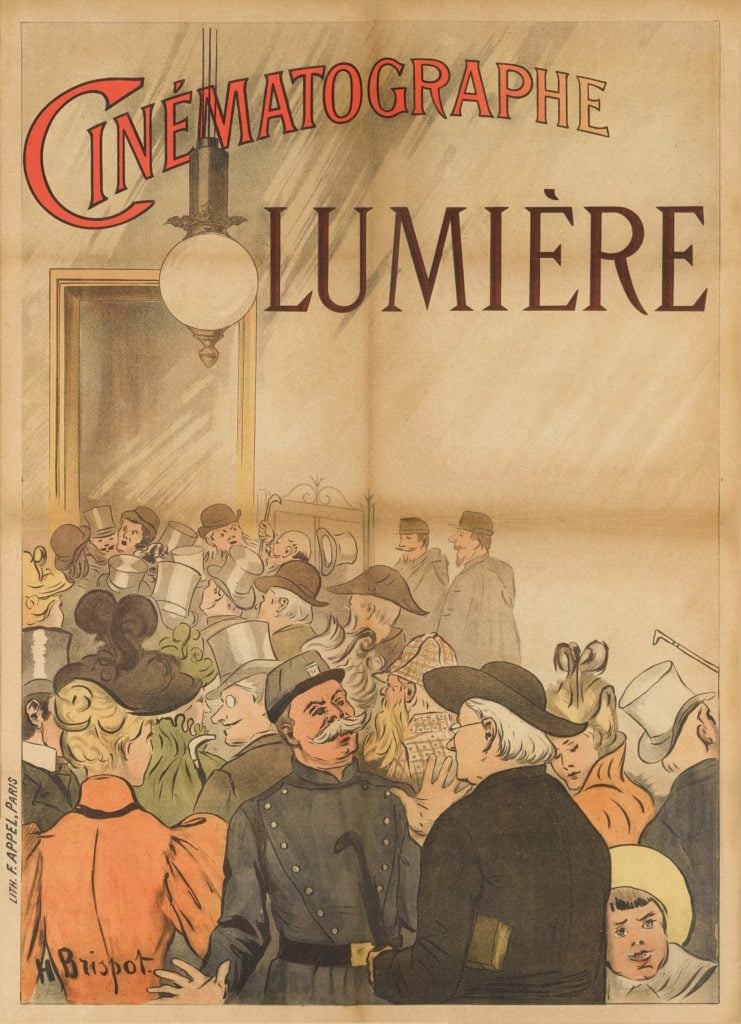 Henri Brispot, Cinématographe Lumière (1896). This poster was created for the Lumière Brothers on the occasion of the world’s first-ever public film screening. It is thought to be the world’s first movie poster. Courtesy of Sotheby’s London.
The world’s first public movie screening was a far cry from today’s red carpet premieres, with just 30 people in attendance for an event that lasted some 20 minutes at a Parisian cafe on December 28, 1895. Now, Sotheby’s is auctioning the poster for that event, held by filmmaker brothers Auguste Lumière and Louis Jean Lumière. It is likely the first film poster ever made.
The design by artist Henri Brispot is one of 164 rare film posters for sale in an online auction held by Sotheby’s London beginning August 28. The poster, which optimistically predicted a much larger crowd than the premiere actually received, carries a pre-sale estimate of £40,000 to £60,000 ($50,830 to $76,240). The auction house calls it “the ultimate collector’s poster,” adding that “this exceptionally rare piece has only surfaced a few times.”
The sale runs through September 4 and also includes rare film posters from the James Bond series, 2001: A Space Odyssey, Star Wars, and King Kong, among other classic movies.
Homer’s Revenge
Woman May Have Lost NASA Internship After Insulting Famed Engineer Homer Hickam
Hickam told the young girl to watch her language on Twitter.

A woman may have lost her NASA internship following a profanity-laced back-and-forth with a user on Twitter, who is none other than the famed former NASA engineer and current space council adviser Homer Hickam.
A user identified as Naomi H. (@NaomiH_official) announced her internship with a tweet that said, “”Everyone shut the f— up. I got accepted for a NASA internship.”
Another user, who ended up being Hickam — the former NASA engineer and inspiration of the 1999 film October Sky, based on his memoir — responded, “Language.” Naomi H. tweeted back with a sexually vulgar tweet, concluding it with “I’m working at NASA.” Hickam responded, “And I am on the National Space Council that oversees NASA.”
New Underground Railroad
No One Is Safer. No One Is Served.
An immigrant family hides from Donald Trump in a Connecticut church.
The legendary Chicago oral historian and moral force Studs Terkel once said, “There is a decency in the American people and a native intelligence—providing they have the facts, providing they have the information.” During a lifetime of listening to Americans, Terkel came to believe that, when Americans have the information, they do the right thing.
So here is the information:
For a hundred and fifty-eight days, Malik Naveed bin Rehman, Zahida Altaf, and their five-year-old daughter, Roniya, have been living in the basement of the First Congregational Church of Old Lyme, Connecticut. There is an electronic bracelet attached to Malik’s ankle, which provides his real-time location to ice authorities. On a recent Saturday morning, Malik showed me the plastic bracelet, which looks like a snug black shackle. Though ice authorities can send pre-recorded messages to him through the bracelet, he said that they prefer to call him on his cell phone, usually between 2 and 5 a.m. “Malik? Are you there?” they ask. He is convinced they do this to prevent the family from sleeping through the night.
Malik and Zahida are a middle-aged couple, originally from Pakistan, who have been in the United States for almost twenty years. They arrived as asylum seekers in 2000, and the first two attorneys they hired both absconded with their money—more than sixteen thousand dollars in total—and were later prosecuted for fraud. Over subsequent years, Malik and Zahida consulted eight more attorneys. In 2008, immigration officials denied their asylum application. They filed an appeal, which was rejected in 2010. Immigration officials then began court proceedings to remove them from the United States.
Cetacean Frustration
Sexually frustrated dolphin named Zafar terrorises tourists on French beach
by Rory Mulholland, Paris
 The dolphin rubs himself up against kayaks and canoes
A seaside village in Brittany has banned swimming on its beach because a dolphin in heat has been scaring tourists and locals by approaching them and trying to rub up against them.The dolphin has even tried to prevent several swimmers from getting back to the beach at Landévennec, using its nose to push one woman out of the water and up into the air.
The beast, often clearly in a state of sexual arousal, also often tries to rub up against kayaks and other small boats.
The three-metre long dolphin, which locals have nicknamed Zafar, has been hanging around the Bay of Brest for months, amusing tourists with its antics as it visited the beaches and shorelines of Plougastel-Daoulas, Logonna-Daoulas and Landevennec.
Children in sailing schools were delighted when the dolphin would suddenly turn up and frolic around their boats, and Zafar sometimes let swimmers grip onto his dorsal fin and go for a ride with him.
But then a few weeks ago he changed.
The Human Hay Bale
Best Books of 2018: KATERINA by JAMES FREY
The Best Books of 2018 (So Far)
Get your to-read list ready: 2018 is already a good year for reading.

We may live in challenging times, and there’s no better escape than through a good book. From new novels from beloved writers to compelling non-fiction examinations of our modern world, 2018 has already delivered some excellent reads.
Would you respond to a cryptic Facebook message from an unrecognized user? Forty-two-year-old novelist-turned-screenwriter Jay does. He’s ambivalent about the messages at first, but their familiar tone piques his interest and reminds him of someone important from his past. Thus, begins this sexy and electric novel that flips between modern-day Los Angeles and Paris in 1992—back when Jay was 21 and burning with the desire to make art that was going to change the world. Frey, perhaps best known for his controversial book A Million Little Pieces, has penned a compulsive novel that speaks directly to the scandal that blew up his own life.
CLICK TO BUY KATERINA on Amazon
[ click to read the rest of the Best 2018 Books at Esquire ]
Neil Simon Gone
Neil Simon dead at 91
 (Getty Images)
Prolific American playwright Neil Simon has died at age 91.
Regarded as the first playwright to have a Broadway theater named after him, Simon’s work dates back to “Come Blow Your Horn” in 1961 followed closely in 1963 with the success of his play “Barefoot in the Park.” Since then, he’s won Tony Awards for shows “The Odd Couple,” “Biloxi Blues” and “Lost in Yonkers.”
In total, Simon wrote more than 30 plays and earned 17 Tony nominations with three wins. He also won a Tony for special achievement as well as a Pulitzer and the Mark Twain prize for humor. Of note is the fact that he had one Broadway season in 1966 in which four of his plays were running simultaneously: “Barefoot in the Park”; “The Odd Couple”; “Sweet Charity”; and “The Star-Spangled Girl.”
A MILLION LITTLE PIECES @ TIFF 2018
TIFF 2018: 5 Drama Films That Explore the Human Condition
 Sam Taylor Johnson with Aaron Taylor-Johnson and Billy Bob Thornton (Photo: Instagram/samtaylorjohnson)
Even if they are from another part of the world and in another language, drama films moveus. Why? Because as humans, we share many of the same emotions and desires. The TIFF 2018 drama section is full of movies based on riveting stories about people caught up in harsh and even tragic circumstances beyond their control. We bring you five TIFF Festival films that will tug at your heart strings and leave a mark on your memory.
The Toronto International Film Festival (TIFF) 2018 is just around the corner, and the buzz is spreading fast that it’s going to be an exciting event. While films of all genres will be screened at the festival, people are eager to know which films will be shown in the “drama” section.
This year, there are fantastic films from all over the world that have entered the drama section and festival-goers will be hard pressed to choose which ones to watch in the limited time they have.
#1] A Million Little Pieces
Director – Sam Taylor-Johnson
Country – USA
James Frey’s controversial bestseller A Million Little Pieces gets the big screen treatment by director Sam Taylor-Johnson.
The film tells the story of an alcoholic crack addict (Aaron Taylor-Johnson) who finds some peace in the company of a former crime lord (Billy Bob Thornton) and a former sex worker (Odessa Young).
It is a harrowing ride into the deepest darkest corners of a drug addict’s psyche and the devastation caused by drug addiction.
It’s a tale about the loss of one’s self-esteem and character but also of hope and the journey towards renewal. The protagonist finds his calling as a writer but only after he picks up the pieces of his shattered self.