
Our New Mini-moon
Mystery object entering Earth’s orbit ‘to become planet’s mini-moon until May’
An object known as 2020 SO is heading towards Earth, and could stay in orbit of the planet from October until May next year – although some think it could just be space junk
By Joshua Smith
Earth could be about to get a new moon – but experts have been left baffled at what the mystery object actually is.
An object known as 2020 SO is heading towards Earth and from October it will be a “mini-moon”, which could stay in orbit of the planet until May next year.
Another object, named 3753 Cruithne, has already been dubbed Earth’s “second moon” – meaning 2020 SO would be our third.
Cruithne is in a normal elliptic orbit around the Sun.
Its period of revolution around the Sun, approximately 364 days at present, is almost equal to that of Earth.
Loving Music & Loathing Bullshit
The Great Stanley Crouch
An American immigrant jazz buff expresses his gratitude to a supremely gifted critic who loved the music and loathed bullshit
BY TONY BADRAN
If I had to name the one writer who was most pivotal for me and for my full assimilation in America, it would undoubtedly be Stanley Crouch, the famed jazz and cultural critic who died last Wednesday in New York at age 74. At this moment in American life, where anything and everything that identifies us and binds us as Americans is under direct assault, Crouch is perhaps more essential than ever, and his passing all the more devastating.
Perhaps even more than Albert Murray and Ralph Ellison, Crouch tied it all together for me. He had a terrific ear for the music I love, and his uncompromising pugnacious style spoke to me directly. For someone who came to America from a sectarian Third World society, his commentary on the Balkanization of America was penetrating and, as we’re seeing today, scarily pertinent.
Crouch had no patience for the self-pitying race politics of grievance and authenticity. He saw it as a hustle and had nothing but contempt for its toxic sales pitch. He arrived at this conviction the hard way, as he explains in the prologue to his fabulous Considering Genius:
The tribal appeal is always great and there is nothing more tempting to the most gullible members of a minority group than suddenly hearing that, merely by being born, one is not innately inferior to the majority but part of an unacknowledged elite. I was not so sophisticated that I could avoid the pull of those ideas and found myself reading all kinds of books about Africa, and African customs and religion. … I would have been pulled all the way into the maw of subthought, from which it might have taken longer to emerge if Jayne Cortez hadn’t introduced me to Ralph Ellison’s Shadow and Act. … Unlike those younger black people who were busy jettisoning their heritage as Americans and Western people—both of which brought the built-in option of criticism—Ellison took the place of his ethnic group and himself as firm parts of American life and a fresh development in Western culture.
This affirmation of Americanness in the face of all tribal impulses, “ethnic narcissism,” and Balkanization, reflects the influence of Ellison and Murray, and their realization, in Crouch’s words, that “America is a land of synthesis.” In The Omni-Americans, Murray builds on Constance Rourke’s description of the composite nature of the American character—“part Yankee, part backwoodsman and Indian, and part Negro.” Blackness, in other words, is a foundational element of the American national character, meaning that all Americans are culturally part Black, whether they like it or not, and that appeals to racial or cultural purity—by anyone, regardless of skin color or claimed ancestry—are sheer nonsense.
Like America, its vernacular aesthetic expression, jazz, is also a composite, an experiment in hybridity. And like America, the Black element in jazz is foundational—not something that needs special pleading or diversity coaches to promote inclusion. Crouch was uncompromising on this point. He fought vigorously against any attempt to remove from its definition the core elements of jazz, which were the contribution of Black artists—blues and swing.
Vote The Assholes Out
The story behind that Patagonia tag, and how the Trump era changed outdoor recreation
By SAMMY ROTH
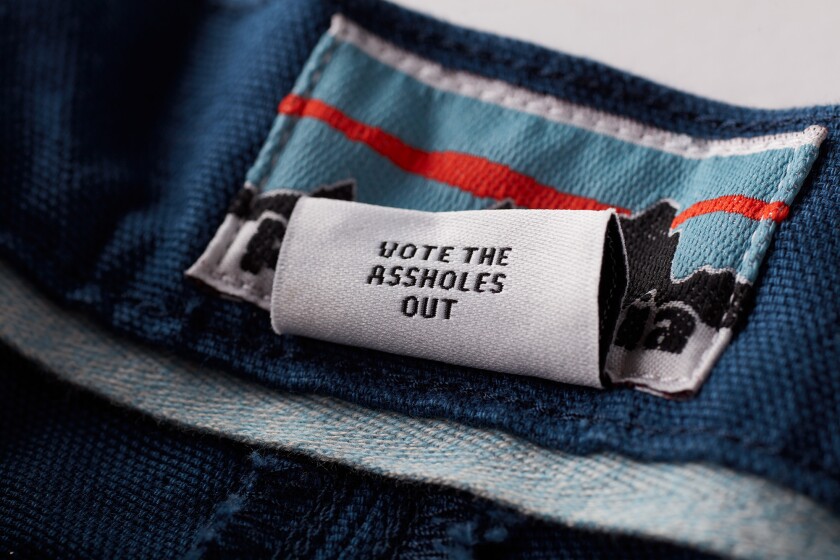
Browse Patagonia’s online shop, and you’ll find T-shirts condemning Big Oil, encouraging people to vote with planet Earth in mind and declaring that when it comes to wilderness, Americans must “defend it or lose it.”
But the company is getting far more attention for a cheeky, hidden message that appears only on the tag of a limited-edition pair of shorts, in tiny print.
The message: “VOTE THE ASSHOLES OUT.”
The label, which went viral on Twitter, was only the latest Trump-era call to action from Patagonia. The company has responded to the federal government’s environmental rollbacks with increasingly vocal campaigns to protect the country’s public lands — and yes, it says the four-word message applies to the president, along with other politicians who refuse to act on climate change.
Tesla Slumber Mode
TESLA DRIVER PULLED OVER GOING 93 MPH WHILE COMPLETELY ASLEEP
by JON CHRISTIAN

Canadian cops say they pulled over a Tesla that was traveling at 93 miles per hour — while the driver was completely asleep, with the seat pulled down like a bed.
“The officer was able to obtain radar readings on the vehicle, confirming that it had automatically accelerated up to exactly 150 km/h [93 mph],” the Royal Canadian Mounted Police said in a statement to Global News.
Non-smoker Held At Gunpoint
Oregon woman holds suspected arsonist at gunpoint as wildfires rage

An Oregon woman forced a suspected arsonist to the ground at gunpoint after she found him on her property with matches, dramatic video footage shows.
“What are you doing on my property? Did you light anything on fire?” Kat Cast shouts as she clutches a firearm, according to footage she posted on Facebook.
When the unidentified man responds that he was “just passing through,” she demands to know why he’s holding matches.
“I smoke,” he replies — to which Cast asks to see his cigarettes. The man then admits that he has none, and she holds him there until police arrive and haul him away in handcuffs.
Ripe giant sperm found in female ostracod
100-million-year-old giant sperm found fossilised in amber could be oldest ever

An international team of palaeontologists unearthed the “spectacular find”, which was preserved inside a female crustacean.
They believe the mussel-like creature mated shortly before becoming trapped in the resin.
Their findings, published in Proceedings of the Royal Society B, provide “an extremely rare opportunity” to learn more about the evolution of the reproductive process, they said.
Until now the oldest known fossilised sperm was found inside a 50-million-year-old worm cocoon from Antarctica.
The crustacean, a new species of ostracod called Myanmarcypris hui, is thought to have lived in coastal and inland waters of what is now Myanmar.
It would have been surrounded by trees that released huge amounts of resin.
While a majority of male animal species, including humans, produce large quantities of very small sperm to increase chances of fertilisation, there are exceptions.
Some creatures, such as fruit flies and modern-day ostracods, produce a small number of oversized sperm, with tails several times longer than the animal itself.
In these cases, the researchers say, chances of fertilising an ovum can increase with the size of the sperm cell.
Eaten By Mycelium
This ‘Living’ Coffin Uses Mushrooms to Compost Dead Bodies
The ‘Living Cocoon’ has already been used in one burial, at the Hague
By Becky Ferreira
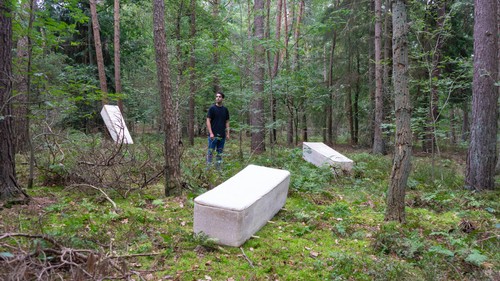
IMAGE: BOB HENDRIKX — LOOP BIOTECH
For tens of thousands of years, humans have developed funeral rites and burial practices that reflected the attitudes of their particular time and place. These traditions of honoring the dead continue to evolve into the 21st century, as people seek “green burials” that are more environmentally friendly than standard coffins.
One of the newest examples comes from Loop, a Dutch biotech company that recently unveiled a biodegradable coffin made of fungus, microbes and plant roots. Called the “Living Cocoon,” the coffin is designed to hasten bodily decomposition while also enriching soil around the plot.
“Normally, what we do as humans is we take something out of nature, we kill it, and we use it,” said Bob Hendrikx, founder of Loop, in a call. “So I thought: what if we humans start moving from working with dead materials toward a world in which we work with living materials?”
“We would not only become less of a parasite, but we could also start exploring super-cool material properties, like living lights, walls that are self-healing, and that kind of stuff,” he added.
Hendrikx was inspired to develop the Living Cocoon while presenting a living home concept at last year’s Dutch Design Week. While houses are obviously for the living, Hendrikx got to thinking about adapting the concept into a coffin powered by mushroom mycelium, which is the filamentary vegetative part of the fungus.
“Mycelium is nature’s biggest recycler,” Hendrikx said. “It is continuously looking for dead organic matter to transform into key nutrients.”
The Oldest Foot
Human footprints dating back 120,000 years found in Saudi Arabia
Issam AHMED, AFP

Around 120,000 years ago in what is now northern Saudi Arabia, a small band of homo sapiens stopped to drink and forage at a shallow lake that was also frequented by camels, buffalo, and elephants bigger than any species seen today.
The people may have hunted the large mammals but they did not stay long, using the watering hole as a waypoint on a longer journey.
This detailed scene was reconstructed by researchers in a new study published in Science Advances on Wednesday, following the discovery of ancient human and animal footprints in the Nefud Desert that shed new light on the routes our ancient ancestors took as they spread out of Africa.
Today, the Arabian Peninsula is characterized by vast, arid deserts that would have been inhospitable to early people and the animals they hunted down.
The Cosmic Brain
Physicist: The Entire Universe Might Be a Neural Network
“The idea is definitely crazy, but if it is crazy enough to be true? That remains to be seen.”

It’s not every day that we come across a paper that attempts to redefine reality.
But in a provocative preprint uploaded to arXiv this summer, a physics professor at the University of Minnesota Duluth named Vitaly Vanchurin attempts to reframe reality in a particularly eye-opening way — suggesting that we’re living inside a massive neural network that governs everything around us. In other words, he wrote in the paper, it’s a “possibility that the entire universe on its most fundamental level is a neural network.”
For years, physicists have attempted to reconcile quantum mechanics and general relativity. The first posits that time is universal and absolute, while the latter argues that time is relative, linked to the fabric of space-time.
In his paper, Vanchurin argues that artificial neural networks can “exhibit approximate behaviors” of both universal theories. Since quantum mechanics “is a remarkably successful paradigm for modeling physical phenomena on a wide range of scales,” he writes, “it is widely believed that on the most fundamental level the entire universe is governed by the rules of quantum mechanics and even gravity should somehow emerge from it.”
[ click to continue reading at Futurism ]
Robinhood Insanity
“It’s a Whole Other Level of Insanity”: How Pandemic Day Traders Are Turning Wall Street Upside Down
Sudden spikes in the value of bankrupt Hertz and joke cryptocurrency Dogecoin are upending the market as hobbyist traders on Reddit and Robinhood go rogue. “It doesn’t really matter what the underlying value of the stock is,” says one. “If there’s enough momentum behind it, you can still make money.”

A few years ago an eight-year-old Shiba Inu dog named Kabosu became an internet meme, her furry face juxtaposed with snippets of text in the parlance of stoner philosophy (“wow. much cake.”). The meme was known as “doge,” and it blew “lolcat” out of the water. Shortly thereafter, in 2013, a cryptocurrency called Dogecoin was launched, mostly as a joke. The coin ballooned then flatlined, hewing since then with the swings of the volatile bitcoin market—until July, when its stock value skyrocketed 104%.
What was going on? The cryptocurrency wasn’t new, and it had never been taken very seriously, even by its own investors. How could a seemingly random stock suddenly more than double in value? “It was a TikTok trend,” said David Hanlin, an e-commerce adviser and day trader who got in on the Dogecoin bump. “In terms of the actual value of Dogecoin from anything other than a meme standpoint, it’s pretty low. But it doesn’t really matter what the underlying value of the stock or the cryptocurrency is. If there’s enough momentum behind it, you can still make money.”
Such is the approach of many day traders, or retail traders—people, often hobbyists, who trade stocks on popular platforms like Robinhood. Since the start of the pandemic, new users have flooded these platforms, propelled in some cases by a conviction that crisis breeds opportunity, and in others by newfound free time. Robinhood alone reported more than 3 million new funded accounts by May, half of which were started by first-time traders. And daily average revenue trades on Robinhood more than doubled in the second quarter compared to the preceding quarter.
Many on Wall Street are baffled by the surge and have become more circumspect about how they read trends. “I’ve spent the last year, basically since March, trying to understand what’s happening, and honestly, I couldn’t tell you exactly. I’m very good at what I do, but there are times I’m just like, I have no fucking clue what’s happening,” said one equity trader for a Manhattan firm. “We were calling it banana land, the guys I work with, because it’s just, like, crazy. And then we started calling it ayahuasca land because it’s not even bananas anymore, it’s a whole other level of insanity.”
Toots Hibbert Gone
Toots Hibbert Dies: Reggae Artist Credited With Naming The Genre Was 77
By Bruce Haring
His death comes days after his group released its first full-length LP and new album in ten years, titled Got to Be Tough. The recording features contributions from Ringo Starr and Ziggy Marley.
Hibbert met Henry ‘Raleigh’ Gordon and Nathaniel ‘Jerry’ in 1962 shortly after he moved to Kingston. They formed the band Toots and the Maytals. Their 1969 recording, Pressure Drop, was instrumental in breaking the band worldwide after it was used in the seminal 1972 reggae film The Harder They Come.
Before that, Toots and the Maytals released a 1968 song, Do the Reggay, which is credited with giving the musical genre its name.
Forrest Fenn Gone
Forrest Fenn, the Eccentric New Mexico Art Dealer Who Buried Treasure for Explorers in the Rocky Mountains, Has Died at 90
Fenn’s $2 million treasure was reportedly found in June.

Just months after revealing that an intrepid explorer had finally solved the 10-year-old treasure hunt he plotted, New Mexico art and antiquities dealer Forrest Fenn has died. He was 90 years old.
Fenn filled his 12th-century bronze treasure chest with golden nuggets, gemstones, and pre-Columbian antiquities from his personal collection. Together, the box and its contents were said to be worth $2 million.
To announce the hunt, Fenn included a cryptic 24-line poem with clues to its location in The Thrill of the Chase, his self-published 2010 memoir. He claimed the goal was to get people off their couches in search of adventure.
Lust In The Heart and a Fatty On The Roof
Jimmy Carter admits son smoked pot with Willie Nelson on White House roof
By Kate Sheehy

Former President Jimmy Carter admits in a new documentary that one of his sons smoked pot with Willie Nelson on the roof of the White House.
Carter, 95, was asked about the legendary country crooner’s previous accounts of puffing on a “big fat Austin torpedo’’ atop 1600 Pennsylvania Avenue in the doc “Jimmy Carter: Rock & Roll President,’’ which came out in theaters this week, the Los Angeles Times reported Friday.
“[Nelson] says that his companion that shared the pot with him was one of the servants at the White House,’’ Carter said.
“That is not exactly true. It actually was one of my sons.’’
As Slow As Possible
John Cage’s 639-Year-Long Organ Concert Attracts a Crowd in Germany
By Helen Holmes
Artists of many different mediums have always loved to play with the concepts of time and duration, and legendary composer and conceptualist John Cage is no different. On September 5, 2001, one of the composer’s final projects was launched to the world: the slowest concert ever composed. Organ2/ASLSP (As Slow as Possible) is a musical piece by Cage that was originally conceived in 1987 and which is expected to take 639 years to be completed, meaning that if things proceed on schedule, the performance will come to an end in 2640. Over the weekend, on Saturday, spectators gathered in Halberstadt, Germany’s St. Burchardi Church to bear witness to the first sonic change in Cage’s composition to take place in seven years.
Specifically, since 2013, an organ in the aforementioned church has been playing the same note in Cage’s composition. In order for the organ’s notes to change, two new pipes, playing the notes g sharp and e, were added to the apparatus on Saturday in front of an audience of hundreds and captured for remote viewers in a livestream hosted by the John Cage ASLSP project which lasted a grand total of four hours.
GBS-3
Welcome to the Next Level of Bullshit
The language algorithm GPT-3 continues our descent into a post-truth world.
BY RAPHAËL MILLIÈRE

One of the most salient features of our culture is that there is so much bullshit.” These are the opening words of the short book On Bullshit, written by the philosopher Harry Frankfurt. Fifteen years after the publication of this surprise bestseller, the rapid progress of research on artificial intelligence is forcing us to reconsider our conception of bullshit as a hallmark of human speech, with troubling implications. What do philosophical reflections on bullshit have to do with algorithms? As it turns out, quite a lot.
In May this year the company OpenAI, co-founded by Elon Musk in 2015, introduced a new language model called GPT-3 (for “Generative Pre-trained Transformer 3”). It took the tech world by storm. On the surface, GPT-3 is like a supercharged version of the autocomplete feature on your smartphone; it can generate coherent text based on an initial input. But GPT-3’s text-generating abilities go far beyond anything your phone is capable of. It can disambiguate pronouns, translate, infer, analogize, and even perform some forms of common-sense reasoning and arithmetic. It can generate fake news articles that humans can barely detect above chance. Given a definition, it can use a made-up word in a sentence. It can rewrite a paragraph in the style of a famous author. Yes, it can write creative fiction. Or generate code for a program based on a description of its function. It can even answer queries about general knowledge. The list goes on.
GPT-3 is a marvel of engineering due to its breathtaking scale. It contains 175 billion parameters (the weights in the connections between the “neurons” or units of the network) distributed over 96 layers. It produces embeddings in a vector space with 12,288 dimensions. And it was trained on hundreds of billions of words representing a significant subset of the Internet—including the entirety of English Wikipedia, countless books, and a dizzying number of web pages. Training the final model alone is estimated to have cost around $5 million. By all accounts, GPT-3 is a behemoth. Scaling up the size of its network and training data, without fundamental improvements to the years-old architecture, was sufficient to bootstrap the model into unexpectedly remarkable performance on a range of complex tasks, out of the box. Indeed GPT-3 is capable of “few-shot,” and even, in some cases, “zero-shot,” learning, or learning to perform a new task without being given any example of what success looks like.
Interacting with GPT-3 is a surreal experience. It often feels like one is talking to a human with beliefs and desires. In the 2013 movie Her, the protagonist develops a romantic relationship with a virtual assistant, and is soon disillusioned when he realizes that he was projecting human feelings and motivations onto “her” alien mind. GPT-3 is nowhere near as intelligent as the film’s AI, but it could still find its way into our hearts. Some tech startups like Replika are already working on creating AI companions molded on one’s desired characteristics. There is no doubt that many people would be prone to anthropomorphize even a simple chatbot built with GPT-3. One wonders what consequences this trend might have in a world where social-media interactions with actual humans have already been found to increase social isolation.
“A frighteningly vast expanse of nothingness”
The weird space that lies outside our Solar System
By Patchen Barss
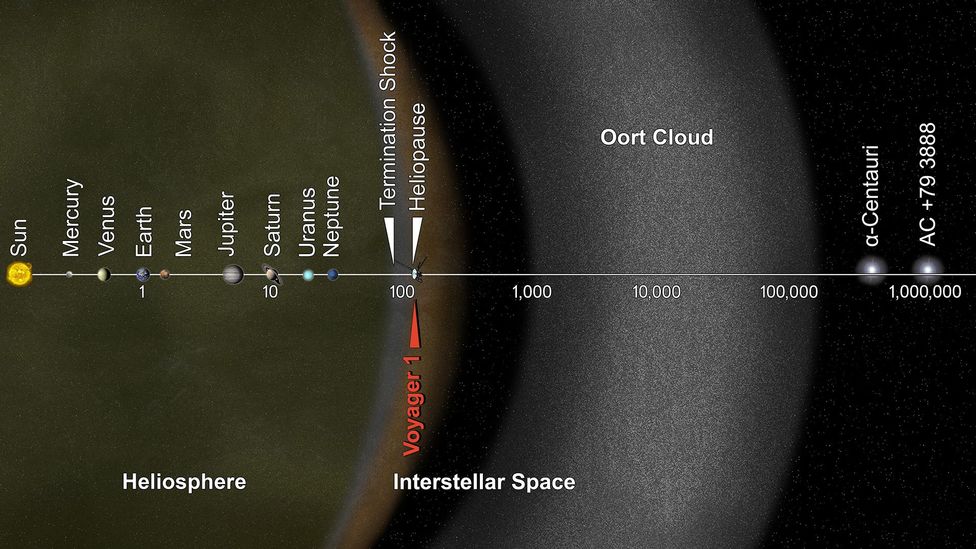
Voyager 1 crossed over into interstellar space in 2012 100 Astronomical Units from the Sun but it still has the vast Oort Cloud ahead of it
(Credit: Nasa/JPL-Caltech)
The mysterious dark vacuum of interstellar space is finally being revealed by two intrepid spacecraft that have become the first human-made objects to leave our Solar System.
Far from the protective embrace of the Sun, the edge of our Solar System would seem to be a cold, empty, and dark place. The yawning space between us and the nearest stars was for a long time thought to be a frighteningly vast expanse of nothingness.
Until recently, it was somewhere that humankind could only peer into from afar. Astronomers paid it only passing attention, preferring instead to focus their telescopes on the glowing masses of our neighbouring stars, galaxies and nebula.
But two spacecraft, built and launched in 1970s, have for the past few years been beaming back our first glimpses from this strange region we call interstellar space. As the first man-made objects to leave our Solar System, they are venturing into uncharted territory, billions of miles from home. No other spacecraft have travelled as far.
The Gravity Hypothesis
One of quantum physics’ greatest paradoxes may have lost its leading explanation

It’s one of the oddest tenets of quantum theory: a particle can be in two places at once—yet we only ever see it here or there. Textbooks state that the act of observing the particle “collapses” it, such that it appears at random in only one of its two locations. But physicists quarrel over why that would happen, if indeed it does. Now, one of the most plausible mechanisms for quantum collapse—gravity—has suffered a setback.
The gravity hypothesis traces its origins to Hungarian physicists Károlyházy Frigyes in the 1960s and Lajos Diósi in the 1980s. The basic idea is that the gravitational field of any object stands outside quantum theory. It resists being placed into awkward combinations, or “superpositions,” of different states. So if a particle is made to be both here and there, its gravitational field tries to do the same—but the field cannot endure the tension for long; it collapses and takes the particle with it.
Renowned University of Oxford mathematician Roger Penrose championed the hypothesis in the late 1980s because, he says, it removes the anthropocentric notion that the measurement itself somehow causes the collapse. “It takes place in the physics, and it’s not because somebody comes and looks at it.”
Tundra Apocalypse
Zombie wildfires are blazing through the Arctic, causing record burning
“Zombie” wildfires that were smoldering beneath the Arctic ice all winter suddenly flared to life this summer when the snow and ice above it melted, new monitoring data reveals.
And this year has been the worst for Arctic wildfires on record, since reliable monitoring began 17 years ago. Arctic fires this summer released as much carbon in the first half of July than a nation the size of Cuba or Tunisia does in a year.
That’s according to monitoring by the Copernicus Atmosphere Monitoring Service, the European Union’s Earth-monitoring organization. More than 100 fires have burned across the Arctic since early June, according to Copernicus. “Obviously it’s concerning,” Copernicus senior scientist Mark Parrington told the BBC. “We really hadn’t expected to see these levels of wildfires yet.”
Six Months In
from Slate
The Terrifying, Liberating Lesson of the Coronavirus Lockdown
Six months later in America, we’re learning how to live again—and to accept the unimaginable.

This is part of Six Months In, a Slate series reflecting on half a year of coronavirus lockdown in America.
A little more than six months ago, I sent a Slack message to Slate’s top editors that said “I think things are about to get really bad, virus-wise. We probably need to start thinking about that.” It was roughly a week before America’s shutdowns began and around the time when New York Gov. Andrew Cuomo was still telling people “there is more fear, more anxiety, than the facts would justify.” At that point, alongside reporting on some of the basic science of the “novel coronavirus,” Slate had told the stories of a Chinese restaurant devastated by xenophobic fear and a woman who had canceled a $24,000 anniversary cruise, and published dispatches from Italy, which at the time seemed like the darkest possible reflection of what might lie ahead. But still, it felt like no one was quite convinced a pandemic was arriving here.
One week later, much of America started to shut down, in some form or another. Slate started to order its employees to work remotely March 11. President Donald Trump gave a speech from the Oval Office that night about the virus, but it felt like it was the suspension of the NBA season and Tom Hanks’ announcement that he’d tested positive that jolted the public consciousness. As the death toll rose, the warnings from abroad got louder alongside our own public health officials’, and it seemed to finally hit many of us that we had to stay inside, isolated, alone, for real, with the occasional sanity-preserving walk. In a span of a few weeks, we went from trying to tell stories of how the virus had disrupted some people’s lives to realizing that the virus was disrupting everyone’s lives, and would be for some time.
Le Blaine Rouge
David Blaine Ascension: Incredible moment magician soars 20,000ft above desert ‘holding onto just 52 BALLOONS’

INCREDIBLE footage shows the moment David Blaine soared above the desert holding onto a bunch of 52 helium balloons in a stunt that looked straight out of the film Up.
The illusionist parachuted towards the ground after releasing himself from the bunch of balloons on Wednesday.
On Wednesday, Blaine returned to solid ground in the Arizona desert after his impressive stunt was a success.
Blaine was strapped in with a harness as he clutched 52 helium-filled balloons and exceeded his projected altitude of 18,000 feet on Wednesday during the “Ascension” stunt.
“Good chance you’ll die…, but it will be pretty glorious if it works out.”
Elon Musk to build ‘glorious’ Martian city with 1,000-starship fleet – but warns first visitors ‘will probably die’
by Sean Keach

The star-gazing billionaire has reaffirmed his vision for a Martian colony that doesn’t rely on support from Earth.
Musk has previously told of how his Starship rocket – currently in testing – will one day ferry Earthlings to Mars.
And he’s said he’ll need a fleet of 1,000 ships to create a sustainable city, as orbits mean the trip is only viable once every two years.
Now speaking at the Humans to Mars summit, Musk says the journey won’t be the hard part.
“Getting to Mars, I think, is not the fundamental issue,” said Musk, as quoted by CNBC.
“The fundamental issue is building a base, building a city on Mars that is self-sustaining.
“We’re going to build a propellant plant, an initial Mars base – Mars Base Alpha – and then get it to the point where it’s self-sustaining.”
Musk is expected to begin orbital Starship test flights next year.
The rocket is designed to be fully reusable, and will allow for long-distance journeys through space.
But the early trips to Mars will be treacherous.
“I want to emphasise that this is a very hard and dangerous difficult thing. Not for the faint of heart,” Musk explained.
“Good chance you’ll die, it’s going to be tough going, but it will be pretty glorious if it works out.”
The SpaceX Starship rocket is still very much in a testing phase.
Black Hole Birth
Scientists Detected a New Kind of Black Hole Being Born in a Bizarre Event
A merger with a black hole possessing an unexplained ‘forbidden mass’ created the first conclusive example of an intermediate black hole in the most massive merger ever detected using ripples in spacetime.
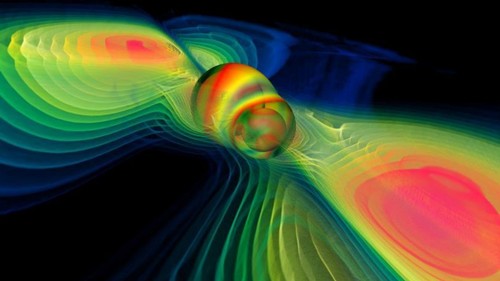
IMAGE: FLICKR/NASA UNIVERSE
An international collaboration of astronomers has observed the formation of a black hole with the mass of 142 suns, the first conclusive evidence of an intermediate-mass black hole. The black hole was the result of the most massive black hole merger ever detected with gravitational waves, which are ripples in spacetime that can be detected from Earth.
Not only did the merger produce the first example of a new kind of black hole, but one of the merging black holes possessed a “forbidden mass” that could not be explained by our usual understanding of how they form.
“I think it’s remarkable that we got such a clear observation of ‘Here’s a black hole with can’t be explained with our classic understanding of how stars collapse,'” said Christopher Berry, an astrophysics professor at Northwestern University and a LIGO Scientific Collaboration Editorial Board reviewer for the discovery paper.
The discoveries were enabled by the Laser Interferometer Gravitational-Wave Observatory (LIGO) and the Virgo interferometer, two of the world’s gravitational wave detectors. Companion papers published in the journals Physical Review Letters and Astrophysical Journal Letters on Wednesday described the signal, named GW190521.
Gone With The Cold-eyed Realism
Knights & their ladies fair
On the cold-eyed realism of Margaret Mitchell’s Gone with the Wind.
by Bruce Bawer
Just after the opening credits of Gone with the Wind and before the start of the film proper is a title card that reads as follows (ellipses in the original):
There was a land of Cavaliers and Cotton Fields called the Old South . . .
Here in this patrician world the Age of Chivalry took its last bow . . .
Here was the last ever to be seen of Knights and their Ladies Fair, of Master and of Slave . . .
Look for it only in books, for it is no more than a dream remembered, a Civilization gone with the wind . .
These are four very important sentences, because they’re intended to shape the way we view the entire 238-minute movie. Down through the decades, they’ve continued to serve that function. But those four sentences were not written by Margaret Mitchell, the author of the 1936 novel on which the film was based. They aren’t even remotely based on anything in the novel. On the contrary, when Mitchell first encountered the title card at the film’s Atlanta premiere, according to her biographer, Anne Edwards, she winced. “ ‘Cavalier,’ ” wrote Edwards, “was not a word she liked associated with the South.” The words don’t appear in the final shooting script, credited to Sidney Howard, or in any of the innumerable earlier versions of the screenplay done by other hands (including F. Scott Fitzgerald). Instead, the title card, along with six cards that appear later in the film, was composed by the prolific screenwriter and playwright Ben Hecht at the last-minute instigation of the movie’s producer, David O. Selznick (“i am certain you could bat them out in a few minutes,” Selznick telegraphed), and was slipped into the beginning of the picture a few weeks after its first sneak preview.
Many people who’ve seen Selznick’s movie but who’ve never opened Mitchell’s novel have acquired the impression that the book is just what Hecht’s title-card suggests: a gauzy, romantic take on the pre-war South. In fact, when the novel is mentioned in passing in accounts of the movie, it’s often summed up by a statement to precisely this effect. For example, in a 2005 biography of Hattie McDaniel, who played Mammy in the film, Jill Watts, a professor of film studies at csu San Marcos, wrote that “In Mitchell’s view, the antebellum South was an era of greatness.” In 2004, Matthew Bernstein, a professor of film studies at Emory, described the racial politics of Selznick’s movie as “less-than-progressive,” while adding that “the film is less offensive than Margaret Mitchell’s novel.”
Hopper Hangs With Welles
Better Off Savage Steve
How Savage Steve Holland Changed Teen Movies Forever With “Better Off Dead”
A childhood birthday party with a drunk clown changed the course of cinematic history
BY GARIN PIRNIA
On August 23, 1985, Warner Bros. distributed the dark teen comedy Better Off Dead, written and directed by first-time feature director Savage Steve Holland. It starred John Cusack as lovesick Northern California teen Lane Meyer, whose girlfriend, Beth (played by Nightmare on Elm Street’s Amanda Wyss), breaks up with him. He’s so heartbroken about her dating the ski jock Roy Stalin (Aaron Dozier) that Lane repeatedly attempts — and fails — to commit suicide. It was a comedy based on Holland’s own life, and inspired by another dark comedy, 1971’s Harold and Maude.
“When I was 11 years old, I had this birthday party and nobody came to it except for this drunk clown,” Holland tells InsideHook. At California Institute of the Arts, where he attended college, he says people wondered why he was always so sad. “I pinned it on that birthday party,” he says. “That was a first-world problem — I had a shitty birthday party and I was depressed about it. I made it into a movie thinking, ‘What a sad story.’” A film-fest audience viewed his short film, My 11-Year-Old Birthday Party, as a comedy. “People thought it was so pathetic and sad that they were laughing their heads off. That’s how I started my career. I dug into things that sucked in my life, and the girlfriend thing that happened to me was the biggest suck of all.” Though almost every time Lane attempts suicide he reconsiders, Holland thinks the movie couldn’t be made today. “It was dark, but I was trying to find a way out that wasn’t so depressing,” he says. “And Cusack actually helped a lot. He felt the same way about it. You don’t want Lane to be such a loser. He has to go, ‘I have something to live for.’ As long as the jokes played off in the end and you laughed at his attempts, I think we were okay.”
Nekkidness On Netflix
Inside Hollywood’s Long, Strange History of Movie Nudity
by Nick Schager
Though I might like to claim otherwise, I’m no expert on big-screen T&A&D. Skin: A History of Nudity in the Movies, however, makes a bid for being the definitive documentary on the subject. Driven by a cornucopia of film clip and talking heads—led by actors, directors, historians and critics—it delivers a thorough chronological timeline of cinematic nakedness. Too bad, then, that when it comes to actually delving into the most interesting aspects of its topic, Danny Wolf’s non-fiction film proves, ahem, skin-deep.
Debuting on VOD on August 18, Skin is most valuable as a survey of movie nudity, ranging from the seminal 1887 work of Eadweard Muybridge to the mainstream BDSM fantasies of 2015’s Fifty Shades of Grey, with just about every other notable example in-between at least briefly mentioned. That means that whatever film first aroused you likely appears in Wolf’s doc, be it silent film star Audrey Munson’s Inspiration (1915), Mae West’s sexual innuendo-laced 1930s output, Cecille B. DeMille’s The Sign of the Cross (1932), Jayne Mansfield’s Promises! Promises! (1963), Michelangelo Antonioni’s Blow-Up (1966), Peter Bogdanovich’s The Last Picture Show (1971), Bernardo Bertolucci’s Last Tango in Paris (1972), Tinto Brass’ Caligula (1979), Amy Heckerling’s Fast Times at Ridgemont High (1982), Paul Verhoeven’s Basic Instinct (1992), or Paul Weitz’s American Pie (1999). For every generation, an iconic unclothed moment is vividly revisited here.
A Timely Failure
The First Clock In America Failed, And It Helped Revolutionize Physics
by Ethan Siegel, Senior Contributor
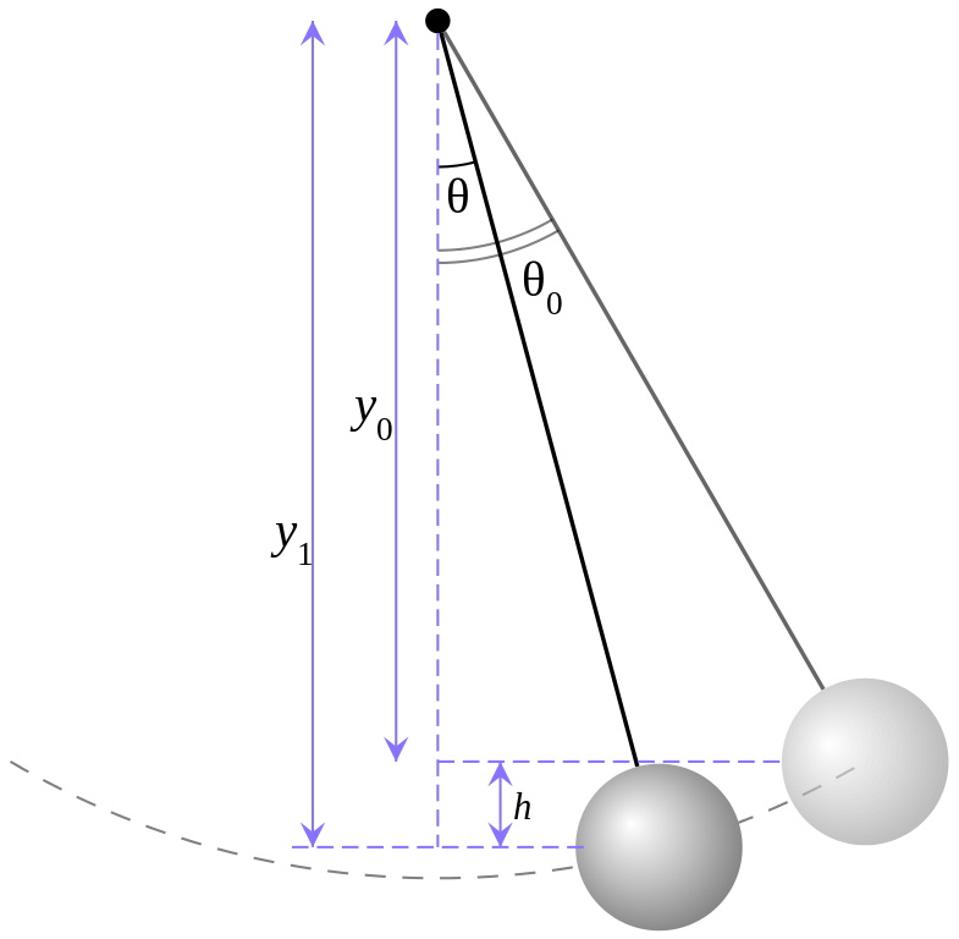
For nearly three full centuries, the most accurate way that humanity kept track of time was through the pendulum clock. From its initial development in the 17th century until the invention of quartz timepieces in the 1920s, pendulum clocks became staples of household life, enabling people to organize their schedules according to a universally agreed upon standard. Initially invented in the Netherlands by Christian Huygens all the way back in 1656, their early designs were quickly refined to greatly increase their precision.
But when the first pendulum clock was brought to the Americas, something bizarre happened. The clock, which had worked perfectly well at keeping accurate time in Europe, could be synchronized with known astronomical phenomena, like sunset/sunrise and moonset/moonrise. But after only a week or two in the Americas, it was clear that the clock wasn’t keeping time properly. The first clock in America was a complete failure, but that’s only the beginning of a story that would revolutionize our understanding of the physics of planet Earth.
Teslaplane
A Tesla Electric Plane? Elon Musk Hints It’s Not Far Away
By Sissi Cao

Elon Musk once said that one day, “all transportation will be electric, except for rockets.” Yes, that even includes airplanes, which have long been on his list of things to electrify.
The Tesla CEO first floated the idea in an interview in September 2018. The plane he envisioned was a vertical take-off and landing (VTOL) vehicle capable of flying at supersonic speeds at high altitudes.
The idea has largely remained a far-fetched dream because in order for Musk’s design to work, the plane would require a battery with an energy density higher than 400 Wh/kg. Tesla’s newest batteries, Panasonic’s “2170” batteries used in Model 3 cars, can only achieve an energy density of around 260Wh/kg.
But Tesla is working to increase that capacity at unprecedented speed right now. In a new exchange with ARK Investment analyst Sam Korus on Twitter, Musk said Tesla may be able to achieve volume production of 400wh/kg batteries in just three to four years.
Neuralink
Elon Musk to unveil Neuralink progress with real-time neuron demonstration this week
by Dacia J. Ferris
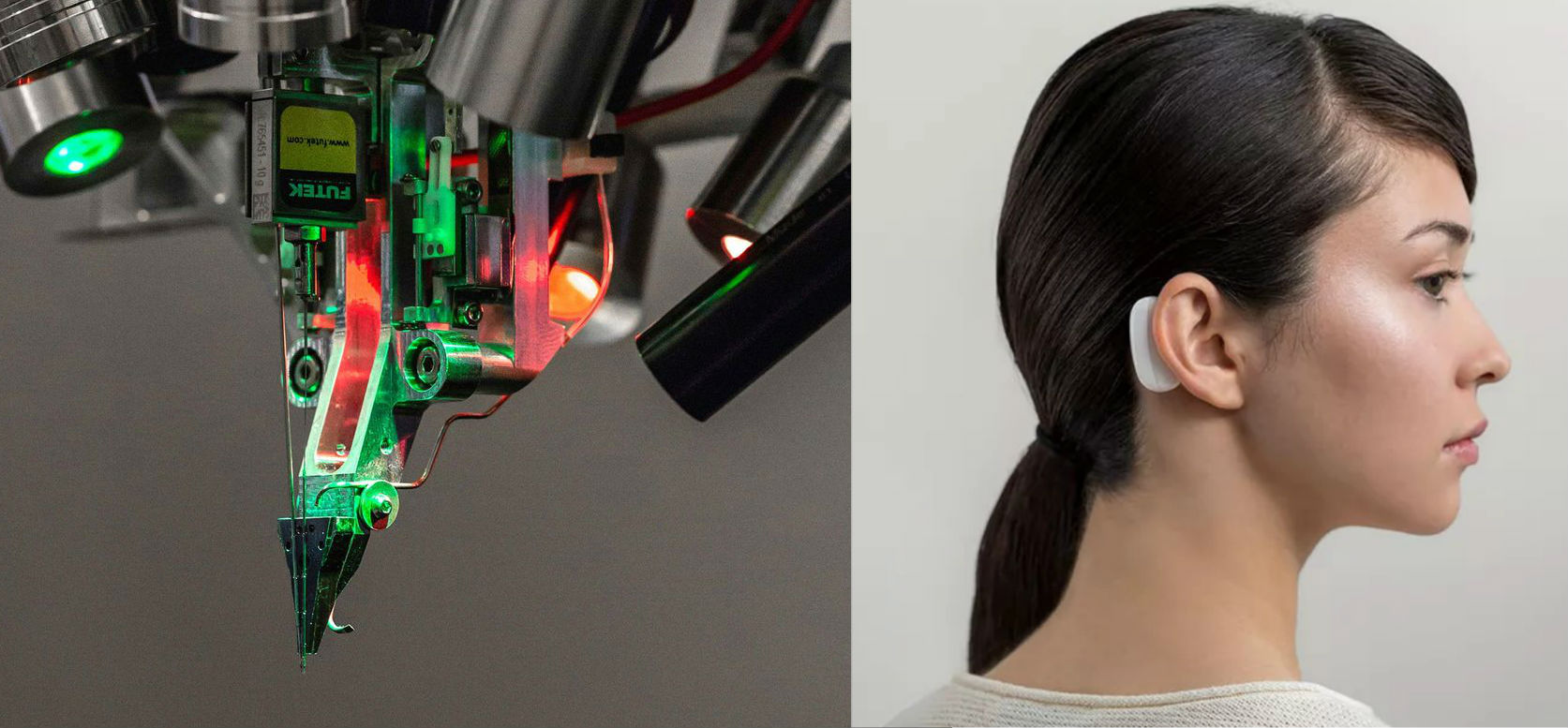
Elon Musk’s brain-machine interface company, Neuralink, has an event scheduled for later this week to update the public on its progress since last year’s presentation. While the agenda is speculative for the most part, one expectation is a live demonstration of neuron activity.
“Will show neurons firing in real-time on August 28th. The matrix in the matrix,” Musk tweeted at the end of July.
He also revealed a few other clues about the early fall announcement at the beginning of the year. “Wait until you see the next version vs what was presented last year. It’s *awesome*,” he wrote in February. “The profound impact of high bandwidth, high precision neural interfaces is underappreciated. Neuralink may have this in a human as soon as this year. Just needs to be unequivocally better than Utah Array, which is already in some humans & has severe drawbacks.”
As its name implies, the roles of neuron activities are very important to Neuralink’s technology. The venture’s long-term goal of obtaining human symbiosis with artificial intelligence (AI) begins by connecting electrodes throughout the brain and reading its neuron signals en masse. Gathering huge amounts of data from the signals gradually teaches Neuralink’s software how they are used by the brain to communicate with the rest of the body, ultimately leading to a certain amount of replication and direction. The possibilities of such a capability seem endless.
The Magic Knife
A Knife Brand Brilliantly Used Rust to Create an Outdoor Ad Highlighting Its Durability
The corrosion of the outdoor ad is made to contrast with the product in the center
BY PATRICK KULP

Austrian manufacturer Tyrolit may have confused some people on the streets of Vienna when it first posted a blank sheet of metal bearing only a small brand name as a billboard.
But over the course of the next few weeks, the display would gradually rust to reveal the silver silhouette of a knife at the center and the tagline “Flawless Forever,” sealed behind a protective layer amid an expanse of reddish brown corrosion.
The clever use of media, which was orchestrated in collaboration with agency Heimat’s office in Wien, Austria, is designed to demonstrate the durability of the Swarovski Group-owned brand’s Iceline line of cutlery.