
Weather
Photo from ‘Adventures in Tornado Alley: The Storm Chasers,’ (Thames & Hudson, $29.95) by Mike Hollingshead and Eric Nguyen.

St. Paul Poetry Slam
Putting poetry in motion
Article Last Updated: 04/06/2008 11:12:43 PM CDT
April is National Poetry Month, so it’s a particularly good time for local bards to polish their works in a competitive performance venue. Poets from Minnesota and Wisconsin have been strutting their stuff the first Monday of most months in St. Paul at the Artists’ Quarter, where tonight is the final night of the regular season.
Up to 10 poets present original works, with each scored by judges picked from the audience. The eight-month season culminates with a Grand Slam in May. The top four finishers form the Soap Boxing Slam team, which will compete in the Poetry Slam Nationals in Madison, Wis., in August.
Frosty’s Gone
from the AP
Breakdance Pioneer Dies in NYC
NEW YORK (AP) — Wayne “Frosty Freeze” Frost, a hip-hop pioneer whose acrobatic performance with the legendary Rock Steady Crew in the 1983 movie “Flashdance” helped set off a worldwide breakdancing craze, has died. He was 44.
Frost died Thursday at Mount Sinai Medical Center after a long illness, said Jorge “Fabel” Pabon, a senior vice president of the crew where Frost and other so-called b-boys (for beat or break boys) made their name performing complicated and daring dance routines.
“He was one of most charismatic b-boys that ever lived,” said Benson Lee, director of the new documentary film “Planet B-Boy.”

Breakdancing emerged from the Bronx and Harlem in the early 1970s, part of the hip-hop culture that also included graffiti, MCing or rapping, and disc jockeys scratching and mixing vinyl records on turntables.
During extended pauses, or breaks, in the music, b-boys would mimic James Brown’s showmanship and footwork and Bruce Lee’s martial arts, adding their own signature moves.
Frost was known for his energetic style, intricate choreography and fearless moves including back flips and head spins. One was even dubbed the “Suicide.”
Frost got his start in 1978 with the Bronx-based Rock City Crew. In 1981, he became part of the Rock Steady Crew, joining such acclaimed breakdancers as Ken Swift and Lil Crazy Legs.
Frost toured the world with the Rock Steady Crew and other hip-hop artists, including Fab 5 Freddy, Futura 2000 and Kool Lady Blue.
Frost’s appearance with Rock Steady Crew in “Flashdance” spread the breakdance phenomenon globally, said Joseph Schloss, a visiting scholar in the music department at New York University. “He was one of the first B-boys that most people ever saw,” Schloss said.
Graffiti artist and close friend Zulu King Slone, who knew Frost for 15 years, said he was “like a walking hip-hop culture encyclopedia.”
As a member of the Rock Steady Crew, Frost also appeared in several movies on hip-hop culture, including “Wild Style,” “Beat Street” and “Style Wars.” He also appeared on the cover of the Village Voice in 1981.
Funeral arrangements were incomplete.
Associated Press writer Tania Fuentez contributed to this report.
On the Net:
Triumph of the Atomized Uprising
from the LA Times
Chicano art, beyond rebellion

© Jason Villegas, LACMA
OFF THE WALL: Artist Jason Villegas’ “Celestial Situations,” a video projection with wall drawing, is part of the new LACMA exhibit titled “Phantom Sightings: Art After the Chicano Movement.”
‘Phantom Sightings: Art After the Chicano Movement’ provides a rare showcase at the Los Angeles County Museum of Art.
VISITORS to the sprawling Chicano art show opening today at the Los Angeles County Museum of Art are greeted by a display of photos depicting a group of daring guerrilla street artists known as ASCO, Spanish for “nausea.” The photographs are from the early 1970s — which seems to defy the show’s title, “Phantom Sightings: Art After the Chicano Movement.”
In one famous photo from 1972, in the midst of the movement, the museum itself was the target of these Dadaesque subversives protesting the exclusion of Chicano art from its galleries. In “Spray Paint LACMA,” ASCO member Patssi Valdez is seen posing outside the museum’s walls, which had been tagged overnight by her rebellious cohorts, Gronk, Willie Herron III and Harry Gamboa Jr. This act of creative defiance — turning the building into a Chicano canvas — is now enshrined in the very place that sparked the protest by treating Chicanos as the phantoms of the art world. So does this mean that Chicano artists have finally found the acceptance they sought? That they can now put down their spray cans and pursue careers as equals in a harmonious “post-ethnic” art world?
“I have a feeling if I was a young person today, I don’t think I would spray paint the museum,” Gamboa, 56, an author and college lecturer, answers slyly. “Because now, [tagging] has been felonized, and to put three signatures on a county building might result in three strikes. Who knows if we would all wind up in prison for life and never have the chance to pursue careers as artists?”
 Variety, not ethnicity, is the show’s hallmark. Artist Ken Gonzales-Day deals with the lynching of Mexican Americans in California by digitally erasing the victims from historic photos. Sandra de la Loza, meanwhile, fills in the gaps that history erased by placing plaques (that are quickly removed) in places such as the whitewashed Siqueiros mural at Olvera Street. And Julio Cesar Morales reveals the resourcefulness of immigrants trying to cross the border illegally by exposing them in their hiding places, such as the little girl inside a piñata, through transparent water-color illustrations based on real cases.
“What about the budonkadonk butt?”

The Show That Spawned A 15-Episode Generation of Environmental Warriors
This was one of the coolest (and warmest) series on Saturday Morning TV – when there was Saturday Morning TV. You can see today still the actual Ark vehicle in which the young eco-saviors scavenge the planet parked at a prop car place on the south/west side of the 101 in Cahuenga Pass in Hollywood
Review of ‘Animal’s People’ by Indra Sinha
from Shelf Awareness
Book Review: Animal’s People
Animal’s People by Indra Sinha (S&S, $25, March 2008)
Animal’s People should have won the Booker Prize.
 It towers over the other shortlisted novels, entertainment on a grand scale, hugely ambitious, brilliantly written in slang-laced language that’s a pleasure to savor aloud, and teeming with unforgettable characters. (Can you remember even one character from The Gathering?) There’s Animal himself, a 19-year-old with a spinal deformity who runs on all fours and is narrating the story into a tape recorder; Elli, the bold, no-nonsense American doctor who has come to open her own free health clinic; Zafar, the beloved leader of the poor who would starve for his cause of justice; Ma Franci, the crazy French nun awaiting the Apocalypse; and Somraj, internationally famous Hindu singer with a damaged throat who now hears music in all the sounds around him. And that’s just a few of them.
The novel takes place 19 years after a nightmarish industrial gas leak in the American factory that dominates the town. This is clearly inspired by the very real industrial disaster at Bhopal, India, on December 3, 1984, when a Union Carbide pesticide plant chemical gas leak resulted in more than 3,000 deaths, deformed births, contaminated food and polluted water.
As a stylist, author Sinha falls somewhere between Rohinton Mistry and Yann Martel, but his classic passion for social justice links him more with Victor Hugo and Emile Zola, and his host of characters verges on Dickensian in numbers, memorability and sheer delight. Sinha loves these characters passionately (Google the incredible lifesize statue by Eleanor Stride that the author commissioned of the novel’s central character, Animal) and tortures the reader with worries over their various fates, as a hunger strike in the deadly hot season and a huge protest movement by the poor veer angrily out of control and erupt into city-wide violence.
Here’s a hefty slice of the human comedy, served up with generous portions of every pleasure fiction can offer: language, character, plot, suspense, surprise and wisdom. Go ahead, start with the first sentence. “I used to be human once.”–Nick DiMartino
[ click to view original review at ShelfAwareness.com ]
[ click to purchase Animal’s People ]
Whenever Queenan Writes It Rings
from the New York Times
There Will Be a Quiz
By JOE QUEENAN
Freelance writers are always looking for ways to scare up a few extra bucks, so recently I tried my hand at writing some of those “Questions for Discussion” that appear at the back of many paperbacks. I got the idea after reading Andrei Makine’s novel “The Crime of Olga Arbyelina,” the hard-luck saga of a Russian émigré with a hemophiliac son who pops up in France after World War II, hoping to put her life back together. Rumored to be kin to the luckless royals who ran afoul of Lenin and the boys back in the old country, Olga endures a life of uninterrupted misery and heartbreak.

The novel’s story line isn’t all that hard to follow, so by the time I reached the end, I had a pretty clear idea that Olga hadn’t gotten a fair shake in life. Be that as it may, I was startled when I turned to the back of the book and encountered eight questions prepared for book clubs that might be interested in discussing the novel further. Question No. 5 ran like this: “Olga has been driven from her homeland by the Bolsheviks, raped by a soldier, abandoned by her husband, treated with indifference by her lover, drugged, sexually violated and impregnated by her son. Does the novel lay the blame for Olga’s fate on the shoulders of the men in her world? Would you?”
At first, I thought this question might be a fluke or an oversight, but then I paged through a pile of other novels containing similar supplementary materials. Now it became clear to me that seemingly off-the-wall questions were a staple of the genre, deliberately included to shake up the musty old world of literature and force readers to think “outside the box.”
I soon discovered that a number of Web sites list proposed questions for book discussion groups, and that on these sites, a kind of down-home, no-holds-barred irreverence rules. On ReadingGroupGuides.com, readers who may not initially have grasped all the nuances of “The Diary of Anne Frank” are confronted by this brain-stumper: “Nazi leader Adolf Eichmann was asked how he could explain the killing of six million Jews. He answered, ‘One hundred dead are a catastrophe, a million dead are a statistic.’ Have we become more or less tolerant of murder since he made this observation?”
Since throwing curves is second nature to me, I decided to take a crack at writing my own unorthodox book-discussion materials to see if some publishing house might purchase my wares. Here are a few examples:
The Odyssey After the fall of Troy, it takes Odysseus 10 years to return home. Since Troy was only a hop, a skip and a jump from Greece, do you think Penelope should have been more skeptical about her husband’s explanation for the long delay — a cabal of one-eyed, man-eating giants; a troupe composed entirely of homicidal, aquatic chantoozies; a sorceress who can turn sailors into pigs? Isn’t the whole thing kind of sketchy?
In describing a woman who can effortlessly turn a man into a pig, is Homer criticizing men in general? Or only sailors? Do you personally know any women like that? Are any of them named Brandi? What time does her shift end?
If it took Odysseus 10 years to make a short trip across a microscopic body of water, why does everyone in “The Odyssey” keep insisting he’s so smart?
Moby-Dick Captain Ahab’s obsession with the white whale leads to complete nautical disaster in this novel, as the vengeful protagonist finally bites off more than he can chew. Do you think Ahab should have taken a page out of “Jaws” and gotten a bigger boat?
The Red and the Black The penniless protagonist of this book has only two career choices open to him: the military or the clergy. Today, poor people have innumerable career options: personal training, consulting, cabaret. If Stendahl were writing today, what color would he use to symbolize a career as a private equity fund manager? Is teal just totally out?
Wuthering Heights Did you see the movie based on this book? Didn’t you think Laurence Olivier was too old to play the part? Boy, I did. I never thought he was all that good-looking, did you?
If Heathcliff had fallen in love with Jane Eyre or Elizabeth Bennett instead of Cathy, do you think his house would have burned down?
If Heathcliff were alive today, would he mention Cathy’s death on his Facebook page and change his relationship status to “It’s complicated”?
Remembrance of Things Past This novel is 4,000 pages long, yet nothing ever happens. Is Proust making some kind of veiled comment about French society?
Do you think this book would have been more interesting if Swann had been replaced by Thorfin Sigurdsson, the Raven-Feeder?
Frankly, I thought I was getting somewhere with my questions. Then I turned to the back pages of “The Strange Case of Dr. Jekyll and Mr. Hyde” and found this:
“What do you make of Hyde’s appearance? (He is small and subtly deformed.) Do you think he should have been depicted as tall and hypermuscular, or obese and debauched, or pale and cadaverous? Why? (Or why not?) Is there a specific meaning in, or reason for, Hyde’s appearance?”
That’s when I decided to bag the whole enterprise. I was a dwarf among giants. These people were totally out of my league.
Joe Queenan writes for Barron’s, The Los Angeles Times and The Guardian.
MTV to Show More Fur
from Variety
MTV grooms ‘Fur TV’
Warp Films moves to tube with warped puppets
By DOMINIC SCHREIBER
MTV has picked up “Fur TV,” an adult comedy series about a group of foulmouthed, sex-mad puppets, made by Warp Films, the U.K. shingle behind BAFTA-winning feature “This Is England.”

Skein is Warp’s first move into TV. Created by filmmakers Chris Waitt and Henry Trotter, “Fur TV” centers around three puppets who share a flat in the human world and spend their time drinking, fighting and trying to chat up girls.
“I can’t imagine any other channels having the guts to commission a concept like ‘Fur TV,’ ” said Heather Jones, executive VP content and creative, at MTV Networks U.K. “It’s fresh, funny and outrageous and will make perfect late night TV.”
Set to launch on MTV One in the U.K. on a Sunday night slot on April 27, theseries started out as a short film, which won a BBC Greenlight Award for new comedy in 2003 and a Golden Rose for best pilot in 2004. It aired on BBC2 in 2004.
When Warp producer Mary Burke came across the short, she approached Waitt about making a feature-length version, but, by then, the project had already been set up at MTV.
Last year, Waitt directed his first film for Warp, the feature documentary “A Complete History of My Sexual Failures,” which recently screened at Sundance. His other credits include the Channel 4 short “The Naked Rambler.”
Based in Sheffield, in the north of England, studio’s other recent releases include thriller “Donkey Punch,” which also premiered at this year’s Sundance, and Paddy Considine’s short “Dog Altogether.”
[ click to view original article at Variety.com ]
Charlie Still Surfs
Even Charles Manson Digs Creative Commons By zab
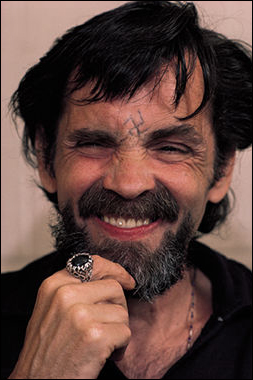 Think nobody interesting uses Creative Commons?
CC is a special license that allows anyone to download, share and mix other people’s music as long as they give proper credit. Recently, Nine Inch Nails released their album under a Creative Commons license, and it has been a great success!
Good old Charles Manson of the Tate and LaBianca murders has done the same thing. His recent album, “One Mind” is licensed in a way that allows anyone to share it with others, remix it and use it for non-commercial uses. The exact legal details are here.
So, you can download the full album here if you like (or you can shop for more Charles Manson at the LimeWire Store
American Retro by Dave Gorman
from the Guardian UK
Audio slideshow: American retro
Frustrated with the faceless, corporate America on offer to the casual tourist, Dave Gorman decided to travel from coast to coast without giving any money to The Man. Read all about Dave’s adventure in this Saturday’s Guardian. America Unchained by Dave Gorman is published by Ebury at £11.99
Press  below to start the slideshow.
[ click to view original article at Guardian UK ]
T.G.I.F. (with a bonus 12″ single)
Soap Drugs & Rock n’ Roll
copped from Conscious Choice
Dr. Bronner’s Magic Media Soap Opera
The counterculture’s exceptionally eccentric soap family hits the big screen
By Charles Shaw
 This is the story of one Dr. Emanuel H. Bronner, chemist, master soap maker, Holocaust survivor and lead prophet for the One God of Spaceship Earth. In 1947, Bronner escaped from a mental institution and began selling soap made from his family’s 150-year-old recipe out of the back of a Los Angeles tenement hotel. Today the company, run by his grandsons, David and Mike, sells more than six million bottles of soap a year.
This tragicomic drama propels the narrative of Dr. Bronner’s Magic Soapbox (magicsoapbox.com) , a new documentary by Sara Lamm that attempts to capture the essence of this thoroughly mad (and at times, thoroughly maddening) genius who was, in the purest sense, far ahead of his time.
As Soapbox illustrates, Dr. Bronner — who passed away in March of 1997, just shy of 90 years old — was definitely out there. He saw himself as part of the long lineage of prophets that includes Jesus, Mohammed, Hillel, Moses and Buddha. Bronner believed these prophets appeared on earth regularly — every 76 years to be exact, inspired by the arrival of Haley’s Comet — to lead their people to God. He was also convinced the most recent of these prophets was Mark Spitz, the American swimmer who won seven gold medals at the 1972 Munich Olympics.
Unfortunately, the course of human history is littered with the literal and symbolic corpses of prophets — real or self-imagined — who bore new truths as harbingers of a new way. And Dr. Bronner’s fate was no different than those who came before him. He was locked away, called insane, discredited and dismissed. The FBI even had him listed in their “nut file.”

However odd or unorthodox his behavior or his theories, though, Emanuel H. Bronner’s product was a hit with the west coast counterculture, who became his best customers and sustained the business for decades. Blind for the last 20 years of his life, he remained first and always a subversive, a true believer in absolute freedom who embraced the work of Thomas Paine, made friends with Black Panther Eldridge Cleaver, advocated for hemp and organic farming, and was so rabidly anti-communist he put Nixon to shame. His “all-one” philosophy was a Universalist doctrine of mutual peace, respect and ecological harmony, based on the central tenet that we are all children of the same divine source.
Headlines Read: “Germ Wrongly Jailed by Soap!”
Another film — this one hitting the small screen (YouTube, to be exact) — continues the epic tale of the noble Bronner clan. The wry, upbeat and at times hilarious web short — which has received tens of thousands of downloads since it was released in early May — centers around David Bronner, grandson of Emanuel, hemp activist and current President of Dr. Bronner’s Magic Soaps, and the recent allegations by police in Newport Beach, Calif. that Dr. Bronner’s Magic Soaps contain traces of GHB (Gamma Hydroxy Butyrate), a notorious “date rape” drug.
Entitled Soap, Drugs & Rock and Roll the seven-minute short is an original and effective use of the media as a PR tool — with our heroes the unassuming soap makers who, in one fell swoop, cast serious doubt on the practice of field drug testing, expose the lies of commercial soap producers, advocate for organic products and educate the viewer on yet another layer of our culture’s dependency on oil.
The circumstances laying the grounds for the story have already become the stuff of legend:
On the night of April 4, Don Bolles, eccentric 51-year-old drummer for punk outfit The Germs, was driving through über-conservative Newport Beach, Calif. on his way to an AA meeting when his tricked-out van was pulled over, allegedly for a broken taillight. Bolles gave consent to search the van, and the presiding officer found a bag of legal medical marijuana sitting next to a bottle of Dr. Bronner’s soap. For some reason (perhaps because the bottle was clearly labeled as hemp soap) the officer decided to apply a NarcoPouch® 928 field test to the soap to assess it for drug content. The test came back positive for GHB, and Bolles was arrested and taken into custody.
Upon hearing this, the Dr. Bronner’s company immediately paid Bolles’ bail and legal fees, and stepped up to defend their brand publicly. David Bronner appeared before California media denouncing the charges as “totally absurd,” and suggesting that Bolles was pulled over for the offense of “driving while weird.” They then ordered the same NarcoPouch® 928 test and began testing their soap products. What they found was astounding.
A frog goes into a bank…
A frog goes into a bank and approaches the teller. He can see
from her nameplate that her name is Patricia Whack.
“Miss Whack, I’d like to get a $30,000 loan to take a holiday.”
Patty looks at the frog in disbelief and asks his name. The frog
says his name is Kermit Jagger, his dad is Mick Jagger, and that it’s
okay, he knows the bank manager.
Patty explains that he will need to secure the loan with some
collateral.
The frog says, “Sure. I have this,” and produces a tiny
porcelain elephant, about an inch tall, bright pink and perfectly
formed.
Very confused, Patty explains that she’ll have to consult with
the bank manager and disappears into a back office.
She finds the manager and says, “There’s a frog called Kermit
Jagger out there who claims to know you and wants to borrow $30,000, and
he wants to use this as collateral.”
She holds up the tiny pink elephant. “I mean, what in the world
is this?”
The bank manager looks back at her and says…
“It’s a knickknack, Patty Whack. Give the frog a loan, His old
man’s a Rolling Stone.”
“Who controls your eyeballs, controls your brain”
I met this guy in a church once and then went and had a beer with him. The video is pretty cool – just turn down or skip past the predictable psychadelic top 10 sequences, altho the version of ‘Incense and Peppermints’ is a nice alternate to what you’re accustomed. – Editor
Anglo Icon Scores From The Grave Again
from the NY Daily News
‘Twist’ my arm! Dickens tome brings $229G
Thursday, April 3rd 2008, 4:00 AM
A first edition of Charles Dickens‘ “Oliver Twist” sold for a record $229,000 at Christie’s auction house in New York Wednesday.
 An anonymous American collector bought the copy of the 19th century novel about a young orphan who falls in with a band of pickpockets and thieves.
First published in 1838, the copy at auction was inscribed by the author to a friend and fellow novelist, William Ainsworth.
A total of 208 lots went under the gavel, part of the William Self family collection.
The previous record for a Dickens item was held by a copy of “A Christmas Carol” that sold for $160,000 in 1996 at Sotheby’s in New York.
The Man Who Went Trying To Come
snipped from Daily Swarm excerpt of a GQ excerpt
James Brown really was a Sex Machine: “That man died trying to come”
TDS EDITORS

Sean Flynn’s lengthy James Brown profile in this month’s GQ (excerpted online here) is making headlines for its claims that the Godfather of Soul had a vasectomy in 1984 (thus throwing doubt on one of the paternity claims filed against his estate), while going a long way to explain why the late soul music legend fully intended to omit most of his blood kin from his will, and how it was almost inevitable that his extended family would battle for their share after his death.
Flynn adds plenty of dirty details about just how and why Brown managed to sire so many children in the first place:
When Mr. Brown grew up, when he was a famous performer touring the world forty, fifty weeks a year, he fucked a lot of women. That is a deliberate term, fucked, because Mr. Brown was not a man who made love or even had sex. Mr. Brown fucked. “He did not know about the soft,” a longtime friend says. A lot of times, he’d let one of his cronies deal with the preliminaries, make small talk with a girl, get her a drink, keep her company. “She ready?” he’d ask. “I ain’t got no time now. Make sure she ready.” He’d hop on, roll off. Straight missionary, straight to the point. He never saw a reason for much else. “Why’s a white man eat a woman?” he once asked a white friend. “What’s he get outta that?”
 Hell, the man was in his sixties before he discovered doggy style on the Playboy Channel. He called up Roosevelt Johnson at three in the morning to tell him about it. “You sittin’ down, Mr. Johnson?” he asked, which is what he always said when he had an astonishing new fact to report. “Black man don’t know nothing. Black man don’t know a damned thing. A white man, he get up in his woman from behind.” Johnson pretended to be surprised by that. (“You had to go there with him,” he says, “because you didn’t know anything Mr. Brown didn’t know.”)
So how many women? How high can you count? Mr. Brown always kept a few girlfriends on the side, some for decades, and he always found a woman or two in whatever city he happened to be playing. “There’d be times, literally, when one would be coming in the front door while another one was going out the back,” says Buddy Dallas.
Naturally, some of them got pregnant.
In fact, even after age, diabetes, prostate cancer, and copious drug use had rendered him impotent, that didn’t stop him from digging into the dust and trying:
“Motherfucker was crazy,” says Gloria Daniel, a girlfriend he kept on the side for forty years. “It was the drugs.”
Mr. Brown smoked his drugs—PCP, until that got hard to find, then cocaine—mixed with tobacco from his Kools. “You sitting there rolling tobacco out of a cigarette—that’s a woman’s job—and you sitting there naked so he can look at you ’cause he getting ready to fuck you,” she says. “Yeah, right.” She rolls her eyes. The drugs, to say nothing of the diabetes and the prostate cancer, made him impotent. “He tried like hell, though,” she says. “He’d wear you out. That man died trying to come.”
 One night in the summer of 2001, after he’d slathered her in Vaseline (“He liked you all greased up,” she says. “Like a porkchop”) and wore her out trying to come, he gave up and left the room, and Gloria dozed off. When she woke up, Mr. Brown was standing at the foot of the bed in a full-length mink coat over his bare chest, a black cowboy hat, and silk pajama pants with one leg tucked into a cowboy boot and the other hanging out. He had a shotgun over his shoulder and a white stripe of Noxzema under each eye. “I’m an Indian tonight, baby,” he announced. “C’mon, let’s let ’em have it.” Then he dumped a pickle jar of change on the floor, told her to get a machete, and went out to the garage. He took the Rolls, drove ten miles to Augusta, weaving all over the road, clipping mailboxes, smoking more dope, and screaming about being an Indian.
There’s lots more at here.
snipped from Daily Swarm excerpt of a GQ excerpt
The Great Annie Leibovitz
from the New York Observer
What Makes Annie Shoot?
The great Leibovitz realized she was never a journalist but made news with magazine covers. An artist who was once fascinated with her subjects lately seems largely fascinated with herself BY CHOIRE SICHA
“I look back at it now,” Annie Leibovitz said at the Rochester Institute of Technology in 1991, “I realize that one of the things I loved toward the end at Rolling Stone were the conceptual covers.” She had left for Vanity Fair in 1983, in part to follow an art director she admired. There she did little until Tina Brown arrived all bluster and balls in 1984—and then she did a lot.
 Jann Wenner, Rolling Stone’s owner-operator, had become overly concerned about newsstand sales. “He wanted really clean, you know, head shots really. There was a study—they started to do studies, you know,” Ms. Leibovitz said. “And they came up with this study that the conceptual covers didn’t sell well because the person wasn’t recognizable. … For example, the Steve Martin photograph against the Franz Kline painting was the worst-selling cover that year.”
Annie Leibovitz had gotten too rock ’n’ roll forRolling Stone.
That worst-selling cover—from February 1982—is a real mess, in today’s focus-group-in-a-Chicago-mall terms. Mr. Martin, in a suit, is painted with crude black stripes, and is in mid-campy-dance-step. The black-and-white painting looms beyond him. (Inside you might have learned that he would prefer not to discuss his relationship with Bernadette Peters.)
Then there was her Matt Dillon cover late that year. Mr. Dillon, pouty and incredibly young, is in slacks and shirt and tie, twisted and reclining, one leg up, thereby showing half his ass—and with his crotch placed nearly dead center on the magazine’s cover. What definitely seems to be Mr. Dillon’s extended middle finger rests near his square hairline. It was her last Rolling Stone cover. Now that’s how you say goodbye—to your magazine, your youth, whatever.
Ms. Leibovitz was, for much of the 80’s, an unusual bridge between the fine art world and the commercial world. This meant that in her practice she gathered commerce in one hand and journalism in the other.
Then as magazines went, so went Annie Leibovitz.
Love Boat For The Agile
THE MOST FUNCTIONAL ENGLISH WORD
Well, it’s shit … that’s right, shit! Shit may just be the most functional word in the English language.
 You can smoke shit, buy shit, sell shit, lose shit, find shit, forget shit, and tell others to eat shit.
Some people know their shit, while others can’t tell the difference between shit and shineola.
There are lucky shits, dumb shits, and crazy shits. There is bull shit, horse shit, and chicken shit.
You can throw shit, sling shit, catch shit, shoot the shit, or duck when the shit hits the fan.
You can give a shit or serve shit on a shingle.
You can find yourself in deep shit or be happier than a pig in shit.
Some days are colder than shit, some days are hotter than shit, and some days are just plain shitty.
Some music sounds like shit, things can look like shit, and there are times when you feel like shit.
You can have too much shit, not enough shit, the right shit, the wrong shit or a lot of weird shit.
You can carry shit, have a mountain of shit, or find yourself up shit creek without a paddle.
Sometimes everything you touch turns to shit and other times you fall in a bucket of shit and come out smelling like a rose.
When you stop to consider all the facts, it’s the basic building block of the English language.
And remember, once you know your shit, you don’t need to know anything else!!
You could pass this along, if you give a shit; or not do so if you don’t give a shit!
Well, Shit, it’s time for me to go. Just wanted you to know that I do give a shit and hope you had a nice day, without a bunch of shit. But, if you happened to catch a load of shit from some shit-head……….
Well, Shit Happens!!!
New Titles Out Next Week
from Shelf Awareness
Attainment: New Titles Appearing Next Week
Selected new titles appearing next Tuesday, April 8:
The Third Angel: A Novel by Alice Hoffman (Shaye Areheart Books, $25, 9780307393852/0307393852) follows three women facing important life choices.
Ladies of Liberty: The Women Who Shaped Our Nation by Cokie Roberts(Morrow, $26.95, 9780060782344/006078234X) chronicles the women involved in the creation of the U.S.
Certain Girls: A Novelby Jennifer Weiner (Atria, $26.95, 9780743294256/0743294254) examines a mother’s struggles with her daughter and husband.
Where Are You Now?: A Novel by Mary Higgins Clark (S&S, $25.95, 9781416566380/1416566384) chronicles a woman’s investigation into a family tragedy.
Zapped by Carol Higgins Clark (Scribner, $24, 9781416562153/141656215X) follows the aftermath of a fictitious New York City blackout.
Bulls Island by Dorothea Benton Frank (Morrow, $24.95, 9780061438431/006143843X) explores a woman’s return to her home town after 20 years away.
The Last Lecture by Randy Pausch and Jeffrey Zaslow (Hyperion, $21.95, 9781401323257/1401323251) examines the story behind the famous “last lecture” given by Pausch, a professor who was terminally ill.
War and Decision: Inside the Pentagon at the Dawn of the War on Terrorism byDouglas J. Feith (Harper, $27.95, 9780060899738/0060899735) is a memoir by the neoconservative who worked at the Department of Defense under Donald Rumsfeld.
New in paperback next week:
Loving Frank: A Novel by Nancy Horan (Ballantine, $14, 9780345495006/0345495004).
Go Green, Live Rich: 50 Simple Ways to Save the Earth and Get Rich Trying byDavid Bach and Hillary Rosner (Broadway, $14.95, 9780767929738/076792973X).
I Feel Bad About My Neck: And Other Thoughts on Being a Woman by Nora Ephron (Vintage, $12.95, 9780307276827/0307276821).
White People Steal Music
from Stuff White People Like Blog
#93 Music Piracy
March 30, 2008 by clander
White people have always been renowned for having ridiculously large music collections. So when file sharing gave white people a chance to acquire all the music they ever wanted, it felt as though it was an earned right and not a privilege.

When (not if) you see a white male with a full iPod, ask him if all of his music is legal. If he does not immediately launch into a diatribe about his right to pirate music, you might have to nudge him a bit by saying “do you think that’s right?” The response will be immediate and uniform.
He will likely rattle off statistics about how most musicians don’t make any money from albums, it all comes from touring and merchandise. So by attending shows, he is able to support the musicians while simultaneously striking a blow against multinational corporations. He will proceed to walk you through the process of how record labels are set up to reward the corporation and fundamentally rob the artist of their rights, royalties and creativity. Prepare to hear the name Steve Albini a lot.
Advanced white people will also talk about how their constant downloading of music makes them an expert who can properly recommend bands to friends and co-workers, thus increasing revenues and exposure. So in fact, their “illegal” activities are the new lifeblood of the industry.
When they have finished talking, you must choose your next words wisely. It is considered rude to point out the simple fact that they are still getting music for free. Instead you should say: “Wow, I never thought of it like that. You know a lot about the music industry. What bands are you listening to right now? Who is good?”
This sentence serves two functions: it helps to reassure the white person that they are your local “music expert,” something they prize. Also, it lets them feel as though they have convinced you that their activities are part of a greater social cause and not simple piracy.
If you bring up this issue with white person who says “nah bro, I don’t give a shit, Dave Matthews has enough money as it is.” You are likely dealing with wrong kind of white person.
In the even more rare situation where someone says “it’s all paid for, and it’s all transferred from vinyl.” You have found an expert level white person and must treat the situation carefully.
The Decline and Fall of the Writer
from the New York Observer
Freelance Fizzle!
The Decline and Fall of the Writer BY DOREE SHAFRIR
“There’s not one path anymore,” David Hirshey, executive editor of HarperCollins and former longtime deputy editor of Esquiremagazine, said the other day. “Thirty years ago, you worked at a newspaper, you moved to a magazine, and then you wrote books or screenplays. Today you can be a blogger who writes books or you can be a stripper who wins an Academy Award for Best Screenplay.”
 It all sounds so … uncomplicated, doesn’t it? Boozy lunches at Michael’s and evenings at Elaine’s, unlimited expense accounts, stories that took months to report and longer to write, maybe a ramshackle house in the Hamptons to complement the musty, book-clogged apartment on the Upper West Side. But above all, there was the sense that magazine writing was at the center of a vital intellectual universe, with New York as its capital, and vaunted writers and editors such as Gay Talese, Tom Wolfe, Joan Didion, Willie Morris, Harold Hayes, Lillian Ross, Clay Felker, Norman Mailer, David Halberstam, Nora Ephron and the like as its reigning princes and princesses, with salaries and perks and moist-eyed acolytes to match. Not to mention scandals, sodden confessions and rumors that could be safely traded and tucked away among trusted friends, with no danger of being scattered like seed spores across cyberspace. Gossip was community-building, not community-busting.
What young Turk, as Esquire founding editor Arnold Gingrich called his up-and-coming editors (Mr. Hayes and Mr. Felker among them) in the late 1950s, wouldn’t want entree into this literary glam world? And until quite recently, landing an editorial assistant gig atEsquire or GQ or Elle, or the reporter-researcher job at The New Republic, or the two-year training program at Vanity Fair, or the (unpaid) internship at Harper’s, or the (nominally paid) internship at The Nation, or even, for the most well-connected and talented graduates, an assistant job at The New Yorker, was the ne plus ultra for the young, tweedy intelligentsia, those graduates of Yale and Vassar who had committed to memory the opening lines of “Frank Sinatra Has a Cold.”
Of course, there’s more than a little romanticization that goes into any characterization of days gone by; nonetheless, there is a discernible sense in the air that, as one young magazine editor put it, “Those kinds of jobs exist, but just not for our generation.” This editor, who is 24, continued, “It’s weird, because I feel like there are certain people I’ve met who are young and super into magazines still, which is always surprising to me, because I don’t know why anyone who wants to be involved with the media would want to turn their attention to magazines.”
THIS DIDN’T HAPPEN overnight. But it’s been especially in the past couple of years that a confluence of factors has resulted in some young people turning their backs on magazines. For one, there is the industry’s notorious (some might say sadistic) gate-keeping, which keeps out a majority of those who would deign to think of themselves as worthy of the industry’s blessing, and which also requires an aspiring magazine writer or editor to commit to working in magazines, preferably while still in college, when an internship at a blue-chip publication (nearly any magazine at Condé Nast, Time Inc., Hearst or Hachette Filipacchi, plus, depending on one’s interest, most political magazines, low-circulation-but-high-influence downtown fashion or art magazines, plus a smattering of others like New York,Spy, Harper’s, Newsweek, etc.) could potentially cement one’s place in the firmament. (It could also leave the less talented, or more charitably, less lucky writers and editors to languish. “I guess my disillusionment is partly just that it’s taken me this long,” one 37-year-old editor told The Observer.)
A generation that is starting to see barely legal bloggers become more prominent in six months than even the most talented contributing editors may not see this path as necessarily the most appealing, or expedient, one.
One 23-year-old political journalist told The Observer that the New Republic reporter-researcher job—famed for launching the careers of Slate editor Jacob Weisberg, New Yorker Washington correspondent Ryan Lizza, Atlantic editor James Bennet and author Hanna Rosin, among others—is no longer quite the coveted position it once was. “Part of the reason why the TNR internship isn’t as big as it used to be is that if you were a young sharpie on the make in 1990 or even 1995, there just weren’t that many places where you could get your start,” the political journalist said. “But the rise of the kind of whole bloggy progressive thing has, I think, really kicked off the careers of some people, or at least for smart liberal college students.”
Another related issue is influence—whether the kind of buzz generated by a magazine story is the kind that young writers still want—that is, attention from a world in which someone may get news not from CNN but from a Facebook posting about a story on CNN. Nothing seems to live for more than a day without commentary; the contemporary version of “if a tree falls in the forest and no one hears it, did it make a sound” is “if an article gets written and no one blogs it, does anyone care?”
Tar Is Art Spelled Loopwise
from MediaBistro
Tar: New Mag From Blackbook Founder

Evanly Schindler, the visionary behind Blackbook, is jumping back into the magazine world with Tar, a glossy publication slated to launch in October produced by Tar Art Media, the company he runs with Maurizio Marchiori, formerly VP of global marketing and communications at Diesel. “Everything [about Tar Art Media] is connected by art, aesthetics and social consciousness,” Schindler said. “[Tar] is a high-concept publication with the ability to be sustainable.”
To achieve this, the magazine will be published on a combination of recycled and eco paper (meaning, for every tree cut down, one is planted). As a result, paper quality and “digital treatment” varies throughout the prototype we were shown, but according to Schindler, advertisers have not shied away — paging through the mag is actually a very cool feeling. “People [and advertisers] are psyched by something that’s beautiful but is going deeper into people’s minds,” Schindler says, crediting the biannual publishing schedule for allowing editors to focus on big-picture topics. (Every page of the prototype has a swatch of tar on it, creating a “visceral experience.”)
But what about the other big names involved with the project?
Known entities fill Tar‘s masthead. John Mailer (son of Norman) and Alexandra Kerry (daughter of John) are editors. Former Domino features editor Zoë Wolfffills the executive editor role. Susan Cappa, launch publisher for Style.com and former associate publisher at Vogue, is the publisher. Neville Wakefield, curator of Frieze and PS1 is Tar‘s creative director with Bill Powers joining as artistic director. The pub won’t skimp on contributors, either, as Schindler tapped his Rolodex and recruited art-world notables Julian Schnabel, Matthew Barneyand Juergen Teller to contribute to the first issue.
Warmest, Wettest Wii Game Ever
from ThinkGeek
Amazing Virtual Pee Experience from Japan

As any good geek should know by now Japan has some of the wackiest and most unusual products anywhere. So when we were visiting Tokyo recently and saw lines of Japanese schoolgirls waiting to play an amazing new game for the Wii called Super Pii Pii Brothers we were only a little surprised. After all with games like WarioWare and Raving Rabbids the Wii is no stranger to crazy gameplay mechanics… but it was quite unusual to see the “strap-on” style accessory and peeing action that Pii Pii Brothers provides.
Normally ThinkGeek doesn’t carry video games, but we were so blown-away by Super Pii Pii Brothers that we immediately got our trusted Japanese importer on the phone and arranged to bring over a limited quantity of this amazing Wii game along with some cross regional boot discs to allow play on USA Wii consoles.
The play mechanics are simple. Prepare yourself by strapping on the included belt harness and jacking in your Wiimote. A series of toilets are presented on screen and the challenge is to tilt your body to control a never-ending stream of pee. Get as much pee in the toilets as you can while spilling as little on the floor as possible.
Sounds easy eh? Well the toilets open and close whack-a-mole style and occasionally the stray cat or other cute critter pops up. Spray a cat for extra points. Get too much pee on the ground and your game is over. With realistic fluid dynamics for the pee and over 100 different bathrooms from bars and palaces to automatic Japanese style toilets you’ll be entertained for hours. And wait until your friends see the multi-player mode with dueling pee streams…
According to the Japanese text on the box “Super Pii Pii Brothers promotes good bathroom skills and allows women to experience for the first time the pleasure of urinating while standing.” What we say is that virtual peeing is damn fun!
Click below to see the Super Pii Pii in action…
Product Features:
- Video Game for Nintendo Wii Provides a Virtual Peeing Experience
- Amazing Realistic Pee Fluid Dynamics
- Imported from Japan
- Comes with game disc and Wiimote belt harness
- Includes cross regional boot disc to allow play on US Wii consoles
- Minimal Japanese text makes game easy to understand if you can’t read Japanese
- Over 100 different peeing environments with multiple toilet and urinal styles
- Up to two players can compete with dueling pee streams
Federal Court Rules on E-mail Delinquency
snipped from TidBits
U.S. Federal Court Declares Email Bankruptcy Illegal
In a move that could affect as many as 20 million Americans, the U.S. District Court for New York has ruled that a Poughkeepsie man will need to retain all the email in

his inbox, and must respond to it with all due haste. The man, 37-year-old Bob Sneed, a sales executive at a local ISP, was intending to delete over 7,500 unread email messages until halted by a court order.
The case was brought by Sneed’s brother-in-law, Philip S. Duenzel, an attorney in Illinois, who used the federal court system because the case crossed state lines. Duenzel alleged, and the court upheld, that he would suffer irreparable damages if Sneed failed to respond to a documented 107 separate emails sent over 3 months, each of which asked for a reply. The email messages variously covered family issues, money owed for shared gifts to relatives, and 23 collections of jokes about lawyers.
In a statement read by his attorney, Sneed said, “I believe the courts are in error for restraining an individual from exercising his right to discrimination: discriminating among which emails are important enough to answer, and which deserve to be deleted without opening.” Sneed is appealing the decision, and until then is relying on a filter that displays and automatically replies to messages from Duenzel as soon as they are received.
Sneed was attempting to declare “email bankruptcy” by deleting all current messages and starting over. According to research ranging from studies by the Pew Internet & American Life Project to the National Rifle Association’s frequent member polls, email bankruptcy is an increasingly attractive option to those overwhelmed with hundreds or thousands of unread email messages.
Judge Randall Siemenbocher’s decision could affect both personal and business users, pending Sneed’s appeal, which has left him in limbo. One Gartner researcher pegged the impact at “$500 billion in lost productivity and legal liability each year” if businesses are prevented from deleting any unread messages. Jaylee Schmitzenlooper, a Gartner senior analyst, said, “Theoretically, this decision could be used to require both individuals and businesses to accept all spam messages, since there’s little technical difference between deleting unread messages in your inbox and having a spam filter do so for you.”
Commenters on Slashdot have already suggested an underground business that would remotely corrupt inboxes in exchange for payments made through third-party anonymous payment systems. One commenter, apparently already in the planning stages for an Albanian-located firm, wrote, “For $50, we could send you an email message that would infect your computer, delete the inbox, and leave clear traces for any potential forensic investigation to prove that it wasn’t your fault. We’d perform an antivirus cleanup at no extra cost.”
For those of us facing nearly 1,000 unread messages with no hope of responding to them all, now is the time to press Delete.
If Daedalus were alive today…
from New Scientist
How to transform your arm into a wing
- 00:01 01 April 2008
- NewScientist.com news service
- Jeff Hecht
Daedalus used feathers and wax – and we all know what happened to his son when he flew too close to the sun. Instead, you could try surgery, says Samuel Poore, a reconstructive surgeon at the University of Wisconsin in Madison who has now described the steps that would be needed to transform human arms into wings.

It sounds like an idea that might come from the underground world of body-modders, who go in for filing teeth to points, implanting horns – and even more extreme modifications. But Poore studied the mechanisms of bird flight under Ted Goslow of Brown University, Rhode Island, before he began medical school and became interested in hand surgery.
A colleague remarked that Poore would never be able to apply his knowledge of bird anatomy to plastic surgery – and that set him thinking.
A functional wing is, sadly, out of the question. Humans lack the shoulder joint and massive muscles that millions of years of evolution gave modern birds. Wing loading is another killer requirement. Modern birds need at least a square centimetre of wing area for every 4 grams of body mass, so an 80-kilogram human would need two square metres of wing.
But an arm might be converted to a decorative wing. Poore suggests modelling it on the wing of Archaeopteryx, the earliest bird, which had a shoulder much closer to humans than the shoulders of better-flying modern birds.
Getting hands-on
First, fuse the outer set of wrist bones and the hand bones to create a bird-like carpometacarpus, the third bone in a chicken wing. The thumb remains free, like the alula that helps guide bird flight, but other fingers would be fused together.
Next, rearrange the muscle and skin to allow articulation of the new bone arrangement.
Things get tricky when it comes to feathering the wings. Hair grows in different skin layers to feathers and the two consist of different types of keratin. No one knows how to convert one to the other.
In case you were looking forward to getting all Birdy, it all adds up to more trouble than it’s worth, Poore concludes. If you want angel wings, go rent a costume.
“Humans should remain human,” Poore says, “while letting birds be birds and angels be angels.”
Journal ref: Journal of Hand Surgery, vol 33A, p 277
Survey SAYS! Animals do have souls…
More Juno
from Reuters
“Juno” star sings in sequel to movie soundtrack
LOS ANGELES (Reuters) – Two months after the soundtrack to the pregnant-teen comedy “Juno” hit No. 1 on the U.S. album charts, a second volume is being prepared for digital-only release.
“Juno B-Sides: Almost Adopted Songs,” a 15-track collection boasting a ditty performed by star Ellen Page, will debut exclusively through iTunes for a suggested list price of $9.99 on April 8, distributor Rhino Records said.
The album will be available through all digital service providers on May 13. There are currently no plans for a physical release.
“None of these songs made the movie, but they are all essential members of the Junoverse,” the film’s director, Jason Reitman, writes in the liner notes.
Olympia, Wash.-based singer/songwriter Kimya Dawson, whose music was prominently featured in the film and the first soundtrack, is back with a pair, including a cover of “All I Want Is You,” the wistful love tune performed over the film’s opening credits.
The man behind that song, children’s entertainer Barry Louis Polisar, also returns, as do Scottish band Belle and Sebastian and Buddy Holly. The soundtrack is rounded out by tunes from indie rock bands Yo La Tengo and Jr. James & The Late Guitar, as well as Boston girl group the Bristols, Mexican combo Trio Los Panchos, and Brazilian bossa nova icon Astrud Gilberto.
Page performs “Zub Zub,” a song written by the film’s Oscar-winning screenwriter, Diablo Cody, for a scene that was eventually cut for time. Page’s character bemoans her fate with such lines as “he filled me with baby batter, then we ate some orange tic tacs after.”
Reitman said the scene provided one of his favorite memories. “I just remember directing with my daughter strapped to my chest in a BabyBjorn (baby carrier) and the whole crew watching on as Ellen noodled around on guitar.”
The original “Juno” soundtrack reached No. 1 on the Billboard 200 in January, becoming the first chart-topper in archival specialist Rhino’s 30-year history
(Reporting by Dean Goodman)