
Zombie Strippers – Enough Said
|
Everything You Could Hope For in a Movie Called Zombie Strippers Sometimes titles don’t lie by Luke Y. Thompson April 15th, 2008 12:00 AM |
 During George W. Bush’s fourth term as president, the administration’s desire for crises and predisposition toward fuck-ups leads to the creation of a zombie virus that the government hopes will help replenish troops for its various overseas conflicts. Infected women become super-strong and maintain their intelligence, but the men remain your typical, shambling, mindless undead. So when the virus leaks into a strip club, the place becomes the most popular illegal joint in town. All too often with horror/cult movies, a catchy title masks a low budget and an even lower level of talent, but director Jay Lee (The Slaughter) delivers absolutely everything you could possibly hope for in a film called Zombie Strippers, with a consistently hilarious, brutal, and titillating mash-up of Return of the Living Dead and Showgirls that actually beats out Mark Pirro’s Nudist Colony of the Dead for the unofficial title of best naked zombie movie ever. He even manages some George Romero–style social commentary, with zombie-dom as a metaphor for plastic surgery—that star Jenna Jameson’s plasticized, pre-zombie face is actually scarier than the final monstrous version only proves the point. During George W. Bush’s fourth term as president, the administration’s desire for crises and predisposition toward fuck-ups leads to the creation of a zombie virus that the government hopes will help replenish troops for its various overseas conflicts. Infected women become super-strong and maintain their intelligence, but the men remain your typical, shambling, mindless undead. So when the virus leaks into a strip club, the place becomes the most popular illegal joint in town. All too often with horror/cult movies, a catchy title masks a low budget and an even lower level of talent, but director Jay Lee (The Slaughter) delivers absolutely everything you could possibly hope for in a film called Zombie Strippers, with a consistently hilarious, brutal, and titillating mash-up of Return of the Living Dead and Showgirls that actually beats out Mark Pirro’s Nudist Colony of the Dead for the unofficial title of best naked zombie movie ever. He even manages some George Romero–style social commentary, with zombie-dom as a metaphor for plastic surgery—that star Jenna Jameson’s plasticized, pre-zombie face is actually scarier than the final monstrous version only proves the point.
|
Why Some Boys Play With Barbies
Novel by Swarm
Bethesda Start-Up Makes Writing a Little Less Lonely
By Kim Hart
Washington Post Staff Writer
On the Web, everyone can be a published author.
Amateur and professional writers alike have found voices in blogs and social-networking profiles, bypassing the cut-throat competition of old-line publishing. Now a Bethesda start-up is trying to leverage that community of would-be authors to help write books, or at least improve them.

WEbook, which launched last week, invites writers, editors, topic experts and anyone else who has something to say to put their virtual pens together to work on literary projects. If the finished works get high marks from the site’s members, WEbook publishes hard copies and sells them through online booksellers such as Amazon.com and retail stores including Barnes & Noble. Some books can also be read via mobile phones or in e-book format.
WEbook’s first published novel, a 58-chapter thriller called “Pandora,” was written by 17 people and will hit shelves next week.
By adopting the growing crowd-sourcing model, which aims to tap into the wisdom of a wide range of people, and the collaborative style of Wikipedia entries, WEbook hopes to help frustrated writers realize their potential.
“The idea is that a book would turn out better if the author could get fast, early feedback during the writing process,” said WEbook President Sue Heilbronner, a former lawyer whose pent-up creative ambitions drove her to the entrepreneurial world.
Novel-writing isn’t considered to be the most social activity, Heilbronner says. That’s why many of the 90 projects on the site take the form of anthologies of first-person essays, how-to guides and short-story collections. Current works in progress include “101 Things Every Man Should Know How to Do,” a playful tutorial on how to cook a steak or break dance, and “The First Year,” a collection of essays about the experiences of first-time teachers.
In addition to attracting writers, WEbook hopes to tap into the expertise of people with detailed knowledge of more esoteric fields. Heilbronner hopes experts in law or espionage, for example, could lend their know-how to make a legal thriller more authoritative.
WEbook plans to pull in revenue by selling content produced on the site, mostly through hard copies of books, e-books or even audio books. For works not selected for publication, the company will give members the option of self-publishing their manuscripts through WEbook. Eventually, the site plans to charge for premium listings for highly skilled writers or book promotions.
WEbook isn’t the first to experiment with collaborative publishing. Last year, Penguin Books in Britain launched a wikinovel project called “A Million Penguins” to see what happens when dozens of people weigh in on the plot, characters and title of a manuscript. Book publisher HarperCollins tried a similar venture by letting teens contribute chapters for a teen novel, now available as an e-book. Each November, National Novel Writing Month, thousands of aspiring writers gather in groups across the country to hammer out 50,000-word novels in social settings.
James Frey Doodles For Charity (this is a good cause – So Donate.)
Visit DoodleDayUSA.org – working to cure neurofibromatosis
James Frey’s first memoir of his treatment at an alcohol and drug addiction rehabilitation facility, A Million Little Pieces (2003), and its follow-up, My Friend Leonard (2005-also a memoir), became New York Times #1 bestsellers.
A Million Little Pieces remained on the New York Times best seller list for 44 weeks, selling in excess of 4.5 million copies. The New Yorker praised the book as “A frenzied, electrifying description of the experience.”
His latest work, Bright Shiny Morning, published by HarperCollins, will be released in June 2008. This new book, a novel, is set in contemporary Los Angeles and tracks the lives of various characters from different backgrounds. These include a male movie star, a Mexican maid, and a homeless man from Venice Beach.
Frey’s books have been published in thirty-one languages worldwide. Visit his Official website.

As part of NF Awareness month, celebrity doodles will be available for auction on eBay from May 8th – 18th.These doodles have a very important aim: the funds they raise will benefit NF, Inc., an organization dedicated to providing support to individuals and families affected by neurofibromatosis (NF).Neurofibromatosis is a genetic disorder that affects one in every 2,500 births. NF is more common than Cystic Fibrosis, Muscular Dystrophy and Huntington’s Disease combined. Funds raised from the Doodle Day auction will go to support education, advocacy, coalitions, and research for treatments and a cure.To learn more about NF, please visit www.nfinc.org.For more information about National Doodle Day, contact 
 Neurofibromatosis, Inc. Neurofibromatosis, Inc. |
 Doodle Day UK Doodle Day UK |
Now I Want A Photo of Sarko In The Buff
Sacre Bruni!
Gorgeous, Stylish, Occasionally Nude … Does Mrs. Sarkozy Matter? France’s 21st-Century Lady of State, Merger of Sex, Power, Art; ‘She Arouses Envy,’ Says Tony Judt, ‘Let ’em Eat Cheesecake!’
Until last Thursday, when a nude photograph of Carla Bruni, the 40-year-old model-turned-pop-star-turned-first lady of France, sold at Christie’s for $91,000, more than 20 times its expected price, Ms. Bruni hadn’t been the  subject of much conversation among New Yorkers. But over the last week, her name popped out of pursed lips at cocktail lounges and long lunches across the city, as men and women started to catch on that a new icon of fashion, sex and sensibility—a 21st-century amalgam of Jackie O, Lady Di and J-Lo—was emerging across the Atlantic. News of the photo sale even made it onto Saturday Night Live’s weekend update.
Thanks to the Internet, the photograph—taken by Michael Comte in 1993, when Ms. Bruni was working as a model—made the rounds. Her face all wide planes, her small breasts pointing off in two directions, she stands with her hands forming a diamond over her nether regions, a sort of ironic Eve pose, but she doesn’t seem to be covering up for her own sake. Her expression—her lips are parted in a parody of innocence, her eyes are semi-frozen—says she had little need for shelter. Her skin is just the outfit she’s put on for the picture, as easy to model as a Dior suit or an Yves Saint Laurent gown. This woman has nothing to hide.
Indeed, in our own political season, when concealment, attack and counterattack are so rife, there was something Edenic about the photo of a first lady standing naked, unapologetic, challenging the viewer to choose between arousal and admiration. Because frankly, she looks great. The fact that the photo was taken 15 years ago is irrelevant, because Ms. Bruni has continued her full-frontal, forward surge of sex and power to this current day.
New Book Titles Out Next Week

Attainment: New Titles Out Next Week
Selected new titles appearing next Tuesday, April 22:
So Brave, Young and Handsome: A Novel by Leif Enger (Atlantic Monthly, $24, 9780871139856/0871139855) recounts the journey of a failed novelist and an outlaw from Minnesota to Mexico during the early 20th century.
The Whole Truth by David Baldacci (Grand Central, $26.99, 9780446195973/0446195979) follows government and media leaders during a geopolitical crisis.
The House at Riverton: A Novel by Kate Morton (Atria, $24.95, 9781416550518/1416550518) follows the servant of a struggling English family during World War I.
Quicksand by Iris Johansen (St. Martin’s, $26.95, 9780312368067/0312368062) is the 12th novel featuring forensic sculptor Eve Duncan.
Santa Fe Dead by Stuart Woods (Putnam, $25.95, 9780399154904/0399154906) is the third thriller with attorney Ed Eagle.
The Third Circle by Amanda Quick (Putnam, $24.95, 9780399154843/0399154841) is the fourth entry in the Arcane Society series.
Willie Nelson: An Epic Life by Joe Nick Patoski (Little, Brown, $27.99, 9780316017787/0316017787) chronicles the life and career of a cultural icon.
It Doesn’t Take Any Brains To Be An Author
He Wrote 200,000 Books (but Computers Did Some of the Work)

Sandy Huffaker for The New York Times
Philip Parker says he has computers do the substantial amount of repetitive work that is required in the writing of so many books.
By NOAM COHEN Published: April 14, 2008
It’s not easy to write a book. First you have to pick a title. And then there is the table of contents. If you want the book to be categorized, either by a bookseller or a library, it has to be assigned a unique numerical code, like an ISBN, for International Standard Book Number. There have to be proper margins. Finally, there’s the back cover.
Oh, and there is all that stuff in the middle, too. The writing.
Philip M. Parker seems to have licked that problem. Mr. Parker has generated more than 200,000 books, as an advanced search on Amazon.com under his publishing company shows, making him, in his own words, “the most published author in the history of the planet.” And he makes money doing it.
Among the books published under his name are “The Official Patient’s Sourcebook on Acne Rosacea” ($24.95 and 168 pages long); “Stickler Syndrome: A Bibliography and Dictionary for Physicians, Patients and Genome Researchers” ($28.95 for 126 pages); and “The 2007-2012 Outlook for Tufted Washable Scatter Rugs, Bathmats and Sets That Measure 6-Feet by 9-Feet or Smaller in India” ($495 for 144 pages).
But these are not conventional books, and it is perhaps more accurate to call Mr. Parker a compiler than an author. Mr. Parker, who is also the chaired professor of management science at Insead (a business school with campuses in Fontainebleau, France, and Singapore), has developed computer algorithms that collect publicly available information on a subject — broad or obscure — and, aided by his 60 to 70 computers and six or seven programmers, he turns the results into books in a range of genres, many of them in the range of 150 pages and printed only when a customer buys one.
If this sounds like cheating to the layman’s ear, it does not to Mr. Parker, who holds some provocative — and apparently profitable — ideas on what constitutes a book. While the most popular of his books may sell hundreds of copies, he said, many have sales in the dozens, often to medical libraries collecting nearly everything he produces. He has extended his technique to crossword puzzles, rudimentary poetry and even to scripts for animated game shows.
And he is laying the groundwork for romance novels generated by new algorithms. “I’ve already set it up,” he said. “There are only so many body parts.”
As part of his love of words, and dictionaries in all languages, Mr. Parker said he has taken to having his computers create acrostic poems — where the first letter of a series of words spells a synonym of those words, often to ironic effect.
Of course, one of the difficulties of generating a hundred thousand poems is stepping back and assessing their quality.
“Do you think one of them is Shakespeare?” he was asked.
“No,” he said. “Only because I haven’t done sonnets yet.”
Half Gallery Opens
April 15th, 2008 11:11 AM
Gallery Opening | Crass Commercialism

Half Gallery owners Andy Spade, Bill Powers, James Frey. (Kaya Yusi)
Half Gallery, the new gallery on Forsyth Street owned by Andy Spade, Bill Powers and James Frey, held its inaugural show last Thursday night for Matt Damhave, best known as a co-founder of Imitation of Christ. Since leaving the label, Damhave has created graphics for the band Gang Gang Dance and most recently contributed artwork to Chloë Sevigny’s look book for Opening Ceremony. Chloë’s brother, Paul Sevigny, was the first to buy a piece, an image called “Already Crass.” The exhibition runs through May 10th. For more information, go to halfgallery.com

The artwork of Matt Damhave. (Kaya Yusi)
 |
  |
 |
“Yes to a riding crop, but no to a saddle…”
The WELL AND THE MINE by Gin Phillips
Shelf Sample: The Well and the Mine
Hawthorne Books and Literary Arts publishes some fine books–American literary fiction and narrative nonfiction, although they say “we won’t turn down a good international title if we find one.” Additionally, the books are beautiful: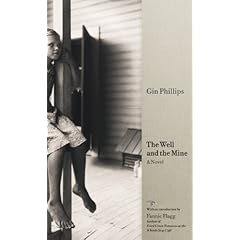 trade paperbacks with acid-free paper, sewn bindings and French flaps. Of course, all this matters not a whit unless the books are good, and they are. One of the latest is The Well and the Mine by Gin Phillips ($15.95, February 2008), a novel set in 1931, in a small Alabama coal mining town. The story begins with nine-year-old Tess seeing a woman remove the cover off her family’s back porch well and drop a baby inside. At first, no one believes her, but then they look, aren’t particularly surprised, and Phillips makes us understand why. She writes about life in the mines, racism, poverty and backbreaking work with grittiness, but there is beauty and love, too, and her spare, graceful prose shines when she writes about the tenderness between Tess’ parents, or the simple fact of coffee:
I pulled his coffee cup from the cabinet and poured over the sink, with the heat from the cup warming my fingers as the brew rose to the top. Just a ground or two floating. Black as night, so hard looking it didn’t seem right that a spoon could move through it.
“Must taste like coal,” I said under my breath, stopping up the pot’s spout with a bit of cloth and setting it back on the stove to keep warm.
“Coffee?” He took a sip, smiled, and closed his eyes as he leaned back. “No, ma’am. Tastes like daylight.”
Maori Tattoos
New Zealand’s Maori rediscover themselves in tattoos

Paul Watson / Los Angeles Times
Oriana McLeod endured the stinging pain of Mark Kopua’s tattoo gun for an hour and a half, and felt the better for it when she saw the design, which depicts the sea and the tossed net of Te Hukiad, a venerated ancestor and tribal leader. “I’ve just found a calling with my Maori-tanga, my Maoriness. It’s a reawakening,” she said.
Ta moko, an art form that once seemed destined for oblivion, is again a solemn declaration of the native people’s identity and dignity.
NEW PLYMOUTH, NEW ZEALAND — With a little ink, some stinging pain and a helping hand from the ancestors, Mark Kopua can heal a wounded soul.
He is a modern master of an ancient art called ta moko, one of the world’s oldest forms of tattooing and a renewed source of pride for New Zealand’s indigenous Maori people.

 PHOTO GALLERY
To those who know how to read the twists, turns and spirals of the ink lines, they tell a rich history of a person’s accomplishments and ancestry. The centuries-old designs turn the faces and bodies of women and men into testaments to their identity, and offer spiritual healing.
“I learned very quickly that moko was therapy for people,” Kopua said. “If you ail inside, and you get taken to a grandparent for advice, the elders are involved in your healing. This is very similar to that.”
The designs have both fascinated and frightened outsiders for generations. In the 19th century, curiosity seekers traded gunpowder with the Maori for the tattooed heads of their dead warriors. Dozens of the dried heads are in a macabre collection hidden away in New York’s American Museum of Natural History.
The tattoos also brought scorn on the Maori from missionaries and other foreigners who saw them as primitive. Even today, some Maori adorned with moko complain that they suffer discrimination when looking for work, or just a drink at a bar.
But in recent years, as Maori stand up to safeguard their culture, an art that once seemed doomed by the onslaught of Western culture is again a solemn declaration of Maori identity and dignity. Their sacred, serpentine designs now adorn foreign celebrities such as British pop star Robbie Williams and boxer Mike Tyson, and Maori are vigorously defending their claim over motifs that many feel are being exploited by outsiders.
My Train Wreck
Sara Nelson, the esteemed Editor-In-Chief of Publishers Weekly, calls my new book un-put-downable, a real page turner, and a train wreck. Thanks Sara. See review below, or see it here: http://www.publishersweekly.com/article/CA6550529.html?nid=2286&source=title&rid=532399248
And if you want to see me read from my un-put-downable, page-turning, train wreck of a novel, here’s my tour schedule: http://bigjimindustries.com/wordpress/index.php/2008/04/tour-schedule/
– posted by JF

Reviewed by Sara Nelson
Bright Shiny Morning
James Frey. Harper, $26.95 (512p) ISBN 978-0-06-157313-2
When James Frey imploded as a memoirist in 2006, many said his A Million Little Pieces should have been—and perhaps initially was—presented as a novel, and that Frey—a sometimes screenwriter—was, both by nature and design, a fiction writer. Bright Shiny Morning is his first official book of fiction. If it’s not quite a novel, less believable in its way than his “augmented” memoir ever was, there’s no doubt it’s a work of Frey’s imagination. Ironic, isn’t it?
Set in contemporary Los Angeles, Bright Shiny Morning is not a cohesive narrative but a compilation of vignettes of several characters (if this were a memoir, we’d call them “composites”) who have come to the city to fulfill their dreams. Some examples: Dylan and Maddie, madly-in-love Midwestern runaways who survive through the kindness of near strangers; Esperanza, a Mexican-American maid tortured by a body that could have been drawn by R. Crumb; a group of drunks and junkies who create a community behind the shacks on Venice Beach; Amberton Parker, a hugely famous married movie star who is secretly—you guessed it—gay. Interspersed with these rotating portraits are random historical and statistical factoids (which better have been fact-checked, even if there is a nudge-nudge, wink-wink disclaimer up front: “Nothing in this book should be considered accurate or reliable”) about L.A.: that, for example, “approximately 2.7 million people live without health insurance” and “there are more than 12,000 people who describe their job as bill collector in the City of Los Angeles.” Frey’s intention, it seems, is to create an onomatopoetic jumble, a cacophony of facts and fiction, stats and stories, that replicate the contradictory nature of the place they describe.
I expect, given the sharpness of the knives that some critics have out for Frey, that many will say the book flat out doesn’t work. First off, there’s that voice, the hyperbolic, breathless, run-on, word-repeating voice that was much better suited to a memoir (or even a novel) in which the hero was a hyperbolic, breathless alcoholic and drug addict. And then there’s the frat-boy swagger that angered some readers of AMLP turning up here, too, so faux-cynical as to be naïve: the gang father’s attaboy about his five-year-old son’s desire to be a cold-blooded killer, and the prurient, adolescent take on sex. (And couldn’t someone have stopped him from exclaiming “woohoo” after some of his “fun” and “not fun” factoids?)
Yet the guy has something: an energy, a drive, a relentlessness, maybe, that can pull readers along, past the voice, past the stock characters, past the clichés. Bright Shiny Morning is a train wreck of a novel, but it’s un-put-downable, a real page-turner—in what may come to be known as the Frey tradition.
Sara Nelson is the editor-in-chief of Publishers Weekly.
Definitely More Chick Flicks, Please
Wary Hollywood Plans More Chick Flicks (Hoping to Lure the Guys)

TriStar Pictures
A scene from “My Best Friend’s Wedding” (1997), a so-called chick flick that was a box office success.
LOS ANGELES — In Nora Ephron’s “Sleepless in Seattle” a weepy Rosie O’Donnell, watching “An Affair to Remember” with a sniffling Meg Ryan 15 years ago, said, “Men never get this movie.”The notion of the “chick flick” thus came into its own. And Hollywood has been fretting about it ever since, trying to recapture that box office magic yet chafing at a label that is increasingly viewed as a marketplace trap. In New York and other locations, two of the most successful directors of the form — Nora Ephron and P. J. Hogan — are currently shooting what might pass for a couple of next-generation chick flicks. But those involved seem determined to avoid having that classification hung on their films, even if it is rooted in honest observation.
Mr. Hogan, who directed the 1997 hit “My Best Friend’s Wedding,” starring Julia Roberts, is filming “Confessions of a Shopaholic,” with Isla Fisher in the lead role, for Touchstone Pictures, owned by the Walt Disney Company. The film is based on a literary series that began with the British publication of Sophie Kinsella’s novel with that title in 2000, about a financial journalist with relationship problems and a penchant for overspending.But the movie is not just for women, the filmmakers insist. “We all have spending habits, a lot of us do,” said Jerry Bruckheimer, one of the film’s producers, speaking by telephone last week.“
If we do our job right, this could be another ‘Wedding Crashers,’ ” added Mr. Bruckheimer, best known for testosterone-fueled entertainments including “Bad Boys”and the “Pirates of the Caribbean” trilogy. He was referring to the 2005 comic hit that included Ms. Fisher, but actually starred Vince Vaughn and Owen Wilson as a couple of playboys who cruise weddings for easy sex — really not the stuff of chick flicks.
But that could be a guy thing, right? “We hope this will be a movie for everyone who likes eating,” said Laurence Mark (“Dreamgirls,” “Working Girl”), one of the film’s producers. He spoke briefly after conferring with Ms. Ephron, who declined to be interviewed for this article.In fact, both films are rooted in a phenomenon — widely styled “chick lit” — that has swept the publishing world in the last decade. The books are written for, and mostly by, professional women in their 20s. The covers are often bright and fluffy, with amusing illustrations. And narrative is often rooted in the first person singular.And the outlook is unabashedly feminine. “There were a lot of romans à clef, from the young working girl’s point of view,” said David Kuhn, of Kuhn Projects, a New York literary agency.
“The Devil Wears Prada,” Lauren Weisberger’s 2003 novel about the travails of a young working girl in the cutthroat New York fashion magazine industry, spawned the genre’s biggest movie hit, for 20th Century Fox, in 2006. The film, which was directed by David Frankel and starred Ms. Streep and Anne Hathaway, took in about $125 million at the domestic box office, and more than $200 million abroad.“Bridget Jones’s Diary,” based on Helen Fielding’s novel about a British woman, made about $72 million at the domestic box office for Miramax Films in 2001.But “The Nanny Diaries,” based on a 2003 novel by Emma McLaughlin and Nicola Kraus, about the travails of a worker in the competitive New York child care business, did less well for the Weinstein Company last year. (Its domestic box office total came in a tad under $26 million.)
At the same time, a run of recent female-oriented romantic films — “The Holiday” with Cameron Diaz and Kate Winslet; “Catch and Release” with Jennifer Garner; “27 Dresses”with Katherine Heigl; “Music & Lyrics” with Drew Barrymore; “P.S., I Love You” with Hilary Swank; and “The Jane Austen Book Club,” with an ensemble cast — has stopped far short of the peaks established years before by films like “Sleepless,” “My Best Friend’s Wedding,” “Runaway Bride” and “Notting Hill.”
Trying to pin down what, exactly, constitutes a supposed chick flick is more of a parlor game than a science. “An Affair to Remember,” in which Cary Grant and Deborah Kerr played star-crossed lovers, clearly makes the cut. “Knocked Up,” in which Ms. Heigl and Seth Rogen played a star-crossed couple of another sort, probably does not.
BRIGHT SHINY MORNING Billboard on Sunset Blvd.
Here is a copy of the billboard for James Frey’s BRIGHT SHINY MORNING that will appear on Sunset Boulevard in West Hollywood right before the Book Tour begins. The second date of the tour will be just down the street at the Whiskey A Go Go on the Sunset Strip with author Josh Kilmer-Purcell and rippin’ band Black Tide.

God’s New Social Network Site
The Cool Hunter Launches New Site “Dear God” – Spirituality For The New Millennium

From the founder of the cool hunter comes dear-god.net; a startlingly new concept of spirituality where people from all over the planet reveal their innermost hopes and fears in the form of prayers to god.
Dear God is completely non-demoninational and the term god is used in the broadest sense – encompassing every religion’s concept of a higher power; be it a Christian god, a Muslim god or simply a fluid idea of universal energy.
In its first week, the site has sparked an organic revolution, with people all over the world embracing the opportunity to unburden themselves, to share their hopes and fears with others in an effort create hope, healing, inner peace and clarity.

From the poignant and the heart-wrenching to even the light-hearted and the humorous, the posts on dear god cover the gamut of human experience, providing a powerfully raw and honest insight into our world today.
As one online site stated: “After viewing this website I found it to be so honest of the world’s reflection and thoughts. See we as believers probably wonder and ask the same types of questions, but never express them to anyone. There are a lot of different views about what and who God is and that is reflected in this site. Try to not view this with a closed mind….Try not to debate that you know the right answer….Try to view this as an opportunity to peek into the heart of our world”.
Niggy Tardust’s Full List of Demands
All the good stuff the commercial leaves out…
Inside The Straight Edge
Exploring the two sides of the ‘straight edge’ culture
“Straight edge” teens should be a godsend for anxious parents and vigilant police officers everywhere. Young people in the movement choose to abstain from alcohol, tobacco products, and drugs, and to resist peer pressure. But a more radical and violent side of the movement is changing the definition of what it means to be straight edge.

“Inside Straight Edge,” a powerful hourlong documentary airing tonight on the National Geographic Channel, explores the two faces of this growing youth culture: positive, tight-knit communities that try to set an example through abstinence; and more militant, fanatical groups that use their intense focus on wiping out substance abuse as justification for violence.
Sonic Youth frontman Thurston Moore narrates the documentary. His presence may help the filmmakers attract an audience interested in a youth movement that’s becoming more prevalent – and harder to define.
The term straight edge was first used in 1981 by the punk band Minor Threat. Their 45-second song “Straight Edge,” famous for the line, “I’ve got the straight edge,” unintentionally sparked the beginning of a movement focused on self-control and protest.
The images associated with straight edge are punk rockers with Mohawks, hardcore kids with tattoos covering their arms and legs, and skaters with X’s written on their hands. The message of abstinence is spread at high-energy concerts, where teens bond over their commitment and release pent-up energy and frustration from the pressures of being young.
Straight edge has grown exponentially over the past few decades and has even become something of the norm in certain towns and cities across the country. “Inside Straight Edge” looks at three cities where the movement is substantial: Boston, Salt Lake City, and Reno.
Director Shadrack Smith’s focus on these cities might seem limiting, but he includes wide-ranging interviews with teens committed to the movement for a host of different reasons, as well as police officers and parents.
Some teens, such as Pat Crane of Massachusetts and Nevada native Zeke Bilyeu, contend they are scapegoated because of violence committed by others who have very different definitions of straight edge. Bilyeu, along with members of the straight edge band Armed for Battle, take issue with a journalistic characterization of them as “white suburban terrorists.” Yet they do make clear that if antagonized, they will defend themselves and members of their community.
According to the film, law enforcement officials in Salt Lake City and Reno, where acts of straight-edge violence are common, now consider anyone affiliated with straight edge to be potentially dangerous. As a result of violence against drug dealers and users on Lansdowne Street in Boston by aggressive straight edgers and the murder of a 15-year-old in Salt Lake City, police officers in those two cities now classify the movement as a gang.
Near the end of the documentary, an eighth grader from suburban Boston stares intensely at the camera while differentiating between the positive version of the straight edge community and the violent side. Asked about his future involvement, he says, “We’re not going to go out and kill people, but I’m not going to tolerate drugs around me and the ones that I love.”
It’s an answer that ends “Inside Straight Edge” on a suitably unsettling note.
Exposing Society’s Great Swindle, the Mailer Way
Norman Mailer celebrated at Carnegie
Random House stages poignant tribute to scribe
By DADE HAYES
Norman Mailer was remembered as equal parts novelist, pugilist, activist and patriarch during a touching and lengthy memorial Wednesday at Carnegie Hall.

“There were so many lives and each of them so worth exploring,” noted Charlie Rose, the day’s emcee, who said he interviewed Mailer a dozen times.
In all, 28 notables and family members paid tribute with words or music to Mailer, who died last November at 84. Random House, his publisher for the last 24 years of his life, organized the memorial. Scheduled to speak at the late-afternoon event were Sean Penn, Tina Brown, Joan Didion and Mailer’s wife of 33 years, Norris Church Mailer.
Novelist William Kennedy, who was a film critic when he met Mailer in 1968, recalled the writer describing the essence of his 32 books, scores of articles, screenplays and plays.
“‘It is the great swindle that society is pulling on itself that there are two literary forms, fiction and nonfiction. Nonfiction is fiction because you never get it right,'” Kennedy said.
Mailer’s nine children, many of whom have wound up working in the arts, painted a vivid group portrait. “It’s hard to rebel against your father when your father is Norman Mailer,” observed Kate Mailer, a writer and performer.
“He was the writer in opposition who stood up against power and reached for a handful himself,” said author Don DeLillo.
Laughs and sardonic witticisms were plentiful at the memorial, relieving the forlorn notes of grief still resonating six months after Mailer’s death. Gina Centrello, prexy and publisher of Random House, set the tone with an anecdote about an editing session during which she told Mailer his book could do without one sizable, digressive passage.
” ‘That would make it more of a page-turner,'” she remembered him saying. ” ‘But Gina, I hate page-turners.’ “
“I don’t want sex I’m just waiting on the bus.”
Beautiful Losers On Screen
Beautiful Losers Hit the Big Screen
A new documentary examines key figures in contemporary art and street culture.
BY: JEFF BEER
In March 2004, the “Beautiful Losers” exhibition debuted at the Cincinnati Contemporary Arts Center and brought together a stunning collection of contemporary and “street” artists whose work is influenced by skateboarding, punk, graffiti, hip hop and an overall DIY approach. After a successful run in Cincinnati, the show traveled to San Francisco, Orange County, Baltimore, then on to Europe, Asia and Australia by last year. There is also the accompanying book and now, theBeautiful Losers documentary.
Beautiful Losers: Trailer | Full View »
The film doesn’t feature every artist from the gallery show, instead choosing to focus on a core group — Harmony Korine, Mike Mills, Stephen Powers, Thomas Campbell, Margaret Kilgallen, Shepard Fairey, Jo Jackson, Ed Templeton, Geoff McFetridge, Chris Johanson and Barry McGee — representing a cross section of the personalities and styles in this particular art movement. While many documentaries tend to discuss subjects well past the studied time frame, director Aaron Rose, also the co-curator of the original art exhibit, wanted to examine this movement while it was still happening. The approach gives the film a welcome immediacy and avoids much of the back-in-the-day pitfalls that can plague any story being told through the often rose-colored lens of hindsight. That’s not to say there isn’t a healthy dose of nostalgia for the days these artists gathered in New York’s Alleged Gallery on the Lower East Side as a group of youthful unknowns, but a good portion of the film also looks at their more recent transition from art world nobodies to working with high profile brands and having work displayed in major galleries and museums around the world. In that way, it’s very much a coming-of-age story, of both the individual artists, their careers and style of art, itself.
We spoke to Rose after the film’s AIGA screening in New York.

Tapes ‘n Tapes
Tapes ‘n Tapes are very cool copycats
4:00 AM

Tapes ‘n Tapes
TAPES ‘N TAPES. “Walk It Off” (XL Recordings)
Everything sputters and whines in the music of Tapes ‘n Tapes. Jittery guitars, fidgety synths and pointy bass parts rattle around the agitated tunes, making every T-N-T song shake.
Crucially, the band knows how to make these neurotic little outbursts catchy. Unfortunately, a lot of other groups figured that out first.
It’s impossible to hear T-N-T’s second album, “Walk It Off,” without thinking of the Pixies, Pavement or Modest Mouse. That is, when you’re not thinking about their antecedents in creative abrasion: Talking Heads and Sonic Youth.
Essentially, T-N-T strikes a fun, fleet but too familiar mean between the classic reference points of noise-pop. Small wonder “Walk It Off” sounds like a compendium of pre-existing strategies, even if they’re undeniably well applied.
Certainly, the group knows how to make potentially irritating music winning. The CD’s opening track, “Le Ruse,” spins out busy little guitar riffs so compelling it anchors another ax devoted to total dissonance.
It’s the balance between the memorable and the difficult that made Tapes ‘n Tapes stand out from the start. The group formed in chilly Minneapolis in late 2003, led by guitarist/singer/lead writer Josh Grier (otherwise known as Tapes 1). They went through a host of personnel changes before releasing their debut, “The Loon,” in late 2005. The disc drew raves in the blogs, no surprise considering the sound had something in common with two other bands hailed by that blabby world: Clap Your Hands Say Yeah and the Arcade Fire.
Like Clap and Arcade, T-N-T has some of the shaky distraction of early Talking Heads. But on the new album, TNT hones its riffs and tunes to find something more pop than either. “Time of Songs” features a liquid guitar that could have fallen off a Bread single from the ’70s. “Hang Them All” has a jerky backbeat you’ll have to move to.
Book Tour Schedule for James Frey’s BRIGHT SHINY MORNING
Following is the appearance and event schedule for James Frey’s BRIGHT SHINY MORNING
| New York, NY Tuesday, May 13, 2008 7:00 PM EST With Josh Kilmer-Purcell BLENDER THEATER 127 E 23rd St New York, NY 10010 Sponsored by Barnes and Noble |
Portland, OR Wednesday, May 21, 2008 7:00 PM PST With Josh Kilmer-Purcell BAGDAD THEATRE 3702 SE Hawthorne Blvd Portland, OR 97214 Sponsored by Powells Bookstore |
|
| Los Angeles, CA Thursday, May 15, 2008 7:30 PM With Josh Kilmer-Purcell & music by Black Tide WHISKY A GO GO 8901 Sunset Blvd West Hollywood, CA 90069 Sponsored by Vroman’s and Book Soup |
Ann Arbor, MI Thursday, May 22, 2008 7:00 PM BORDERS BOOKS AND MUSIC 612 E Liberty St Ann Arbor, MI 48104 Sponsored by Borders |
|
| San Francisco, CA Friday, May 16, 2008 7:00 PM PST With Stephen Elliot, Josh Kilmer-Purcell & music by Third Rail SLIM’S 333 11th St San Francisco, CA 94103 Sponsored by Books Inc. |
Philadelphia, PA Tuesday, May 27, 2008 7:00 PM FREE LIBRARY OF PHILADELPHIA Montgomery Auditorium 1901 Vine ST Philadelphia, PA 19103 Sponsored by the Free Library of Philadelphia |
|
| Marin, CA Saturday, May 17, 2008 1:00 PM With Josh Kilmer-Purcell BOOK PASSAGE 51 Tamal Vista Blvd Corte Madera, CA 94925 |
Boston, MA Wednesday, May 28, 2008 6:00 PM EST COOLIDGE CORNER THEATER 290 Harvard St. Brookline, MA 02446 Sponsored by Brookline Booksmith |
|
| Seattle, WA Monday, May 19, 2008 7:30 PM With Josh Kilmer-Purcell SEATTLE TOWN HALL 1119 8th Ave Elliott Bay Book Company Seattle, WA 98101 Sponsored by Elliott Bay Books |
Toronto, ON Tuesday, June 3, 2008 7:00 PM INDIGO AT THE MANULIFE CENTRE 55 Bloor St. West Toronto, ON M4W 1A5 Sponsored by Indigo Books |
|
| Seattle, WA Tuesday, May 20, 2008 6:30 PM WORDS & WINE AT THE W 4th and University W Hotel Seattle Seattle, WA 98101 Sponsored by Words and Wine Series |
Amagansett, NY Saturday, June 7, 2008 5:30 PM EST BOOKHAMPTON Amagansett Square 154 Main ST Amagansett, NY 11930 Sponsored by Bookhampton |
|
| Brooklyn, NY Thursday, July 24, 2008 7:00 PM EST BOOKCOURT 163 Court St. Brooklyn, NY 11201 (718) 875 3677 |
Memoir From Guyville
Oh My God, Liz Phair Is Writing A Novel
 This weekend we learned via the Times Book Review, where Liz Phair reviewed Dean Wareham’s memoir ‘Black Postcards,’ that she is working on a book of her own — “fiction, not memoir.” “It was 4 am and the light was gray, like it always is in paperbacks” is probably not the first line, but wouldn’t that be awesome?
This definitely counts as a career upswing for Phair: Fans of her initial incarnation as the absolute ultimate goddess of post-collegiate stoned romantically confused totally frank lady-wisdom have lately been baffled by the Matrix-produced, CW drama soundtracky direction of her last two albums. The explanation probably lies in Phair’s long-ago admission that “it’s nice to be liked, but it’s better by far to get paid.” So we hope that she gets a fat advance for that novel! Or maybe she’s already gotten one? Publisher’s Marketplace doesn’t know, but maybe one of you does. Tell! Also, can Phair write, you know, not-songs? Let’s take a look at that book review.
Well, it’s pretty great, though Phair ultimately fails to answer the question — “Guilty? Not guilty? What are we as a jury to think?” — that she poses about Galaxie 500 and Luna frontman Wareham’s confessions, which she compares stylistically to “good courtroom testimony” at the review’s outset. She’s funny and evocative, not too conversational, and not afraid to be a little goofy: “Even his writing style has a rhythm to it: passages move rapidly back and forth between incident and impression, creating a kind of (I’m not kidding) rock ‘n’ roll.” It’s disappointing that she closes the review by quoting what seems like Wareham’s garden-variety midlife therapy session, rather than weighing in on whether he should be held accountable for his unabashed commitment to the rock’n’roll lifestyle.
But then, who is Liz Phair to judge? Actually, maybe the exact perfect person. Anyway, that novel is going to be amazing.
Organ Harvester Pleads Mercy
Master ghoul in body parts scam wants plea deal
Sunday, April 6th 2008, 4:00 AM
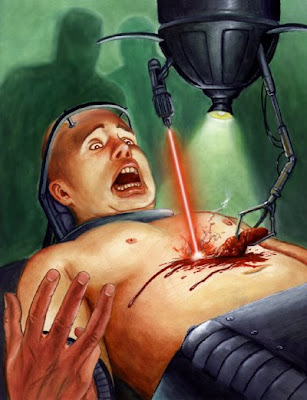 A former oral surgeon who admitted trafficking stolen body parts in New York is now trying to cut a deal in Philadelphia to avoid serving more time for a similar body-snatching charge.
Michael Mastromarino wants his latest sentence to run concurrently with the 18- to 54-year sentence he is already serving – meaning he would not spend one extra day in jail. But prosecutors are balking at the two-for-one proposal and want the so-called master ghoul to serve an additional 20 to 40 years in the slammer.
Mastromarino, 44, was the boss of a multimillion-dollar body-snatching ring that plundered at least 44 corpses, according to Philadelphia prosecutors. He has already pleaded guilty to carving up hundreds of corpses at area funeral homes in New York and illegally selling body parts. He was sentenced in that case last year.
Mastromarino did not appear at a pretrial hearing in Philadelphia on Friday but defense lawyer Charles Peruto Jr. vowed to push for concurrent sentences.
With News Wire Services
Posted Because Naomi Watts Is Hots
Funny Games
 (Cert 18)
Peter Bradshaw The Guardian

Double take … Naomi Watts and Michael Pitt in Funny Games, the 2008 version
Michael Haneke’s new movie is an Americanised replica-remake of his 1997 cult shocker Funny Games: just as before, it’s an icy ordeal of sadism, a macabre vivisectional experiment in pure cruelty, practised upon a bland upper-middle-class family – two parents, tousle-haired kid, adorable dog – which thinks itself safe in its prosperous cocoon. And just as before, it caused my stomach muscles gradually to contract to about a sixth of their original volume. Repeat performance this may be, but its brilliance and technique and ingenuity are still in a different league from anything else around. It is horrifying, genuinely horrifying, in a way that regular horror films never are, and somehow never expected to be.
PJ O’Rourke once wrote that there are two kinds of dangerous: fun-dangerous, like speedboats and race-cars, and not-fun-dangerous, like open-heart surgery or the South Bronx. Haneke is a great believer in making us experience the second kind of dangerous. What his target American audience will make of this is anyone’s guess: maybe the National Rifle Association will use it as a recruitment video. Or maybe it will be the surprise smash of 2008 and Haneke can franchise it out to every foreign-language territory in the world.
It is famously not explicit in the usual sense: you don’t see the actual gory impacts. But it is explicit in a far more horrible way, making us live through the anticipatory fear, and giving us a closeup view of the victims’ horror and despair. The critical convention with violent movies is to compare them to Kubrick’s A Clockwork Orange, and there is an obvious similarity here: after a while, you will feel, like Malcolm McDowell’s punished delinquent, that you are watching with your eyelids clipped open.
Free Bullets With Every Purchase!
Warning: That rifle may be loaded
Sunday, April 6th 2008, 4:00 AM
A Brooklyn rifle manufacturer has asked arms dealers nationwide to make extra safety inspections after discovering it accidentally shipped four guns loaded with live ammunition.

Henry Repeating Arms, a maker of lever-action rifles like ones used in the 1860s and 1870s, said inventory checks revealed no other loaded weapons.
“We would never want anybody to get hurt,” Anthony Imperato, the Park Slope company’s president, said.
As a rule, firearms are distributed unloaded to prevent potentially deadly accidents.
Every gun made by Henry Arms is test-fired before it is sold, a common practice in the industry. The rifles are then supposed to be checked to make sure no rounds remain, but Imperato said an error allowed a few guns to be distributed still loaded for the test-firing procedure.
Lily Allen Saves Literature
Lily Allen drops out as Orange prize judge
Sean Michaels
Monday April 7, 2008
guardian.co.uk
Lily Allen was never the most obvious pick to judge a major literary prize. She’s famous not for her views on novels but for a song about London that doesn’t even spell out the city’s whole name.

That didn’t stop the organisers of the Orange Broadband prize (awarded for the best novel in English by a woman). In December, they added Allen’s name to a judging panel alongside broadcaster Kirsty Lang, journalist Bel Mooney, novelist Philippa Gregory and the Guardian’s Lisa Allardice.
Many lit snobs squawked, wondering what a 22-year-old pop singer would bring to the table – other than chewing gum and photographers’ flash-bulbs. And now, well, they can stop squawking. Because Lily Allen’s out.
“It is with deep regret that Lily Allen has withdrawn from the judging panel,” Allen’s manager told the Daily Mail this weekend. “Lily had read extensively for the first stage of the judging process and was looking forward to the shortlist meeting but recently found that she was unable to commit 100% to the role due to ill-health.”
Allen did not attend a judges’ meeting last month to discuss the 20-book longlist, according to the Daily Mail. Instead she participated by telephone. Allen also missed a debate last week to decide the shortlist.
“Lily hopes that her withdrawal will not detract from the huge importance of the Orange prize and sends her sincere apologies to her fellow judges and to the individual authors,” her manager added.
Porn No Longer Banned At Crucifixion
Rethink over Christ ‘porn’ film ban
An arthouse movie refused a licence 20 years ago could be released after repeal of blasphemy law
Jamie Doward, home affairs editor
Sunday April 6, 2008
The Observer
A landmark decision to ban a film showing Christ being caressed on the cross on the grounds that it was blasphemous could be reversed after almost 20 years.
The 1989 ruling by the British Board of Film Classification to refuse a release licence for Visions of Ecstasy, a low- budget film depicting the 16th-century Spanish mystic St Teresa of Avila caressing the body of Jesus on the cross provoked a national furore.While the film’s director, Nigel Wingrove, believed he was making art, the board, under its heavily censorious director James Ferman, took a different view and said its mix of pornography and religion risked upsetting the Anglican Church. Now, however, in a sign that Britain’s social mores have moved on, Craig Lapper, of the board’s examining body, has invited Wingrove to resubmit the film for classification.
While the film’s director, Nigel Wingrove, believed he was making art, the board, under its heavily censorious director James Ferman, took a different view and said its mix of pornography and religion risked upsetting the Anglican Church. Now, however, in a sign that Britain’s social mores have moved on, Craig Lapper, of the board’s examining body, has invited Wingrove to resubmit the film for classification.
The invitation comes ahead of the repeal in June of the blasphemy law, which has long been a source of anger for those working in the creative industries who complain it is an archaic piece of legislation that stifles art.
A decision to allow the film’s release would bring to an end one of the most controversial chapters in British cinematic history. Coming amid the arguments surrounding Salman Rushdie’s provocative novel The Satanic Verses, the board’s decision was seen as an attack on freedom of speech by organised religion. The debate raged all the way up to the European Court of Human Rights in Strasbourg, which upheld the decision to ban the love scene, thereby killing the film’s release.
[ click to read rest of article at Guardian UK ]
Picasso Is Dead
Picasso is Dead in France at 91
Special to The New York Times
Mougins, France, April 8 — Pablo Picasso, the titan of 20th- century art, died this morning at his hilltop villa of Notre Dame de Vie here. He was 91 years old.

The death of the Spanish-born artist was attributed to pulmonary edema, fluid in the lungs, by Dr. Jean-Claude Rance, a local physician who was summoned to the 35-room mansion by the family. Dr. Rance said that Picasso had been ill for several weeks.
With him when he dies was his second wife, the 47-year-old Jacqueline Roque, whom he married in 1961. In the last few years, Picasso rarely left his 17-acre estate, which was surrounded by barbed wire. He had been in exile from his native land since 1939, when Generalissimo Francisco Franco defeated the Republican Government of Spain in the three-year Civil War.
About 10 days ago, Picasso was helping to assemble 201 of his paintings for exhibition at the Avignon Arts Festival, which will open in that city May 23 at the Palais des Papes. According to Paul Puaux, the festival director who had visited the artist at his home on the Riviera above Cannes, these canvases covered the artist’s output from October, 1970 to the close of 1972.
“There was something completely different, something less tortured in certain paintings,” Mr. Puaux said today in Paris. He added:
“You feel there is a change, a new period. There is much less eroticism and much more softness. His wife told me that he was working much more slowly, more deliberately now, searching and dogging into each canvas.”
The main subject of the 201 works, Mr. Puaux said, “is man, as always – children, a number of mothers with child- but also musical instruments, trumpets and flutes, birds and one very, very beautiful landscape, which is rather unusual for Picasso.”
The dominant color of the canvases is bistre, a warm, brownish black, Mr. Puaux said.
Major Show in 1970
Three years ago, in 1970, 165 of Picasso’s paintings and 45 drawings were shown in the Palais des Papes. They constituted Picasso’s production from January, 1969, through January 1970. The pictures were mostly of vibrant men and women, often in close embrace. There were also dozens of goateed, lusty figures, which the artist’s friends called “the musketeers.”
In 1971, on the occasion of Picasso’s 90th birthday, the Museum of Modern Art in New York, which has the world’s largest public collection of his works, put on a special exhibition. At the same time, the French Government displayed some Picassos in the grand gallery of the Louvre, the first time the museum had ever exhibited the work by a living artist.
As for Picasso, he ignored his birthday, shutting himself up in his villa, even refusing to receive a delegation from the French Communist party, of which he was a member. The group included his old friend, Louis Aragon, the poet.
Why He Was a Communist
The artist had a succinct reply to those who asked him why he was a Communist. “When I was a boy in Spain, I was very poor and very aware of how poor people had to live,” he told a journalist in 1947, adding:
“I learned that the Communists were for the poor people. That was enough to know. So I became for the Communists.”
Sometimes, however, Picasso was an embarrassment to his party. A portrait he did of Stalin on the Soviet leader’s death in 1953 caused a furor in the party leadership. Earlier, the Soviet Government had locked its collection of Picasso’s early works in the basement of Leningrad’s Hermitage Museum.
Publicly, Picasso displayed amusement at the Soviet Union’s banishment of his paintings. Everybody had a right to react to his work as it affected them, he said.
Although the artist passionately detested Franco, he admired his fellow countrymen. One expression of his feelings came in the spring of 1970, when he decided to give 800 to 900 of his early works to Barcelona. These were said to be the best of his output up to 1917.
Earlier, in 1963, Picasso’s close friend, the late Jaime Sabartes, had donated his Picasso collection of some 400 works to the city of Barcelona, and the Palacio Aguilar was then renamed the Picasso Museum. However, the Franco regime covertly opposed the museum, and the artist’s name, was not on the door.
A Paris friend credited Picasso’s gift to Barcelona to his sense of irony. “He liked putting an important Picasso collection right in the middle of Barcelona when there was unrest in Spain and Franco was on his way out,” the friend explained.
Picasso’s works fetched enormous prices at auction, in the hundreds of thousands of dollars. By sales through his dealers, the artist himself became wealthy, although the precise size of his state was not known.
In addition to his wife, Picasso leaves four children, a son, Paulo, born to his late first wife, the dancer Olga Khoklova; a daughter, Mrs. Pierre Widmaier, born to his mistress Marie-Therese Walter, and a son, Claude, and daughter, Paloma, both the children of Francoise Gilot, another mistress, now the wife of the biologist Dr. Jonas Salk.
Funeral plans were incomplete last night.