
The Old Man And The Poem
When Hemingway turned his hand to verse
Poems – unpublishable at the time – were scribbled at end of story collection
Mark Brown, arts correspondent
Wednesday June 4, 2008
The Guardian

Ernest Hemingway, pictured in 1944. Photograph: Corbis
There is probably a good reason Ernest Hemingway is known for his novels, short stories and journalism rather than his poetry, and it can be found in a remarkable first edition of his first American book. Clearly, he was not a great poet.Hemingway scribbled two poems – unpublishable at the time because of their rudeness – in the 1925 first edition of In Our Time for his lifelong friend and drinking buddy Jack Cowles. The volume’s current owner, Mark Hime, said: “We’re not talking TS Eliot here.”
The inscribed book shines a light on how Hemingway, who suffered depression throughout his life, was feeling at the time and also makes clear his disdain at being edited: he has handwritten all the original words in the short story collection changed by his US publishers.
 The book is heading to London as one of the most eye-catching attractions of this weekend’s antiquarian book fair at Olympia, where more than 160 booksellers offer the chance to pick up rare editions of everything from the Aeneid to Harry Potter.
Hemingway was obviously delighted at having In Our Time published in America, and Cowles was one of his closest friends. He wrote: “To Jack Cowles on Valentine’s Day (this has no sexual significance) Ernest Hemingway.”
Above the inscription Hemingway has drawn a pierced bleeding heart with an arrow pointing to drops of blood and annotated it: “blood ($2.00 worth)”.
In the back of the book, on two of the blank endpapers, are the poems. One is a humorous defence of the “lost generation”, the name given by Gertrude Stein to the expatriate American writers living in Paris in the 1920s who met up in the bars and cafes to drink and set the world to rights.
By some accounts it sounds like one long party as the likes of Hemingway, F Scott Fitzgerald and Ezra Pound lived it up in Montparnasse. The poem is called The Age Demanded. The second poem is called The Earnest Liberal’s Lament and disparages St Valentine’s Day.
 Elsewhere, Hemingway has changed the text where his publishers have decided his original words – mostly about trying to make a baby – go too far.
Hime, who owns California-based bookseller Biblioctopus, is selling the edition for £75,000. He agreed the poetry was not great but said the first edition was remarkable. “There is nothing like this, even in the Kennedy Library: Hemingway didn’t do this sort of thing. I’ve seen lots of inscribed books but nothing with this much in it.
“I think at the time Hemingway was feeling really good, he was back with his friends, he was having a good time, he’s having a book published in America, he thinks he’s going to be famous and he’s just excited.”
This year’s fair will also feature the only surviving copy of Shelley’s Poetical Essay on the Existing State of Things, printed in Oxford in 1811, which was written to raise money for the Irish journalist Peter Finnerty. There will also be rare photographs on sale, including ones which capture an encounter with Australian Aborigines in 1891.
When a Persian woman challenges the young Comedian Aristophanes to become a Tragedian…
Playwright/actor is a fine dramaturge with the ear of a poet
When 26-year-old actor Matthew Amendt decided to write a play, he could have done what plenty of others his age have done: scribbled down some ironic, self-referential, comic tripe that would provide stage time for himself and his buddies. Instead, he looked to antiquity and penned a 2 1/2-hour story imagining what would happen if Aristophanes — the best known ancient writer of comedy — had attempted to write a noble tragedy.
Only a young man would attempt such an unbridled, uncommercial act of chutzpah. And while “The Comedian’s Tragedy” isn’t perfect, it’s a work of such lyric beauty, such prescient wisdom, such clarity of vision and such contemporary resonance that I’m going to rave about it anyway: This isn’t just a good first play. It’s a good play, period.
As it tells the story of an artist struggling with his conscience and his muse (Tracey Maloney, feisty and fine), “The Comedian’s Tragedy” deftly mixes the high-blown language of the ancient plays with a contemporary sensibility — a blend made manifest in Ron Menzel’s elegant, excuse-me-please turn as the Chorus Leader.
Amendt plays Aristophanes, blending Method Actor heat with classical actor cool to ask the Big Questions of that age and ours. Can art change the world? Do we dare to hope? Would you die for your ideals or live to fight for them? The story is told with measures of naivete and hard-won experience, sensuality and violence, finished off with a dollop of existentialism.
Amendt is a fine actor, but his dramaturgical gyroscope is impeccable, and he has a poet’s ear for the well-turned phrase. What lovelier compliment can you pay someone than to say, “You run, and the light chases you”? What more damning indictment of an adversary than to call him “folly made flesh”? And what more potent image of the power of drama than to claim that “the trees themselves bent their branches” to hear a tale?
[ click to read full article including showtimes if you’re in MPLS ]
James Frey Speaks Out In London
James Frey speaks about his new book ‘Bright Shiny Morning’, what happened with Oprah and how he feels he has been treated by the world’s media.
Harpo Building Designated As Mistreatment-Free Zone
Memo Pad: Oprah Talks…
Published: Tuesday, June 03, 2008
OPRAH TALKS: Oprah Winfrey rarely sits down for interviews, but now is as good a time as any. According to several reports (including a lengthy one on May 26 in The New York Times), her empire might be facing some tough times. Her ABC show “Oprah’s Big Give” was canceled; the circulation of O, The Oprah Magazine has fallen 8 percent in three years, to 2.4 million, according to Audit Bureau of
 Circulations (a decline mirrored by many of the title’s peers), and Nielsen Media Research ratings for “The Oprah Winfrey Show” reportedly show viewership has declined 7 percent this year. As she preps for the 2009 launch of her own television network, OWN (Oprah Winfrey Network), Winfrey opened up to Black Enterprise in the June issue to talk about lessons learned during her years in business. She claims none of her business ventures have come out of forethought: “I haven’t planned one thing — ever. I have just been led by a strong instinct, and I have made choices based on what was right for me at the time.” She also doesn’t judge a business venture by its profitability. “I don’t care about money,” said the woman who’s worth $2.5 billion. “It throws people off all the time in business meetings. They start shuffling papers.”
Speaking of meetings, writes Black Enterprise editorial director Sonia Alleyne, Winfrey takes them all: “In her 22 years of business, she remembers canceling only three meetings due to dire situations,” the article states. “‘The greatest fear for me of ever canceling is that you’re going to disappoint somebody,’ [Winfrey] explains.”
She also believes in treating her staff well. At Harpo Inc. in Chicago, employees are treated to Google-esque office amenities. “There is a cafe on premises as well as Club Harpo, a workout facility, and the Spa at Harpo.” And according to Winfrey, “I don’t yell at people, I don’t mistreat people. I don’t talk down to people, so no one else in this building, in this vicinity, has the right to do it.” — Stephanie D. Smith
Yves St. Laurent Is Gone
He Put a Swagger In Women’s Steps
Yves Saint Laurent Threaded His Designs With an Empowering Aesthetic
By Robin Givhan
Washington Post Staff Writer
Monday, June 2, 2008; C01
 Often, when a fashion designer dies and his life’s work is assessed, some insistent hyperbole is necessary before the death matters to anyone beyond his loyal band of ladies who spend their time dashing between luncheons and charity balls. Most modern women are not going to weep at the passing of a fashion designer whose heyday was some 30 years ago.
But this time, it’s Yves Saint Laurent who has died. He passed away yesterday evening, at age 71, at his Paris home. And no exaggeration is required to explain the impact he has had on modern fashion. In the 1960s and ’70s, when he was at the height of his influence, he brought popular culture, a mannish swagger, sexual power and ethnic awareness to fashion. He gave women a wardrobe that spoke of confidence and authority. He didn’t give them armor for the boardroom as much as he gave them the sartorial equivalent of chutzpah, tough talk and bawdiness. He gave dames and broads their costumes.
 Saint Laurent elevated youth culture and street style by equating it with the confections whipped up in a fancy atelier. And most important, he began fashion’s steady march toward democracy and the dissolution of the industry’s stultifying hierarchy.
Because of Saint Laurent, women’s closets are filled with now-classic garments that have become the backbone of a wardrobe. Items such as the safari jacket and “le smoking” — a tuxedo — have become such standard parts of a woman’s everyday life that it is difficult to remember a time when they did not exist. Avant-garde designers such as Rei Kawakubo and Yohji Yamamoto have been influenced by Saint Laurent and the way in which he feminized menswear. Halston drew upon the sexual ease in a Saint Laurent garment.
 While designer Gabrielle “Coco” Chanel championed the notion of women in trousers, it was Saint Laurent who sold the public on the idea. Saint Laurent put women in pants. It’s as simple and as influential as that. Without him, how would our mind’s eye see the authoritative ease expressed by Nancy Pelosi and Hillary Clinton? That accomplishment alone would have been enough to secure him a place in history.
But Saint Laurent was not merely a part of fashion history, he was instrumental in writing the vast majority of it. He popularized the bohemian-chic sensibility that later went on to define the hippie aesthetic and its many artsy, grungy, hipster derivations. He welcomed so-called exotic and unorthodox influences into his work, such as the traditional prints of Africa and the folkloric costumes  of Russia. He forged a relationship between fashion and the art world, most dynamically with his Mondrian dress of 1965. Without Saint Laurent, there would arguably be no Marc Jacobs, so greatly influenced by the work of Takashi Murakami, Stephen Sprouse and Richard Prince.
“Most people are lucky if they can do one thing, if they can make one major contribution,” fashion historian Valerie Steele said last night. Saint Laurent’s contributions could fill volumes.
Seattle WORDS & WINE Interview with James Frey
More Dust Than Digital documents this conversation between Warren Etheredge and James Frey. The conversation took place as part of Seattle’s Words and Wine series.
Video production by Harry Calbom, Austin Wilson, Adam Bale, and Jeremy Thornburg.
Music by Ellis Hawes.
Friggin’ Rodents
Venice officials take on city’s pigeons

Luigi Costantini / Associated Press
RULING THE ROOST: Pigeons swarm around a bird-feed vendor in St. Mark’s Square in 2007. Venetian officials, who have banned bird-feed vendors and anyone else from feeding the birds, say the policy is showing results.
They say the birds, with their poop and pecking, are ruining Italy’s art and architecture and harassing tourists and customers. But some animal activists are flouting a ban on feeding them.
Venice, Italy
The pigeons are hungry. Venetian pirates to the rescue!
A band of animal lovers armed with skull-and-crossbones flags zips over the choppy Venice lagoon in speedboats. They dock at the palace-lined piazza, lug out 20-pound sacks of birdseed and scatter the food for all to eat. Or peck. The pirate pigeon- saviors have made three lightning raids into St. Mark’s, the first two at the crack of dawn and now, at midday, to deliberately confront the police and their ban on feeding the birds.
So goes Venice’s battle over its ever-multiplying pigeons. “Flying rats,” in the view of the mayor — airborne menaces that poop all over precious, centuries-old marble statues. “Cool,” in the view of many tourists — can you imagine a picture of St. Mark’s without them?
“Overfeeding is a problem because those that are ill and not strong live longer than they should,” Belcaro says from his office overlooking the Grand Canal. “It is no longer a natural thing.”
Once the mighty center of a seafaring empire, Venice has fought off predators for centuries, from invading armies coveting its strategic location and ample wealth, to the rising ocean tides that are slowly engulfing its islands. Modern times brought a new set of threats, including smog, water pollution, hordes of tourists and the pigeons. Officials argue that the pigeons’ highly acidic guano seeps into fissures in thousands of marble monuments and building facades, weakening the structures. In addition, they scratch and peck at the marble, seeking its calcium content as a nutrient, doing further costly damage.
Renata Codello, an official with the Italian Cultural Works Ministry, says the pigeons are destroying Venice’s architectural heritage. The poop, she says, is a biohazard, igniting a chain reaction producing algae, spores and fungus, while the birds are potential carriers of diseases and nasty bugs.
“They treat the pigeons like they were demons,” says Paolo Mocavero, head of the 100% Animalisti organization that conducts the pirate feeding operations. The city’s decade-old practice of using wide nets to capture pigeons is especially objectionable, activists say. “The pigeons suffer a lot,” says Gianpaolo Pamio of the Bird Protection League. “I want to know what the city is doing with the pigeons. Are they going to end up on our plates?”
“It’s sad, but what can we do?” Belcaro says. He dismisses alternatives that activists propose, such as trying to ply the birds with contraceptives. Birth control, which has to be consumed regularly, is difficult to administer efficiently in such a huge, nomadic population, he says.
Even in the first weeks of the birdseed ban policy (pirate feedings aside), Belcaro says, he already sees success in a notable decline in the number of birds congregating in St. Mark’s Square. True, there may be slightly fewer of them, but they seem to be getting a bit more aggressive. After all, food shortages often lead to riots.
 Under the porticoes of the creamy Doges’ Palace on a sun-filled late morning in May, one pigeon went after a woman with an apple. She danced and bobbed to get away, screaming, “Let me go! GO AWAY!” Still, most of the waddling bevies of tourists seemed to delight in the pigeons. Americans, Russians and Japanese played the stunt of stretching out arms, then squealing when birds alighted, as friends and family snapped photos. One Spanish-speaking woman had no fewer than 10 pigeons on her arms, shoulders, head and purse. Real Hitchcock material.
“I like the pigeons,” says tourist Hunter Latour, 18, from West Palm Beach, Fla. “It’s part of the experience of coming to Venice and to St. Mark’s, the attraction. Take that away and you lose something.”
“The pigeons are a part of the history of Venice,” vendor Daniela D’Este says. Take away the pigeons, she says, and “it’s like Venice without the gondolas.”
Loogie Lovin’ Black Lips
|
Maxwell’s Rock/Pop/Etc., Music The singer of this Atlanta band is known for hocking wads of spit into the air only to land them on his tongue seconds later. I’ve never tried to catch a loogie in my own mouth—it’s basically spitting on yourself, which isn’t cool or punk or revivalist. Spitting on others is a different story, but who wants to deal with messy saliva stains in 2008? Remember: There’s a difference between the Stooges and stooges. With Gringo Star. DOMBAL. |

Olsen Twins And Prince Gett Off at Annual Book Orgy
The buttoned-down publishing industry went Hollywood over the weekend as booksellers gathered for BookExpo America, their annual convention. USA TODAY’s Jocelyn McClurg and Carol Memmott report from Los Angeles. Olsens use their ‘Influence’
Young stars Mary-Kate and Ashley Olsen mingled with 70 booksellers at a party in West Hollywood to promote their glossy October book, Influence. The bash wasn’t open to reporters, but Mary-Kate got on the phone later to talk about the project and why the twins wanted the word out early. “It was the first party to launch the book, and we just wanted booksellers to know that we’re really excited about it,” says Olsen, 21. “We worked so hard on it.” In the photo-heavy Influence (Razorbill, $35), Mary-Kate and Ashley together and separately interview 22 actors, designers and photographers they consider influential, including Karl Lagerfeld, Lauren Hutton, Diane von Furstenberg and Margherita Missoni. There will be two jackets, with a different Olsen on each front cover and the other on the back. “We wanted it to be an inspiring book about people who are successful,” Olsen says. “Sometimes we all get lost in the process of our lives, and it’s inspiring to hear others’ stories and to know there will be ups and downs and to hear how they got through it.” Does Mary-Kate, who describes herself as a perfectionist, think she is an influential fashion icon? “You would have to ask someone else that,” she demurred. — J.M. One night with Prince
Star-struck booksellers could schmooze with any number of celebrity authors, including Barbara Walters, who autographed her best seller Audition. But one ticket was the hottest: an invite to the home of rock star Prince, whose first book, 21 Nights, arrives in September. Guests wandered the palatial home and grounds in the hills above L.A. but never encountered the private rocker until he stepped onto an outdoor stage at 1:45 a.m. Saturday and gave a free concert in his own backyard. It was worth the wait: a 1 hour, 15 minute set, mostly covers of other artists, including Sly and the Family Stone, The Beatles and the Doobie Brothers. The show ended after 3, with Purple Rain and 1999, and Prince saying it was time to let the neighbors get some sleep. 21 Nights (Atria, $50) is based on his 21 concerts in 21 nights in London last year. — J.M. |


NYT Puzzles In Tribute to Noah Webster
Puzzles: Noah’s Art

Amy Goldstein, Mike Shenk and Robert Leighton

No. 1 Finding the Perfect Word
(pdf)

No. 2 Breaking Your Word
(pdf)

No. 3 Get a Word In Edgewise
(pdf)

No. 4 From the Word Go
(pdf)

No. 5 In So Many Words
(pdf)

No. 6 Mark My Words!
(pdf)

No. 7 The Last Word
(pdf)
View all the puzzles (pdf) together.
Bo Diddley Gone
Bo Diddley’s Dead
Thank the heavens we knew Diddley.
Bo Diddley, the rock ‘n’ roll architect whose trademark shuffling rhythm powered everyone from Buddy Holly to the Rolling Stones to Jack White, but whose most famous duet partner might have been athlete Bo Jackson in the famed Nike commercials, died today after years of declining health. He was 79.
Inducted into the Rock and Roll Hall of Fame in 1987, Diddley’s signature hits included “Who Do You Love?” and the self-titled riff, “Bo Diddley.”
Damien’s Lamb Becomes Latest Victim Of Police State
Guns guard Damien Hirst’s lamb at BCAM

Mel Melcon, Los Angeles Times
ART GUARD: BCAM uses armed guards to protect its treasures, including “Away from the Flock,” by Damien Hirst.
Armed security is not common at museums. But at LACMA, a formaldehyde work raises safety concerns.
As you stroll through the Broad Contemporary Art Museum, images of guns confront you, including Andy Warhol’s hip-swiveling, gun-slinging “Elvis,” Chris Burden’s Los Angeles policemen and the gun-brandishing fascist thugs of Leon Golub. And there are other armed men at BCAM.
On a recent day, at least three security officers with holstered guns and batons guarded the new Los Angeles County Museum of Art addition. One carries a 9-millimeter pistol. Another, armed with a .38-caliber pistol, is assigned to stand a few feet in front of an artwork with a dead lamb, embalmed in a tank filled with formaldehyde and water, created by British artist Damien Hirst.
The current guard in front of the Hirst piece has been there about a month, guards say, noting the potential for vandals to smash the tank and create a toxic leak. BCAM was evacuated for about an hour in April when a drop of formaldehyde about the size of a quarter leaked from the Hirst work, which is called “Away From the Flock.” Another museum spokeswoman said that a change in barometric pressure was responsible and that a conservator had resealed the case.
Art heists
In a world of sensational art heists, armed guards at museums filled with priceless works might not seem surprising. “The Scream,” Edvard Munch’s emblematic “Skrik” of existential angst, went back on display at the Munch Museum in Oslo this month after being stolen in 2004 and recovered, with some damage, in 2006. In the last 20 years, vandals have urinated on a Marcel Duchamp urinal at the Tate Modern, vomited on Mondrian’s “Composition in Black, Red and White” at New York’s Museum of Modern Art and poured black ink into the formaldehyde encasing a Damien Hirst lamb at London’s Serpentine Gallery.
“Several museums feel that the risk of a shootout, where many of the public may be hurt, is a bigger concern,” Hall wrote in an e-mail. “They would rather have the police respond. Some institutions face risks, though, where they feel they need armed officers as a deterrent, and to protect visitors and staff. . . . Risk varies, from location to location.”
‘A kind of paranoia’
One LACMA visitor, Laura Silagi, a Venice artist, said she first noticed the armed guard in front of the Hirst piece a few weeks ago. “I’ve never in my life seen armed guards in a museum,” she said. “It interferes with an art experience. There’s a kind of paranoia attached to it.”
Inside BCAM, one armed guard is stationed in front of Hirst’s white lamb, entombed in a glass case that shows some condensation at the top.
Nearby is a device marked “Formaldehyde monitoring” and “Do not touch,” with instructions to call the number for the “Conservation Center” with any questions. The Environmental Protection Agency classifies formaldehyde as a probable carcinogen, with immediate respiratory risks.
“Some crazy guy could smash it with a hammer, and the formaldehyde would spill all over the floor, and it could take two weeks to clean up,” the guard, who declined to give his name, said of the Hirst work.
anne-marie.oconnor@latimes .com
STUCK In America’s Windshield
Hit-and-run drives this taut drama
‘Stuck’ Thriller about a hit-and-run victim trapped in a windshield. With Mena Suvari, Stephen Rea. Directed by Stuart Gordon (1:25).R: Violence, sexuality. At the Angelika.
 Horror and gore, in the right hands, can free up ideas. David Cronenberg refined himself through great psycho-chillers, and Sam Raimi and George Romero didn’t let blood get in the way of satire. Writer-director Stuart Gordon is the same way, though his output has been spotty since the 1985 cult favorite “Re-Animator.”
But Gordon was inspired when he came upon a disturbing true story in 2001: A homeless man, hit by a car driven by a woman who didn’t want to report the accident, spent hours trapped in her windshield before dying. Gordon turned that story into “Stuck,” and, with scripter John Strysik, altered it to make a taut drama that manages to be thoughtful without forgetting it’s a creep-out.
Mena Suvari is Brandi, first seen conscientiously cleaning up after residents at the nursing home where she works. After a night of partying with drug-dealer boyfriend Rashid (Russell Hornsby), Brandi gets behind the wheel and hits Tom (Stephen Rea), a down-on-his-luck guy whose day began by being evicted from a fleabag hotel before being shooed away by an employment agency.
 When Tom goes sailing into Brandi’s front window, her initial terror turns to trickiness. She pulls into her garage, intending for Tom to just die there. But he doesn’t: While she and Rashid have sex and do what they can to hurry along his demise, Tom attempts to free himself from the shards of glass keeping him attached to the car. From the glimpses into his life prior to the accident, he’s had bad breaks. This one, however, he’s going to fight.
Rarely do films show the systemic disregard faced by people living on the edge, the little pushes that hurry along a slipping-down life. “The Pursuit of Happyness” was maybe the last. This movie actually takes time to know its characters. Tom’s descent to sleeping in a park is mirrored by Brandi’s eagerness to get promoted. Suvari (“American Beauty”) and, especially, Rea (“The Crying Game”) show how hunger for respect can bring out a person’s true colors.
Of course, “Stuck” is anything but high-minded. Any movie that has bloody windshield wipers, ripped-up faces and people on fire really just wants to get a reaction. Gordon wields horror traditions like a scalpel – will the neighbor come to the rescue? Do we root for the monster or the victim? Don’t go with a weak stomach. But expect it to be turned into knots.
Happy Emos “not afraid to keep on living” – Mothers feel safe leaving newly chipper kids alone to go shopping
Emo runs high as fans defend band against Daily Mail
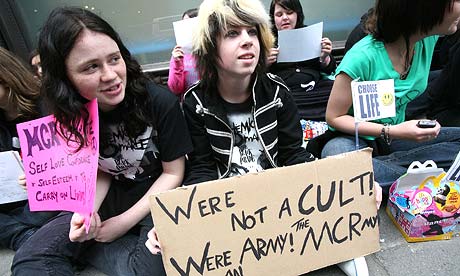
Fans of My Chemical Romance came from all over the country but the atmosphere was more carnival fairground than protest. Photograph: Anna Gordon
There are few things that would drag a typical teenager out of bed early on a Saturday morning, but defending the honour of a beloved band from tabloid attacks is probably one of them.
 Around 100 My Chemical Romance fans had already gathered at Marble Arch, in central London, by 10.30 this morning – not bad given that organisers had given the protest a 12-hour window, of 10am to 10pm, and that there was a last minute change of venue.
The fans were objecting to Daily Mail reports describing My Chemical Romance as a “suicide cult band” and linking the recent suicide of a Peckham schoolgirl, Hannah Bond, 13, to the fact that she had started following the band two weeks before her death.
The Daily Mail has called the New Jersey-based band one of the foremost of the “suicide cult” groups forming part of the “emo” phenomenon. The paper described “emo” as a teenage trend that started in the US in the 1980s and was “characterised by depression, self-injury and suicide”. Its followers, the tabloid said, wore tight jeans, studded belts and wristbands and had dyed-black hair and long fringes obscuring their faces.
The atmosphere at the protest was more carnival fairground than riot, with fans clutching balloons and soft toys and singing My Chemical Romance songs loudly and passionately – but not always tunefully. Lyrics included “teenagers scare the living shit out of me” and “I’m not afraid to keep on living”.
 A few were dressed in typical dark, “emo” fashion but most followed the request of the organisers, who had written on the website: “Please consider dressing to suit the day … Don’t try to dress stereotypically.” Many of the fans had homemade shirts with positive slogans such as, “Think happy thoughts.”
“I love MCR, it saves lives. The Daily Mail are liars and all they want to do is put the youth against the adults; they just hate us and it’s really unnecessary, it’s just wrong,” she said. “I’ve read a couple of the [Mail] articles and they’ve actually misquoted lyrics and the research was so badly done, it was unbelievable. I actually thought [the story] was a hoax when I found it on the internet.”
Vikki Bourne, who came to the protest from Crawley in West Sussex with her daughter Kayleigh, 15, and their dog, Jack, said they were both huge fans of My Chemical Romance and had a closer relationship as a result.
“Emos are being portrayed as self-harming and suicidal and miserable and they’re not,” she said. “Since my daughter met the friends she’s got, she’s happy, she’s got a social life, she’s not suicidal, she’s got confidence. It’s about the music and being friends and having fun.
 “It’s a waste of time, there’s no one here today,” one security guard told MediaGuardian.co.uk. “Look at them – they’re eating their lunch and their mums are off shopping.”
One of the few boys to attend today’s protest, Craig Goodwin, 17, from Upminster in Essex, said he was there with the blessing of his parents. “They didn’t mind – my dad used to do protests because he was a rocker back when it was mods and rockers, and my mum liked My Chemical Romance, so she didn’t care, either,” he said.
“I know people who’ve done it [self harm] in the past but they’ve always come through it. Some have listened to MCR and it’s built their confidence up so they could come back like they were before.”
The Poo Date
Michelangelo in Marble (with a 500-year Warranty)
Michelangelo for Readers With Deep Pockets
BOLOGNA, Italy — The gala presentation of “Michelangelo: La Dotta Mano” (“Michelangelo: The Wise Hand”), a volume of photographs of this Renaissance master’s sculptures, may well have been the most lavish book debut in history.
 |
| Aurelio Amendola/FMR |
With Piazza Maggiore, Bologna’s main square, as the backdrop, a short video depiction of the volume, which can be seen onwww.fmronline.it, was followed on Thursday night by an hourlong spectacle that included dozens of costumed dancers, a string quartet playing from a stage suspended in midair, suckling pigs roasted over a pit, a fake snowfall and a foppishly dressed acrobat walking Spiderman-style up the facade of San Petronio, the city’s cathedral.
But then, this is no ordinary book, starting with its retail price of 100,000 euros, or around $155,000, at Friday’s exchange rate.
Included in the price of what its publishers are calling “the most beautiful book in the world” is a sleek black case, its own stand and a 500-year guarantee.
“This isn’t an appliance,” Marilena Ferrari, chairman of the book’s publisher, Gruppo FMR, told Bologna’s mayor and guests at the book’s official presentation in a grand salon in City Hall on Thursday morning. “That’s the amount of time we feel we can guarantee the materials we used to craft it.”
 Using the high standards of the privately published books in the 19th century — an ideal known as the “book beautiful” — as a starting point, FMR sought expert artisans from various fields to create something Ms. Ferrari described as “a work of art in itself.”
Aurelio Amendola’s black-and-white photographs were printed on paper made exclusively for the project. There are detachable reproductions of Michelangelo drawings on handmade folios created according to centuries-old traditions. And then there’s the cover: a scale reproduction in marble of the “Madonna della Scala” (“Madonna of the Steps”), a bas-relief of the Virgin and Child sculptured by Michelangelo when he was still in his teens. The original is housed in the Casa Buonarroti in Florence.
I Hope Jerry Garcia Goes Zombie So He Can Stomp All Over This
Simply wrong.

Activist Guerillas Begin Bombing L.A.
Guerrilla gardener movement takes root in L.A. area

Scott planted the garden on the median early in the morning to avoid detection. He continues to weed and clean. Residents encourage his work. Photo by Mark Bolster/LA Times
Stealth growers seed or plant on land that doesn’t belong to them. The result? Plants that beautify or yield crops in otherwise neglected or vacant spaces.
BRIMMING with lime-hued succulents and a lush collection of agaves, one shooting spiky leaves 10 feet into the air, it’s a head-turning garden smack in the middle of Long Beach’s asphalt jungle. But the gardener who designed it doesn’t want you to know his last name, since his handiwork isn’t exactly legit. It’s on a traffic island he commandeered.
“The city wasn’t doing anything with it, and I had a bunch of extra plants,” says Scott, as we tour the garden, cars whooshing by on both sides of Loynes Drive.
Scott is a guerrilla gardener, a member of a burgeoning movement of green enthusiasts who plant without approval on land that’s not theirs. In London, Berlin, Miami, San Francisco and Southern California, these free-range tillers are sowing a new kind of flower power. In nighttime planting parties or solo “seed bombing” runs, they aim to turn neglected public space and vacant lots into floral or food outposts.
 Part beautification, part eco-activism, part social outlet, the activity has been fueled by Internet gardening blogs and sites such as GuerrillaGardening.org, where before-and-after photos of the latest “troop digs” inspire 45,000 visitors a month to make derelict soil bloom.
“We can make much more out of the land than how it’s being used, whether it’s about creating food or beautifying it,” says the movement’s ringleader and GuerrillaGardening.org founder, Richard Reynolds, by phone from his London home. His tribe includes freelance landscapers like Scott, urban farmers, floral fans and artists.
“I want to encourage more people to think about land in this way and just get out there and do it,” says Reynolds, whose new handbook for insurgent planters, “On Guerrilla Gardening,” is out this week.
The activists see themselves as 21st century Johnny Appleseeds, harvesting a natural bounty of daffodils or organic green beans from forgotten dirt. It’s a step into more self-reliant living in the city,” says Erik Knutzen, coauthor with his wife, Kelly Coyne, of “The Urban Homestead” to be released in June. The Echo Park couple have chronicled “pirate farming” on their blog, Homegrown Evolution. Guerrilla gardening, Knutzen says, is a reaction to the wasteful use of land, such as vacant lots and sidewalk parkways. He’s turned the parkway in front of his home into a vegetable garden.
Welcome to LA
Bright Shiny Morning by James Frey
From the publisher: Welcome to LA. City of contradictions. It is home to movie stars and down-and-outs. Palm-lined beaches and gridlock. Shopping sprees and gun sprees. Bright Shiny Morning takes a wild ride through the ultimate metropolis, where  glittering excess rubs shoulders with seedy depravity. Frey’s trademark filmic snapshots zoom in on the parallel lives of diverse characters, bringing their egos and ideals, hopes and despairs, anxieties and absurdities vividly to life. Some suffer, like the otherworldly wino who tries to save a spoilt teenage runaway. Others gain, like the canny talent agent who turns sexual harassment to blackmailing advantage. Some are loaded, or grounded, and have luck on their side. Others, like the countless actresses-turned-hookers, or schoolboys-turned-gangsters, are doomed.“
Out of the many characters in Bright Shiny Morning, one dominates them all – the city of Los Angeles. Frey etches out the city’s persona through the experiences of a cross-section of its inhabitants, from the highest to the very lowest. It is testament to his skills that even the most profoundly unsympathetic of these individuals cannot fail to get under your skin and the novel is always engaging although don’t expect a story in the conventional sense.”
Tom Goddard, Waterstones.com
 An ambitious and wide-ranging first novel from the author of the controversial rehab memoir, A Million Little Pieces which paints a vivid fictional portrait of the city of Los Angeles and its many and varied inhabitants…Did you feel that James Frey suceeded in creating believable and sympathetic characters here? How did you find the unconventional narrative structure of the book? Did it affect your overall enjoyment of the book? Does the book provide a rounded portrait of the city that gives a real impression of sense of place and what the city is like? Did you empathise with any of the characters more than others? Amberton, Dylan, Old Man Joe – who did you feel was the most convincing character?
UK Releases Slasher PSAs To Quell Knife Crimes
Home Office enlists teenagers for £3m anti-knife adverts
Video ads such as the one above will be distributed on mobile phones and social networking sites. WARNING: CONTAINS EXTREMELY GRAPHIC IMAGES OF STAB WOUNDS. DO NOT CLICK PLAY IF YOU ARE ONE TO ABHOR THE GORE.
A £3m advertising campaign devised by teenagers to warn young people of the physical and emotional consequences of knife crime is to be launched today by the Home Office.
The campaign, which will run over the next three years, will feature national radio, website and mobile phone adverts as well as print and “viral ads” to be distributed via social networking sites such as Bebo and mobile phones.
The radio commercials feature teenagers talking about the emotional impact of a knife attack on their boyfriends and girlfriends while promotional postcards feature a thumbless hand, with the message: “If you carry a knife you’re more likely to get stabbed yourself.”
The campaign concept was devised by a group of young people who also scripted and recorded the radio adverts. The 18 teenagers from England and Wales took part in a creative summit in April to share ideas on how to make their peers think twice about carrying a blade.
One of those who took part, Khadijah Murchison, aged 18, from Bristol, said: “All the young people that went to the creative summit have been affected by knife crime, so to share our experiences and come up with ideas and adverts that will help reduce knife crime was great. Hopefully it will make a real difference.”
The creative summit followed discussions between the Home Office and 70 teenagers which aimed to gain an understanding of young people’s experience of knife crime and possession and what motivated them to carry a blade.
The ads are to be supplemented by a series aimed at mothers encouraging them to talk about knives with their children, and to offer them support.
Home Office minister Vernon Coaker said: “We know that many young people carry a knife because they are fearful and these adverts tell powerful stories about the dangers of going down that path. People have got to get the message that if they carry a knife there’s more chance of it being used against them.”
Instructions for a fun time on the interstate
Step 1. Tie these balloons to your car.
Step 2. Drive like a bat out of hell.

“If he wasn’t such a [punk], he could have avoided all of that…”
Comcast Hijackers Say They Warned the Company First
By Kevin Poulsen May 29, 2008 | 7:44:07 PMCategories: Crime, Hacks And Cracks
The computer attackers who took down Comcast’s homepage and webmail service for more than five hours Thursday say they didn’t know what they were getting themselves into.
 In an hour-long telephone conference call with Threat Level, the hackers known as “Defiant” and “EBK” expressed astonishment over the attention their DNS hijacking has garnered. In the call, the pair bounded freely between jubilant excitement over the impact of their attack, and fatalism that they would soon be arrested for it.
“The situation has kind of blown up here, a lot bigger than I thought it would,” says Defiant, a 19-year-old man whose first name is James. “I wish I was a minor right now because this is going to be really bad.”
The two hackers are members of the underground group Kryogeniks. The interview was arranged by Mike “Virus” Nieves, an 18-year-old New Yorker who pleaded guilty as a minor last year to hacking AOL. Neives, who was on the call, is also a member of Kryogeniks, though he and his compatriots say he’s stopped hacking.
Nieves vouched for the identities of the hackers. Threat Level also confirmed Defiant’s identity over AOL instant messenger, on a handle that’s known to belong to Defiant.
Neither hacker would identify their full names or locations. Defiant’s MySpace profile lists him in Cashville, Tennessee, but he says that’s incorrect. His girlfriend lists herself in New York. Threat Level expects both hackers’ names and locations will emerge soon.
The hackers say the attack began Tuesday, when the pair used a combination of social engineering and a technical hack to get into Comcast’s domain management console at Network Solutions. They declined to detail their technique, but said it relied on a flaw at the Virginia-based domain registrar.
 Network Solutions spokeswoman Susan Wade disputes the hackers’ account. “We now know that it was nothing on our end,” she says. “There was no breach in our system or social engineering situation on our end.”
However they got in, the intrusion gave the pair control of over 200 domain names owned by Comcast. They changed the contact information for one of them, Comcast.net, to Defiant’s e-mail address; for the street address, they used the “Dildo Room” at “69 Dick Tard Lane.”
Comcast, they said, noticed the administrative transfer and wrested back control, forcing the hackers to repeat the exploit to regain ownership of the domain. Then, they say, they contacted Comcast’s original technical contact at his home number to tell him what they’d done.
When the Comcast manager scoffed at their claim and hung up on them, 18-year-old EBK decided to take the more drastic measure of redirecting the site’s traffic to servers under their control. (Comcast would neither confirm nor deny the warning phone call.)
“If he wasn’t such a prick, he could have avoided all of that,” says EBK. “I wasn’t even really thinking. Plus, I’m just so mad at Comcast. I’m tired of their shitty service.”
“They called me back five minutes later and said, ‘We got Comcast’,” recalls Nieves.
The defacement message was short and simple: “KRYOGENICS Defiant and EBK RoXed Comcast,” it read. “sHouTz to VIRUS Warlock elul21 coll1er seven.”
 Fellow hackers, relying on press reports claiming that customer data may have been compromised, are hitting up the duo for passwords to Comcast e-mail accounts, which they say they don’t have. “Nobody was listening in on the ports to try and get usernames and password,” says Defiant. “We could have, but we didn’t.” (On this point, Comcast and the hackers agree).
The hackers say the flaw they exploited still exists, and that other large websites are equally vulnerable. Asked if they plan to attack anyone else, EBK says, “Who knows. Only Kryogeniks knows”
The elder hacker in the team says he was reluctant to use his access to take over Comcast.net, and emphasizes that the pair tried to warn Comcast about the flaw.
“I was trying to say we shouldn’t do this the whole damn time,” says Defiant.
“But once we were in,” adds EBK, “it was, like, fuck it.”
(David Kravets contributed to this report)
Circle K Launches Answering Service For Chatty Wives – Marks First Foray Into Telecom Sector for Slurpee King
Let’s Read To Our Kids More. Please.
Parents urged to read to children
Fewer than one in two parents say they read to their children each day, with one child in 10 getting a bedtime story less than once a month or never, according to figures published today.

A “state of the storytelling nation” study by the campaign team behind this year’s National Year of Reading presents both good and bad news: parents who do read to their children regularly do so with humour and inventiveness; but there is a rump of parents who do not bother at all.
Honor Wilson-Fletcher, director of the National Year of Reading, said: “Parents just need to understand the importance of making it fun. There is a relationship between reading in later life and storytelling and how well you do it. The better you are at it the more likely you will enjoy it, and the other way round.”
Of 2,207 parents surveyed by YouGov, 49% read to children each day. On average, 19% read four or five times a week, 14% two or three times a week, 5% once a week, 5% once a month or less, and 5% never.
Funny stories are the most popular choice. While 12% of parents said their children liked traditional fairytales, 28% said humorous stories by the likes of Roald Dahl and Dr Seuss went down the best.
Most parents throw themselves into storytelling, with 82% putting on accents for characters – “posh” was top choice for a hero (followed by Yorkshire and cockney) and cockney top for a villain (then posh and Scottish). Most popular books were The Gruffalo, The Very Hungry Caterpillar, The BFG, and (tied) Where’s Spot? by Eric Hill and CS Lewis’s The Lion, the Witch and the Wardrobe.
James Frey As Yenta to DolceGoldin
MEDIA FIRM OWES ALL TO WRITER FREY
By PETER LAURIA
May 30, 2008 — In addition to being a notorious author, it turns out that James Frey is also a matchmaker.

The author of the partially fabricated memoir “A Million Little Pieces” is responsible for bringing former Details and Star Editor-In-Chief Joe Dolce and former MSNBC Editorial Director Davidson Goldin together to launch a media-strategy and branding consulting firm called DolceGoldin, The Post has learned.
The firm, which officially went into business this month, aims to be a behind-the-scenes operator helping politicians, pop culture figures and businesses make sure “the attention they are getting is the attention they want,” Goldin said in an interview with The Post.
DolceGoldin was founded after Frey’s wife, Maya, who was friends with Goldin at Cornell University, introduced Goldin to her author husband.
The two hit it off and Frey hired Goldin in January to provide support for a media strategy devised by his publisher, HarperCollins, ahead of the launch of “Bright Shiny Morning,” which will debut at No. 9 on the New York Times bestseller list this weekend.
The next month Goldin received an e-mail from Frey introducing him to Dolce and suggesting that the pair go into business together. Dolce and Goldin were soon drawing up plans and seeking out office space for their new venture.
“There are many people and companies that are great at making products, but are not as great at communicating their message to the public,” Dolce said.
Let’s Live!
My Mom Just Bought Me This New Chair But I’m Not Sure Where To Stick It

Hell’s Canucks Rumble With Canadian Politicians
Canadian Sex and Biker Scandal Comes Alive on YouTube
Finally, an inventive new use for YouTube that doesn’t involve a kid practicing Star Wars moves or Kobe Bryant jumping over a pool full of snakes. Someone by the screenname BLABLABLAPQ has posted a musical montage that starts with the phrase “Le Scandale de la Semaine au Quebec” (“The Scandal of the Week in Quebec”). The video, which is comprised of screenshots and French pull quotes, highlights the sex-politics-and-biker-gang scandal currently engulfing Canada, all set to a poppy Francophone soundtrack. (Minus a random Britney Spears vamp.)
According to Ian Austen in today’s New York Times, Canadian minister of foreign affairs Maxime Bernier has resigned because “his former romantic interest, Julie Couillard, was linked to Quebec’s motorcycle gangs, which have long tried to infiltrate politics and the justice systems. … Biker gangs in Mr. Bernier’s home province of Quebec have, among other things, killed prison guards and shot one prominent crime journalist.” (Who knew our neighbors to the north were so hardcore?)
Shelfari Review of BRIGHT SHINY MORNING

Bright Shiny Morning
by James Frey
Editorial Review
One of the most celebrated and controversial authors in America delivers his first novel—a sweeping chronicle of contemporary Los Angeles that is bold, exhilarating, and utterly original.
Dozens of characters pass across the reader’s sight lines—some never to be seen again—but James Frey lingers on a handful of LA’s lost souls and captures the dramatic narrative of their lives: a bright, ambitious young Mexican-American woman who allows her future to be undone by a moment of searing humiliation; a supremely narcissistic action-movie star whose passion for the unattainable object of his affection nearly destroys him; a couple, both nineteen years old, who flee their suffocating hometown and struggle to survive on the fringes of the great city; and an aging Venice Beach alcoholic whose life is turned upside down when a meth-addled teenage girl shows up half-dead outside the restroom he calls home.
Throughout this strikingly powerful novel there is the relentless drumbeat of the millions of other stories that, taken as a whole, describe a city, a culture, and an age. A dazzling tour de force, Bright Shiny Morning illuminates the joys, horrors, and unexpected fortunes of life and death in Los Angeles.
Bovine Growth Hormone Hits Women’s Professional Tennis

As with athletes in most professional sports, today’s tennis players are much more physically developed than their predecessors. While critics concede that bigger players have made women’s tennis in particular a faster and more exciting game for the TV audience, they also blame this rapid increase in size for the decline of the backhand on the WTA circuit.