
Tim Burton’s VINCENT
Win a Free Copy of HIT ME WITH YOUR BEST SHOT
from the San Jose Mercury News
Contest: Win a copy of ‘Hit Me With Your Best Shot: The Ultimate Guide to Karaoke Domination’
Enter to win today
About the book

Author Raina Lee helps beginners and veterans conquer stage fright, pick songs to showcase vocal talent (or disguise a lack thereof), and master their moves (mic twirls, Mick Jagger kicks, etc.). She turns what can be a terrifying social rite of passage into a party no one wants to miss.
With lists of the best songs for all occasions, advice from World Karaoke Champions, hand-drawn typography and illustrations, plus party scene snapshots of people singing their hearts out, this pocket-size resource will turn up the volume on happy hour.
Attend the karaoke book release party with author Raina Lee
9 p.m. on Friday at Seven Bamboo in San Jose
7 p.m. on Saturday at the the Mint Karaoke Lounge in San Francisco
Axl Don’t Mess
Guns n’ Roses’ “Chinese Democracy” Leaker Gets FBI Visit
6/24/08, 5:45 pm EST
Last week, the Internet was rocked when California blogger Kevin Skwerl posted nine newly leaked Chinese Democracy tracks,  including three previously unheard songs allegedly from Guns n’ Roses long-awaited album. Skwerl — who used to work in the distribution department of Universal Music and is now a Web designer — runs the blog Antiquiet, and says he received the tracks from “an anonymous online source.”
Yesterday Skwerl was surprised to find himself face to face with two FBI agents who paid a visit to his day job. “It was kind of an ambush,” Skwerl tells Rolling Stone. “When I came back from lunch they were waiting in the lobby for me. It’s a little creepy they know where I work.” Two young FBI officers, who Skwerl describes as “Mulder and Scully types,” questioned him for 15 minutes about where he got the tracks and made plans to visit his house at 7:00 a.m. this morning.
“I wasn’t sure if they were going to come by with a warrant and trash the place, like in the movies,” he says. “It was nothing like that.” The FBI officials wanted to see the  original files, but Skwerl erased them last week per instructions from Axl Rose’s attorneys. Skwerl ultimately gave them second-hand files that are now widely available on the Internet.
Last week Skwerl’s blog crashed from the traffic flood that resulted from his controversial posting. “My host contacts me and says, ‘What the fuck did you do?’” I go, “Uhhhh. I posted some music.” He goes, “What exactly did you post?” I go, “Uhhhh. [Meek voice] New Guns n’ Roses.” He goes, “Motherfucker.” Before long his cell phone rang with an unfamiliar 323 number. “It was a really cool guy from the Gn’R camp that was a middle man between someone who was very angry and me. He was trying to reach out and see if I’d go without a fight, which is more or less what I did.”
Geisha Head So Good Cultural Revival via Internet
Renewed respect as geisha make a comeback – and take to cyberspace
Teenage girls are flocking to enter ‘floating world’ in return to traditional culture

Kyoto geisha girls. Photograph: Jeremy Sutton-Hibbert
Miehina has barely taken a dozen steps along a Kyoto street before the audio backdrop to her every public move comes to life. In the fading light of an early summer evening, the metronomic clip-clop of her platform okobo sandals is accompanied by the clicking of shutters, as a gaggle of amateur photographers seeks the perfect snapshot of one of Japan’s most venerated women.
They stay with her until she retreats down a backstreet and slips through the sliding wooden door of her teahouse, her emerald green kimono, worth tens of thousands of pounds, now no more than a photogenic imprint.
In the past tourists would have had to wait hours for a fleeting glimpse of a lone geisha on her way to an appointment. Now they are spoiled for choice.
After decades of decline, Japan’s traditional entertainers are making a comeback. Earlier this year the number of geisha trainees – known as maiko – reached 100 in Kyoto for the first time in four decades.
Much of the mild embarrassment many Japanese felt about the geisha thread running through their cultural fabric arose from popular misconceptions: the suspicion that, beneath the veneer of cultural exclusivity, they were little more than high-class prostitutes.
Experts believe the recent surge in teenage girls hoping to enter the “floating world” of tea ceremonies, performing arts, and yes, flirtatious exchanges with inebriated clients, is evidence of renewed respect among the Japanese for their traditional culture.
The 14,000 Words He Left Us – Carlin’s Last Interview
George Carlin’s Last Interview
By Jay Dixit on June 23, 2008 in Brainstorm
 Ten days ago, on Friday, June 13th, 2008, I had the extraordinary privilege of talking to George Carlin. As far as I know it was the last in-depth interview he gave before he passed away yesterday at age 71. Originally it was slated to run as a 350-word Q&A on the back page of Psychology Today. But I was so excited to talk to him—and he was so generous with his time—that I just kept on going. By the end I had over 14,000 words.
On stage, George Carlin came across as a grouch, often vulgar and sometimes misanthropic. But with me he was patient and warm, happy to talk through the minutiae of his creative process and eager to share stories about his childhood, his evolution as a comic, and his influence. What struck me most was the joy in his voice as he talked about the wonderful feeling he got in his gut while writing. I was also moved by the gratitude he expressed for his mother, who he said “saved” him and his brother—leaving her bullying, alcoholic husband when George was just two months old, getting a job during the worst years of the Depression, and raising two boys on her own.
He spoke about the pride he took in his work. As a ninth-grade dropout, he said, it was gratifying to see his words quoted in textbooks, classrooms, and courtrooms. And he was proud to have inspired other comedy greats, who routinely called him to say, “If it weren’t for you, I wouldn’t be doing this.” As he looked back on his astonishingly prolific 50-year career—which includes 130 Tonight Show appearances, 23 albums, 14 HBO specials, three books, and one Supreme Court case—the interview became a sort of retrospective of his life.
One Artist We Hope Has Filed His Tax Returns Properly
Photographer Documents Secret Satellites — All 189 of Them
By Bryan Gardiner  06.21.08

Artist Trevor Paglen’s time-exposure photographs show the streaks of light left by classified satellites.
Photo: Trevor Paglen
BERKELEY, California — For most people, photographing something that isn’t there might be tough. Not so for Trevor Paglen.
His shots of 189 secret spy satellites are the subject of a new exhibit — despite the fact that, officially speaking, the satellites don’t exist. The Other Night Sky, on display at the University of California at Berkeley Art Museum through September 14, is only a small selection from the 1,500 astrophotographs Paglen has taken thus far.
In taking these photos, Paglen is trying to draw a metaphorical connection between modern government secrecy and the doctrine of the Catholic Church in Galileo’s time.
“What would it mean to find these secret moons in orbit around the earth in the same way that Galileo found these moons that shouldn’t exist in orbit around Jupiter?” Paglen says.
Satellites are just the latest in Paglen’s photography of supposedly nonexistent subjects. To date, he’s snapped haunting images of various military sites in the Nevada deserts, “torture taxis” (private planes that whisk people off to secret prisons without judicial oversight) and uniform patches from various top-secret military programs.

While all of Paglen’s projects are the result of meticulous research, he’s also the first to admit that his photos aren’t necessarily revelatory. That’s by design. Like the blurry abstractions of his super-telephoto images showing secret military installations in Nevada, the tiny blips of satellites streaking across the night sky in his new series of photos are meant more as reminders rather than as documentation.
“I think that some of the earliest ideas in the modern period were actually from astronomy,” Paglen explains. “You look at Galileo: He goes up and points his telescope up at Jupiter and finds out, hey, Jupiter has these moons.”
More significant than the discovery itself, Paglen says, was the idea that anyone with a telescope could verify it and see the same exact thing that Galileo saw — an idea Paglen is trying to re-create in his own photographs.
“It really was analogous to a certain kind of promise of democracy,” says Paglen, who sees a similar anti-authoritarian premise running through his own work.
Richard Prince’s Fast Cars, Nurses and Other Male Obsessions
Girlz on the hood
Richard Prince has a thing about fast cars, nurses and other supposed male obsessions. Adrian Searle wonders what lies behind all the secondhand jokes and macho excess
Tuesday June 24, 2008
The Guardian 
A sculpture installation of a car at the Richard Prince: Continuation exhibition at the Serpentine Gallery in London. Photograph: Christian Sinibaldi
Walking into Richard Prince’s show, the bonnet of a car greets you, like a shark or a maître d’ with perfect American teeth. Every exhibition at the Serpentine gallery in London now has to have a dramatic opening: last time it was a self-portrait by Maria Lassnig, naked and pointing a gun at us, another gun pressed to her temple; Anthony McCall opened his show last year with a projector aimed straight at the door, like a Gatling gun. Such gambits are designed to make us forget the gallery was once just a tea house in Kensington Gardens.
Prince chartered his own flight to London, stacked with work for the Serpentine, and installed the show himself, in record time. But his car isn’t going anywhere – it’s just a fibreglass body set into a chunky cubic block. Surrounding this are further car hoods, hung on the wall like paintings, or the shields of gasoline warriors in a comic-book universe. These, too, appear to have been sculpted from some plaster-like material. Their chevron shapes are inset with cowls and scoops, giving them the air of a certain kind of painted, post-industrial abstract relief I haven’t seen in years.
 Never mind that what I’m actually looking at are auto bonnets and custom cowl induction hoods. According to Carhoods.com, where Prince orders these bizarre body parts, they “can be flanged, trimmed and easily welded in place to fit your needs – whether you want to draw more air into your engine, are in need of engine clearance, or yearning for a cool new look”. They could have been manufactured with art in mind.
These objects also appear to have been coloured with loose, brushy paintwork; one might think of early Richard Diebenkorn or Ron Gorchov. Up close, it turns out to be the work of a disk sander and a filler knife. That’s not impasto – that’s Bondo. Instead of Cézanne gone abstract, or a sensitive balancing of directional brushstrokes, we have the tough but tender swagger of the bloke in the garage.
Prince, of course, knows this. It is one of the things his art is dealing with. Nevertheless, works such as Gomper, Hum Bomb and the wonderfully titled No Milk No Butter Since My Cow Left Home have a satisfyingly weighty, chunky feel. The masculinity in Prince’s art is as unavoidable as it is ambiguous.
 Prince also expects his audience to be as knowing as he is. (It never does to overestimate the intelligence of the art lover, especially the collecting classes. They say Rothko killed himself because he met the people who bought his art.) Prince has chosen these forms both because he’s a car nut, and because he, too, recognises their resemblance to art. And also, undoubtedly, because the car and the artwork are both commodity fetishes whose place in culture is more than utilitarian. His art often depends on its resemblance to other things – to other art, as well as to its overt references in popular culture. If you hold a mirror to the world, are you responsible for what it reflects?
Lots of artists have worked with cars – from the French artist César to Gustav Metzger, from Sarah Lucas to Gabriel Orozco to Joseph Beuys. There’s another automobile-cum-altar in the centre of another room in this show, and a real Buick 1987 Regal, whose entire body has  been covered in a vinyl wrapping of images of hot young babes. Prince is really tripping on the unreconstructed male psyche here, unless, that is, he’s deconstructing it.
Prince has just held a Guggenheim retrospective, of which the Serpentine show is a pared-down continuation (hence the exhibition title). Yet, it is disarmingly accessible and oddly attractive. In the middle of one gallery is a giant garden planter, fashioned from a truck tire and cast in glowing orange resin. You could say that Prince has domesticated his art for London, except that the artist, who lives in depressed, upstate New York, has always liked to see his work in domestic situations: he has bought several countryside properties to work in and house his stuff.
The artist is also an avid collector of books – from Nabokov to pulp, hardboiled crime to Beat poetry – and, in the words of Jack Bankowsky, the Artforum editor-at-large, ” traffics in rumour and refusal”. There is much that remains opaque about Prince’s practice. For ZG magazine in the mid-1980s, Prince invented an interview between himself and JG Ballard, and insinuated that his father did something shady for the CIA down in Panama, where Prince was born.
Elsewhere in this show, there are appropriated photos of biker chicks lounging on motorcycles, their stockings ripped, their chests bared. There’s a recent set of drawings riffing on the style of Willem de Kooning, except the old abstract expressionist only drew women who looked like Bette Davis and Joan Crawford, while these are manic androgynes, De Kooning’s swervy charcoal swipes and blurry erasures reduced to a merely competent and  mannered style. One figure shows his/her willy, encased in a pair of see-through plastic panties. Prince’s art appears to celebrate trashiness and low-rent style. He has rephotographed Marlboro adverts, keeping the wild west cowboy fantasy and losing the logo and the fags. His art is full of recycled gags; he also has a thing about nurses, whose images fill a concurrent Gagosian gallery show in London’s West End.
Either Prince just lets his obsessions hang out, or he has something to say about the state of American culture – or both. It is too late to be a wide-eyed pop artist. Prince is not just an appropriationist, though he first appeared on the New York scene in the mid-1970s as just that, and as the then partner of Cindy Sherman, for whom success came much more quickly. In the end, Prince’s problem is that he’s just not as good as Bruce Nauman or Matthew Barney, or Sherman at her best. His art knows this and tries to deal with it by way of jokes and excess.
Prince’s nurses stalk the Serpentine as though patrolling the wards on night duty. In their masks, mascara and starched uniforms, they appear both bloodied and predatory. Derived from the covers of pulp novels, Prince  photographically reproduces these images on canvas and then overpaints them, giving them the transgressive frisson of medical fetishism. His nurses are more Carry On Matron than Sister Ingrid the Catheter Queen.
Somehow, Richard Prince’s art spurns my critical advances. My excuse is that what Prince does and deals with is just too much a macho guy thing for me. I don’t drive, I have no interest in cars, I’ve never had the fantasy of nailing a nurse on the hood of my Buick or of being picked up by a bare-boobed biker chick riding a throbbing Harley. I even had to have the cultural significance of Brooke Shields, about whom Prince once made an iconic and infamous early work, explained to me. Prince the artist is cool and fashionable, both attributes I have some difficulty keeping up with.
When he copies old New Yorker cartoons and sad stand-up jokes on canvas, stencilling their punchlines or using them to interrupt achingly vacuous fields of colour, he is just compounding one kind of empty gesture with another. “A girl phoned me the other day and said, ‘Come on over, nobody’s home.’ I went over, nobody was home,” reads one canvas. Ba-boom.
Maybe the artist sees himself as the failed comedian, the fall guy in the gag. Or maybe that’s us, his audience. Maybe the art is like the girl on the phone, promising everything, delivering nothing. It’s a joke all right. It’s painful.
· Richard Prince: Continuation is at the Serpentine gallery until September 7. Details: 020-7402 6075.
“So just where you think you’re goin’ there, boy…”
Denied! No U.S. visa for Boy George
Monday, June 23rd 2008, 12:41 PM
 Kitwood/Getty
Give the Boy a break!
U.S. Customs is denying Boy George his visa, cutting off his hopes for a U.S. tour.
The denial comes after the British pop icon’s offer to show his appreciation for the Department of Sanitation of New York (DSNY) and play a free concert for their Family Day on August 17. George got to know the DSNY in 2006 when he swept the streets of New York while serving a community service sentence.
“I’m pretty devastated because I am so excited about this forthcoming tour, and having my visa application denied seems unfair after I swept the streets of New York spotless,” George tells PaperMag. “I committed a crime and I happily paid the consequences, and I should be allowed to move on and get on with what I do best – and that is performing and making people dance and cry!”
Shaq Invites Kobe Over For Warmed Sushi
Dying For Porn
Disgruntled porn store owner dies in standoff
Little Falls gunman had history of disputes with county officials
Article Last Updated: 06/25/2008 07:11:09 AM CDT
A man who lost numerous legal battles with Minnesota’s Morrison County over his now-closed adult entertainment businesses was fatally shot after he walked into a county board meeting Tuesday and held at least seven people hostage.
Gordon Wheeler Sr., 60, of Little Falls, was wounded after the county sheriff, a sheriff’s lieutenant and a state trooper opened fire, minutes after he took several county officials hostage as they were wrapping up a board meeting.
Wheeler died later at St. Gabriel’s Hospital in Little Falls, about 100 miles northwest of St. Paul.
It was unclear whether Wheeler returned fire or if he turned the gun on himself, said Dave Bjerga, assistant superintendent for the state Bureau of Criminal Apprehension.
“He talked the whole while, he never quit talking for at least 10 minutes, until the climax,” Wenzel said. “He looked to me like a farmer; he didn’t seem out of the ordinary. I thought, ‘Oh, maybe it was somebody with news or something to say.’
“He had something to say, I guess.”
Wheeler had owned a few adult businesses in the county. In 2003, the county tightened its land-use ordinance for sex-related businesses and shut down an adult book and video store Wheeler owned near Swanville called Lookin’ Fine Smut and Porno, according to reports by the St. Cloud Times.
Monet Still Moving Major Moolah
A Monet Sets a Record: $80.4 Million

Andy Rain/European Pressphoto Agency
“Le Bassin aux Nymphéas,” the record-breaking Monet.
LONDON — The summer auction season here began at Christie’s on Tuesday night when a standing-room-only crowd of dealers, collectors and art lovers came from all over the world to watch and bid on one of the largest London sales the auction house has held. Early in the evening a record price for a Monet, $80.4 million, was set for one of the rarest of his waterlilies.
A sea of hands shot in the air when that painting, “Le Bassin aux Nymphéas,” which had been expected to sell for $36 million to $47 million, came up on the block. The previous record for a Monet, $41.4 million for “The Railroad Bridge at Argenteuil,” was set last month at Christie’s in New York.
“Le Bassin aux Nymphéas,” from 1919, a large horizontal work measuring more than 3 feet by 6 feet, is from a series of four that Monet signed and dated and that experts consider to be among the most important paintings from his late period. Unlike most of his late works, which remained unfinished at the time of his death in 1926, this series was sold by him. One is in the collection of the Metropolitan Museum of Art; another was cut in two; and a third is in a private collection, having been sold at Christie’s in New York in 1992 for $12.1 million, a stellar price at the time.
The Monet up for auction Tuesday belonged to J. Irwin and Xenia S. Miller, collectors from Columbus, Ind. Mr. Miller, the chairman of the Cummins Engine Company who died in 2004, and Mrs. Miller, who died in February, helped transform Columbus into a showcase for modern architecture by supporting historic buildings and projects.
 In addition to the Monet the Millers also owned a Cubist Picasso, another popular work in the auction. “La Carafe (Bouteille et Verre),” painted in the winter of 1911-12, went to a telephone bidder for $7.3 million, above its high $5.9 million estimate.
Another big seller on Tuesday was “Dancers at the Bar,” a Degas pastel being sold by an unidentified private collector. The work, from around 1880, is considered important not only for its composition — two young dancers, their white skirts and pink ballet slippers perfectly rendered — but also because of its provenance. It had been owned by Louisine Elder, the wife of H. O. Havemeyer, the American sugar magnate whose bequest forms the bulk of the Met’s Degas collection. The pastel remained in the Havemeyer family for three generations before being sold at Christie’s in New York in 1982 for $1 million.
Playing to Russian collectors, Christie’s sale included a group of works by Russian artists. One, called “The Flowers,” from 1912, by Nathalia Goncharova, was estimated to bring $6.9 million to 8.9 million. It sold for $10.8 million, a price that set two records: for the artist at auction, and for a female artist at auction.
Several works that had belonged to Simon Sainsbury, the British philanthropist and grocery store magnate who died in 2006, were also for sale Tuesday. Among the best was an early pointillist painting by Signac, “Collioure, Les Balancelles,” a composition of sailboats in the water created in September and October 1887 while he was in the seaside Mediterranean town of Collioure. The painting sold for $5.8 million, higher than its expected estimate of $3.6 million to $4.9 million.
Van Man Black Disses Sedaris
from The GalleyCat @ MediaBistro
‘Why does David Sedaris hate America?’

Michael Ian Black, author of My Custom Van: And 50 other mind-Blowing Essays that will Blow Your Mind All Over Your Face is endorsed by Amy Sedaris (“Enjoy the ride of your lifetime”) but is gunning for her brother David. Since Black realized that his book is currently higher ranked on Amazon.com than David Sedaris’s 1994 book Barrel Fever, Black’s begun a “desperate bid to dismantle that mo-fo David Sedaris’s lock on all things ‘best-selling,'” Most importantly he wonders “Why does David Sedaris hate America?” (Sedaris lives in France)
In Black’s laugh-out-loud collection of short comic essays from Simon Spotlight Entertainment (which includes an introduction from Abraham Lincoln) he throws down the gauntlet with the essay ‘Hey David Sedaris – Why Don’t You Just Go Ahead and Suck It?’ He now continues the fued online with several Sedaris blogs at the moment including Some Ways to Casually Put Down David Sedaris at Your Next Social Event Without Looking Like a Total Jerk which includes this gem:
Say, for example, you are at league bowling night and your buddy finds himself facing an easy pick-up for a spare. Just before he bowls say something like, “Don’t miss, Bob, or you might hear David Sedaris telling a long and humorous story about what a boob you are on ‘This American Life.'”
Interview w/James Frey in Macleans
Interview with James Frey
‘I would say hello but I can’t imagine Oprah and I would have much to talk about’
HEIDI STASESON | May 28, 2008 |
 It’s been 2-½ years since James Frey, author of A Million Little Pieces, published as a memoir, was denounced as a liar by the queen of daytime television, Oprah Winfrey. The scandal over Frey’s book not only ruined his reputation among readers (the book had by then sold more than 3.5 million copies) but called into question the integrity of the entire book publishing industry. Frey has just released a novel, Bright Shiny Morning, with a new publisher.
Q How important will Oprah’s opinion about this new book be to you? Do you think she might ever trust you again?
A: Um, you know, I don’t really even think about it. If she reads it, cool; if she doesn’t, cool. I don’t expect ever to be back on her show.
Q: What if you saw her walking down the street, what would you say to her?
A: I would say hello and be as polite as I needed to be but I can’t imagine that we would have much to talk about. I wish Miss Winfrey the best in everything she does.
Q: After A Million Little Pieces, you lost your agent, were abandoned by friends and peers, shunned by the publishing industry, and cast out as a not-to-be-trusted pariah. How has this life experience changed you?
A: I mean it was an unpleasant experience. I can think of a lot of things in life that would be much worse.
Q: Like what?
A: I mean nobody died; I didn’t lose anybody in my life. My family is okay, my wife and child are great. I’m not a soldier fighting in a war, I’m not sick. There are many, many, many things involved in life that are a much bigger deal than anything I had to deal with. How did it change me as a person? It definitely humbled me; it definitely made me realize how fortunate I am in a lot of ways to have a family who was there, and friends who were there.
Q: Evgenia Peretz [in Vanity Fair] talked about how it was humiliating to the point where you actually felt driven to go back to the bottle for a while. Is that true?
A: It was hard, sure. I have a history of addiction. Sometimes when you feel things you might want to drink. But I never did. I was never, I felt, in any danger. It was a sh—y situation but you get through it like any other sh—y situation. I mean at no point was I, like, in the corner, huddled up crying. It was a bad couple of months. And there were some really, really hard moments, but you get through them.
Q: You just plowed into the book and didn’t [succumb]?
A: I mean I wrote a movie before I wrote the book. I didn’t start the book until October of 2006.
Q: Was that the Hells Angels movie by [director] Tony Scott?
A: Yes. I don’t know when it’s even getting made or if it’s getting made. I had been hired to write it in 2005 and after everything happened Tony was like, “Well, I still want you to write it. Let’s get to work.” And so I did. I wrote the movie.
Q: You have a fascination with gang life and bikers and tough guys — they’re all in this new book. Did that research from Scott’s movie help you with this book?
A: The bikers in Bright Shiny Morning are absolutely not Hells Angels. I got an interesting education in biker culture writing the Hells Angels movie. I had a lot of fun hanging around with some of the members of the club.
Q: Why are you interested in Hells Angels?
A: They’re rebels. They do what they want, when they want. They don’t care about what people think about them.
Q: Kind of like you. Didn’t you hang out with the Top Dog of the club?
A: I met Sonny Barger on a number of occasions and he’s a really cool, funny, very, very smart guy. It was a real honour to get to hang out with him. Sonny’s had a really interesting life. He’s an American hero to millions of people. He’s 69, maybe 70. He’s the founder of the Oakland chapter of the Hells Angels.
Q: But they’re tough guys and you portray a lot of tough dudes in your novels, including even yourself in A Million Little Pieces.
A: I’m nowhere near as tough as any Hells Angel on the planet.
Q: Let me see your [right wrist] tattoo?
A: Those are my daughter’s initials.
Q: How many tattoos do you have?
A: Ten, 15 — I don’t know. I don’t want to talk about my tattoos.
Q: While labelled as fiction, your novel is strewn with factoids about Los Angeles. It seems more akin to the non-literary fiction style of contemporary American pros like Joan Didion or the Mailers of the world. Were you going for something like that here?
New Titles Out Next Week
Attainment: New Books Out Next Week
Selected new titles appearing next Tuesday, July 1:
Rome 1960: The Olympics That Changed the World by David Maraniss (S&S, $26.95, 9781416534075/1416534075) examines a politically eventful yet often overlooked Olympics.
 Death Angel: A Novel by Linda Howard (Ballantine, $26, 9780345486547/0345486544) features a woman fleeing her crime lord lover after stealing his money.
The Last Patriot: A Thriller by Brad Thor (Atria, $26, 9781416543831/141654383X) chronicles the worldwide struggle to uncover an ancient Islamic secret.
A Summer Affair: A Novel by Elin Hilderbrand (Little, Brown, $24.99, 9780316018609/0316018600) tells the story of a Nantucket glass artist having an affair with her friend’s husband.
Chasing Darkness by Robert Crais (S&S, $25.95, 9780743281645/0743281640) continues the Elvis Cole series.
The Modern Day Definition Of Hope
Many Dutch prepare for 2012 apocalypse
 AMSTERDAM, Netherlands, June 23 (UPI) — Thousands of people in the Netherlands say they expect the world to end in 2012, and many say they are taking precautions to prepare for the apocalypse.
The Dutch-language de Volkskrant newspaper said it spoke to thousands of believers in the impending end of civilization, and while theories on the supposed catastrophe varied, most tied the 2012 date to the end of the Mayan calendar, Radio Netherlands reported Monday.

De Volkskrant said many of those interviewed are stocking up on emergency supplies, including life rafts and other equipment.
Some who spoke to the newspaper were optimistic about the end of civilization.
“You know, maybe it’s really not that bad that the Netherlands will be destroyed,” Petra Faile said. “I don’t like it here anymore. Take immigration, for example. They keep letting people in. And then we have to build more houses, which makes the Netherlands even heavier. The country will sink even lower, which will make the flooding worse.”
Kevin Teare: Bumpology, the Clinton Years @ Glenn Horowitz Bookseller

Kevin Teare: Bumpology, the Clinton Years
June 28 through August 3, 2008
Glenn Horowitz Bookseller is pleased to announce an exhibition of paintings by Kevin Teare. Teare admits to a perhaps unhealthy level of preoccupation with covert U.S. history, English rock bands from the 60s, and other matters pop or political. You wouldn’t immediately know it to look at his paintings – gorgeous abstract compositions of shape and color floating on pale expanses of primed canvas—but titles like There Are Exactly 57 Reds (for John Frankenheimer), which alludes to both a notorious quotation from Senator Joe McCarthy and to Frankenheimer’s film The Manchurian Candidate, suggest that Teare’s paintings are operating on other levels besides those immediately apparent. Visit our website for more information.

87 Newtown Lane
East Hampton, NY 11937
P: 631.324.5511
www.ghbookseller.com
Art Gallery & Bookshop
Mon thru Sat: 10am to 5pm
Sun: 12pm to 4pm
Closed Wed & Thurs, Oct thru April
Carlin Gone
COMEDIAN GEORGE CARLIN DIES AT 71 IN LOS ANGELES
7 minutes ago
Comedian George Carlin, a counter-culture hero famed for his routines about drugs and dirty words, died of heart failure  at a Los Angeles-area hospital on Sunday, a spokesman said. He was 71.
Carlin, who had a history of heart problems, died at St. John’s Health Center in Santa Monica about 6 p.m. PDT (9 p.m. EDT) after being admitted earlier in the afternoon for chest pains, spokesman Jeff Abraham told Reuters.
Known for his edgy, provocative material, Carlin achieved status as an anti-Establishment icon in the 1970s with stand-up bits full of drug references and a routine about seven dirty words you could not say on television. A regulatory battle over a radio broadcast of his “Filthy Words” routine ultimately reached the U.S. Supreme Court.
(Reporting by Dean Goodman; Editing by Patricia Zengerle)
Ten-Hanging Fans of ‘Amistad’ Star Beat Paparazzo With His Own Stick
Violent Surfers Shred Paps Over McConaughey
A group of surfers just got gnarly on a group of paps — all over photos of beach king Matthew McConaughey!
Around 12 photographers were on the beach in Malibu this afternoon trying to get shots of Matty hitting the surf, when an all-out smackdown was laid on the pappers by turf-protecting surfers.
One pap was hit in the face and we’re told suffered a broken nose, while another was thrown into some rocks and had his camera smashed. McConaughey was not involved in the ruckus.
Police tell us a battery report was filed by one photographer and no arrests have been made.
A rep for Matthew has yet to get back to us.
My Little Dog Lucy & The Blonde
 I pulled into the crowded parking lot at the Super Wal-Mart Shopping Center and rolled down the car windows to make sure my little dog Lucy had fresh air.
She was stretched full-out on the back seat and I  wanted to impress upon her that she must remain there. I walked to the curb backward, pointing my finger at the car and saying emphatically, ‘Now you stay. Do you hear me?’ ‘Stay! Stay!’
The driver of a nearby car, a pretty young blonde lady, gave me a strange look and said,…
“Why don’t you just put it in park?”
Massive Vangelis
Massive Attack, Vangelis and other replicants
Massive Attack’s memorable rendering of Vangelis’ Blade Runner soundtrack with the Heritage Orchestra helps the movie legend live on
June 19, 2008 12:30 PM

A still from Ridley Scott’s Blade Runner. Photograph: The Kobal Collection
On Tuesday, as part of the Meltdown festival they’re curating, Massive Attack mixed Vangelis’ original score of Blade Runner with the 45 piece Heritage Orchestra. The triumphant event marked yet another appearance of the infamous score in the pop culture zeitgeist.
The mythology surrounding Blade Runner is well known: the movie being re-cut at least seven times; Scott being fired by the producers of the film but continuing to work on it  regardless; the notorious original release, which featured a Harrison Ford voiceover dubbed in pre-production and with unused scenes from Kubrick’s The Shining spliced into the closing scenes. Yet the soundtrack, too, is the subject of legend. Like the movie, it has been released and re-released with more and more extras added but, unlike the movie (a seven DVD box set was released last year), it remains far from complete.
Though trailed on the credits of the original theatrical release, the full soundtrack was never released. Instead, the producers got the New American Orchestra to arrange Vangelis’ original score. However, the last 25 years have seen the emergence of a cottage industry of bootleggers releasing the Vangelis version. Over 25 known versions exist in some form or other (some even more complete than the recently released three CD box set) and there is a blog where you can hear them.
The reason why Vangelis withheld the score has never been adequately explained, beyond his vague remarks upon the re-release in 1994 score about “finding myself unable to release these recordings at the time”. Some point to Scott’s use of other source music beyond Vangelis’ score. Others say that Vangelis never signed his contract to allow commercial use of the recordings. It’s rumoured that a rift between Scott and Vangelis was subsequently healed, upon which Vangelis ceded the commercial rights.
The constant stream of bootlegs was the official reason why Vangelis decided to release his 1994 version of the score. Even though his was the official version, many fanatics still regarded it as incomplete. It appeared to have been embellished by Vangelis after the fact. It was, however, to be the final word on the subject from Vangelis until last year when he released the three CD set of music to accompany the movie.
So why all the fuss?
The Integratron
Encountering the Integratron in the Mojave Desert

Robert Gauthier / Los Angeles Times
Carlos Coyan of Rancho Cucamonga meditates as more than a dozen people gather at the Integratron in Landers for a “sound bath.” “I would describe it as the fusion of art, science and magic,” said co-owner Joanne Karl. Video
Three sisters take over the dome in Landers, where therapeutic ‘sound baths,’ time travel and who knows what else are said to be possible.
If you set off one morning and drive into the desert, past swirling dust devils and Wile E. Coyote rock formations, and then you drive some more, all the way until the paved road ends, you might find yourself at the Karl sisters’ place, where time travel might, or might not, be possible.
Here’s Joanne Karl now, at 53, the oldest of the trio, striding across the compound. Today, she’s all desert flower — billowing dresses and sun-bleached tresses. Like the others, she’s strayed from her roots.
 The sisters grew up in the New York suburbs. Their father worked in plastics; Saturday meant the country club and Sundays meant church. They also had a whimsical mother who, at 79, has yet to acknowledge that questions have been raised about the existence of Santa Claus.
“Be bold,” Jackie Karl told them time and again, “and mighty forces will come to your aid.”
That, topped off with a collective case of wanderlust, helps explain how Joanne, Nancy and Patty Karl came to own 11 acres of unforgiving Mojave Desert moonscape — and one 38-foot-tall, blindingly white dome called the Integratron.
Out There Southern California chronicles
- Mojave Desert: Encountering the Integratron
- Historic Filipinotown: Back on a roll in L.A. with Derby Dolls
- Chino Hills: Tiny tributes to life in L.A.
- Poinsettia Park: United by death
- Montrose: A small town war
- San Diego: The artist behind the iconic ‘running immigrants’ image
- Skid row: Joy is permitted on Fridays
Air Face
from the San Francisco Chronicle
Guitar Hero’s front man: Adam Jennings
Joel Selvin, Chronicle Senior Pop Music Critic
(06-17) 04:00 PDT Sherman Oaks (Los Angeles County) —
About once a week, actor Adam Jennings drives a few miles down the San Fernando Valley from his apartment to a converted warehouse in nearby Woodland Hills. He lies on a couch for the better part of an hour while technicians attach about 70 little spherical sensors to his face with adhesive.
 When they are done, Jennings sits on a stool in a large, dark room for eight-hour sessions and lip-syncs rock songs while his face is filmed by as many as a dozen motion-capture cameras, collecting data that will be turned into computer-generated graphics for video games.
Adam Jennings is the face of the wildly popular Guitar Hero.
“There may not even be a handful of people doing facial motion capture,” says the 24-year-old Bay Area native and Burlingame High School graduate.
He cradles the toy guitar that comes with the game and sits on the edge of his living room table as Journey’s “Any Way You Want It” blasts out of his plasma TV. Jennings, eyes locked on the screen, flutters his fingers over the colored buttons on the fret board and picks away at the plastic tab where a real guitar’s strings would be. He’s done this before. Every few bars a sign pops up on the screen: “50 Note Streak.” At the end of the song, the screen informs him he hit 94 percent of the notes.
Jennings fell into the work. After graduating from high school in 2001, Jennings moved south to attend Cal State Northridge but dropped out four years ago to pursue acting full time. His agent sent him to audition for the Tony Hawk skateboard game. A lifelong skateboarder, Jennings felt right at home delivering the punchy dialogue (“Hey skater, meet me over by the half-pipe”) while holding a board under his arm. “I booked the part,” he says.
From saloon girls to swedish
He worked on three Tony Hawk games, playing all the parts, reading all the lines, after studying scripts the size of small telephone books.  When Neversoft went into production on a Wild West fantasy game called Gun, Jennings again did all the roles, including the saloon girls. When the company landed Guitar Hero, it put Jennings to work learning how to expertly lip sync.
Jennings cut hundreds of rock songs. He lip-synced in foreign languages as remote from his native tongue as Swedish. He learned the Axl scream for “Welcome to the Jungle” and taught himself to lip-sync in a British accent.
Neversoft likes to work with real rock musicians. The Sex Pistols and Living Colour are among the bands that have re-recorded their old repertoire for the game. Joe Perry of Aerosmith saw his kids playing the game and approached the company. The entire band wore the rubber suits for Guitar Hero: Aerosmith, and vocalist Steven Tyler did the facial motion capture, putting on a face full of tiny, round sensors, which are inevitably referred to as “balls.”
“There’s pretty much an endless stream of ball jokes,” says Jennings, without any particular enthusiasm.
Video: To see Adam Jennings as DMC in Guitar Hero: Aerosmith, go to links.sfgate.com/ZDUB
Archaic Forms Of Social Networking, Exhibit 334

Roller Derby Yeah
Back on a roll in L.A. with Derby Dolls

Francine Orr / Los Angeles Times
Roller derby is making a comeback with the L.A. Derby Dolls. Sandra “Tara Armov” Frame, clockwise from top left, Alex “Axles of Evil” Cohen, Mary Krueger and Vanessa “Fighty Almighty” Williams are a few of the roughly 60 women on four teams who race at a warehouse in Historic Filipinotown.
The Sweetness Of The Avisual Artist
John McEwan on the new book by Peter Mann and Sargy Mann

This is the tribute of a child to a parent, especially commendable when the very concept of fatherhood is threatened; rarer still, the co-authors are themselves artists in their separate fields. Peter Mann is responsible for the pleasing design and photographs, and Sargy Mann has answered his son’s questions to provide an autobiographical text which largely concerns visual perception, ‘not at all straightforward even when you can see’, as Peter Mann says.
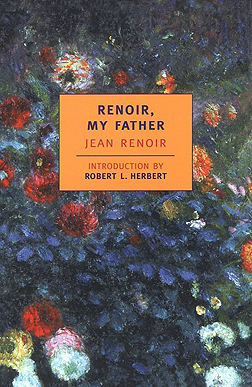
Jean Renoir’s Renoir, My Father is the prototype. Sargy Mann selected and discussed 27 paintings or series of paintings covering his career and Peter Mann has photographed them as they hang today in private houses. This novel idea is also indebted to Renoir, who told his son:
 You don’t look at a painting. You live with it … It becomes part of your life. It acts on you like a talisman. The museums are only a makeshift. How can you get excited over a picture with a dozen or so people around you, whispering asinine comments?
So the book is in praise of art as a cherished and beautiful, as opposed to a purely marketable, thing; a reminder of the sweetness pictures can add to life.
Sargy Mann inherited very short sight and astigmatism, had cataracts removed in 1973 when he was 36, lost the sight of his right eye through a retinal detachment in 1979. From 1987 the sight in his remaining eye was so poor he used a small telescope or monocular. Soon he also required a white stick.
NATASHA by Vladimir Nabokov (Fiction from The New Yorker)
NATASHA by Vladimir Nabokov

In the stairs Natasha ran into her neighbor from across the hall, Baron Wolfe. He was somewhat laboriously ascending the bare wooden steps, caressing the bannister with his hand and whistling softly through his teeth.
“Where are you off to in such a hurry, Natasha?”
“To the drugstore to get a prescription filled. The doctor was just here. Father is better.”
“Ah, that’s good news.”
She flitted past in her rustling raincoat, hatless.
Leaning over the bannister, Wolfe glanced back at her. For an instant he caught sight from overhead of the sleek, girlish part in her hair. Still whistling, he climbed to the top floor, threw his rain-soaked briefcase on the bed, then thoroughly and satisfyingly washed and dried his hands.
 Then he knocked on old Khrenov’s door.
Khrenov lived in the room across the hall with his daughter, who slept on a couch, a couch with amazing springs that rolled and swelled like metal tussocks through the flabby plush. There was also a table, unpainted and covered with ink-spotted newspapers. Sick Khrenov, a shrivelled old man in a nightshirt that reached to his heels, creakily darted back into bed and pulled up the sheet just as Wolfe’s large shaved head poked through the door.
“Come in, glad to see you, come on in.”
The old man was breathing with difficulty, and the door of his night table remained half open.
“I hear you’ve almost totally recovered, Alexey Ivanych,” Baron Wolfe said, seating himself by the bed and slapping his knees.
Khrenov offered his yellow, sticky hand and shook his head.
“I don’t know what you’ve been hearing, but I do know perfectly well that I’ll die tomorrow.”
He made a popping sound with his lips.
“Nonsense,” Wolfe merrily interrupted, and extracted from his hip pocket an enormous silver cigar case. “Mind if I smoke?”
Nabokov At Last To Live
Wylie Agency Adds Nabokov Estate To Its Client List
 Getty Images |
Less than a month after Dmitri Nabokov announced, following years of indecision, that he would publish his late father Vladimir’s unfinished final novel, The Original of Laura, he has hired a new literary agent to represent the Nabokov Estate.
That agent is Andrew Wylie, who is as famous for his expert handling of posthumous work by heavyweights like Saul Bellow, Lionel Trilling and Richard Yates as he is infamous for his tendency to lure high-profile clients away from less powerful agents.
It is unclear whether Nikki Smith of New Jersey-based agency Smith-Skolnik Literary Management, who has repped the Nabokov Estate since 1986, is still involved, or how far she got in the process of finding a publisher for Laura before Mr. Wylie was brought on board.
Reached by phone this afternoon, Ms. Smith said, “We are not answering any questions,” and hung up.
The original manuscript of the book takes the form of 138 index cards—Nabokov wrote all of his first drafts on index cards—each of which contains about 150 words of prose. Before his death in 1977, Nabokov instructed his wife and son to destroy the cards because the book was unfinished, and his son publicly grappled with those instructions for about 15 years before finally deciding that his father wouldn’t be so sore if he went ahead and published it.
Nabokov scholar and biographer Brian Boyd told The Observer in April that a collection of unpublished letters, a few plays, and a compilation of interview transcripts and book reviews that Nabokov wrote early in his career for The New York Sun and The New Republic would eventually see the light of day. Presumably—though we can’t say for sure—Mr. Wylie will eventually handle these projects as well.
A book of poems, titled Verses and Versions, will be published by Harcourt-Houghton Mifflin in the fall.
Chinese Democracy Unleashed
Purported New Guns N’ Roses Tracks Hit The Web
“Rhiad,” which was played live by Guns N’ Roses in 2001 and 2002, is a pounding rocker with a trademark down-and-dirty main guitar riff and a flashy solo. “If the World” is a head-spinning blend of flamenco guitar, industrial synth tones, bluesy piano licks and Rose at the top of his vocal register, while the unnamed track is an even more unusual melange of piano-led crooning, orchestral bombast and a serene instrumental outtro. But even if its release is drawing near, “Chinese Democracy” will likely go down as the album with the most troubled birth in rock history. Work began on it way back in 1994, and since then, Rose has burned through a reported $13 million in production costs as well as every lone original member of the group. |
 Nine purported “mastered, finished” tracks from Guns N’ Roses’ 14-years-in-the-making album “Chinese Democracy” were leaked online yesterday (June 18) by the Web site Antiquiet.com, prompting a quick cease-and-desist from the band’s handlers and the removal of the links.
