
Alexander Solzhenitsyn Gone
 from AP via the Arizona Republic
Author Alexander Solzhenitsyn dies at 89
MOSCOW – Russian news agencies say author Alexander Solzhenitsyn, the Nobel prize-winning chronicler of the horrors of the Soviet gulag system, has died of heart failure. He was 89.
UK Guardian Review of James Frey’s BRIGHT SHINY MORNING
Saved by the City of Angels
Irvine Welsh is entranced by James Frey’s tale of redemption – ‘the literary comeback of the decade’
James Frey’s first foray into the world of books, his supposed autobiography A Million Little Pieces, was a spectacular debut in that it provoked that rarest of events: a genuine literary scandal. The book, and its follow-up My Friend Leonard, were grim tales of a life of addiction, depravity and criminality, written with uncompromising turbo-charged power. Endorsed by literary kingmaker Oprah Winfrey in her book club, A Million Little Pieces went on to swiftly achieve bestseller status.
There was only one problem: the life and the events depicted had little to do with the author. The Smoking Gun website undertook a thorough investigation, through court reports and interviews with local police officials, producing a damning rebuttal of Frey’s incarceration claims. Old cohorts were hunted down, who testified to his unremarkable rather than misspent youth. The biographies amounted to more than a white suburban kid’s petty exaggerations of his misdemeanours; the Smoking Gun highlighted many outright fabrications, one of which was particularly shameful and highly distressing to the friends and family of a girl who had died in a road accident.
Frey was originally feted by Hollywood and many of its stars, excited by what they saw as the real deal in that chamber of artifice. His transformation from literary hero to pariah was complete when his publishers were compelled to admit to the falsifications in the books, and even took the unprecedented step of offering purchasers their money back. Frey gamely reappeared on Oprah, where the host, livid at being cast as an unwitting stooge in the scam, tore strips off both him and his publisher, eliciting sheepish confessions. For the US reading public, it was a bit like finding out that Frank McCourt grew up in a luxury penthouse on Manhattan’s Upper West Side.
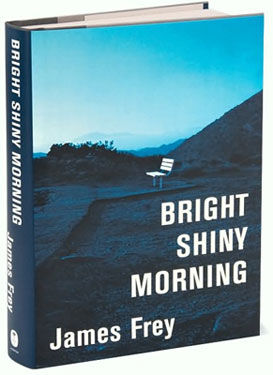
You would perhaps think that the only occasion on which Frey might have been inclined to look at a pen and paper again would have been filling in a bookie’s slip with a trembling hand. But he has shown remarkable resilience, producing Bright Shiny Morning, a work of fiction that carries the disclaimer: “Nothing in this book should be considered accurate or reliable.” That acknowledgment is of course redundant here, belonging instead on his first two works.
The amazing thing about Bright Shiny Morning is that it is an absolute triumph of a novel. In fact, it’s so good that it makes Frey’s real-life resurrection from crooked biographer to great American novelist far more impressive than his fantasised one from down-and-out drug monster to bestselling writer. Freed from the responsibility of getting the facts right, Frey, a natural novelist to his fingertips, hits the deeper truths with this honest, vibrant and tender portrait of Los Angeles and the American dream. It’s Bright Shiny Morning, not A Million Little Pieces, that is the real tale of stunning redemption.
As Frey depicts a litany of lost and hopeful souls who are sucked into the City of Angels, the novel becomes a comprehensive biography of that most alluring and dangerous metropolis. He understands LA, its attractions and dangers, and the diverse aspirants who navigate its choked freeways, cheap motels, seedy apartments and gated mansions. The touching love story of runaways Dylan and Maddy and the well-meaning beach bum Joe, who woke up one morning 30 years older, runs side by side with the tale of the predatory closet-homosexual movie star Amberton and his sham business-partner wife, Casey. Then there is the self-conscious cleaner Esperanza, abused by a rich, racist white woman before finding an unlikely but convincing love.
The book contains historical vignettes of LA, tracing its corruption and its foibles, until – as always happens in the best novels – the city itself becomes a character; a wild and volatile multi-tentacled beast capable of bestowing great hurt (and the odd chunk of real love) on those who are enmeshed in it. By its end, the reader has been privy to that rarest of things: a searing critique of the world we’ve created, yet an uncompromising affirmation of our humanity.
Bukowski has been cited as one of Frey’s literary antecedents, but the truth is that the former never wrote a novel as good as Bright Shiny Morning. The voice is assured yet compassionate, and only occasionally slips out of register, usually when Frey falls back into the showboating sneer of A Million Little Pieces: “At the turn of the century, when opium and cocaine were outlawed (yeah, both used to be legal, woohoo, woohoo), and alcohol and prostitution became the area’s primary business …”
Such lapses, though, are very rare in a beautifully disciplined and weighted novel, propelled forward with great narrative skill. It can be no exaggeration to say that Bright Shiny Morning amounts to the literary comeback of the decade. It may be a pitiful weakness that led Frey down the road to deceit in A Million Little Pieces, but by penning his own resurrection, he has demonstrated unquestionable courage and a wholly justified self-belief in his skills as a writer. If his story tells us anything, it’s that being a deluded fantasist and pathological liar may be a disadvantage for a biographer, but it’s a decided asset for a novelist.
As hard as it may be for many to swallow, particularly those who place a premium on personal integrity, James Frey is probably one of the finest and most important writers to have emerged in recent years. Nobody likes to be conned, but real lovers of enlightened, cutting-edge contemporary fiction who elect to miss Bright Shiny Morning on the basis of the myriad deceptions contained in A Million Little Pieces are cutting off their noses to spite their faces.
· Irvine Welsh’s latest novel is Crime (Cape)
Evidence of Van Gogh’s Secret Woman At Last Uncovered
Scientists recreate hidden Van Gogh portrait
A team of European scientists unveiled on Wednesday a new method for extracting images hidden under old masters’ paintings,  recreating a color portrait of a woman’s face unseen since Vincent van Gogh painted over it in 1887.
For years, art historians have been using x-rays to probe artworks hidden underneath other paintings, a technique resulting in a fuzzy, black-and-white image. But Joris Dik, a materials scientist from Delft University, and Koen Janssens, a chemist from the University of Antwerp in Belgium, combined science and art to engineer a new method of visualizing hidden paintings, using high-intensity x-rays and an intimate knowledge of old pigments.
The pair used the new approach on “Patch of Grass,” a small oil study of a field that Van Gogh painted in Paris while living with his brother Theo, who supported him.
While not exact in every detail, the image produced is a woman’s head that may be the same model Van Gogh painted in a series of portraits leading up to the 1885 masterpiece “The Potato Eaters.”
 Though his paintings are now worth millions, Van Gogh was virtually unknown during his lifetime and struggled financially before committing suicide in 1890. He often reused canvas to save money, either painting on the back or over the top of existing paintings, and experts believe roughly a third of his works hide a second painting underneath.
The painting under “Patch of Grass” adds weight to the theory that Van Gogh mailed paintings from the Netherlands to his brother Theo, and, after moving to Paris to join him, found the old works and painted over them.
Both Dik and Meedendorp were excited about the prospect of using the technique to probe paintings by Van Gogh and other famous artists such as Rembrandt and Picasso.
The US antihero: James Frey
August 2, 2008
The US antihero: James Frey
Author James Frey talks about ambition, Oprah, and his new life
Going along the clean and orderly main street of tiny Amagansett, way out at the end of Long Island, you don’t see the place as an obvious home for one of the most notorious US antiheroes. Never in modern America has a man been more publicly hissed at for writing about his life than 38-year-old James Frey, author of the bestselling A Million Little Pieces. This told the story of the war he had waged, and won, against cocaine and alcohol addiction. It was a raging, blood-spitting tour de force, powering its way in the rawest prose through degradation and near-death to the green shoots of recovery. It was a young man’s journey as ground-breaking as Jack Kerouac’s On the Road half a century before. America was hooked. Oprah Winfrey couldn’t put it down, and after her massively influential TV book club made it a must-read in September 2005, its sales soared higher still and it became the fastest-selling title in the club’s ten-year history.
 The trouble was, some of the stuff in the book wasn’t true, even though it was billed as non-fiction. When Oprah got him on the show to explain, in January the following year, she called him a liar and went for him like a hell-cat.
The audience carried on booing him through the commercial breaks. The public picked up the habit and heckled him in the streets of New York, Boston, small towns, wherever he happened to be. Doing a Frey came to mean passing fiction off as fact. The many discrepancies between his book and what had actually happened, or hadn’t, were first brought to light by the investigative website The Smoking Gun. The most serious was that while the Frey of the memoir has served three months in jail for hitting a cop with his car, assault with a deadly weapon and violent resistance to arrest, the Frey of real life has done just five hours, after being issued with two traffic tickets. According to police, he was polite and well behaved. There were many more discrepancies, including his part in the death of a young woman, which turned out to be negligible, and an attack which left him needing 40 stitches to the face (no signs of such surgery today).
These and others were then chewed over remorselessly by the press. They were seen as important not just because they were made up, or exaggerated, but because of their impact on the rest of the story, particularly the question of how its troubled young hero is going to face the consequences of his crimes.
Frey’s fall from grace was a mighty and public one. Barely a few months before his exposure, the people stopping him on the sidewalks were doing so in order to praise him for his fearless honesty. Some wanted just to touch him. Now they wanted to sneer. His publisher and agent dropped him, and Warner Bros scrapped its plans for the movie. The Frey story was parodied in an episode of South Park. It featured a character called Towelie, a pot-smoking towel who writes a made-up memoir and gets it in the neck from Oprah. Frey and his wife decamped for a while to France – literary, liberal France – to escape the vilification.
Even before it all exploded, Frey, he now says himself, was having trouble with the relationship between fact and fiction, and sought help from a therapist. As he tells it, the problem was that he had become famous overnight, was being hailed as a guru, and couldn’t handle it. “When something like that happens to you,” he says, “your reality changes in a very dramatic way. I lost my anonymity very quickly. If you want to become rich, be a banker. If you want to become famous, be a movie star. But writers, even many of my favourites, I wouldn’t recognise if they walked down the street.”
 No such obscurity for him, although here too he appears conflicted, cherishing the privacy of his family life but also wanting acclaim on the scale of Mailer and Hemingway and the other famous bad boys of American letters. There are some critics who are saying this is not such an outrageous hope as it sounds. Mailer, a fan, came to his aid when the storm was at its fiercest, inviting him to his Brooklyn Heights home and explaining how America always needed a villain and was deciding that Frey was it; Bret Easton Ellis, author of the disturbing novel American Psycho, also became a friend. “During the Oprah stuff I called him and said, ‘Dude, what the f*** do I do?’, and he laughed and said, ‘You have so far exceeded any of the messes I made that I can no longer give you advice.’” And the therapist’s recommendation? “To separate my own self from the public [self]. Separate myself from the book.”
He has done his best. For a start, he’s been clean and sober for 15 years. Amagansett, just one stop from the end of the rural Long Island Rail Road, has an air of comfortable normality: soft furnishing stores, good cafés, unimpeachable $3 million homes behind white picket fences. The place doesn’t preen quite like the Hamptons that you come through to get here. It’s friendly but not over-interested. At the boarding house just down from the Freys, the people who run it don’t even know he’s living here.
When his wife comes into the room, she is stepping straight out of his fiction. There is a woman of the same name, Maya, with whom James falls in love in My Friend Leonard, the 2005 novel which took his story on into the early days of recovery. She is a warm, pretty woman, was with him through the troubles, and the two are plainly devoted. They first met when they were next-door neighbours in Los Angeles and started dating when he returned to the city three years later. She used to work as a creative director at an advertising agency in New York, where they also have a $2.5 million flat in SoHo. On a day like today, with the sun on the pool and a gentle breeze coming up from the beach, Frey’s main job is taking their three-year-old daughter Maren to nursery school.
He has a new book out, Bright Shiny Morning, which sprawls and brawls across Los Angeles, presenting the lives of the highest achievers and lowest losers in that most stratified of American cities. Capitalising on what has gone before, the publicity blurb bears a single sentence, garishly repeated in blue and red capitals: “Nothing in this book should be considered accurate or reliable.” As if to enrage his enemies still further, Frey has punctuated the book with lists of facts about the development of LA. They might have been taken from an encyclopaedia – but an unreliable one. When asked whether these “facts” are true, he gives a crooked smile and says, “About 75 per cent.” To his amusement, one reviewer has already been drawn into the game, writing that he hoped the fact checkers at HarperCollins had done their work properly. But this is fiction, billed and marketed as such. Fiction has no responsibilities to literal truth. This begs the obvious question of why Frey did not publish A Million Little Pieces as fiction in the first place. The answer is that he tried, but was turned down by 17 publishers, including Doubleday, which eventually took it, with some reworking, as a memoir.
The furore that he is only now emerging from was largely about trade descriptions and consumer protection. He will probably never fully escape from it: the notoriety has given him the profile to operate as the thing he wanted to be in the first place, a novelist. The British press did not share the same sense of having been duped. We seemed more ready to accept such notions as the fallibility of memory, the impulse to embellish, the blurring of genre boundaries and, above all, the essential truth at the heart of a work, no matter what protocols may have been flouted in its presentation. That was always his defence, and still is when he feels like acknowledging the attack. This he does not always do, tending to counter the old arguments against him by saying, repeatedly, “I don’t care.”
Oprah’s America was having none of this essential-truth business. The nation, deeply worried about the way the White House had sold the war in Iraq, had a hunger for plain truth.
Rejected “Making of…” for MAN ON WIRE – Sundance Winning Docu on Philippe Petit Tightroping the Twin Towers
Extract of BRIGHT SHINY MORNING @ The UK Independent
Book Extract: Bright Shiny Morning by James Frey
Frey’s first novel tells the story of LA and the lost souls who live there
Sunday, 3 August 2008
She is 26 years old. She is originally from Indianapolis. She has lived in LA for nine months, she moved here to become a publicist, her family did not approve. Three weeks ago she was walking through a parking garage, it was late at night, she had been on a first date, she had had two glasses of wine with dinner. Her date had wanted to walk to her car, but she liked him, really liked him, he was a year older, an entertainment attorney, someone who wanted, like her, a career and later a family, and she knew if he walked to her car he would try to kiss her. She wanted to take it slowly, try to engage in as old-fashioned a dating process as possible. She said she’d be fine. He said he would call her. She smiled and said she looked forward to it. She walked away.
She had been in the garage many times, her office was down the street, it was in Santa Monica, which is a safe, wealthy, stable community. The garage was fairly empty. She took an elevator to the fourth floor. She got out and started walking towards her car, which was on the opposite side of the garage.
She immediately felt uneasy. She started walking more quickly something was wrong wrong she was suddenly terrified absolutely fucking terrified something was wrong. She was 20 feet from her car, 15, 10 she reached for her keys 10 feet away as she reached for her keys she was terrified. He stepped out from between two cars, came at her from behind, she was five feet away, her keys in her hand.
Ricky hasn’t had a job in four years. He used to work at a printing shop, but it closed due to advances in printing technology that allowed small businesses to do their own printing. He went on unemployment, it ran out, he couldn’t find another job, printing shops all over the city were going under. He liked sitting at home watching television and drinking beer all day, so he stopped trying to find another job. He needed money, was trying to figure out how to get it, when a friend, a convicted felon, called him and asked him to buy a gun (felons can’t buy firearms in California). He went to Larry’s Firearms with the friend, bought a 9mm semi-automatic handgun and a California-legal assault rifle using the friend’s money. When he got home with the weapons, he filed off the serial numbers. He charged his friend, who needed good weapons for his work, 500 bucks.
That felon told another felon who told another felon. Ricky started making money. Under California law, he could only buy one handgun a month, but there was no limit on the number of assault rifles, and if needed, he could always go to Arizona or Nevada to circumvent the California law. He bought a set of files and some hydrochloric acid to make the serial numbers disappear properly. At this point, not one of the 300 firearms he has bought for convicted felons has been traced back to him.
He’s in Larry’s today with a man named John. John just got out of prison for manslaughter and wants an assault rifle. Ricky doesn’t ask why, but John makes several comments about an ex-wife, a former business partner, and some missing money. Larry is showing them AKs and AR-15s, weapons that can be easily converted from semi-automatic to full automatic. Ricky, as per John’s instructions, buys one of each. He also buys the parts that allow the conversion from semi-auto to full, and a book with instructions on exactly how to do it. Ricky will have to wait a day to pick up the weapons, and will need two more days to get rid of the serial numbers. At that point, he will turn them over to John, and if asked, will deny ever meeting him, speaking to him or having anything to do with him. What John does with the weapons is none of his business. None.
He held a gun to her head, made her drive into the hills above Malibu, made her park at the end of a remote fire lane. He raped her in the backseat. He pistol-whipped her. He threw her into the dirt and drove away.
It took her four hours to find help. She went to the hospital, filed a police report. The incident was reported in the papers and on the local news. There were no fingerprints. There was no DNA.
She didn’t tell her parents or her co-workers. She didn’t want to hear I told you so, she didn’t want any pity. She took her vacation and she stayed at home in bed and cried for two weeks. She called the detective working on her case twice a day, there were no leads.
When she went back to work, she was a different person, she no longer smiled, laughed, she ate lunch alone, she left at exactly five and never went out with her co-workers. The man she had dated that night called her and she never called back, he called three more times she never called back. She saw a therapist it didn’t help. She saw a rape counsellor it didn’t help. She saw a pastor it didn’t help. She joined a support group it didn’t help. She started drinking it didn’t help.
She recognised him when he took her order at a fast-food restaurant. He had worn a mask and she didn’t see his face, but she knew his voice and she knew his eyes. He smiled at her as she ordered. He asked if they knew each other from somewhere. He asked her name. There was no mistaking the fact that he knew who she was, and he knew that she recognised him. He touched her hand as he passed her order over the counter. As she walked away, he smiled at her and said I hope to see you again.
She never went back to her job. She stopped leaving the house she was scared. She didn’t pick up the phone or use her computer. She stared at the ceiling, at her pillow, at her wall. She never looked in the mirror. This morning she woke up and she showered and, for the first time in months, she put on her makeup and did her hair. She looked beautiful, like the girl who had arrived from Indianapolis with dreams, with a future, with a life ahead of her. She went out for breakfast with two of her friends from work. She called the man who had taken her on the date and apologised for not calling him earlier. She sent e-mails to friends and called her parents. She told them all that she loved them.
When she was done she drove to Larry’s Firearms. She bought a brand-new Colt .45. She submitted the information necessary to acquire the weapon. She left with a smile. Tomorrow she’s going to pick up the weapon, bring it home, load it. At that point, she will make the decision, find him and shoot him in the face and kill him, or put the gun in her own mouth and blow the back of her head away. Either way, she will think of him just before she pulls the trigger, think of him touching her and smiling at her, think of him standing behind the counter knowing that she recognised him. Either way, her life will be over. She is going to think of him touching her and smiling at her. She is going to pull the trigger.
Larry closes the shop, goes home eats dinner and drinks a six-pack of nice, cold American beer. He sleeps without a care.
© James Frey 2008
‘Bright Shiny Morning’ by James Frey is published on Thursday by John Murray, at £12.99
Stunning Monsoon Photos

Lightning strikes over the historic Rosson House in downtown Phoenix during a summer monsoon storm. Michael Chow/ The Arizona Republic

Lightning crackles in the sky as seen from a desert area near 67th Avenue and Happy Valley Road. Mark Schiefelbein

A monsoon storm moves over Scottsdale towards Phoenix as viewed from north Mesa. Michael Chow/ The Arizona Republic
geordiegirl Reads James Frey
from geordiegirls ‘A Little Bit of Me’ blog
Long over due
Here’s a catch up on the books I’ve read… I’ve probably forgotten a few by now.
29, Wonderboy, Fiona Gibson
28, Endgame, Andy Secombe
27, The Accidental, Ali Smith
26, Crime Zero, Michael Cordy
25, Dead Beat, Jim Butcher
24, A Spot of Bother, Mark Haddon
23, Philip Pullman, The Amber Spyglass
22, Philip Pullman, The Subtle Knife
21, Philip Pullman, Northern Lights
20, Angels and Demons, Dan Brown
19, The Tenderness of Wolves, Stef Penny
18, Mad, Bad and Dangerous to know, Ranulph Fiennes
17, Broken Angels, Richard Montanari
16, The Skin Gods, Richard Montanari
15, The Rosary Girls, Richard Montanari
14, The Keep, Jennifer Egan
13, The Lucifer Code, Michael Cordy
12, Childhood Interrupted, Kathleen O’Malley
11, Belle De Jour, The Further Adventures of a London Call Girl
10, Belle De Jour: diary of a London Call Girl
9, My Friend Leonard, James Frey
8, A Million Little Pieces, James Frey
7, Lords and Ladies, Terry Pratchett
6, Sleepers, Lorenzo Carcaterra
5, A safe place, Lorenzo Carcaterra
4, Wyrd Sisters, Terry Pratchett
3, Equal Rites, Terry Pratchett
2, The abortionist’s daughter, Elisabeth Hyde
1, The survivor, James Herbert
Release Party for New Monograph on Rachel Feinstein (Foreword written by James Frey)
from Glenn Horowitz and John McWhinnie

Rachel Feinstein Monograph
Book Release Party
Saturday, August 2nd, from 6 to 8 p.m.
The first monograph on Rachel Feinstein includes full-color reproductions of paintings, drawings, and sculptural constructions from 1998 to 2008 as well as installation views from her exhibitions. Foreword by James Frey, interview with Feinstein by Sofia Coppola, edited by Bill Powers.

87 Newtown Lane
East Hampton, NY 11937
P: 631.324.5511
www.ghbookseller.com
Art Gallery & Bookshop
Mon thru Sat: 10am to 5pm
Sun: 12pm to 4pm
Closed Wed & Thurs, Oct thru April
God Loves A Troll
The Trolls Among Us

Robbie Cooper for The New York Times
The Trolls Among Us: Weev (not, of course, his real name) is part of a growing Internet subculture with a fluid morality and a disdain for pretty much everyone else online.
One afternoon in the spring of 2006, for reasons unknown to those who knew him, Mitchell Henderson, a seventh grader from Rochester, Minn., took a .22-caliber rifle down from a shelf in his parents’ bedroom closet and shot himself in the head. The next morning, Mitchell’s school assembled in the gym to begin mourning. His classmates created a virtual memorial on MySpace and garlanded it with remembrances. One wrote that Mitchell was “an hero to take that shot, to leave us all behind. God do we wish we could take it back. . . . ”  Someone e-mailed a clipping of Mitchell’s newspaper obituary to MyDeathSpace.com, a Web site that links to the MySpace pages of the dead. From MyDeathSpace, Mitchell’s page came to the attention of an Internet message board known as /b/ and the “trolls,” as they have come to be called, who dwell there.
/b/ is the designated “random” board of 4chan.org, a group of message boards that draws more than 200 million page views a month. A post consists of an image and a few lines of text. Almost everyone posts as “anonymous.” In effect, this makes /b/ a panopticon in reverse — nobody can see anybody, and everybody can claim to speak from the center. The anonymous denizens of 4chan’s other boards — devoted to travel, fitness and several genres of pornography — refer to the /b/-dwellers as “/b/tards.”
 Measured in terms of depravity, insularity and traffic-driven turnover, the culture of /b/ has little precedent. /b/ reads like the inside of a high-school bathroom stall, or an obscene telephone party line, or a blog with no posts and all comments filled with slang that you are too old to understand.
Something about Mitchell Henderson struck the denizens of /b/ as funny. They were especially amused by a reference on his MySpace page to a lost iPod. Mitchell Henderson, /b/ decided, had killed himself over a lost iPod. The “an hero” meme was born. Within hours, the anonymous multitudes were wrapping the tragedy of Mitchell’s death in absurdity.
Someone hacked Henderson’s MySpace page and gave him the face of a zombie. Someone placed an iPod on Henderson’s grave, took a picture and posted it to /b/. Henderson’s face was appended to dancing iPods, spinning iPods, hardcore porn scenes. A dramatic re-enactment of Henderson’s demise appeared on YouTube, complete with shattered iPod.  The phone began ringing at Mitchell’s parents’ home. “It sounded like kids,” remembers Mitchell’s father, Mark Henderson, a 44-year-old I.T. executive. “They’d say, ‘Hi, this is Mitchell, I’m at the cemetery.’ ‘Hi, I’ve got Mitchell’s iPod.’ ‘Hi, I’m Mitchell’s ghost, the front door is locked. Can you come down and let me in?’ ” He sighed. “It really got to my wife.” The calls continued for a year and a half.
In the late 1980s, Internet users adopted the word “troll” to denote someone who intentionally disrupts online communities. Early trolling was relatively innocuous, taking place inside of small, single-topic Usenet groups. The trolls employed what the M.I.T. professor Judith Donath calls a “pseudo-naïve” tactic, asking stupid questions and seeing who would rise to the bait. The game was to find out who would see through this stereotypical newbie behavior, and who would fall for it. As one guide to trolldom puts it, “If you don’t fall for the joke, you get to be in on it.”
In Defense Of Art In LA
from the San Jose Mercury News
Graffiti vandals turn violent in LA
LOS ANGELES—One man got stabbed. Another got shot in the chest. A 6-year-old boy was temporarily blinded when he was spray-painted in the face. And they were the lucky ones among those who have had run-ins with graffiti “crews,” or gangs.
Over the past 2 1/2 years in Southern California, three people have been killed after trying to stop graffiti vandals in the act. A fourth died after being shot while watching a confrontation between crews in a park.
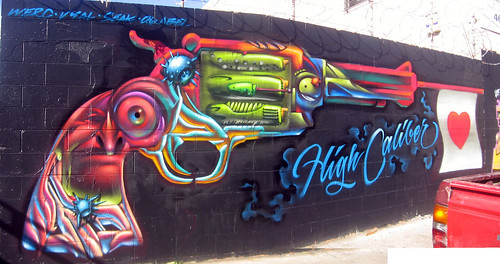
“We have seen a marked increase in these graffiti-tagging gangs taking to weapons and fighting to protect their walls, their territory, their name,” said Los Angeles County sheriff’s Lt. Robert Rifkin.
“If we see someone calling the police, then we target them,” said Mario Garcia, 20, who describes himself as a former tagger trying to become a professional artist. “You are trying to stop me from what I live, what I believe in and what I breathe? We are not going to let no one get in the way.”
In an attack last month, two youths spray-painted the face and body of the 6-year-old boy who spotted them scribbling gang signs on a wall near Compton. The boy recovered from chemical burns to his eyes.

On the same day, a 51-year-old auto mechanic was shot in the chest in Los Angeles when he confronted two suspected gang members painting the wall of his shop.
Another man, Michael Lartundo, 26, was stabbed in the hand and arm after yelling at a group of graffiti vandals scrawling on a wall in March behind his brother’s house in suburban Whittier. “I just told them it ain’t right,” Lartundo recalled. “I said, ‘If you are going to write on the wall, write on your own wall.'”
Last August, Maria Hicks, 58, was shot in the head and died after flashing her headlights and honking at a teenager spray-painting a wall near her home in Pico Rivera, a blue-collar suburb east of Los Angeles. Four people have been charged with murder.
Ten days after Hicks died, Seutatia Tausili, 65, was fatally shot and her grandson wounded when he told taggers to stop vandalizing a trash can outside their home in Hesperia in San Bernardino County. Three men were charged with crime.
The First Anniversary of Jake Brown’s Blowout
The greatest wipeout in sports history – a 4.5 story flailing drop to the hardwood. Skip to the slo-mo’s at the end and watch Jake’s shoes ejecting for a sense of just how hard he hit. And then he walks away.
1984 Is Almost Here
29 July, 2008 by orwelldiaries
Orwell Diaries
23 July, 2008 by orwelldiaries
‘When one reads any strongly individual piece of writing, one has the impression of seeing a face somewhere behind the page’, wrote George Orwell, in his 1939 essay on Charles Dickens.
From 9th August 2008, you will be able to gather your own impression of Orwell’s face from reading his most strongly individual piece of writing: his diaries. The Orwell Prize is delighted to announce that, to mark the 70th anniversary of the diaries, each diary entry will be published on this blog exactly seventy years after it was written, allowing you to follow Orwell’s recuperation in Morocco, his return to the UK, and his opinions on the descent of Europe into war in real time. The diaries end in 1942, three years into the conflict.
What impression of Orwell will emerge? From his domestic diaries (which start on 9th August), it may be a largely unknown Orwell, whose great curiosity is focused on plants, animals, woodwork, and – above all – how many eggs his chickens have laid. From his political diaries (from 7th September), it may be the Orwell whose political observations and critical thinking have enthralled and inspired generations since his death in 1950. Whether writing about the Spanish Civil War or sloe gin, geraniums or Germany, Orwell’s perceptive eye and rebellion against the ‘gramophone mind’ he so despised are obvious.
Orwell wrote of what he saw in Dickens: ‘He is laughing, with a touch of anger in his laughter, but no triumph, no malignity. It is the face of a man who is always fighting against something, but who fights in the open and is not frightened, the face of a man who is generously angry— in other words, of a nineteenth-century liberal, a free intelligence, a type hated with equal hatred by all the smelly little orthodoxies which are now contending for our souls.’
What will you see in the Orwell diaries?
I Do (With Blueberry Maple Syrup On Top)
New Entertainment Service Offers Every Man A PILF
Pregnant Prostitutes To Face Charges
Two women were charged with prostitution in Camden County on Thursday after they were arrested in a sting operation at a Lake Ozark hotel last week.
Two other women were also arrested, and three of the women are pregnant. Alexandra Wells and Allysia Waldrop were both charged on Thursday. Waldrop is pregnant, but is not known if Wells is also.
The undercover bust went down at a Lake Ozark area hotel after the sheriff’s department received several reports that pregnant women were advertising prostitution on an internet advertising site.
One of the women arrested was eight months pregnant, another six months pregnant, and another was three months pregnant. They ranged in age from 18 to 22 years old.
When The Wife Doesn’t Listen
Butthole Surfing Now Taught At School of Rock
Back to School With the Butthole Surfers
They’re collaborating with teenagers now. Terrible idea. Wonderful idea.
By Michael Hoinski
Gibby Haynes is 50, but he’s still off the wall like he was in the ’80s, when he and the rest of his Butthole  Surfers were passing off hallucinogenic-fueled performance-art shows as “music” for the likes of a young, impressionable Daniel Johnston and other Austin freaks looking to get their psych on outside of cosmic country.
“It’s a big que sera, fuckin’ Hallmark, fuckin’ Valentine’s Day, kinda fuzzy- feeling dealie,” Haynes says over the phone about the Surfers’ classic lineup—including guitarist Paul Leary, bassist Jeff Pinkus, and stand-up drummers King Coffey and Teresa “Nervosa” Taylor (the weirdo in Slacker who tries to pawn off the Madonna pap smear)—reuniting for the first time since their 2002 reincarnation at Japan’s Fuji Festival, this time for a 14-date run with the Paul Green School of Rock Music All-Stars.How ass-backwards. The Surfers are (or were, back in the day) totally X-rated. Among  other acts of decadence, their shows featured a naked dancer named Kathleen Lynch, a/k/a “Ta-Da the Shit Lady,” whom Haynes reportedly had sex with onstage while Leary punctured the club’s speakers with a screwdriver. They used films of penis-reconstruction surgery andFaces of Death–type car wrecks as backdrops. And, of course, they got a real kick out of cross-dressing and arson, too. Meanwhile, the fact that the 2003 movie School of Rock is based on the grade-school bashers who receive tutelage at the Paul Green School of Rock Music chain (with Jack Black starring as a non-anal version of Paul himself) just about says it all. But this is of little consequence to Haynes, who insists that Surfers gigs are way tamer than in the olden days and that it’s now more or less about the music.
“It’s just really fun,” he adds of the collaboration, facilitated by fellow shtick-rock band Ween. “I mean, they’re kids, and some of ’em are really, really talented. You can see the ones who are gonna be totally fucked up when they’re older.”
 Seminal Surfers albums like Psychic . . . Powerless . . . Another Man’s Sac, their 1985 debut, with its innovative tape-looping up against Haynes’s perverted, bullhorn- amplified, “Gibbytronix”-inflected gibberish, are indeed lessons in coordinated chaos lost in translation as noise. But in order to properly convey the older, borderline- improvisational hardcore-punk songs that constitute most of the Surfers’ set lists on this tour, some live theatrics are essential. That’s where Sheehan and Johnson strike again: The smoke machines, projectors, and strobe lights are part of their double-duty tour, thanks to their work in the same capacity during a string of Haynes solo shows in New York (where he relocated five years ago) that preceded this tour. “By now, we’re into a groove on how to do that,” says Johnson, who also plays in a band called the Will.
Get Some Nuts (Banned SNICKERS Ad)
Cuckoo’s Nest To Be Razed
Cuckoo’s Nest Hospital to be Torn Down
By AP/BRAD CAIN
(SALEM, Ore.) — So long, Cuckoo’s Nest.
Oregon State Hospital, the mental institution where the 1975 movie One Flew Over the Cuckoo’s Nest was filmed, is making way for a new complex. 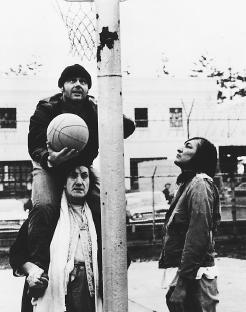 Most of the dilapidated, 125-year-old main building will be torn down and replaced starting this fall.
Although mean Nurse Ratched was pure fiction, the Oregon State Hospital has struggled with some very real troubles over the years, including overcrowding, crumbling floors and ceilings, outbreaks of scabies and stomach flu, sexual abuse of children by staff members, and patient-on-patient assaults.
Politicians had been talking for years about the need to replace the hospital, but didn’t get serious about it until a group of legislators made a grim discovery during a 2004 tour: the cremated remains of 3,600 mental patients in corroding copper canisters in a storage room. The lawmakers were stunned.
“Nobody said anything to anybody,” said Oregon Senate President Peter Courtney, who dubbed the chamber “the room of lost souls.”
 The remains belonged to patients who died at the hospital from the late 1880s to the mid-1970s, when mental illness was considered so shameful that many patients were all but abandoned by their families in institutions.
Milos Forman, the director, lived for six weeks at the institution and had his actors study real patients, according to a 1975 account in Rolling Stone magazine. Nicholson became depressed because of what he saw, including electroshock being administered to a patient.
The front section of the building, including the cupola, will be preserved as a museum on the history of mental health care.
Other parts of the building were abandoned decades ago and are now a ghostly sight. The paint has been scoured off the bricks by the weather and the passage of time, and the wings are cluttered with old equipment, fallen plaster and piles of pigeon droppings. The third floor is so rotted it is not safe to walk on. The building is also contaminated with lead paint and asbestos.
The Morning After (With Him)
The Green Areas Indicate Where The Cancer Has Metastasized
Watching the Growth of Walmart Across America
In the spirit of Toby’s Walmart growth video, using data from Freebase, I mapped the spread of Walmart using Modest Maps. It starts slow and then spreads like wildfire.

Yeah go ahead and SuperPoke me again motherf@cker…
‘Shank’ website is aimed at the kids who carry knives

All in the game … list of SuperPoke! icons includes smacks, hugs, bouquets, smiles – and horrifying ‘shank’ threat
By JAMES CLENCH and JONATHAN WEINBERG
THE uncle of murdered Harry Potter actor Rob Knox last night said Facebook bosses should be arrested for allowing a vile knifing game.
Members of the social networking site have been using a chilling blade icon to virtually “shank” – street slang for stab – other users.
The news comes amid an epidemic of knifings across the country, with tragic Rob, 18, among the victims.
Uncle John, 57, branded the website “disgusting” and said the game targeted teen thugs who carry blades.

Knife victim … tragic actor Rob Knox
He said: “Why the hell would a social networking site for teenagers put something like this forward?
“If the authorities really want to get tough on knife crime, the CEO or directors of Facebook should be arrested for inciting violence.”
“The stupidity of having this on their site is unbelievable. And they deliberately use the street term ‘shanked’, which is even worse. They are targeting the kids who are on street corners carrying knives.”
Facebook allowed the virtual knife threat as part of its SuperPoke! application.
Members use the blade icon to deliver the “attack” to any friend or stranger who has a profile. The victim then receives a chilling message saying they have been “shanked”. The SuperPoke! system is a favourite among teens, with more than a BILLION virtual actions sent – including kisses, hugs and slaps.
The software is made by US firm Slide, which tells users: “Use SuperPoke to do stuff to your friends. If you get lucky, they might just do it back to you.”
Gnarls Rips White Boy’s Heart Out in New Video
For Those Who Like It Hair-y
‘Hair’s’ bohemian chic is still hip
Monday, July 21st 2008, 4:00 AM

‘Hair’ starts previews Monday night in Central Park.
When “Hair” starts previews Monday in Central Park, it will be a flashback to the 1960s, the decade the rock musical debuted. That era that looks a lot like today: an unpopular war was raging, young people were keyed up about activism, and people let it all hang out — Naked Cowboy-style — to express their freedom.
But in this reincarnation of the seminal show at the Delacorte Theater, some of the biggest things on parade are the costumes. “Hair” costumer Michael McDonald looked to rock stars — Donovan, Jimi Hendrix and Janis Joplin — for inspiration in putting together the looks for the cast in the groundbreaking musical about youths rebelling against conservative authority and the Vietnam War.
Director Diane Paulus, who also staged the concert version of the show last summer, was a stickler for authenticity, says McDonald: “It’s so easy to make it look like a Halloween party.” No-nos included tie-dyed shirts and elephant bell-bottoms.
“Too ’70s,” he says. He speaks with authority. McDonald researched the era extensively, studying footage of the ’67 Monterey Pop Festival for reference.
Gorillaz Make Monkey Movie for Olympics
Before Hannah and Dora, There Was Sid & Marty
Sid and Marty Krofft are still pulling the strings

Krofft Picture Archive
THEIR HEYDAY: Sid, left, and Marty Krofft with Jack Wild, the young star of “H.R. Pufnstuf,” which premiered in 1969. The show’s premise — a child stumbles upon a hidden fantasy world — turned into a winning formula for the Kroffts, who also created “Lidsville” and “Land of the Lost.” There’s a new appetite for their low-budget shows.
Nearly 40 years after the psychedelic splash of ‘H.R. Pufnstuf,’ the bickering puppeteers believe their time has finally come.
By Geoff Boucher, Los Angeles Times Staff Writer, July 26, 2008
Hollywood is often described as a dream factory, but really it’s just as often a salvage yard. Anxious studio executives would rather bet their $100-million budgets on nostalgia than on new ideas, which is why, against all odds, Sid and Marty Krofft are back in business.
 The Krofft brothers, both now in their 70s, have a showbiz story that dates back to the final days of vaudeville. But for children of the Nixon years, their name is the brand behind some of the era’s strangest TV programming: shows such as “H.R. Pufnstuf,” “Lidsville,” “Land of the Lost” and “Sigmund and the Sea Monsters.”
Those low-budget shows had rubber-costumed actors, fluorescent puppets and psychedelic sets that were by the 1980s hopelessly dated; and by the end of that decade, the same could be said of the Kroffts.
Today, though, thanks to the Hollywood appetite for all things kitschy and high-concept, the Kroffts are poised for the biggest payday of their career — unless, of course, they strangle each other first.
“Things did get lean, but we never gave up,” said Sid, 78, the smiling, soft-spoken dreamer of the two.
There are still plenty of young dreamers, oddballs and colorful hucksters in the entertainment industry, but, really, the modern corporate era has wiped away most of its greasepaint charm. In the flashbulb era, big stars were bigger and tall tales were taller.
For example, take the celebrated Krofft family history: Sid and Marty are supposedly fifth-generation puppeteers, dating to the opening of the Krofft Theater in the early 1700s in Athens. It is a truly amazing tale and cited in almost every article every written about them, and it’s the first line of their bio.
The Olympics’ Strangest Moments
from the Independent Publishers Group
The Olympics’ Strangest Moments
Extraordinary but True Stories from the History of the Olympic Games
 Updated edition
Geoff Tibballs (Author)
The world’s greatest sporting occasion has historically been filled with unusual occurrences and peculiar situations. In 1908, Dorando Pietri was stripped of his gold medal in the marathon after he was helped over the finish line by over-anxious officials. From “Eric the Eel” of Equatorial Guinea—the slowest swimmer in the history of the games—to Fred Lorz, who was disqualified after it was discovered that he had hitched a lift in a car during his marathon run, this is an exciting collection of the most humorous and jaw-dropping stories from the Olympic games.
Geoff Tibballs is the author of numerous books, including Great Sporting Scandals, Motor Racing’s Strangest Races, and Royalty’s Strangest Characters.
A Pretty Ugly Exhibition
Art Makes Such Weird Bedfellows

Thomas Müller
Pretty Ugly The group exhibition, split between Gavin Brown’s Enterprise and the Maccarone Gallery, features works from about 75 artists, including Bernard Buffet’s “Les Folles.” More Photos>
Everyone-into-the-pool gallery group shows are always a welcome distraction in a steamy New York midsummer, even when the water is tepid and unsightly matter floats to the top, as is the case in “Pretty Ugly,” a group exhibition split between Gavin Brown’s Enterprise and the Maccarone Gallery.
There are about 75 artists on the guest list, though it feels like a cast of thousands, so logic-defying is the lineup. Hannah Wilke rubs shoulders with Marsden Hartley, and both press flesh with Elizabeth Peyton, Rudolph Schwarzkogler and Bruce LaBruce.
 Like most art world shindigs, this is an intensely networked affair. Lots of best friends of friends — artists who are the partners of curators, who are planning retrospectives of other artists, who are represented by the galleries presenting the show — along with a few bused-in oddballs (two Stanislaws, Szukalski and Witkiewicz) and recruits from the modernist mothball brigade (Pierre Alechinsky, Bernard Buffet).
Summer shows of this kind can be newsy; they can indicate shifts in direction in art that will unroll in the season ahead. But this one doesn’t feel that way. In fact it feels a little old. Its basic premise is that our ideas of beauty in art are changing, but we’ve known that for years. Pretty and ugly have been the twin poles of contemporary figure painting for ages now. Merged together — and they are always merging — they turn into weird. And weirdness is, basically, what “Pretty Ugly” is about.
An installation of such paintings across a front wall at Maccarone establishes a couple of things: first, the show as a whole will be organized by themes; and second, it will be an old-new mix. In the floral lineup we find a 1918 Abraham Walkowitz still life next to Andy Warhol’s 1964 poppies along with Mark Grotjahn’s “Angry Flower (Big Nose, Baby Moose)” (2003), all bracketed by Takashi Murakami smiley faces from just last year.
 The sculptor Stanislaw Szukalski (1893-1987), also from Poland, was an art star in his day, so highly regarded that, when he was at mid-career, the Polish government erected a museum in his honor. When the building was leveled by German planes in 1939, Szukalski fled to the United States and settled in Burbank, Calif.
Although he lived in obscurity there, he was not inactive. Among other things he formulated a universalist theory of history called Zermatism, based on the premise that all human life originated on Easter Island, that Polish was the source of all languages, and that a race of malevolent Yetis was destroying civilization as we know it.
His freely espoused aesthetic and political views gained attention in California cultural circles: he was as rabidly anti-Picasso as he was pro-Ronald Reagan and regarded art critics as the scum of the earth. The attraction of his neo-Symbolist sculpture — a life-size bronze bust in the show of the Polish military hero Bor Komorowski looks like a sad-eyed Darth Vader — is harder to fathom.
Summertime Fingerfood For Heartless Barbarians

James Frey Reading Tonight @ BookCourt in Brooklyn 7pm

JAMES FREY Reading Tonight
Thursday, July 24 at 7pm
@ BookCourt in Brooklyn
163 Court StreetBrooklyn, NY 11201(718) 875.3677
[ click for map ]