
Jesus H. Ska
At Play On The Runway
James Frey Brings His Daughter for a Playdate at Cynthia Rowley’s Show

At Cynthia Rowley’s show on Sept. 11 at a loft in Chelsea, three little girls ran around the runway, tugging at their parents’ arms and climbing on and off the chairs in the front row.
There was 4-year-old Maren Frey, the platinum blond, adorable little daughter of Bright Shiny Morning author James Frey and wife, Maya. Tiny Maren was outfitted in a white dress, silver sandals, and a string of pearls for her Fashion Week debut. Gigi Clementine, a 3-year-old dressed in a tiny floral number, was the daughter of Ms. Rowley and husband, author Bill Powers (wearing silver sneakers), who was seated next to the Freys. The third girl, a brunette in a blue dress, looked to be around the same age and spent much of her time on the lap of actress Tatum O’Neal, who as far as we know has not given birth in the last five years. (Perhaps a niece?)
Mr. Frey’s presence at the show was not surprising. When Daily Transom found the author in the front row of Ms. Rowley’s show in September 2006, he insisted he was dragged to the show by his wife, who is apparently very into fashion. (When we caught up with the spouses in 2006, Mrs. Frey was in Hermes and Prada, and Mr. Frey was wearing Hanes, Adidas, and J. Crew.) To yesterday’s show, Mr. Frey wore an untucked white polo shirt, khakis, and sneakers.
Ms. O’Neal was seated in the front row next to Julia Stiles and several seats away from author Candace Bushnell and actor Alan Cumming, who was (embarrassingly!) wearing the same plaid blazer as Mr. Powers. Across the runway were the Freys seated next to Mr. Powers and his little girl in the front row.
As the bleacher stands at Ms. Rowley’s show began to fill up with editors and guests at 3 p.m. (the scheduled time for the show), the girls ran between the adults seated across the runway from each other, bumping into the photographers who were snapping photos of the front row guests. By the time the show began at 3:40, the girls seemed to have worn themselves out and all three settled into the laps of Mr. Frey and Mr. Powers. And once the models began to come down the runway, the girls watched with interest and when inspired, raised their heads to deliver their reviews to the adults.
“Some day a real rain is gonna come and wash the scum the filth.”
Bringing L.A.’s alleys out of the shadows
Urban planners re-imagine the city’s concrete connectors as community oases, replacing trash and crime with trees, grass and swing sets — and civic leaders are paying attention.
 At the southern tip of Los Angeles, stashed behind railroad cars and fuel depots, is a pillbox of a community center called Mahar House.
Inside, there is a tiny library for kids, with titles by C.S. Lewis and a biography of Paul Revere. In a classroom down the hall, equations used to teach parents the value of building credit are on a chalkboard. In the front room, volunteers give away food they’ve rescued from markets that were going to throw it away.
It’s the kind of place you root for.
Behind it, almost inevitably, is the kind of place you try to avoid.
The alley smells like urine and is lined with cinder-block walls, some topped with razor wire that catches stray plastic bags on windy days. Brown weeds hide a strange array of items: a sock, a broken string of cheap, plastic beads. Someone has dumped a sagging, torn armchair and a filthy mattress.
 Men stash stolen cars there, with wires poking out where the stereos used to be, but that’s not the worst of it, said Paula Juarez, who raised two daughters here in Wilmington. Others have been caught peering into apartments, she said. The other day, one tried to talk a 5-year-old girl into taking her clothes off.
The alley, like so many others in L.A., is the scourge of the neighborhood. But a growing coalition of researchers, urban planners, public land advocates and government leaders say it doesn’t have to be that way. Alleys, they argue, could offer enormous environmental and public health benefits — if they could be turned green.
James Frey Australian Tour
 SYDNEY
Tuesday 16th September
7pm, The New Theatre, 542 King Street, Newtown.
Bookings through Better Read than Dead Bookshop, Ph: + 61 2 9557 8700
MELBOURNE
Wednesday 17th September
6.30pm Readings Bookshop Hawthorn, 701 Glenferrie Road, Hawthorn, Ph: + 61 3 9341 7726
BRISBANE (Brisbane Writer’s Festival) tickets available for all BWF sessions:http://www.brisbanewriters
Or available on the day from the box office.
Thursday 18th September
3.40pm BWF SESSION: A Biography by Any Other Name James Frey, John Hughes, Lloyd Jones
Venue: Queensland Terrace, State Library of Queensland, Cultural Centre, Stanley Place, South Bank, Brisbane
Friday 19th September
10.30am BWF EVENT: QLD University presentation, James Frey
Venue: QLD University Campus, Art Museum, building 11 on University Drive
12.40pm BWF SESSION: From Brisbane to LA Ian Commins, Simon Cleary, James Frey
Venue: Queensland Terrace, State Library of Queensland, Cultural Centre, Stanley Place, South Bank, Brisbane
Saturday 20th September
3.20pm BWF SESSION Bright Shiny Morning: James Frey in conversation with the Literary Editor of The Sydney Morning Herald
Venue: Auditorium 1, State Library of Queensland, Cultural Centre, Stanley Place, South Bank, Brisbane
Pilobolus
PICTURE PERFECT for John McWhinnie @ Glenn Horowitz

Picture Perfect
Images and Shapes in Seventies & Eighties Vinyl
Culled from the collections of George Meredith
September 16th to October 12th 2008
Please join us for a reception
Tuesday, September 16th from 6 to 8p.m.
Visit our website for more information.

50 1/2 East 64th Street
New York, New York 10065
P: 212.754.5626
www.johnmcwhinnie.com
Gallery Hours
Tues thru Fri: 10am to 6pm
Saturday: 10am to 5pm
Closed Sundays and Mondays
Damien Does TIME
Damien Hirst: Bad Boy Makes Good
For more than a decade Damien Hirst has been one of the richest and most famous artists in the world. All  the same, when you sit down with him, he still seems surprised by it. “I grew up with quite an impoverished background,” he says. “I didn’t see any possibility that I would ever get paid for doing anything
I enjoyed.” Hirst tells me this one rainy afternoon in July at one of his many studios. This one is in Stroud, a rural town in Gloucestershire, about two hours’ drive west of London. When he says this I think immediately about the bull in the next room, which I’m pretty sure he enjoyed coming up with, and very sure he’s about to be paid for. A lot, actually.
the same, when you sit down with him, he still seems surprised by it. “I grew up with quite an impoverished background,” he says. “I didn’t see any possibility that I would ever get paid for doing anything
I enjoyed.” Hirst tells me this one rainy afternoon in July at one of his many studios. This one is in Stroud, a rural town in Gloucestershire, about two hours’ drive west of London. When he says this I think immediately about the bull in the next room, which I’m pretty sure he enjoyed coming up with, and very sure he’s about to be paid for. A lot, actually.
 The bull is called The Golden Calf and it’s headed to market at Sotheby’s in London, where it will be the star of a much hyped two-day sale of 223 works by Hirst that begins on Sept. 15. This will be the first time any auction house has sold a quantity of work fresh out of an artist’s studio. As auction prices for contemporary art have rocketed ever higher, galleries have been dreading this very possibility: that a famous artist would bypass his dealers — who usually get a cut of roughly half of a work’s sale price — and make straight for the auction houses. (The auctioneer’s fee is paid by the buyer on top of the sale price, which means Hirst will walk away with pretty much every dollar his work gets hammered down for.) If it meets expectations, the sale could put about $120 million into Hirst’s already well-lined pockets, a payday unlike anything any living artist has seen. And The Golden Calf will be the prime lot, with a presale estimate of $14.6 million to $22 million. Sometimes a bull is truly a cash cow.
 And also a very witty performance. The Golden Calf is a white bullock preserved in a tank of formaldehyde that’s mounted on a high marble plinth. His hooves and horns are 18-carat gold. His head is crowned by a gold Egyptian solar disk. Seen head-on, he’s a false idol whose headgear is simultaneously silly and mesmerizing. (Hirst is assuming his buyers know the Bible story about worshipping a false god, just like the one they are about to worship.) But the beast is best seen in profile, the view that leaves you to reconcile as best you can his hieratic gravity with the laugh-out-loud abundance of his genitals. When Hirst is good, he’s good, and The Golden Calf is a nimble concoction, designed to all at once beguile, flatter and parody the big-swinging billionaires who are likely to bid on it.
Going once. Going twice.
When Pad Thai Is Corruption
Thai PM forced out over TV chef role
By Amy Kazmin in Bangkok
Published: September 9 2008 11:22 | Last updated: September 9 2008 18:48
Samak Sundaravej, Thailand’s prime minister, was ordered on Tuesday to resign from his post by the constitutional court, which ruled that he had violated constitutional conflict-of-interest rules by making paid-for guest appearances on a television cooking programme after taking office.
The verdict is the latest bizarre twist in a destructive political stand-off pitting Mr Samak, 73, a conservative, against dogged protesters and influential Thais who believe that he is a proxy for Thaksin Shinawatra, the controversial former prime minister ousted in a 2006 coup.
Mr Samak, the leader of the People’s Power party, which is packed with loyal Thaksin allies, has been resisting intense pressure to stand down since August 26, when members of the People’s Alliance for Democracy seized his offices, vowing to remain until he quit.
But while Mr Samak has refused to yield – even declaring a state of emergency last week in a futile attempt to evict the demonstrators – the sharp-tongued politician has been undone by a post-election star turn on Tasting and Complaining, a television cookery and chat show.
A famous foodie, the bulky Mr Samak hosted the popular show until recently, whipping up spicy curries and other flaming Thai dishes accompanied by a stream of invective on whatever was on his mind.
At Last May We Come To Truly Know Our Past
from the New York Times (and Google)
Google to Digitize Newspaper Archives
SAN FRANCISCO — Google has begun scanning microfilm from some newspapers’ historic archives to make them searchable online, first through Google News and eventually on the papers’ own Web sites, the company said Monday.
 Google, based in Mountain View, Calif., will place advertisements alongside search results, and share the revenue from those ads with newspaper publishers.
Google said it was working with more than 100 newspapers and with partners like Heritage Microfilm and ProQuest, which aggregate historical newspaper archives in microfilm. It has already scanned millions of articles.
The National Digital Newspaper Program, a joint program of the National Endowment for the Humanities and the Library of Congress, is creating a digital archive of historically significant newspapers published in the United States from 1836 to 1922. It will be freely accessible on the Internet.
Alain Jacquet Gone
from the Long Beach Press-Telegram
Jacquet, 69, was icon of French pop
 NEW YORK – Alain Jacquet, a French pop artist known for his reinterpretations of famous paintings, has died, the French Embassy said.
Jacquet, who lived in New York and Paris, died of cancer Thursday at New York-Presbyterian Hospital, the embassy said in a statement. He was 69.
Jacquet’s work often reflected the sensibilities of pop art, which emerged in Britain and the United States in the 1950s and `60s and drew on advertising, comics and other pieces of popular culture.
He also revisited well known artworks from previous eras.
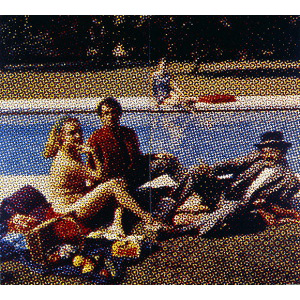 One of his best-known paintings recasts the impressionist giant Edouard Manet’s “Dejeuner sur l’Herbe,” which depicts a female nude picnicking with two fully clothed men. In Jacquet’s version, they are replaced by a gallery owner, an art critic and a painter. He also based works on two other renowned nudes, Manet’s “Olympia” and the neoclassical painter Jean-Auguste-Dominique Ingres’ “La Source.”
Born Feb. 22, 1939, in Neuilly-sur-Seine, France, Jacquet had his first exhibition in France in 1961. His work is held by institutions including New York’s Museum of Modern Art, the National Museum of American Art in Washington and the Musee d’Art Moderne de la Ville de Paris in France, the embassy said.
Are you going to call Child Services or should I?
Angel Down
Hells Angels leader Mark “Papa” Guardado shot dead in the street in San Francisco

Members of the Hells Angels. The San Francisco branch particularly has a history of clashes with the law.
———
Mark “Papa” Guardado, leader of the Hells Angels in San Francisco, was shot down on a city street there Tuesday night.
Guardado was found with gunshot wounds about 10:30 pm about a mile from the group’s clubhouse, according to CBS5 TV in San Francisco.
Witnesses told investigators the gang leader and the gunman struggled before the shooting, and that the suspect fled on a motorcycle, according to reports.
Guardado was taken to San Francisco General Hospital and died shortly afterwards.
The biker had been involved in an ongoing fight with a rival from another motorcycle group before he was killed, according to the Associated Press.
The San Francisco Hells Angels could not be reached for comment.
“I can draw the guitar like a motherf≥ckin’ riot…”
¡El Marielito Ha Veulto!
‘WRESTLER’ TAKES TOP HONORS AT VENICE
Aronofsky film pins down festival’s Golden Lion
VENICE — Darren Aronofksy’s drama “The Wrestler,” starring Mickey Rourke as Randy (the Ram) Robinson, a washed out pro-wrestler in comeback mode — both on and off the screen, it turns out — has pinned down the Venice Film Festival’s Golden Lion, providing the Lido with a grand finale.
“I think the reason people are reacting to this film is that there is a great talent revealing his soul,” said Aronofsky.
“Darren Aronofsky came here a couple of years ago and fell on his ass,” Rourke recounted in the Lido’s packed Sala Grande theatre, referring to the helmer’s “The Fountain,” which premiered in Venice in 2006 and subsequently flopped.
“I am glad he had the balls to come back,” Rourke added.
Step Up On The White Thang and Get Rid Of That Annoying Plastic Hoop
Damien’s Super Ego
Frank Dunphy’s art-market instincts have served Damien Hirst well in the past. The artist says he owes much of his global-brand status and $1 billion personal fortune to Mr. Dunphy. As far as Mr. Dunphy is concerned, the prices for Mr. Hirst’s art have never been high enough.

Mr. Hirst, known for his devil-may-care persona, rose to fame in the early 1990s by using dissected or pickled animal carcasses to explore themes like death and decay. Last year, the average auction estimate for a Hirst piece was about $470,000, up from $63,000 a decade ago. In June 2007, the royal family of Qatar paid Sotheby’s a record $19 million for “Lullaby Spring,” a mirrored cabinet lined with shelves of multicolored pills.
“People have a habit of underestimating Frank,” Mr Marlow says, “but you can’t outmaneuver him. He believes in Damien Hirst more than he believes in God.”
Tall and white-haired, Mr. Dunphy has a father-confessor demeanor that some attribute to his years of Catholic schooling in Dublin. He spent years as an accountant, filing tax returns for British performers such as Coco the Clown and strippers like Peaches Page before meeting a shaggy-haired Mr. Hirst over a snooker table at London’s Groucho Club in 1995. The artist had just won the prestigious Turner Prize and his hard-partying ways had made him a tabloid favorite.

Mr. Dunphy says he immediately recognized a star barely tapping his financial potential. He offered the artist his services, and the pair soon settled into a comfortable partnership, with Mr. Dunphy playing the bow-tied super-ego to Mr. Hirst’s id.
Friends say the artist loves to play pranks on his manager. During a trip to New York several years ago, he crept in to Mr. Dunphy’s hotel room while he was sleeping and decorated the entire room with cutout images of devils and demons “so that Frank would wake up in hell,” says Richard Wadhams, Mr. Dunphy’s former business partner.
Carlin’s Baseball vs. Football
AIDS Virus Yet Another Evil Plot of Caesar
Britons may be more vulnerable to Aids due to Roman invasion

Dr Faure believes the Romans introduced a disease which killed off people with a variant gene that now protects against HIV Photo: TELEVISION STILLS
Researchers found that people who live in lands conquered by the Roman army have less protection against HIV than those in countries they never reached.
They say a gene which helps make people less susceptible to HIV occurs in greater frequency in areas of Europe that the Roman Empire did not stretch to.
The gene lacks certain DNA elements, which means HIV cannot bind to it as easily and is less able to infect cells.
People with the mutation have some resistance to HIV infection and also take longer to develop AIDS, reports New Scientist.
A study of almost 19,000 DNA samples from across Europe showed the gene variant seemed to dwindle in regions conquered by the Romans.
Generally only people in Europe and western Asia carry the gene and it becomes much less frequent as you move south.
More than 15 per cent of people in some areas of northern Europe carry it compared with fewer than four per cent of Greeks.
It is not clear why this is so since the spread of HIV – which began in the early 1980s – is too recent to have influenced the distribution of the variant.
The difference in frequency of the key gene mutation reflects the changing boundary of the Roman Empire between 500 BC and AD 500.
But study leader Dr Eric Faure, of Provence University in France, does not believe the Romans spread the regular version of the gene into their colonies by breeding with indigenous people.
Dr Faure, whose findings are published in Infection, Genetics and Evolution, said: “Gene flow between the two was extremely low.”
Instead he believes the Romans introduced a disease to which people carrying the gene variant were particularly susceptible. As the Romans moved north this disease killed off people with the variant gene that now protects against HIV.
“Hello, Naomi – didn’t work out this time. You know they’re going to go for someone a little more sexy.”
Degas’ Dancers
Degas’s Ballet Students Teach the Lessons of Their Art

Librado Romero/The New York Times
Visitors with “The Little 14-Year-Old Dancer,” a bronze by Edgar Degas, from about 1880, at the Metropolitan Museum. The galleries have two depictions of her. More Photos>
In 1955 the art historian Kenneth Clark was visiting a museum in Copenhagen with Ninette de Valois, the artistic director of the Royal Ballet in Britain and the main architect of its style in the classroom. “How beautiful, “ Clark remarked as they were looking at paintings and statues of dancers by Degas. Soon he became aware of a severe expression on de Valois’s face. Then she said, disapprovingly, “Line!”
 That story returned to mind as I recently viewed the endlessly absorbing Degas ballet paintings and sculptures at the Metropolitan Museum of Art.
Even if you’ve been looking at Degas ballet pictures for decades, it remains astonishing how few of his dancers are actually dancing. The rest are stretching, adjusting ribbons and costumes, waiting in the wings, resting, gossiping or watching what performing there is.
By contrast, in Degas’s 1890s paintings of Russian folk dancers, you can’t miss that these women are all dancing. Their long sleeves and boots (Degas called this series “orgies of color”) are another world from the Paris Opera ballet he had been depicting since 1870. (The Met has just one Russian dancer, from 1899.)
 The ballet pictures feature remarkably little pointwork. Even when it occurs, Degas sometimes obscures it. In “The Dance Class” (1874), a single dancer is stepping onto point in attitude. Yet we can’t quite see the clinching detail of her toe, for the tulle of another performer’s skirt blocks our view.
The proportion of dance content is higher in the room of Degas statues, which contains 25 bronzes of dancers. Most, interestingly, show models in the nude. And three depict women doing the same arabesque penchée; each might have caused de Valois to exclaim, “Line!”
Rothko’s Chapel
He was one of the 20th century’s greatest artists, whose hypnotic paintings grew darker and darker. Jonathan Jones travels to Texas to take in Mark Rothko’s final, misunderstood masterpiece – a haunting chapel the artist never lived to see
Jonathan Jones
The Guardian, Monday September 1 2008
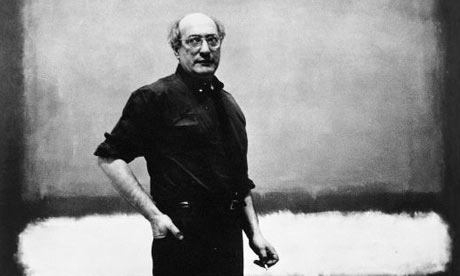
Darkness dawns … Rothko at work in 1961. Photograph: © 1998 Kate Rothko Prizel & Christopher Rothko / VG Bild Kunst, Bonn 2008
‘Can you see it?” says the man in the Hawaiian shirt, pointing up at the purple canvas towering over us. “I’ve never been here before,” he says, his shirt standing out wildly in the cool grey of the octagonal concrete room. “But I saw it in a matter of minutes. Can you see the figure of Jesus Christ our Lord on the Cross?”
I look politely into the misty bloom of the gigantic abstract work. It contains no images whatsoever, Christian or otherwise. I mumble something noncommittal, and he goes around pointing out Christ to everyone else in the room. They soon leave. I walk around staring at one colossal rectangle of sombre colour after another. A student comes in and kneels before a vast triptych that people choose to see as an altarpiece.
This is the Rothko Chapel in Houston, Texas. Art surrounds you here. Paintings on a majestic scale dominate each of its eight walls. There is little to interrupt their power, just the bare plaster, a few benches, and a couple of cushions on the floor. There are doorways, but they don’t lead anywhere, except into a tiny alcove containing nothing.
La Premiere Chanteuse de France
| Carla Bruni to jam with McCartney, Metallica | |
| AFP | Published:Sep 01, 2008 |
 French first lady Carla Bruni Sarkozy will jam live with Paul McCartney and Metallica on British television next month in support of her new album.
The erstwhile supermodel — who married French President Nicolas Sarkozy in February — will appear on “Later … with Jools Holland” on BBC television when it starts a new series on September 16.The late-night show traditionally starts with piano-playing Holland and his guests jamming together.
Bruni, who recently featured on the cover of Vanity Fair magazine in the United States and Britain, will perform “a song or two from her recently released third album”, the BBC said in a statement.
On the same night, Metallica will make its first appearance on the show in 12 years, while ex-Beatle McCartney will team up with record producer and bassist Martin “Youth” Glover under the name The Fireman.
Italian-born Bruni’s new album “Comme si de rien n’etait” (Simply) rode high in the hit parade in France after its highly publicised release in July in much of Europe, including Britain.
No More Lines for Mirren
Helen Mirren: why I stopped taking cocaine
The Guardian, Monday September 1 2008
There are many reasons to give up cocaine: the price, the health risks, the illegality. But for Dame Helen Mirren the decision to turn her back on the drug was more specific: Klaus Barbie.
Mirren, who won an Oscar last year for her portrayal of the Queen, says she took the decision after discovering the Nazi war criminal had been making money from selling cocaine while he was in hiding in South America in the early 1980s.
 “I loved coke. I never did a lot, just a little bit at parties,” said Mirren. “But what ended it for me was when they caught Klaus Barbie, the Butcher of Lyon, in the early 80s. He was hiding in South America and living off the proceeds of being a cocaine baron. And I read that in the paper, and all the cards fell into place and I saw how my little sniff of cocaine at a party had an absolute direct route to this fucking horrible man in South America.”
Mirren says that from then on she never took cocaine again. “Until that moment I had never grasped the full horrifying structure of what brings coke to our parties in Britain.”
In the interview with GQ magazine, Mirren, who starred in Prime Suspect as DCI Jane Tennison, says she has been held back by her looks. “I’ve always had big tits and blonde hair. That’s an … can be a terrible disadvantage,” she said. “Because you’re not allowed to be intelligent if you’re a woman with big tits and blonde hair. And if you are, it offends people. Intelligence does not fit into that package, and you are patronised, condescended and insulted. Professionally.”
The Model With The Golden Arm
Solid gold statue of Kate Moss unveiled at British Museum
A solid gold statue of supermodel Kate Moss worth £1.5 million is being unveiled in the British Museum today.
By Sarah Knapton

First glimpse of a solid gold statue of Kate Moss by artist Marc Quinn Photo: PA
Siren is the work of artist Marc Quinn whose most famous sculpture was Alison Lapper Pregnant which appeared on the Fourth Plinth in Trafalgar Square
His sculpture of Moss said to be the largest gold statue to be made in the world since the time of Ancient Egypt.
Speaking about choosing the supermodel as a subject, Quinn said: “I thought the next thing to do would be to make a sculpture of the person who’s the ideal beauty of the moment.”
The 50kg statue will be displayed in the Nereid Gallery of the British Museum, alongside other statues such as Crouching Venus, a Hellenistic model of Venus surprised while bathing.
Quinn’s latest work, which shows Moss in a yoga pose, is part of a collection, entitled Statuephilia, by contemporary artists going on display at the British Museum.
It is the second time the London-born artist has used the model as his muse. He previously created Sphinx, a white-painted bronze sculpture of the fashion icon.
Quinn is also known for Self, a bust of his head made from eight pints of his own frozen blood.
Other artists exhibiting include Damien Hirst and Angel of the North creator Anthony Gormley.
Claudio Gone
Gorilla mourning her son is image of grief that breaks human hearts, too
 Bild-Zeitung /Marco Stepniak
A mother gorilla bereft over the death of her baby son brought humans to tears – and brought humanity a little closer to animals.
It is a picture of pain that made mothers of all species cry – a grieving gorilla named Gana holding her dead baby in her hands.
Gana’s traumatic ordeal began when her 3-month-old son, Claudio, suddenly died in her arms.
Holding him like a doll, Gana stared at her son, apparently puzzled by his lolling head and limp arms.
Gently, she shook her boy.
Gently, she stroked his hair.
There was no response.
A crowd gathered outside Gana’s compound at the zoo in Munster, Germany, drawn by the unfolding tragedy, but Gana only had eyes for her son.
She prodded her boy. She caressed her boy. She seemed to be trying to will him back to life.
After a while, Gana gently placed Claudio on her back and slowly circled the compound, stopping every few steps to see if her boy was breathing again. Claudio gave no sign of life.
So Gana, age 11, resumed her lonesome pacing while all around her hearts were breaking.
Hundreds of humans bore witness to Gana’s torment on Saturday
Dusty Likes It
If you accidentally inject air into your vein, it is important to cut off your arm immediately so you don’t die.
Man Attempts To Amputate Own Arm In Denny’s
 Modesto police say a local man who tried to cut off his own arm at a Denny’s restaurant thought he had injected air into one of his veins while shooting cocaine and would die unless he took drastic action.
The man, identified by police as Michael Lasiter, 33, rushed into the restaurant on Friday night and started stabbing himself in the right arm with a butter knife he grabbed from a customer’s table, police say. When that knife didn’t work, Lasiter allegedly took a butcher knife from the kitchen and dug it into his arm.
Lasiter, who was arrested and taken to a local hospital with severe cuts, told officers he thought he needed to amputate his arm to keep himself from dying from the cocaine injection, says Modesto police Sgt. Brian Findlen.
The Denny’s closed for the night after the incident.
Dorman Lost and Found
Josh Dorman’s collaged paintings on display at the Craft and Folk Art Museum
His works are built of topographical maps and other elements.
By Leah Ollman, Special to The Times
August 30, 2008
Josh Dorman’s show at the Craft and Folk Art Museum opens with a warning, but not the usual sober sign you see at the entrance to certain exhibitions, aiming to shelter the unprepared from “inappropriate” content.
 The notice, painted in sprightly letters on a plum-colored wall, alerts visitors that viewing Dorman’s collaged paintings may cause them to experience instability or dislocation. They might lose track of scale, gravity, time. “While clear answers may or may not reveal themselves,” the wall text declares, “the loose logic of a dream state will surely reveal much truth.”
Most of the work in “Within Four Miles: The World of Josh Dorman” is based on old topographical maps that the artist has cut out and collaged onto panels or canvas, drawn into and painted over. Typically, maps offer certitude and a clear sense of positional relationships. Dorman’s versions shed the anchors of rational order. They trade scientific method for poetic instinct. In finding a new use for old materials, Dorman has also resuscitated an obsolete definition of the word “map”: “to bewilder.”
Mystery Tweet by Tweet
from the Bits Blog at NY Times
Introducing the Twiller
You might remember the novel in its earlier form; it had a cover, and many pages, forethought of plot, editors and agents weighing in, and, oh yes, it generally had sentences and punctuation. And, finally, some poor suckers had to take the time out of their busy days to actually read it.
 Who has time for all those niceties? They’re so first half of 2008.
Introducing the Twiller.
Recently, a handful of creators (present company included) have scrapped pen and paper for mobile phone and keypad, and started texting their novels — in real time, just a few characters at a time. Our medium is Twitter, a service that lets you broadcast bursts of 140 characters at a time to be read by people who subscribe to get your updates.
In my case, I’ve for the last two months been using Twitter to write a real-time thriller. Hence: Twiller. (Cheap word play is what you get when you disintermediate, as they say, your agent and editor).
It’s about a man who wakes up in the mountains of Colorado, suffering from amnesia, with a haunting feeling he is a murderer. In possession of only a cell phone that lets him Twitter, he uses the phone to tell his story of self-discovery, 140 characters at a time. Think “Memento” on a mobile phone, with the occasional emoticon.
Review of BRIGHT SHINY MORNING AudioBook
Bright Shiny Morning by James Frey
 read by Trevor White and Lorelei King
For Raymond Chandler, 1940s Los Angeles was a big hard-boiled city ‘with no more personality than a paper cup’. James Frey dissects the same big hard-boiled city sixty years on through a relentless depiction of the hopes and shattered dreams of the many and various who move to the sprawling and diverse metropolis – a mesmerising and moving microcosm of the human condition.
Bringing to life (and to death) a selection of the multitude drawn to the city of angels, Frey populates his book with the lonely, the egotistical, the depraved and the lost in what for many is an illustration of the decay that prefigures the decline and fall of a once-great empire – the United States of America.
Trevor White and Lorelei King share the narration in a stunningly brilliant example of the art ofaudiobook performance, chorusing the ups and downs (mostly downs) of the characters in the novel.
Bright Shiny Morning is one of the outstanding publications of the year and will be top of my list for an audiobookaward.
* * * * *
© 2008 AudioBooksReview