
Herb & Dorothy
from The Moment blog @ The New York Times
ABMB | Meet the Vogels
Megumi Sasaki’s documentary film “ Herb & Dorothy” debuts tonight at The Colony Theater in Miami as part of ABMB’s “Art Loves Film” series. The movie is a sweet tale about Herbert and Dorothy Vogel, a postal worker and a librarian, respectively, who amassed one of the most important contemporary art collections to date on a modest budget. (An excerpt from the film is above.) Here, The Moment caught up with Dorothy Vogel about the fluctuating art economy, dealer camaraderie, and advice for collecting in today’s market.
In the film, you say you collected minimal and conceptual art because Pop art was too expensive. Does this mean your collection evolved out of what you could afford?
It’s true, everything else was not affordable. But, we happened to have a natural attraction to minimal and conceptual so it made it easy to collect. I would have liked to have some Pop but it got expensive very quickly and Abstract Expressionism was out the question.
Rumor has it the gallerist Leo Castelli sold you a lot of your work.
We bought our Donald Judd from him. He was a wonderful man and very supportive. We did not buy a lot through him though because he always gave us artists’s phone numbers and told us to call them directly.
Did any artist refuse to sell you work? Did you feud with dealers because of your aggressive collecting style?
Generally people wanted to come into our collection, so it was the other way around unfortunately. We never had problems with dealers. I know John Weber said that in the film but in many cases, we started buying before they had representation. John always knew which of his artists we were directly buying from and we never told other people to go to the artist directly. We always told them to go to the dealer.
“As long as I’ve still got rubber and a stiff handbrake…”
“I hurt so much / I bleed.”
Self-injury on the rise among young people
Self-inflicted injuries appear to be on the rise, with some young people actually embedding objects in their skin. Stress may be a factor.
By Shari Roan
December 8, 2008
The revelation was shocking enough. That a growing number of teenagers and young adults deliberately embed needles, paper clips or staples in their skin may have seemed unthinkable before an Ohio radiologist presented disturbing proof at a medical meeting Wednesday.
 Even more disturbing than his X-rays and accompanying report, however, could be the size and pervasiveness of the trend from which it derives — self-injury.
Cutting, burning and biting one’s body is a habit increasingly taken up by young people who find themselves simply unable to cope with stress. Embedding appears to represent a more extreme form of the disorder.
“We always saw a little bit of this, but it was in people already identified as having a psychiatric disorder,” says Janis Whitlock, a prominent researcher on self-injury at Cornell University. “What doesn’t seem to make much sense is why we’re seeing it so much in seemingly healthy kids.”
Experts who study the behavior say that 15% to 22% of all adolescents and young adults have intentionally injured themselves at least once in their lifetimes. One study of 94 girls, ages 10 to 14, found that 56% had hurt themselves at least once. It was published in February in the Journal of Consulting and Clinical Psychology, part of a special issue devoted to self-injury.
 The behavior may be building among adults as well. One study found that 1% of adults self-injure.
Illinois therapist Karen Conterio, who operates a self-injury treatment program, says 11% of her clients are age 40 and older. And surveys by Whitlock have identified self-injurers in their late 20s and 30s.
Expressing pain
The leading theory behind the behavior is that cutting, burning or hitting oneself externalizes brutal and persistent emotional pain. A poem published in a newsletter called the Cutting Edge sums up the disorder, says Ruta Mazelis, a consultant with the Sidran Institute in Baltimore, an organization that focuses on traumatic stress.
“I hurt so much
I bleed.”
— Robin et al.
Cafe du Mort
France fears death of village life as cafés call last orders
Threatened by new habits and a shrinking rural population, a national institution is fighting for survival
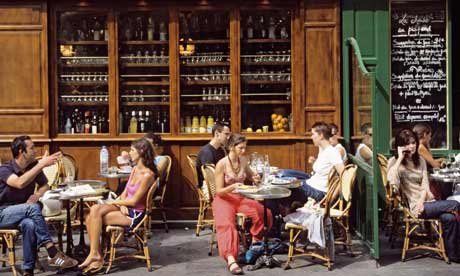
Cafe Terrace on Rue Vieille du Temple. Photograph: Corbis
As he drives through the hills and fields of the Ardennes, José Hody points out the landmarks of a devastated landscape. There’s Café de la Paix, on the brink of bankruptcy; there’s Le Malibou, which has already shut down. In the town of Sedan, Hody, who hires out games to 100 local establishments, indicates La Taverne, now converted into a florist, and Quai 32, which is on the point of closure.
We move on to Vendresse, a village of 550 inhabitants surrounded by muddy fields and the overflowing Meuse river. We visit the last remaining café – once there were five – with the last remaining darts board, a menu du jour at £10, pastis and worn Johnny Hallyday tapes. The table football game, one of scores that Hody once supplied to local businesses, has already gone.
‘We are going to have to sell up and, as there are no buyers, that’s it for the café,’ said Ingrid Meurquin, the patronne of Le Donjon for the past eight years. ‘It’s sad for us and sad for the village.’
All over France it is the same story. Changing social habits, rural depopulation, the recently introduced ban on smoking, strict laws prohibiting fruit machines, inflation, static salaries and the economic crisis are forcing thousands of cafés and bars to the wall.
Soft Tools In A Hard World
It’s official: Men really are the weaker sex
Evolution is being distorted by pollution, which damages genitals and the ability to father offspring, says new study. Geoffrey Lean reports
The male gender is in danger, with incalculable consequences for both humans and wildlife, startling scientific research from around the world reveals.

The research – to be detailed tomorrow in the most comprehensive report yet published – shows that a host of common chemicals is feminising males of every class of vertebrate animals, from fish to mammals, including people.
Backed by some of the world’s leading scientists, who say that it “waves a red flag” for humanity and shows that evolution itself is being disrupted, the report comes out at a particularly sensitive time for ministers. On Wednesday, Britain will lead opposition to proposed new European controls on pesticides, many of which have been found to have “gender-bending” effects.
It also follows hard on the heels of new American research which shows that baby boys born to women exposed to widespread chemicals in pregnancy are born with smaller penises and feminised genitals.
“This research shows that the basic male tool kit is under threat,” says Gwynne Lyons, a former government adviser on the health effects of chemicals, who wrote the report.
[ click to read full account of this calamity at The Independent ]
Who Needs A Master?
Braised Red Cabbage With Toasted Hazelnuts

Arts and Roots
| I Love My Shop with Roots Restaurant and Gallery | |
| Nomfundo Xulu | Published:Dec 04, 2008 |
|
|
|
| Where is the restaurant?
It’s in central Western Jabavu, Soweto, across the road from the famous Morris Isaacson High School. What kind of place is it?
How long have you been in the art and food industry? I studied art and have been involved in the industry for the past five years, and I’ve been working with food for two years now. Tell us the story behind the name of the restaurant. The name is a symbol of what we are about as township people. We are going back to the importance, the roots, of township life, which is about arts, music and good food. When did Roots open? We planted our roots on December 12 last year. What were you doing before that? I have a day job in advertising, but I go to Roots every day after work and at weekends. What plans do you have for Roots? I’d like it to be a franchise, but I do not want to go to the suburbs — I would like Roots to be strictly a township thing. So next up are Guguletu and Alexandra.
The food … where does one begin? It smells of early mornings, it reminds one of family, friends and the orchestra of street life , where kids play easy, like day will never be night. We offer township cuisine with interesting model C-type sticky wings, ivy league steak and Sunday-lunch chicken stew. Whose art do you display? The artwork is amazing and our current exhibition is by Mongezi Gum, an artist who really reflects the township vibe. There are more artists coming up soon. What kind of customers do you attract? Roots has visits from a number of tourists, artists and people who miss that homely ambience. Describe your restaurant in one word. Home. What type of music do you play? The music ranges from township jazz to lounge. And your decor? Classic township decor, which includes those velvet couches our parents used to cover with transparent seat covers, and the classic photograph of a mother and child caressing, which every township house used to have in the lounge. |
|
 I wanted to create a place where people can reflect on where they come from and where artists, poets and musicians can showcase their work. So Roots Restaurant and Gallery, aka Roots, is just that — a restaurant and a gallery.
Thou Shalt No Longer Hang Bling
Is glitzy art on the way out?
The changing market may diversify the works being produced
Judith H. Dobrzynski | 4.12.08 | Daily fair edition
Prices aren’t the only thing different about the art on offer at ABMB this year: tough economic conditions have also influenced what many dealers have brought and what many collectors are buying. Eventually, the times may also affect what art is made.
In a word—or a few—big, glitzy, high-cost art is out, replaced by smaller, less showy works that don’t require artists or dealers to take out a mortgage to produce, or collectors to build showcase museums to display their treasures.
 “The art here is more conservative, more accessible and more residential-compatible,” says Ann Richards Nitze, who both collects and guides other collectors. Advisor Todd Levin agrees: “That whole big ‘I’m going to build a museum, here’s the huge coffee-table book’ thing has gone ‘poof!’ So all those huge installations have disappeared from the fair. Now people are returning to cocooning, so they want domestic-size art that they can live with.” Diamond-dusted works seem to be gone, too, also a casualty of the times. The tone is simply different this year.
Some long-time collectors welcome the trend as good not only for their budgets but also for artists, especially those who’ve struggled to get noticed in the money-driven market of the past several years. Now people may look for these kinds of artists—the young or overlooked. “I’ve heard collectors saying: ‘I’m going back to my roots of collecting younger artists’,” says Andrea Rosen (C15).
In fact, this is the kind of market that collectors such as Agnes Gund, president emerita of the Museum of Modern Art, says she likes. “The froth is gone. There’ll be less blingy art,” she says. “The market is better for selling less-well-known but important artists like Lynda Benglis. She’s finally coming into her own.
Bangladesh Requests Emergency Bailout of Forklifts, Pallets and Labor Union Reps
This is a video that shows how glaringly the United States is behind even nations like Bangladesh in the fight against global warming.
The Heart’s Filthy Video
Regarding David Bowie’s Music-Videos at MoMA
One man’s total reinvention, live
By Saul Austerlitz

An archaeological dig through David Bowie’s astonishingly varied career as a musician and cultural provocateur eventually reveals three sharply distinguished phases: the 1970s Glam Androgyny Era, the 1980s Mainstream-Chasing Era, and the Return to Respectability begun in the ’90s and continued intermittently today. But within these periods lies an infinite substrata of poses and personae. Bowie has been so many different things to so many different people—worn so many masks, slipped into and out of such an astounding variety of guises—that the opportunity to see it all at once, in chronological order, feels oddly like peeking into the man’s diary.
Assisting cultural archaeologists of all stripes, Bowie donated his entire music-video collection to the Museum of Modern Art earlier this year….
“I have nothing to do today. You know what? I’m dying to look at a painting.”
Rosa!
December 3rd, 2008

Art Basel Miami is in Miami because of collectors like Rosa de la Cruz. Along with a dozen other obsessive collectors, de la Cruz made Miami more than outpost of the art world. They turned it into a Mecca for the far-flung faithful of Contemporary art.
ArtInfo has an interview with her where she talks about her planned space that will be about art first and foremost:
“there are too many parties. Lately art has become a purely social scene. I’ve met people at parties who are buying art, and they don’t know what they are buying.
I think there are too many shows. We’ve been running a marathon for the past few years. With everything that’s happening in the world right now, we need to slow down and spend more time looking at works. So there will be the collection, and that’s it. And a little library. I want people to say, “I have nothing to do today. You know what? I’m dying to look at a painting.”
‘Cause you’re just a dog!
Grace Before Meat
 These days an adjective recognised in the OED, Mills & Boon has become a genre unto itself over its 100-year history. To mark its centenary, The Art of Romance tells the publisher’s story with a century’s worth of covers. Here is a selection, offering fascinating insights into the changing meaning of ‘romance’.
At the end of the gallery, there’s a chance for you to win your own copy of the complete book, with a competition to come up with the most accurate, or funny, or simply darling alternative title for the cover with its name blanked out. Here’s looking at you.
[ click to view slideshow and enter contest to win Grace Before Meat & more! ]
“To The Brothers Wit’ The 808”
Slaves to the rhythm
Kanye West is the latest to pay tribute to a classic drum machine
Last Updated: Friday, November 28, 2008 | 10:57 AM ET
By Jason Anderson, CBC News
 The Roland TR-808 Rhythm Composer, a programmable drum machine introduced in 1980. The machine has been used by musicians from Marvin Gaye to the Beastie Boys to Beyonce to Kanye West. (Roland/Drum Machine Museum)
It helped Marvin Gaye get some sexual healing. Beyonce and the Beastie Boys have sung (and rapped) its praises. The most revered makers of hip hop, techno and industrial rock couldn’t live without it. And now the most popular MC of our day pays tribute to it in the name of his new album.
Some may see the title of Kanye West’s 808s and Heartbreak (out this week) and assume those digits are just another of those cryptic numbers that musicians like to throw around (see also: Prince’s 3121, Nena’s 99 Luftballoons, Rush’s 2112). But the reference couldn’t be more specific — West has taken this opportunity to declare his loyalty to the Roland TR-808.
 Soul singer Marvin Gaye used the Roland TR-808 for his 1982 hit Sexual Healing.(Pictorial Parade/Getty Images)
Introduced in the early ’80s as one of the first programmable drum machines, the 808 was surpassed long ago by more high-tech musical tools. And yet musicians of all stripes and styles have deemed it indispensable for its stark percussion sound. With its metronomic precision, it may have none of the swing of a human drummer, but the 808 can still provide a futuristic kind of funkiness, especially when it’s in the right hands. This special timeline reveals how this once-lowly machine attained its iconic status.
1932: Developed by Leon Theremin at the behest of composer Henry Cowell, the Rhythmicon makes its public debut. The most sophisticated of the early electronic drum machines, it can play 16 different rhythms with no need for hands or sticks. Despite its enormous promise, it is soon sidelined by Cowell; Theremin’s innovations are ignored for decades.
1959: Wurlitzer introduces the first commercially available drum machine, the Sideman. The company builds it into many of their organs. Manufacturers like the Italian company Bontempi gradually follow suit with their own versions, thereby ensuring that future generations of kids fooling around with dusty organs in their grandparents’ homes will have formative encounters with the bossa nova beat.
1967: Use of the drum machine begins to proliferate after the Hammond Organ Company incorporates a fully transistored rhythm machine by the Ace Tone company (later renamed Roland) into its products. Sly Stone is an early adopter of the technology in the rock world, using a drum machine on the loping hit Family Affair and throughout his 1971 album There’s a Riot Goin’ On. Jimi Hendrix can also be heard using a drum machine on a demo version of the posthumously released Angel. Luckily, the Beatles’ breakup spares Ringo Starr the indignity of being replaced by a mechanical model.
1980: The Roland Corporation introduces the Roland TR-808, a programmable drum machine. According to Greg Rule’s book Future Shock, five percussion sounds characterize the 808: “the hum kick, the ticky snare, the tishy hi-hats (open and closed) and the spacey cowbell.” A Roland representative later credits the machine’s design to a Mr. Nakamura (responsible for the analog voice circuits) and a Mr. Matsuoka (who developed the software).

A 1980s advertisement for the 808. (Roland/Drum Machine Museum)
The 808 receives many poor reviews in the gearhead press of the day, generally being deemed inferior to the Linn LM-1, the first drum machine to use digital samples (i.e., prerecorded rather than machine-generated sounds). Nevertheless, it gains some popularity due to its relatively low cost of $1,195 US. Yellow Magic Orchestra, the pioneering Japanese synth-pop band, is the first band to put the 808 to use.
“Finding out that a stupid, ridiculous thing like copying a postcard could lead to a picture.”
Photographer Hans-Peter Feldmann: Life for sale
Liz Jobey looks at German artist Hans-Peter Feldmann, whose latest book collates a myriad of images – beauty queens, horses, cigarette cards – into a bittersweet reflection on consumerism

Striking a pose … a page from Hans-Peter Feldmann’s Album
In the late 1960s, the German artist Hans-Peter Feldmann produced a series of small books titled Bild (Picture) or Bilder (Pictures). Each book contained a number of black-and-white photographs of a particular subject – 14 mountains, 12 views of aircraft in the sky, 11 sets of women’s knees, six pictures of football players – and was titled accordingly. Each had “Feldmann” printed on the front cover in capitals, and though the women’s knees were credited to photographer Wolfgang Breurs, there was little else to identify the meaning of the pictures or the “author” of the books. In 1971 a portfolio of 10 books was published by the Galerie Paul Maenz in Cologne.
 In their bland depiction of ordinary objects, and in their serial groupings, they were reminiscent of the small books made a few years earlier by Ed Ruscha. In 1962 Ruscha had experimented with paintings and collages based on photographs he had taken on a road trip through Europe the year before. His subjects were ordinary scenes and objects from his travels, but once photographed, they took on a more significant role as specimens of everyday culture – apartment buildings, shop fronts, restaurants, signs, posters, a car, a motorbike, a pair of shoes.
Soon after he returned to California he made a set of photographs of household products, which he called Product Still Lifes. Ruscha recognised that photographs were inherently indexical: they allowed him to compare and contrast similar structures or objects when placed side to side. They also had a flat, deadpan quality that reflected the banality and standardisation of post-war American life. Soon Ruscha was laying out his pictures serially in what would become the first of his now famous set of books, Twenty-six Gasoline Stations, published in 1963. This small white paperback marked the advent of the contemporary artist’s book: it was cheaply produced, cheap to buy ($3 [£2] a copy) and, most importantly, it used photographs not as illustrations but as the visual expression of an idea.
In Düsseldorf, around the same time, Gerhard Richter began to use photographs as an aid to his paintings. “Do you know what was great?” he wrote in 1964, “Finding out that a stupid, ridiculous thing like copying a postcard could lead to a picture.”
Odetta Gone

Legendary American folk singer Odetta, whose powerful voice influced so many musicians, has died of heart disease at Lennox Hill Hospital in Manhattan. She was 77. She was long-associated with the civil rights movement. Odetta called on her fellow blacks to “take pride in the history of the American Negro.”.
Credits: Davis, Clarence Published: 12/03/2008 10:48:37
Legendary L.A. Eatery and Its Shrine To Rock God Urine
from the LA Times Pop & Hiss music blog
Barney’s Beanery: Jim Morrison peed here (on the bar)
02:05 PM PT, Nov 27 2008
 You have to be really, really famous — no, legendary — to make a restaurant want to put up a memorial plaque marking the exact spot on its bar where you peed in the 1960s. You’d have to be the kind of guy who Val Kilmer played in a movie, the kind of guy who needs guards stationed to this very day — at your grave — to protect it from being completely covered in joints, urine and whiskey. The kind of guy whose filthy leather pants (that you never took off and probably wore without underwear) are enshrined at the Hard Rock Cafe.
In short, you’d have to be Jim Morrison, and the place that wants to make a shrine to something arguably really uncool that you did (like peeing on its bar) would have to be West Hollywood’s equally legendary (well, sort of) Barney’s Beanery.
Consider Barney’s the ultimate L.A. roadhouse (with a menu of greasy offerings so lengthy that it shames “War and Peace”) and consider this forthcoming plaque a birthday present to Morrison, who would have turned 65 on Dec. 8.
To mark the event Barney’s is throwing a birthday bash for the Lizard King.
Attached
from 9 News Australia (via T. Carney’s Facebook feed)
Man tries to pay bill with spider drawing
Friday, November 14, 2008
Below is the complete email conversation that Adelaide man David Thorne claims he had with a utility company chasing payment of an overdue bill.
From: Jane Gilles
Date: Wednesday 8 Oct 2008 12.19pm
To: David Thorne
Subject: Overdue account
Dear David,
Our records indicate that your account is overdue by the amount of $233.95. If you have already made this payment please contact us within the next 7 days to confirm payment has been applied to your account and is no longer outstanding.
Yours sincerely, Jane Gilles
From: David Thorne
Date: Wednesday 8 Oct 2008 12.37pm
To: Jane Gilles
Subject: Re: Overdue account
Dear Jane,
I do not have any money so am sending you this drawing I did of a spider instead. I value the drawing at $233.95 so trust that this settles the matter.
Regards, David.

From: Jane Gilles
Date: Thursday 9 Oct 2008 10.07am
To: David Thorne
Subject: Overdue account
Dear David,
Thankyou for contacting us. Unfortunately we are unable to accept drawings as payment and your account remains in arrears of $233.95. Please contact us within the next 7 days to confirm payment has been applied to your account and is no longer outstanding.
Yours sincerely, Jane Gilles
From: David Thorne
Date: Thursday 9 Oct 2008 10.32am
To: Jane Gilles
Subject: Re: Overdue account
Dear Jane,
Can I have my drawing of a spider back then please.
Regards, David.
From: Jane Gilles
Date: Thursday 9 Oct 2008 11.42am
To: David Thorne
Subject: Re: Re: Overdue account
Dear David,
You emailed the drawing to me. Do you want me to email it back to you?
Yours sincerely, Jane Gilles
From: David Thorne
Date: Thursday 9 Oct 2008 11.56am
To: Jane Gilles
Subject: Re: Re: Re: Overdue account
Dear Jane,
Yes please.
Regards, David.
From: Jane Gilles
Date: Thursday 9 Oct 2008 12.14pm
To: David Thorne
Subject: Re: Re: Re: Re: Overdue account
Attached
From: David Thorne
Date: Friday 10 Oct 2008 09.22am
To: Jane Gilles
Subject: Whose spider is that?
Dear Jane, Are you sure this drawing of a spider is the one I sent you? This spider only has seven legs and I do not feel I would have made such an elementary mistake when I drew it.
Regards, David.
From: Jane Gilles
Date: Friday 10 Oct 2008 11.03am
To: David Thorne
Subject: Re: Whose spider is that?
Dear David, Yes it is the same drawing. I copied and pasted it from the email you sent me on the 8th. David your account is still overdue by the amount of $233.95. Please make this payment as soon as possible.
Yours sincerely, Jane Gilles
From: David Thorne
Date: Friday 10 Oct 2008 11.05am
To: Jane Gilles
Subject: Automated Out of Office Response
Thankyou for contacting me. I am currently away on leave, traveling through time and will be returning last week.
Regards, David.
From: David Thorne
Date: Friday 10 Oct 2008 11.08am
To: Jane Gilles
Subject: Re: Re: Whose spider is that?
Hello, I am back and have read through your emails and accept that despite missing a leg, that drawing of a spider may indeed be the one I sent you. I realise with hindsight that it is possible you rejected the drawing of a spider due to this obvious limb ommission but did not point it out in an effort to avoid hurting my feelings. As such, I am sending you a revised drawing with the correct number of legs as full payment for any amount outstanding. I trust this will bring the matter to a conclusion.
Regards, David.

From: Jane Gilles
Date: Monday 13 Oct 2008 2.51pm
To: David Thorne
Subject: Re: Re: Re: Whose spider is that?
Dear David, As I have stated, we do not accept drawings in lei of money for accounts outstanding. We accept cheque, bank cheque, money order or cash. Please make a payment this week to avoid incurring any additional fees.
Yours sincerely, Jane Gilles
From: David Thorne
Date: Monday 13 Oct 2008 3.17pm
To: Jane Gilles
Subject: Re: Re: Re: Re: Whose spider is that?
I understand and will definately make a payment this week if I remember. As you have not accepted my second drawing as payment, please return the drawing to me as soon as possible. It was silly of me to assume I could provide you with something of completely no value whatsoever, waste your time and then attach such a large amount to it.
Regards, David.
From: Jane Gilles
Date: Tuesday 14 Oct 2008 11.18am
To: David Thorne
Subject: Re: Re: Re: Re: Re: Whose spider is that?
Attached
Punk Morning at Christie’s

Melena Ryzik writes:
Vivienne Westwood bondage pants, photographs of Lou Reed and Blondie, badges for the Buzzcocks and concert flyers from clubs like Max’s Kansas City went up for bid at the decidedly nonpunk hour of 10 a.m.
Photo: Hiroko Masuike for The New York Times
The Young Dead
The shining stars who burned out too soon
AIDAN DUNNE
Thu, Nov 27, 2008
VISUAL ART:A NUMBER OF ARTISTS who died fairly recently and prematurely but whose influence is still very much alive are featured in Now’s the Timeat the Hugh Lane Gallery.
 It’s an interesting idea for a show, because there is, sadly, no shortage of potential participants. The reasons for early demise vary, but the usual suspects, including drugs and drink, certainly feature, though not as prominently as cruel illnesses and misadventure – the gifted Helen Chadwick, for example, was killed by heart failure induced by a rare virus. But there was much speculation that her infection with the virus may have been related to the micro-organisms she was using in her work.
Chadwick remains a highly significant artist, not least for the way she pioneered the idea of the body as the site of art rather than something to be depicted. Jean-Michel Basquiat, the graffiti artist turned art world superstar, and protégé of Andy Warhol, succumbed to his insatiable appetite for a mixture of heroin and cocaine. A victim of his own success and prone to depression, he was still in his 20s when he died in 1988.
Why Roget Was Roget
Roget’s Thesaurus is more than just a book about words—and the story of its author’s often unhappy life provides a suggestive counterpoint to its complexities
Lesley Chamberlain
Peter Mark Roget, the future Linnaus of the English word, began compiling word-lists at the age of eight. Why was he not playing with other children, honing his social skills? The problem was his mother, a widow at 28, who drained her son of sympathy. Catherine Romilly gave birth to a wonderful, handsome, talented boy , but couldn’t let him be himself.Independence, he would write in his Thesaurus under list 744, equals freedom of action, unilaterality; freedom of choice, initiative.  But for freedom see also non-liability, disobedience, seclusion and liberation: the way one insists on freedom in the face of opposition.
Catherine Roget née Romilly came from a well-regarded and successful London Huguenot family blighted by mental illness. After the early death of her Swiss-born husband, Catherine never recovered her capacity for normal life. Her own mother had been mentally incapable and Catherine slipped inexorably into a lesser version of her mother’s state. Shlepping with his sister backwards and forwards between London and the country on the wheels of maternal restlessness, Peter never felt he had a home, except in his wordlists. He worked on them in solitude, while qualifying as a doctor.
Fully fledged at 20, five years too young to practise, he was exceptionally able and also peculiar and solitary. He hated disorder and dirt. When he took a job accompanying two rich teenagers on their European Grand Tour, their notebooks revealed his crabbed and pernickety mind. He taught them to count the windows in cathedrals, and visitor numbers, and tally how many paintings were in a collection. He taught them to structure the world prosaically and reliably; at all costs to avoid emotional surrender. His response to both human and natural life was to classify it, the foundation of his great work to come.
Jamaican Dancehall Culture in Pictures

9 / 14
Wayne Smith in Jammy’s Yard. In 1985 he released the revolutionary track Under Mi Sleng Teng – the first fully-computerised hit
Beth Lesser
Once There Was A Silly Old Ram
China executes man for ant-breeding scheme
BEIJING – China has executed a businessman convicted of bilking thousands of investors out of $416 million in a bogus ant-breeding scheme, state media reported Thursday.
 The official Xinhua News Agency said Wang Zhendong, who was found guilty of fraud and sentenced to death in February last year, was executed in north China’s Liaoning province on Wednesday.
The death penalty is used broadly in China. Though usually reserved for violent crimes, it is also applied for nonviolent offenses that involve large sums of money or if they are seen to threaten social order.
Wang, chairman of Yingkou Donghua Trading Group Co., had promised returns of up to 60 percent for investors who purchased ant-breeding kits from two companies he ran. Ants are used in some traditional Chinese medicinal remedies, which can fetch a high price. Wang sold the kits, which cost $25, for $1,300, local media reported earlier.
Wang attracted more than 10,000 investors between 2002 and June 2005, when investigators shut down his companies. The closure of his business set off a panic among small-time players who saw their life savings disappear overnight.
Buy Now and Plan Ahead

‘When Black Friday comes, I’m gonna dig myself a hole…’
Hitler’s Bookmark. No seriously – Hitler’s Bookmark
Federal agents recover ‘Hitler’ bookmark
Romanian man arrested trying to sell item to undercover officers
 updated 3:45 p.m. MT, Wed., Nov. 26, 2008
SEATTLE – Authorities have recovered a stolen 18-carat gold bookmark that reportedly was given to Adolf Hitler by his longtime mistress, Eva Braun.
Christian Popescu, a Romanian national, was arrested Tuesday outside a suburban Starbucks after trying to sell the bookmark to an undercover agent for $100,000, according to papers filed in U.S. District Court.
Federal prosecutors said the bookmark was among several items taken in an auction-house heist in Madrid six years ago. At the time, some antiquities experts questioned its authenticity.
Fixins On The Cheap
A feasible feast
 Savvy use of supermarket products keeps your Thanksgiving fuss-free
Thanksgiving dinner conjures up Currier & Ives memories of rosy-cheeked grannies, aided by a phalanx of aunties, sisters and assorted female cousins mustering up a veritable groaning board of goodies while the menfolk chaw away the hours in the front parlor.
 But in this 24/7 workaday world, T-Day reality can be quite different.
Don’t despair.
You don’t have to splurge on a fancy dinner to evoke the true spirit and foods of Thanksgiving past. You can still gather the family, however nuclear, around the table and give thanks for what you have and for being together and for pulling a wonderful meal together without getting crazed.
Just be prepared to cheat. A little.
Supermarkets, delis, caterers and restaurants all sell a variety of precooked, ready-to-cook and assemble-X-Y-Z-and-cook dishes you can place on your holiday table. That can lighten the load so you can concentrate on the Thanksgiving dish that really matters to you, be it the roast turkey, the mashed potatoes, the pumpkin pie or the chili-cheese nacho pie you serve up with the football game on TV.
My mother cooked like this for years. She would jazz up packets of frozen onions in white sauce, add her own vegetables to commercially prepared stuffing mixes and pour a can of chicken broth into pan juices to make a quick gravy.
Whiteley Enriches Cezanne
Whiteley’s Balmoral nets $990k for Cezanne fund
 The Art Gallery of New South Wales has sold two paintings to help fund its purchase of a $16.2 million work by French artist Paul Cezanne.
Brett Whiteley’s Balmoral fetched $990,000 at the Sotheby’s auction in Melbourne.
John Perceval’s Pleasure Craft sold for $198,000.
Cezanne’s Bords De La Marne is the most expensive artwork ever bought by an Australian public gallery.
‘Witness them setting a drunk girl’s hair on fire, feeding aspirin to a squirrel, singing a piss-poor “Under the Bridge” to Anthony Kiedis…’
 |
|
 |
|
 |
 |
 Justice JusticeA Cross the Universe By Cam Lindsay There are tour documentaries and then there’s Justice’s tour documentary. There is a difference. In documenting their 2008 North American tour, the Parisian production/DJ team (aka Gaspard Augé and Xavier de Rosnay) wanted everything caught on film — warts, arrests, drunken weddings, sexual romps and all. Using a blend of raw footage and nicely arranged jump cuts of their extraordinary life on the road, those expecting a concert film will be sorely disappointed, for the music is secondary to the hedonism off stage. Hiring their friends/video directors Romain Gavras and So-Me to shoot them, A Cross the Universe is a one-hour-long recap (accompanied by a CD recording of their live set) that plays out like a “greatest hits,” which from beginning to end becomes a lesson in shock and awe cinema. Since there’s no privacy, viewers are invited into their world to meet the duo’s gun-toting tour manager Bouchon (who’s arrested twice) and their Guinness-record-attempting cowboy bus driver, as well as witness them setting a drunk girl’s hair on fire, feeding aspirin to a squirrel, singing a piss-poor “Under the Bridge” to Anthony Kiedis, smashing a bottle over an overzealous fan’s head (and then getting arrested) and of course, getting married while drunk in Vegas. Anyone who’s waiting for the adaptation of Mötley Crüe’s The Dirtshould try seeking Justice, who’ve made the most decadent music doc ever. (Ed Banger/Warner) [ click to read full article at exclaim.ca ]
|
|