
Contradicting Rich
How the web is undermining reading
From Plato to Guitar Hero, we have always been wary of change – but the internet poses a serious threat to society’s ability to read

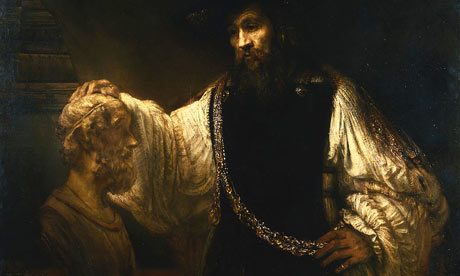
Rembrandt’s Aristotle with the Bust of Homer. Photograph: Corbis
For as long as humans have been developing new technology, we’ve been worrying that our inventions will cause our brains to decay.
Even the development of writing was seen as a threat to the memory skills that enabled ancient poems to be passed from teller to teller –many scholars believe Homer‘s epics weren’t written by a single man, but were the product of a long tradition of oral poetry. Arguably civilisation gained something better in exchange, but there were still those who bemoaned the loss of the memory skills of the oral culture; in Mary Renault’s novel The Praise Singer, master-memoriser Simonides worries that his student’s memory will become hazy because he is writing things down.
There are some signs that we may be approaching a similar cultural moment, although perhaps with fewer reasons to be cheerful. Reading has been on the decline for the past half-century – largely, it seems, because television has replaced reading in our leisure time. I love television: even with the slew of boring reality shows currently broadcast, TV still offers some very enriching cultural experiences. But the loss of reading – that is, not purely literacy but reading for pleasure – could have wide cultural implications. Reading brings with it a host of other skills and benefits, the loss of which would leave our society poorer, including the ability to absorb information quickly, to think through complex problems or to compare points of view.
And it’s not just television that poses a threat to reading, it’s the internet too.
Caveat Emptor
Asking the Artist for a Do-Over
By DANIEL GRANT
Art is long and life is short, according to the old Roman saying, but sometimes art doesn’t hold up its end of the bargain. The canvas warps, the metal bends, the paper turns brown: New artworks may look like old works in a short period of time, leaving their buyers perhaps feeling as though they have been had. One such collector brought back to New York gallery owner Martina Hamilton a painting she had purchased there by the Norwegian artist Odd Nerdrum that now looked as though the “painting was falling off the canvas,” Ms. Hamilton said.
Art is sold “as is” by galleries or directly from artists. (Can you imagine Consumer Reports reviewing art?) Still, dealers hope to maintain the goodwill of their customers, and artists don’t want to develop a reputation for shoddy work. But it’s not fully clear what responsibility artists bear to their completed work, especially after it has been sold. That’s particularly the case for artists who purposefully use ephemeral materials in their art (bee pollen, banana peels, lard, elephant dung, leaves, mud, moss and newspaper clippings, to name just a few examples) — isn’t it the buyers’ responsibility to know what they are getting?
![[Asking the Artist for a Do-Over]](http://s.wsj.net/public/resources/images/ED-AI896_grant_D_20090121151420.jpg)
Barbara Kelley
David Novros, a Manhattan artist, was asked in 2006 what to do about a 1965 acrylic lacquer painting in the Menil Collection in Houston that had extensive “cracks, canyons and fissures” all over the surface, and he decided “to remake the work with the same materials as before.” The work, “6:30,” is now dated “1965/2006.” Back in 1990, the Museum of Modern Art had come to Mr. Novros about a 1966 painting in its collection whose canvas had discolored, also affecting the handmade plywood stretcher. He scraped off the old paint and put on new. The museum labels the work, titled “VI.XXXII,” as “1966 (repainted in 1990).”
Artists’ experimenting with materials is only one reason contemporary art may not hold up even in the short-run. Another is that the training of artists nowadays rarely includes educating them about the properties of the materials they use. Sometimes, artists shortchanged their own art because of a lack of money, a problem not unique to artists alive today. Early in their careers, Mexican muralist David Alfaro Siquieros and French cubist Fernand Léger both painted on burlap sacks, while Marc Chagall made designs on bed sheets and Franz Kline worked on cardboard. And sometimes the artists simply lacked the technical know-how to make their art last.
mental_floss on Rumpus
Raisin’ a Rumpus: an Interview with Stephen Elliott
by – January 21, 2009 – 7:21 AM
There are many short biographies of writer Stephen Elliot floating around the internet, but this one, from the Chicago Tribune, is my favorite:
Elliott has been a ward of the State of Illinois, a stripper and a law school admissions counselor. Now, he’s becoming a literary success. He is starting to get some serious book buzz and was just named a finalist for the New York Public Library’s Young Lions Fiction Award to be announced this spring. He’s a player in the hipster, cult publishing world of writer Dave Eggers and his McSweeney’s Quarterly, and it was Eggers himself who edited “Happy Baby” (”Surely the most intelligent and beautiful book ever written about juvenile detention centers, sadomasochism and drugs,” said an excerpt from a New York Times review printed on the cover.) In short, in some circles, Elliott’s got — or is, at least, getting — rock star status.
 Now, after all the excitement that’s been generated about Elliott’s literary career, he’s gone and done something few could have anticipated: started a website. Therumpus.net isn’t your run-of-the-mill content aggregator/blog, though: it features original reviews, interviews and essays on art, culture and whatever Elliott finds interesting by writers of literary merit, and blogs by long-established icons like Rick Moody (who wrote The Ice Storm), Jerry Stahl (Permanent Midnight) and others. But enough of my yakkin’ — I’ll let Stephen Elliott tell you about it himself.
Ransom: Who is the site for? What’s the angle?
Stephen Elliott: The site’s for a lot of people. It’s for people who are overeducated and underemployed. People who want to kill time at work and want an intelligent website that’s always being updated (we update fifteen to twenty times a day). A lot of these people are visiting sites like The Huffington Post or The Daily Beast because they don’t know where else to go. They’re reading rants and they’re reading different takes on the same “story of the day.” A lot of those people would rather read a short interview with somebody interesting or a book review or a really well written short personal essay.
Sandburg’s Line
The Play’s The Scene
Director accidentally shoots actor during play rehearsal

A Smith and Wesson .38 calibre gun. Photograph: PA
Real-life tragedy nearly struck at a Florida theatre on Monday night, when an actor fired a live gun at a cast member’s head.
During rehearsals for an amateur production of John Steinbeck’s Of Mice and Men in Sarasota, the show’s director, Bill Bordy, shot 81-year-old actor Fred Kellerman in the back of the head at point-blank range, only to realise with horror that the gun he used was loaded with live ammunition. Luckily the shot only grazed Kellerman’s skull, and he was quickly released from hospital.
The incident occurred during the final run-through of the play’s last scene, in which George Milton shoots his friend Lennie Small to spare him a painful death at the hands of a lynch mob. The Smith and Wesson pistol had been borrowed from a fellow cast member in the Sarasota Senior Theater who had, it appeared, forgotten that it was loaded.
In his defence, Bordy told reporters: “I’m the actor, I’m the director and we’re running late, and without thinking I didn’t check the gun.”
“I was like, ‘Oh my God, dear Lord, no’. Luckily I was a lousy shot.”
The End of The End
“Crazed and broke and very much alone.”
Our Critic’s Tip Sheet on Current Reading: Peter Ackroyd Briefly Resurrects Edgar Allan Poe, Birthday Boy
2:59 PM JANUARY 19, 2009
 Grim is the only way to begin the story of Edgar Allan Poe, who was born 200 years ago this week; grim is the only way to end it. In between there’s poverty, drunken sprees, illness, dashed hopes, more drunkenness and a messy heap of bad behavior (Hemingway, operating on the two-birds-one-stone principle, once remarked that Faulkner was “almost as much of a prick as Poe”). And yet Poe managed to produce a body of work that’s frankly amazing and heroically perverse (the painter Robert Motherwell once called him “a one-man modernist”). The gothic tales and the poems (especially “The Raven”) made him briefly semi-famous, but never eased his financial misery. Born poor and swiftly orphaned, Poe died at the age of 40, crazed and broke and very much alone.
Right on time for his bicentennial comes Peter Ackroyd’s biography, Poe: A Life Cut Short(Nan A. Talese/Doubleday, $21.95).
Jose ‘Cheguí’ Torres Gone
Puerto Rican boxer Jose ‘Cheguí’ Torres dies at 72
Updated Monday, January 19th 2009, 5:55 PM
 Garrett, Jim
Jose “Cheguí” Torres sparing with Cleo Daniels in a training session before a fight in 1969
Hall of Fame boxer Jose “Chegui” Torres, the former light heavyweight champion and Olympic Silver Medalist who went on to become a newspaper columnist, author, boxing official and revered representative of the Puerto Rican community, died at his home in Puerto Rico early this morning of a massive heart attack. He was 72.
On March 30, 1965, Torres electrified the Latin American world when he defeated Willie Pastrano by a technical knockout at Madison Square Garden to become the first Hispanic light heavyweight champion.
Before the match, Torres exhibited his fierce pride in his Puerto Rican heritage when insisted he would not get in the ring unless Madison Square Garden officials agreed to play the island’s national anthem as well as the Star Spangled Banner. Garden officials agreed.
Pissed Off Catholic Mother
from TCarney’s FB feed
More Emo Belittlement (because it’s there)

How Many Pollacks Does It Take To Break The Ice
Cerny Riles Again
Art Hoax Unites Europe in Displeasure
By SARAH LYALL
Published: January 14, 2009
LONDON — Why didn’t anyone realize right away that there was something seriously weird about the new piece of art in Brussels?
The piece, an enormous mosaic installed in the European Council building over the weekend, was meant to symbolize the glory of a unified Europe by reflecting something special about each country in the European Union.

But wait. Here is Bulgaria, represented as a series of crude, hole-in-the-floor toilets. Here is the Netherlands, subsumed by floods, with only a few minarets peeping out from the water. Luxembourg is depicted as a tiny lump of gold marked by a “for sale” sign, while five Lithuanian soldiers are apparently urinating on Russia.
The 172-square-foot, eight-ton installation, titled “Entropa,” consists of a sort of puzzle formed by the geographical shapes of European countries. It was proudly commissioned by the Czech Republic to mark the start of its six-month presidency of the European Union. But the Czechs made the mistake of hiring the artist David Cerny to put together the project.
[ click to continue reading at NYTimes.com ]
[ click to view slideshow of David Cerny’s ‘Entropa’ ]
Get It On
Dandelion Greens & Goat Cheese Empanadas

Daniel Nagrin Gone
Dancer’s choreography defied gravity
When he was a teenager, Daniel Nagrin learned to cope with the burden of homework. He’d plug away for hours, but before long, he couldn’t stand it anymore.

He’d jump from his seat, flip on the radio and dance. Dance. Dance. Dance.
In telling the tale, he described such outbursts as intoxicating, happy with the “sheer act of flying over furniture.” He should have known then that his plan to become a psychiatrist was headed down a new path.
Nagrin eventually followed the beat he couldn’t ignore, becoming an eminent professional dancer and choreographer known for his frenetic, passionate style. A private man who often couched his emotions in public, he let his guard down on stage, leaving audiences rocking from poignant and raw techniques.
He never garnered the fame of a Mikhail Baryshnikov but ironically, it was Baryshnikov who once told a reporter that Nagrin was one of his heroes.
Nagrin, who defied the laws of physics with leaps that seemed to hang in midair, had a career that spanned New York City’s Broadway to the academic halls as a dance professor at Arizona State University in Tempe. He danced for decades, until just a few years ago. Illness finally sidelined him, and he died Dec. 29. The Tempe resident was 91.
“Hey, Look – here comes that cute little Paulie-boy.”
The Rumpus Beta Gone
from Stephen Elliot’s TheRumpus.net
THE EDITOR’S DESK: What’s Been Going On
Well, we’re getting ready to launch this bad boy. I know for a lot of regular readers the site is already launched, but things are going to be different around here once Obama is sworn in as president. For example, after Obama is sworn in there will be design on every page, not just the front page. When you click through to Rick Moody’s blog, for example, you’ll see other recent blog posts on the right. The site’s going to be more colorful and easier to navigate. Rumpy, The Rumpus mascot, will be wearing nicer clothes. 
We’re also going to have a neat new easily accesible feature called “The River.” That’s basically for hard-core Rumpus readers, people who are seriously over-educated and under-employed, checking this site three or four times a day, who want to read The Rumpus in a continual stream of updated content right down the center of the page. The choice will be yours.
In addition to tons of new content (like Josh Mohr’s review of America America or Scott Hutchins interview with Steven Soderbergh, both coming this week) we’re going to republish a lot of our original content from this beta period. So don’t freak out when you see our interview with James Frey or Malcolm Gladwell in the feature box; this is not a rerun, it’s a starting over. The Morning Coffee will still be fresh every day at 6a.m.
Andrew Wyeth Gone
American painter Andrew Wyeth dies at 91
Artist gained fame for his ‘Christina’s World’ collection, Helga portraits

Andrew Wyeth / AP
“Christina’s World” by Andrew Wyeth is the artist’s best-known painting.

PHILADELPHIA – Artist Andrew Wyeth, who portrayed the hidden melancholy of the people and landscapes of Pennsylvania’s Brandywine Valley and coastal Maine in works such as “Christina’s World,” died early Friday. He was 91.
Wyeth died in his sleep at his home in the Philadelphia suburb of Chadds Ford, according to Jim Duff, director of the Brandywine River Museum.
The son of famed painter and book illustrator N.C. Wyeth, Andrew Wyeth gained wealth, acclaim and tremendous popularity on his own. But he chafed under criticism from some experts who regarded him as a facile realist, not an artist but merely an illustrator.
Wyeth was a secretive man who spent hours tramping the countryside alone. He painted many portraits, working several times with favorite subjects, but said he disliked having someone else watching him paint.
Much of Wyeth’s work had a melancholy feel — aging people and brown, dead plants — but he chose to describe his work as “thoughtful.”
“I do an awful lot of thinking and dreaming about things in the past and the future — the timelessness of the rocks and the hills — all the people who have existed there,” he once said. “I prefer winter and fall, when you feel the bone structure in the landscape — the loneliness of it — the dead feeling of winter. Something waits beneath it; the whole story doesn’t show.
“I think anything like that — which is contemplative, silent, shows a person alone — people always feel is sad. Is it because we’ve lost the art of being alone?”
Stephen Lynch’s “Craig Christ”
George Tooker Slideshow

Spoonbridge Sculptress Gone
Coosje van Bruggen dies at 66; art historian made sculptures with husband Claes Oldenburg

Vera Isler
Coosje van Bruggen was a respected art historian, writer and curator known for her almost scientific approach to looking at an artist’s oeuvre. She collaborated with her husband, artist Claes Oldenburg, to build startlingly large sculptures of ordinary objects.
Works include a dropped ice cream cone in Germany; a bow and arrow in San Francisco; a broom and dustpan in Denver, ‘Toppling Ladder with Spilling Paint’ in downtown L.A. and binoculars in Venice.
By Suzanne Muchnic, January 13, 2009
Coosje van Bruggen — an art historian, writer and curator whose professional partnership with her husband, artist Claes Oldenburg, turned ordinary objects into startling monuments around the world — died Saturday at her Los Angeles residence. She was 66 and was battling metastatic breast cancer.
Van Bruggen was the author of scholarly books and essays on the work of major contemporary artists including John Baldessari, Bruce Nauman and Gerhard Richter. She also wrote a monograph on architect Frank O. Gehry’s Guggenheim Museum in Bilbao, Spain. But she is best known for collaborations with Oldenburg, which have placed giant trowels, shuttlecocks, bowling pins and typewriter erasers on parklands, civic squares and museum grounds in Europe, Asia and the United States. Cologne, Germany, has its upside-down ice cream cone; San Francisco, its bow and arrow; Denver, its dustpan and broom.

In Los Angeles, “Collar and Bow” — a 65-foot metal and fiberglass sculpture in the shape of a man’s dress shirt collar and bow tie, designed for a spot outside Walt Disney Concert Hall — was stalled and eventually canceled because of technical problems and escalating costs. But Van Bruggen and Oldenburg are represented by other public works including “Toppling Ladder With Spilling Paint” at Loyola Law School in downtown L.A. and “Binoculars,” the central component of a commercial building in Venice designed by Gehry.
“Don’t fµck with me fellas!”
Happy Birthday Faye Dunaway (68 yesterday)
Your Daughter For a Few Burgers and Some Beer
from the San Jose Mercury News
Deal to sell daughter for beer, cash part of Mexican culture
Posted: 01/13/2009 06:55:33 PM PST
The story of the Greenfield man who allegedly sold his 14-year-old daughter to a young suitor for cash and beer went worldwide, and the police chief who ordered the arrest said Tuesday the incident arose from a clash of cultures.
The social mores in parts of rural Mexico, where arranged marriages are common for young girls, ran head-on into California law designed to protect juveniles from sexual predators.

“It’s kind of a clash of two different cultures, but I have to uphold the local law,” Greenfield Police Chief Joe Grebmeier said.
The case involves a father, Marcelino DeJesus Martinez, 36, a young male neighbor, Margarito DeJesus Galindo, 18, and Martinez’s 14-year-old daughter who Galindo sought to marry.
Police said the young man and girl spent a week together in Soledad, the girl having gone along willingly, after a marriage deal was brokered that called for Martinez to receive $16,000, 150 cases of beer, 150 cases of soda and Gatorade, and several cases of wine and meat.
Police said Martinez first reported the girl as a runaway in an apparent effort to get their help in having her returned because the young man hadn’t paid.
The Informers
Injecting a Taste of the Flush and Flashy ’80s Into Sundance

Van Redin/Senator Entertainment
Mickey Rourke in “The Informers,” a film showing at Sundance that was adapted from a book of Bret Easton Ellis stories.
LOS ANGELES — From a glass-walled penthouse above the Sunset Strip it is impossible not to observe that times have changed.
Just down the street, the original Spago restaurant, that emblem of the flush 1980s, is an empty shell. And here in the penthouse offices of Senator Entertainment, Bret Easton Ellis, another symbol of those super-slick times, is sprawled in a soft chair, wearing decidedly unslick running shoes and sweats.
Mr. Ellis, now 44, was 21 when he chronicled this city’s high life in “Less Than Zero” (1985), his debut novel.
Asked last week whether he missed any of it — the heat, the flash, the coke-blurred frenzy of Los Angeles past — he shuddered. “Oh, no,” he said, and appeared to mean it. “I don’t miss it at all.”
Still, Mr. Ellis and Senator are bringing a bit of that lost world to the Sundance Film Festival next week.
On Jan. 22 they are planning a premiere screening of “The Informers,” directed by Gregor Jordan and based on Mr. Ellis’s collection of stories of the same title. Written during his college years, the stories describe the beautiful wreckage of lives in and around the expensive part of Los Angeles, about 1983.
The film has sex. “I think Amber Heard wears a dress once in the entire movie,” Mark Urman, Senator’s president of distribution, said. He was speaking of a young actress, last seen in “Pineapple Express,” who spends much of “The Informers” undressed, and in bed.
The movie — “a guilty pleasure,” Mr. Urman calls it — also has drugs, alienation and enough glam-rock to set it apart from other work at this year’s festival, which begins on Thursday in Park City, Utah, and runs through Jan. 25.
Sociological Storytelling
Novels help to uphold social order
WHY does storytelling endure across time and cultures? Perhaps the answer lies in our evolutionary roots. A study of the way that people respond to Victorian literature hints that novels act as a social glue, reinforcing the types of behaviour that benefit society.
Literature “could continually condition society so that we fight against base impulses and work in a cooperative way”, says Jonathan Gottschall of Washington and Jefferson College, Pennsylvania.

Gottschall and co-author Joseph Carroll at the University of Missouri, St Louis, study how Darwin’s theories of evolution apply to literature. Along with John Johnson, an evolutionary psychologist at Pennsylvania State University in DuBois, the researchers asked 500 people to fill in a questionnaire about 200 classic Victorian novels. The respondents were asked to define characters as protagonists or antagonists, and then to describe their personality and motives, such as whether they were conscientious or power-hungry.
The team found that the characters fell into groups that mirrored the egalitarian dynamics of hunter-gather society, in which individual dominance is suppressed for the greater good (Evolutionary Psychology, vol 4, p 716). Protagonists, such as Elizabeth Bennett in Jane Austen’s Pride and Prejudice, for example, scored highly on conscientiousness and nurturing, while antagonists like Bram Stoker’s Count Dracula scored highly on status-seeking and social dominance.
Johnny The Horse
Yeah Right.
Fiction Reading Increases for Adults
After years of bemoaning the decline of a literary culture in the United States, the National Endowment for the Arts says in a report that it now believes a quarter-century of precipitous decline in fiction reading has reversed.
 The report, “Reading on the Rise: A New Chapter in American Literacy,” being released Monday, is based on data from “The Survey of Public Participation in the Arts” conducted by the United States Census Bureau in 2008. Among its chief findings is that for the first time since 1982, when the bureau began collecting such data, the proportion of adults 18 and older who said they had read at least one novel, short story, poem or play in the previous 12 months has risen.
The proportion of adults reading some kind of so-called literary work — just over half — is still not as high as it was in 1982 or 1992, and the proportion of adults reading poetry and drama continued to decline. Nevertheless the proportion of overall literary reading increased among virtually all age groups, ethnic and demographic categories since 2002. It increased most dramatically among 18-to-24-year-olds, who had previously shown the most significant declines.
“There has been a measurable cultural change in society’s commitment to literary reading,” said Dana Gioia, chairman of the National Endowment for the Arts. “In a cultural moment when we are hearing nothing but bad news, we have reassuring evidence that the dumbing down of our culture is not inevitable.”
Regis and the Mad Cow
My wife and I were watching Who Wants To Be A Millionaire while we were in bed. I turned to her and said, ‘Do you want to have sex?’
‘No,’ she answered.
I then said, ‘Is that your final answer?’
She didn’t even look at me this time, simply saying ‘Yes.’
So I said, ‘Then I’d like to phone a friend.’
And then the fight started….
———————————————
I took my wife to a restaurant. The waiter, for some reason, took my order first. ‘I’ll have the strip steak, medium rare, please.’
He said, ‘Aren’t you worried about the mad cow?’
‘Nah, she can order for herself.’
And then the fight started…
The Film That Should Have Won A GG for Best Picture
Hey, Mickey, you’re so fine…
Mickey Rourke wins Best Actor Golden Globe. Fantastic.
