
Duff an’ The Buff

Thanks For The Train Wreck
PW‘s Sara Nelson Saw Book Crowd As Coolest On Earth
Laid-Off Editor Says, ‘ No Highs Match Falling in Love’
New York Times media columnist David Carr, who was hired at Inside.com a few months after Ms. Nelson was, remembered an obsessively competitive reporter whose taste for scoops matched the uncommonly speedy metabolism that Inside.com was aiming for.
 “We were both smokers, and it would be 10:30 in the morning—we would have already filed—and we’d both be outside scuffing the ground and saying, ‘I’ve got nothing,’” Mr. Carr said. “You never saw a more hard-core competitive journalist than Sara Nelson. Freakish. Freakish. She would see something come up on her screen and just explode.”
Mr. Carr went on: “She was the rare trade reporter who could write and think and who could do real-time analytics. And so she took full advantage of the platform in terms of breaking a lot of news, and doing it so it was clear not just what happened but why.”
We used to report auctions in real time at Inside,” Ms. Nelson said. “We’d put up a story, you know, ‘Ann Godoff is up to $200,000! This one’s up to 300!” It was like a horse race. You know, ‘… Aaaand coming around the corner is …’ It was fun, but also it was new—nobody else had ever done it.”
Predictably, Ms. Nelson said, she saw the publishing industry from a rather different light as editor of PWthan she had as a beat reporter. Among other things, she noticed for the first time a hostility from the outside world directed towards editors, agents and all the rest of her people—a creepy chorus of eager detractors who snarled with glee whenever someone in the industry screwed up. The controversy around James Frey’s A Million Little Pieces, she said, is what set it off: “It opened the floodgates for people to say, ‘It’s all publishing’s fault! They’re all a bunch of insiders who scratch each other’s backs and don’t check their facts and keep the rest of us out and think they’re better than us!’”
This vinegary sort of scolding initially stunned Ms. Nelson (“I was like, what?”), but in the years since she has developed a clearer theory of where the vitriol comes from.
“I think it’s because many, many, many, many people think they can write and that they have a book in them,” she said. “And they are very, very resentful of someone else who has a book come out. … I think everybody thinks that there but for the luck of knowing a New York editor goes their memoir.”
Chicharrones de queso with tomatillo-radish salsa

Mike Elmer’s Frey
Bellingham bookstore increases its online sales
ANNA WALTERS / THE BELLINGHAM HERALD
In a business landscape marred lately by empty storefronts and layoffs, one Bellingham bookstore has managed to beat the economic blues by increasing its online inventory and sales. Michael’s Books, located on Grand Avenue downtown,  reported 43 percent year-over-year growth in its online sales in 2008 – a feat owner Michael Elmer credits largely to upping the number of books available on the store’s Web site and signing on with Amazon.com in December 2007.
Today, the store’s online catalog has about 10,000 books.
Elmer has been working in bookstores since his teens. He even did a four-year stint at one of the biggest bookstores in the nation, Powell’s Books, which now takes up an entire city block in Portland, Ore.
Elmer’s store, which has been a fixture in Bellingham for about 25 years, has about 250,000 books lining its shelves. Elmer said the business of book selling brings him in contact with interesting people and amazing books.

“I never know what the next person in will want or will have and it’s always exciting,” he said. “There are so many books. I can never see them all.”
Elmer is a collector himself and keeps his own rare hoard in a shelved nook inside the store, equipped with two cozy arm chairs and a mirrored ceiling. He has hundreds of literary treasures, from an early “Tarzan of the Apes” to a 1943 diving manual published by the U.S. Navy.
He also has a signed copy of James Frey’s controversial “A Million Little Pieces,” with an inscription penned by Frey himself thanking the book’s recipient for an alleged liaison and wishing her luck with her wedding.
“Every book has a story that’s beyond the book itself,” Elmer explains.
Living With A Wound
Art Sales: TV Santhosh’s Living With a Wound
Living With a Wound, paintings of November’s terrorist attacks in Mumbai by Indian artist TV Santhosh, may help the Indian art market avoid the chill of recession.
By Colin Gleadell
Last Updated: 2:53PM GMT 02 Feb 2009

TV Santhosh, Living with a Wound I
Paintings by one of India’s most successful young artists that were made in response to last November’s terrorist attacks in Mumbai are to be exhibited for the first time in London this week. Drawing on details from the newspaper and television images that shocked the world, the artist TV Santhosh, whose work has attracted the attention of British collectors Frank Cohen and Charles Saatchi, has painted the images so they look like photographic negatives imbued with garish neon green, yellow and red colours. In one, security guards pour out of a truck as the bombs are going off; in another, a sniffer dog is at work outside the Taj Mahal Hotel where a car has just exploded; and in a third, a woman searches through the rubble carrying a piece of paper with a child’s photograph on it.
The exhibition, entitled Living with a Wound, comes at a time when the Indian art market is feeling the chill of recession. Having experienced an unparalleled five-year boom, at first for modern art from the Fifties and Sixties, and then for more recent work by younger artists, cracks began to appear last autumn.
Albee On Art
Edward Albee: Part-time pussycat

Jennifer S. Altman, xx
A WRITER’S HAVEN: Edward Albee and cat Abigail share a Manhattan retreat adorned with masks and rare art.
The playwright fills his works with piercing observations. He’s strongly opinionated, it’s true. Then again, he seems to feel pretty affectionate toward the rest of us cats.
Edward Albee, without question our nation’s greatest living playwright, lives just the way you might expect him to — in a rarefied artistic ozone that feels completely at home to him.
African sculptures and 20th century European and American paintings proliferate in his TriBeCa loft, like wildflowers on a sunny hillside. An elevator opens directly to the apartment, where a flirty feline named Abigail, a part Abyssinian acrobat, insists on making friends before allowing entry into this heightened realm, in which a Kandinsky and a Chagall stare each other down, a little Picasso etching lurks on a back table, and alarming masks and seemingly animate artifacts track your every move.
Famously fussy about language, Albee prefers to call himself an “accumulator” rather than “a collector,” though there’s nothing random about the objects in his private gallery. Asked what the display might say about his aesthetic, he dryly answers, after a meditative beat, that he “knows what he’s doing.” He lightly shoos away the notion of a connection with his playwriting, but the truth is probably closer to what he told his biographer Mel Gussow: “Art should expand the boundaries of the form and, simultaneously, it should change our perceptions. I despise restful art.”
They Know Your Secret Place, They Know What Books You Read
Some Fear Google’s Power in Digital Books
IN 2002, Google began to drink the milkshakes of the book world.
 Back then, according to the company’s official history, it began a “secret ‘books’ project.” Today, that project is known as Google Book Search and, aided by a recent class-action settlement, it promises to transform the way information is collected: who controls the most books; who gets access to those books; how access will be sold and attained. There will be blood, in other words.
Like the oil barons in the late 19th century, Google is thirsty for a vital raw material — digital content. As Daniel J. Clancy, the engineering director for Google Book Search, put it, “our core business is about search and discovery, and search and discovery improves with more content.”
He can even sound like a prospector when he says Google began its effort to scan millions of books “because there is a ridiculous amount of information out there,” he said, later adding, “and we didn’t see anyone else doing it.”
But there is a crucial difference. Unlike Daniel Plainview, the antihero of “There Will Be Blood,” played by Daniel Day-Lewis, who cackles when describing how his rigs can suck the oil underneath other peoples’ property — drink their milkshakes, if you will — when Google copies a book the original remains.
Instead, the “property” being taken is represented by copyrights and other kinds of ownership. There will be lawsuits.
Revenge Of The Disco Squaws
Why Billy Carter Was Always Smiling
Charges against George Obama dropped
From David McKenzie CNN
NAIROBI, Kenya (CNN) — All charges against George Obama, half-brother to U.S. President Barack Obama, have been dropped after his arrest in a drug raid, according to police in Kenya.
 He was released on Saturday hours later, police added.
Obama was arrested in a Nairobi slum, and he was picked up with people who possessed marijuana, said police spokesman Eric Kiraithe.
“Being found with people who are in possession of cannabis is a petty offense,” Kiraithe said.
Earlier, police had told CNN that Obama had been arrested for possessing cannabis and resisting arrest, which can carry a sentence of up to a year in jail or hefty fines.
“Police in Kenya do not look at criminals in light of associations with relatives,” Kiraithe said.
Obama and the president barely know each other, though they have met. George Obama was one of the few people closely related to the president who did not attend the inauguration in Washington.
Rumpus And Beyond

CRASH MANSION
With the Christian Science Monitor announcing that it plans to cease publishing a print edition and move its operations entirely to the Internet and the same strategy reportedly in the works at U.S. News & World Report and other publications, the future of journalism increasingly looks like it’s going to be in the electronic realm. Entering into the competition for online readers is the new site therumpus.net, a compendium of original content, blogs, and stories from around the World Wide Web. The site celebrates its launch with a party on Feb. 5 at 7. With performances by the musicians Will Sheff and Timothy Bracy; readings by James Frey, Andrew Sean Greer, and Jonathan Ames; and an appearance by Starlee Kine, of the radio show “This American Life.” (199 Bowery. For more information, visit therumpus.net.)
House of Blues Heritage In Dire Straits
Downtown Dallas at the Crossroads
The city’s effort to clean up downtown could cost us important parts of history.
By Robert Wilonsky
 It stands at the end of a short, out-of-the-way dead-end street a few blocks from City Hall: 508 Park Ave., where a man and a guitar more or less invented rock and roll 72 years ago. The building is vacant and decaying, but not alone. On a recent Saturday afternoon, the small block upon which it sits was lined with the homeless, who surrounded an idling car parked in front of the building where in the summer of 1937 Mississippi-born bluesman Robert Johnson recorded 13 of the most important pieces of the American songbook. The homeless gathered around the car with their hands out, and it drove away—it was like something out of a zombie movie, a sad and familiar sight in downtown Dallas.
 The building was carved out of marble in the 1920s, when it was constructed as the home of the Warner Bros. Pictures storage facility. Marble, builders believed, would contain a conflagration should the highly flammable nitrate film stock ever catch fire. Historians also believe the marble created the marvelous acoustics that led Brunswick Records to use the building as its branch office and makeshift recording studio.
Evidence of that sound clarity exists on the handful of recordings producer Don Law made there with Johnson in 1937. Decades old, they still resonate like a thunderstorm that’s only just passed.
It wasn’t until 2006 that historians had definitive proof that Johnson recorded such immortal, oft-covered songs as “Hellhound on My Trail,” “Love in Vain” and “Traveling Riverside Blues” at 508 Park Ave.
International Bright Young Things
Vile Bodies
BY DAMIAN DA COSTA |
Bright Young People: The Lost Generation of London’s Jazz Age
By D.J. Taylor
Farrar, Straus and Giroux, 361 pages, $27
British tabloids of the 1920s bestowed the sobriquet “Bright Young People” on the generation born near the turn of the century, a generation alienated from older siblings traumatized and decimated by the Great War, and even more alienated from parents whose pre-War mind-set stranded them on the far side of a moral chasm. Their isolation led the Bright Young People to create a new kind of social life—less formal, more sensation-seeking, essentially communal in character.  They invented “gatecrashing,” popularized late-night scavenger hunts, and threw the wild dress-up parties that have come down to us in Evelyn Waugh’s Vile Bodies (1930): “Masked parties, Savage parties, Victorian parties, Greek parties, Russian parties, Circus parties, parties where one had to dress as somebody else, almost naked parties in St. John’s, parties in flats and studios and houses and ships and hotels and night clubs. …”
The legend of the core group is well known: A clique of literary aesthetes bound by ties to Eton and Oxford—some, like Waugh and Anthony Powell, with an edge of seriousness; others, like the Mitfords and Brian Howard, for whom “idiosyncratic” is too mild—took up residence in Mayfair and presided over a revolution in decorum. Then as now, it was a matter of time before the scene they started was co-opted, packaged and sold back to the public as society gossip. By 1931, their heyday had passed and only a few, creatively speaking, survived.
In Bright Young People: The Lost Generation of London’s Jazz Age, D. J. Taylor, author of a first-rate life of George Orwell, shows the sharp instincts of an expert biographer in his approach to 1920s English youth culture. He knows, for example, that the essence of a social scene is most faithfully preserved in the lives of its failures—those who, unlike Waugh, never managed to transcend the group identity that first brought them notice.
We Are In An Exponential Age
The Young Toreros
Deaths in the afternoon
An 11-year-old breaking a bullfighting record is no surprise in a world where maestros start young
In the spring of 1999 a matador called Julián López Escobar – El Juli – was gored by a bull called Ostrero in the ring at Seville. The afternoon had been cinematic, almost implausible, in its drama – El Juli, a young and already much-admired torero, takes risk after risk until he is gored, drops to the sand and is helped up by Enrique Ponce Martinez – Spain‘s leading matador and his partner for the afternoon’s corrida.
 El Juli, bleeding from his thigh, shrugs off the maestro’s assistance while his support team, the cuadrilla, lure the bull away. At this point El Juli allegedly tells Ponce: “If you want to help me, get them out of here. I have a bull to kill.”
It was the stuff of legend, a wounded man staring down a wounded animal before the kill is made with a single thrust. Both stood one swaying moment more then fell. The bull was dragged from the ring, the man was carried shoulder-high to the infirmary amid an unheard-of tumult. I was there to see it because I was researching a book on bullfighting, and I lingered with the rest of the crowd outside la Maestranza bull ring, waiting for news of El Juli’s injuries. And in the crowd? Boys. So many boys. Boys lost in the solemn and passionate seriousness that only children and lovers seem able to sustain. One child standing close to me, he was probably seven or eight, sported a thin pigtail – a coleta – the mark of a torero – the mark of a dream.
H.R. Gets His Docu Day
John McClean @ Poussin Gallery

The abstract painter John McLean celebrates his 70th birthday this year, and the enterprising Poussin Gallery (Block K, 13 Bell Yard Mews, 175 Bermondsey Street, SE1) has mounted a show of his recent prints in recognition (until 14 February).
The abstract painter John McLean celebrates his 70th birthday this year, and the enterprising Poussin Gallery (Block K, 13 Bell Yard Mews, 175 Bermondsey Street, SE1) has mounted a show of his recent prints in recognition (until 14 February). McLean is an inventive printmaker and when paired with a master craftsman, as he is here — work produced at the Cambridge studio of Kip Gresham — the results are first rate.
 McLean’s introduction to the little catalogue accompanying the show is a fascinating and lucid account of his techniques, which range from screenprinted monoprints to carborundum etchings via drypoints and woodcuts. They come in different sizes and prices (from about £400 to £3,000), vibrant images dancing with a variety of emotions, most of them uplifting. Taking an apparently simple approach to the relationship of roughly geometric shapes, McLean stacks and disperses his wedges and blocks of vivid colour in wonderfully subtle and audacious ways. A delight, but check opening times — Wednesday to Saturday, afternoons only — to avoid disappointment.
The Laughing Quadruplets
Cool Bikes

Australia-based designer, Chris Hunter compiles a daily dose of cool bike images on bikeexif.com.
Requiem By A Heavyweight
Requiem
 It came to me the other day:
Were I to die, no one would say,
“Oh, what a shame! So young, so full
Of promise — depths unplumbable!”
Instead, a shrug and tearless eyes
Will greet my overdue demise;
The wide response will be, I know,
“I thought he died a while ago.”
For life’s a shabby subterfuge,
And death is real, and dark, and huge.
The shock of it will register
Nowhere but where it will occur.
— JOHN UPDIKE
click to read at NYTimes.com ]
One Question In Brooklyn
Dog
Rabbit Gone
Famed author John Updike dies of cancer at 76
(CNN) — Author John Updike, regarded as one of the greatest and most prolific writers in modern American letters, died Tuesday, his publicist said. He was 76.
 Updike passed away Tuesday morning after battling lung cancer. He lived in Beverly Farms, Massachusetts.
“He was one of our greatest writers, and he will be sorely missed,” said Nicholas Latimer, vice president of publicity at Updike’s publisher, Alfred A. Knopf.
Updike was a rarity among American writers: a much-esteemed, prize-winning author whose books — including “Rabbit, Run” (1960), “Couples” (1968), “The Witches of Eastwick” (1984) and “Terrorist” (2006) — were also best-sellers. Updike won the Pulitzer Prize twice: for “Rabbit Is Rich” (1981) and its successor, “Rabbit at Rest” (1991). iReport: Share your tributes to John Updike
The “Rabbit” series, about an angst-ridden car dealer in a town much like Updike’s hometown of Shillington, Pennsylvania, spanned four novels, a novella and four decades. In the books — which also included 1971’s “Rabbit Redux” and a 2001 novella, “Rabbit Remembered” — onetime basketball star Harry “Rabbit” Angstrom negotiates marriage, divorce, wealth and health problems, never quite understanding the larger forces shaping his life.
“Rabbit is not a character calculated to inspire affection, but he is an unflinchingly authentic specimen of American manhood, and his boorishness makes his rare moments of vulnerability and empathy that much more heartbreaking,” wrote Time’s Lev Grossman in naming “Rabbit, Run” to Time’s “All-Time 100 Novels” list.
Debarking Eucalyptus
Skip to 1:40 in for the big fun stuff.
Ramos & The Devil Doll
The Image Is Erotic. But Is It Art?
WALKING out of a Mel Ramos exhibition the other day, my companion remarked on how benignly amusing his paintings now seemed. Back in the 1970s, when she was a younger, more fiery feminist, his works infuriated her.
 Times have changed, although Mr. Ramos evidently has not, judging from a small (19 pieces) career survey at Louis K. Meisel Gallery in SoHo that includes paintings from the early ’60s to the present, as well as luminous painted cast-resin sculptural versions of some of his classic images.
Mr. Ramos is still painting naked, pneumatic women emerging “Birth of Venus”-like from candy-bar wrappers and banana peels, riding oversize cigars like horses and otherwise toying with the lubricious responses of his viewers. What is different is that a 50-year history of ever more sexually provocative imagery in art and popular culture at large makes Mr. Ramos’s paintings now seem comparatively innocent and even wholesome.
Although he seems to be continually hovering just outside the club door, the serious art world’s velvet ropes have never been let down for him.
Mr. Ramos always painted on the teasing edge between acceptable and unacceptable taste. In the early ’60s he made Pop-style paintings of Amazonian comic-book heroines like Wonder Woman and Sheena, Queen of the Jungle. Thickly painted in vivid colors within sharp contour lines, statuesque women in scanty costumes appear in posterlike compositions with their names spelled out in big, graphically charged letters. In the current exhibition, Cave Girl poses in a white fur-trimmed leather one-piece suit in front of the monumental letters of her name, which look as though they were carved from stone.
Unlike the women in Roy Lichtenstein’s paintings, Mr. Ramos’s sirens were not just enlarged, slightly modified copies of comic-book images. His innovation was to model their bodies on those of real women — movie stars like Jane Russell and Marilyn Monroe or anonymous magazine models. So despite their nonrealistic comic style, Mr. Ramos’s women had an erotic presence that comic-book women of the day never had.
Dina Vierny Gone
Dina Vierny dies at 89; sculptor’s muse, artists’ model

Louis Carre / AFP-Getty Images
Dina Vierny, seen in 1944 with French sculptor Aristide Maillol, began modeling for him at age 15. She was his greatest devotee and the leading force in making his acclaimed figurative bronzes available to the public.
Dina Vierny, muse to French sculptor Aristide Maillol and model for painters Henri Matisse and Pierre Bonnard, has died, her sons announced Wednesday in Paris. She was 89.
Vierny, who began modeling for Maillol at age 15, died Tuesday morning at an undisclosed location.
Vierny was Maillol’s greatest devotee and the leading force in making his acclaimed figurative bronzes available to the public.
Born in 1919 in what is now the Moldovan capital, Chisinau, and was then part of the Russian empire, Vierny fled Stalinist Russia with her family, settling in France.
Through a family friend, she was presented to Maillol, becoming his model in 1934. She collaborated with the artist until his death in a car accident in 1944, inspiring sleek, bold works like “La Montagne” (The Mountain), “L’Air” (Air) and “La Riviere” (The River), one of his last works.
She was a member of the French Resistance during World War II and was arrested. After helping to obtain her release, Maillol sent her to southern France to stay with his friend Matisse, reportedly instructing him to use her as a model.
The Kid With The Lobster Accordion
Hank Williams Jr & Hunter Hayes
by hotrockers
I want this kid’s shirt.
The reason the world thinks health care in America sucks is b/c of the dental work on The Nashville Network. – Editor
Doug Aitken’s “Write-In Jerry Brown President”
After the opening [for Doug Aitken’s latest art book, Write-In Jerry Brown President], a group of us caravanned to Lucques for the gallery dinner. Anderson regaled her tablemates over plates of salted cod and lamb-shank with tales of her genius preteen son, apparently being “recruited by the Pentagon.” Pamela Anderson dominated Richard Prince throughout the dinner, though she wasn’t the only power-player at the table. Wherever Prince is, Larry Gagosian isn’t far behind.

Left: Dealer Stellan Holm with musician Anthony Kiedis. Right: Writers James Frey and Bret Easton Ellis.
Bret Easton Ellis finally broke from his seat, bookended by Anderson and James Frey, to join editor Karen Marta and me over a couple of glasses of wine. Ellis’s latest tale of ’80s hedonistic excess, The Informers, premiered at Sundance days before amid some controversy, a topic that seemed to bore Ellis to no end. He was much more excited about his most recent project, a screenplay on the mysterious suicides of Jeremy Blake and Theresa Duncan, two onetime Angelenos who died in New York. Having recently said goodbye to all that to return to the West Coast, he still seemed to be suffering ennui. “I moved back and live here now permanently,” he said, looking askance at the glamorama crowd. “But somehow I thought it would be different.”
— Andrew Berardini
Grand Theft Dali
Spanish police seize fake and stolen Dalís
£1.1m bronze elephant among 81 works confiscated in raid on Costa del Sol hotel
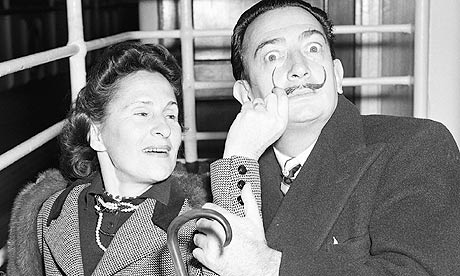
Salvador Dali and his wife, Gala, photographed in 1954. Photo: Bettmann/Corbis
Spanish police are seeking the owner of a £1.1m bronze elephant, possibly sculpted by Salvador Dalí, that was stolen with a major haul of work purportedly created by the mustachioed master of the so-called paranoid-critical method.
The three-metre-high elephant was impounded with 81 works that had been on display at a hotel in the southern Costa del Sol region. It was not clear whether the pieces were stolen, genuine or fakes.
The works, which included sculpture, bas reliefs, lithographs, textiles, furniture and cutlery had been transported to the hotel in Estepona from France and were due to be auctioned there. The asking price for the elephant sculpture, believed to be a work known as the Space Elephant, was €1.2m (£1.1m) .
Police said they were investigating reports from around the world that up to a dozen pieces similar to those on display had been stolen. The robberies had been reported in the United States, France, Belgium and Spain. An unidentified Frenchman was arrested and charged with fraud and faking documents, they said.
Still Publishing
Books Unbound
Here’s a literary parable for the 21st century. Lisa Genova, 38, was a health-care-industry consultant in Belmont, Mass., who wanted to be a novelist, but she couldn’t get her book published for love or money. She had a Ph.D. in neuroscience from Harvard, but she couldn’t get an agent. “I did what you’re supposed to do,” she says. “I queried literary agents. I went to writers’ conferences and tried to network. I e-mailed editors. Nobody wanted it.” So Genova paid $450 to a company called iUniverse and published her book, Still Alice, herself.
 That was in 2007. By 2008 people were reading Still Alice. Not a lot of people, but a few, and those few were liking it. Genova wound up getting an agent after all–and an offer from Simon & Schuster of just over half a million dollars. Borders and Target chose it for their book clubs. Barnes & Noble made it a Discover pick. On Jan. 25, Still Alice will make its debut on the New York Times best-seller list at No. 5. “So this is extreme to extreme, right?” Genova says. “This time last year, I was selling the book out of the trunk of my car.” (See the top 10 non-fiction books of 2008.)
Something has changed, and it’s not just the contents of Lisa Genova’s trunk. We think of the novel as a transcendent, timeless thing, but it was shaped by the forces of money and technology just as much as by creative genius. Passing over a few classical and Far Eastern entries, the novel in its modern form really got rolling only in the early 18th century. This wasn’t an accident, and it didn’t happen because a bunch of writers like Defoe and Richardson and Fielding suddenly decided we should be reading long books about imaginary people. It happened as a result of an unprecedented configuration of financial and technological circumstances.
