
Breast-feeding Brand Baby

Tom Waits: Life On Mars sucks.
Tom Waits Denies ‘Life on Mars’ Song, Says Show Sucks
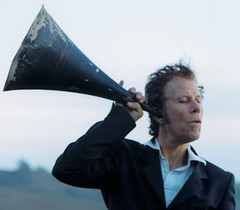 ABC’s time-travel cop drama Life on Mars was canned after only one season, so now the show’s producers, Josh Appelbaum and Scott Rosenberg, are free to share all the behind the scenes dirt. When asked by TVGuide.com if there were any songs that they couldn’t get on their show despite all efforts, theLife on Mars producers had this interesting exchange about Tom Waits:
Appelbaum: We write every song into the script, not after the fact, because the music is so important. And only one person denied us.
Rosenberg: Because he thought the show sucked. [Laughs]
Appelbaum: It was Episode 6, and Sam describes when he met Maya (played by Lisa Bonet) for the first time. He flashes back to the scene and “Tom Traubert’s Blues” is playing. It was so good. Tom Waits approves all of his licensing, and he sent an email saying he thought the show was [bad]. It was pretty funny.
Tom Waits once said, “I’d rather have a hot lead enema” than license a song for a commercial.
Flut Twitter!
Ungentlemanly Officiating
Footballer given yellow card ‘for breaking wind’ during penalty shot
Referee books Chorlton Villa player for distracting rival with ‘ungentlemanly conduct’ at key moment in match
The drive to bring good manners back to football has reached new heights after a referee issued a yellow card to a player for “breaking wind” as a penalty was being taken.
 The official deemed the act “ungentlemanly conduct” and booked the player responsible. However Chorlton Villa, who conceded a goal on the second take, went on to win the match 6-4 against local rivals International Manchester FC at Turn Moss in Stretford, Manchester, last Sunday.
Ian Treadwell, manager of Chorlton Villa for the past eight years, said his team had learnt lessons from the game in which three players were dismissed and two were booked.
“The other player had the penalty saved because it was a bad penalty it was nothing to do with any noise. Not one of their team remonstrated with the referee when the first penalty was taken.
Robert Delford Brown Gone
Robert Delford Brown, ‘Happenings’ Artist, Dies at 78
Robert Delford Brown, a painter, sculptor, performance artist and avant-garde philosopher whose exuberantly provocative works challenged orthodoxies of both the art world and the world at large, usually with a big wink, was found dead on March 24 in the Cape Fear River in Wilmington, N.C.
 The death has been ruled accidental, Deputy Sheriff Charles Smith of the New Hanover County Sheriff’s office in North Carolina said. The cause appeared to be drowning. Mr. Brown was last seen on March 20, said his stepdaughter, Carol Cone. Mr. Brown, who had had hip surgery and walked with a cane, was known to have been scouting locations for an art project in the river involving a number of rafts, and he is thought to have fallen in.
A colleague of artists like Jim Dine, Claes Oldenburg and Nam June Paik, Mr. Brown was a central figure in the anarchic New York art scene of the early 1960s, a participant in — and instigator of — events-as-art known as “happenings.” He saw the potential for aesthetic pronouncement in virtually everything. His métier was willful preposterousness, and his work contained both anger and insouciance.
His raw materials included buildings, pornographic photos and even meat carcasses.
He often performed in the persona of a religious leader, but dressed in a clown suit with a red nose and antennas hung with ripe bananas. In the end his message to the world was that both spirited individualism and unimpeded creativity must triumph.
One happening, a 1964 performance of a musical theater piece by Karlheinz Stockhausen called “Originale,” included, according to Time magazine, “two white hens, a chimpanzee, six fish floating in two bowls suspended from the ceiling, a shapely model stripping to her black lace panties and bra, and a young man who squirted himself all over with shaving lather and then jumped into a tub of water.”
Back into the Frey
Back into the Frey
James Frey’s first memoir of recovery from addiction to drugs and alcohol was lauded before he was forced to admit there were fabrications, prompting uproar. But Frey is back and unrepentant, Emily Hourican finds and defying the media by lifting the lid on LA in his novel, Bright Shiny Morning
Sunday April 05 2009
Having heard author James Frey on radio, I know he is in combatative form over the controversy that surrounded his first book, A Million Little Pieces.
 “Only 15 pages of a 450-page book contained disputed information,” he told his interviewer sternly, so I’m not surprised when he insists to me that the entire episode was “not a big deal. I don’t think people have a problem with it, I think the media has a problem with it.” Later, he will tell me why, indeed, it was all a good thing, and how it made his brand new novel, Bright Shiny Morning, possible.
A Million Little Pieces, the story of Frey’s slow crawl back from the shattered depths of drug and alcohol addiction, was pitched as a memoir, and at first loved and lauded by everyone from Bret Easton Ellis to Gus Van Sant; even chosen by Oprah for her hugely influential book club. Naturally, it then went to number one in the New York Times Bestseller list, where it stayed for 15 weeks. As a writer, Frey had made it, and then some. But then an investigative website, The Smoking Gun, lashed out with claims that much of the book was false. And the good times began to fall apart.
Frey was invited back onto Oprah’s show, where she laid into him, ultimately forcing a confession that there were some fabrications. He was promptly dropped by his agent, and his American publishers offered a refund to readers who felt defrauded by the experience. Later editions carried a Note to the Reader, in which Frey apologises to those “disappointed by my actions”.
It was, depending on your point of view, an outrageous literary fraud, justly brought to book, or a massive storm in a teacup. And Frey is refusing to play the role of contrite sinner any longer. “The public face I showed at the time was more contrite than I really felt,” he tells me over Diet Coke in the Merrion Hotel.
“Absolutely. Some of the disclaimers placed in the books were placed for legal reasons, not because I felt some great need to do it. And they’re all coming out. They’re already out of the British edition of the book.” Not that it didn’t hurt, plenty, at the time.
“I had much more anger than I’m expressing to you, I had a bigger chip on my shoulder than I’m going to tell you.” But despite the humiliation, his self-belief, “at least my belief in my ability to write” never wavered. By so vigorously championing his own cause, he makes it look, rightly or wrongly, as though he is ranged on the side of freedom, the imagination, a certain largeness of vision, against the po-faced, reductionist, letter-of-the-law-abiding forces of puritanism. Under the circumstances, that’s quite a coup to pull off.
This bravado is what spurred him on to write his latest book, and first novel, Bright Shiny Morning, a sparky, sprawling homage to Los Angeles, written at a time when his career looked to be all washed up; he had no agent, no US publisher and for many, the status of Public Enemy Number One.
“I wrote it with a chip on my shoulder. I believed I had more to say. And I did set out to prove something, I did set out to show I wasn’t broken, I wasn’t changed, I wasn’t repentant, I wasn’t apologetic and I wasn’t going to back down or stop. I was going to say, OK, here I am again.” And here indeed he is. Bright Shiny Morning starts with the telling epigraph “Nothing in this book should be considered accurate or reliable.”
It’s another gauntlet thrown down, an in-joke for the initiated, and two fingers to the media. The book covers huge ground, historically, geographically and emotionally; with a large cast of characters, great chunks of facts — “the average citizen of Los Angeles consumes 250 tacos a year,” of which at least a third are, according to Frey, made up — and a potted history of LA, much of which is also invented, all running side-by-side.
“I always wanted to write a book about LA. LA is one of the great cities of the world and most of the rest of the great cities of the world have been written about — Joyce wrote about Dublin; Hugo, Paris; Dickens, London; Tolstoy, Moscow.” False modesty about the kind of literary company he aspires to keep is not Frey’s thing. “No one had ever taken LA on in a serious way. I wanted to do it. Because of the way the city is, I thought you couldn’t take a single narrative. It’s too big, too disconnected. So there are hundreds of parts that could stand alone, unto themselves, but can also function as something bigger.”
The city is very much the central character of the book, arching over everything, a muse unto itself. And of course, because this is LA, the entertainment industry features heavily, as a beacon of light visible for thousands of miles around, drawing the 100,000 hopefuls who arrive each year, then churning their dreams into dust.
Frey, who is from Cleveland, Ohio, moved to LA when he was 25, and was, briefly, until he thought better of it, almost one of the success stories. He wrote a couple of screenplays for films that got made, and even directed one, and so his insights into that business, though hard-boiled, count.
“I don’t try to be cynical about it I just try to present it as it is. A lot of people move out there because they love movies and they think people are going to embrace them. But it’s the film “business”, and when you’re out there trying to break into it, people will size you up and if they think they can make money off of you, you’ll work, and if they don’t, you won’t. It’s as simple as that.”
Would he like Bright Shiny Morning to be read as a cautionary tale by those naive enough to head for the bright lights with no plan other than ambition? “Yeah, for sure. I think people should know you can move to Los Angeles and your dreams can come true, you can become a worldwide superstar, but the chances are much greater that you will move there and fail, and become something that you don’t want to become.”
Despite a very privileged upbringing — Frey’s father was a successful businessman — he has a fascination for life’s seedy, even sordid, edges, the marginalised world of addicts, hookers, pimps and hustlers. “I know that, growing up, the books I loved were a lot about those things — Henry Miller, Charles Bukowski, Baudelaire, Rimbaud; you seek out experience. You can’t seek out experience in a bubble of privilege.” This of course is the double-edged sword of affluence for an artist; “I grew up in an upper-middle class American household; I definitely have benefited from my father’s success, but in my life as a writer, I haven’t benefited in any way.”
Towards his own addictions, to alcohol and drugs, Frey shows the same kind of machismo that characterised his attitude to Oprah (of whom he says, “I don’t care what Oprah was. I don’t base my self-worth on the opinion of a TV talkshow host”). He has consistently refused the support of a 12-step programme.
“I just don’t drink, don’t use drugs, I don’t see any positive reason to, they’re not going to do anything but f*** my life up. That’s not to say I don’t sometimes have urges to drink and use drugs, but I know nothing good will come of it. It depends on the day; some days it’s not hard, some days it is. It’s like anything, you get better at it, you get more practised. I am accepting of my situation, which is that the shit will f*** me up if I do it, and so I can’t, and I don’t judge other people for doing it.”
It’s tough talk, but backed by 15 years of sobriety and therefore convincing. During that time he has moved to New York, at the insistence of his wife (“I have a policy in my marriage which is ‘just say yes!”), had two children, aged four and two, and made enough money to indulge his passion for art — on the walls of his apartment are works by Picasso, Matisse and Francis Bacon. It’s been a productive sobriety.
Bright Shiny Morning is open-ended in its conclusions, dispassionate in its presentation of LA and the lives of its protagonists. Deliberately so. “I tried to write from a distance and let the reader decide how they feel about it,” says Frey. “I give the reader a lot of credit, I believe they’re smart, cool, interesting people who want to be presented with challenging material.” This belief has been borne in on him, and is confirmed, by the reaction to A Million Little Pieces. He has received tens of thousands of emails from readers who loved and were greatly moved by the book. Only one in every couple of hundred, he claims, was not supportive. It’s a continuing reaction that reinforces his relief at the dramatic turn his career took. Because yes, Frey has convinced himself that the Smoking Gun exposure was a good thing.
“A lot of good came out of it. I wasn’t comfortable with the way things were. I didn’t like being placed on this pedestal. This work of what I considered literature got taken out of that and placed into this self-help context which it was actually designed to insult. I didn’t want to be that person. I’m a writer, I’m not Wayne Dyer or Deepak Chopra. The controversy pushed it back into the place it belonged, pushed me back into the place I belong, with literary writers.”
In an odd kind of way, Bright Shiny Morning has to both live down the controversy of A Million Little Pieces, as well as live up to the rave reviews it got, even after the exposure. Does he not worry that no other book he writes will quite escape the shadow of his first? “At a certain point, I just don’t think I’ll talk about any more. I’ll talk about it now because it’s the first book after that happened, but if I write books that matter, the more of them I write, the further away from that I get, the less it all matters. If that continues to happen, it will make the controversy not relevant.”
And so he neatly draws a line under the experiences of the last few years. Now, it’s about the future, and the future, to Frey, looks shiny and bright. “When Time magazine wrote their review of Bright Shiny Morning, the headline was “America’s Most Notorious Author Returns”. When I read that I though, f*** yeah, that’s where I always wanted to be. I didn’t get there the way I expected to, it was a little harder and more uncomfortable than I wanted it to be, but that’s where I am, that’s where I’m happy. And that’s where I’m going to stay.”
Bright Shiny Morning is out in paperback; John Murray, £7.99
– Emily Hourican
QT Returning
Quentin Tarantino makes Cannes comeback
Hollywood’s most controversial director hopes to reignite his career through a return to the famous festival with Nazi epic starring Brad Pitt
Quentin Tarantino is to return to the film festival that made his name with a movie that is certain to be the most controversial of his career.

Next month, the brilliant and outrageous director will arrive in Cannes, where his 1994 film Pulp Fiction was such a hit, to relaunch a career that, by his high standards, has been in the doldrums.
The work he is taking to the world’s premier film festival is an ultra-violent take on the second world war and that most sacred of Hollywood movie subjects, the Holocaust.
The news that Tarantino was bringing his film, with the deliberately misspelt title Inglourious Basterds, set the movie world alight with speculation that Tarantino and his star, Brad Pitt, will dominate Cannes this year.
It is certainly a place where Tarantino has always felt at home. Pulp Fiction won the festival’s highest honour, the Palme d’Or, 15 years ago, catapulting the already controversial director of cult hit Reservoir Dogs to worldwide fame and acclaim. Since then he has served as president of the festival’s jury and also shown several other films there.
Pitt…, playing the leader of a group of Jewish American soldiers recruited to hunt down and kill Nazis in the most dramatic and brutal ways possible, inspiring panic in the Third Reich. In a trailer, Pitt’s character gives his squad a pre-mission pep talk: “We’re going to be doing one thing and one thing only: killing Nazis!” If the rest of the trailer – blood spattering on walls and violent shoot-outs – is anything to go by, Pitt’s men deliver.
A teenage boy walking in the woods of Bruckberg, Bavaria…

Future Inductee To The Financial Hall Of Fame
Duff McKagan Restarts Loaded, Says U.S. Economy ‘Will Recover’
April 03, 2009 10:33 AM ET
Duff McKagan wants to be of service with more than his music these days.
The Guns N’ Roses and Velvet Revolver bassist, who’s now back to fronting his other band, Duff McKagan’s Loaded, is also busy these days writing a weekly financial column Duffnomics, for Playboy.com. He’s qualified — McKagan holds a finance degree from Seattle University — and McKagan tells Billboard.com that he wants to take economics and finances “back to basics” to help his readers understand what’s going on in this current state of crisis.
|


Run Hits The Hall
Run-DMC, Metallica in Rock Hall of Fame
CLEVELAND — Metallica shoved the mosh pit into the Rock and Roll Hall of Fame.
 Heavy metal’s heaviest hitters, whose menacing, monstrous sound has banged heads around the globe for decades, were inducted into rock’s shrine on Saturday night, capping a star-studded ceremony that felt much more like a concert than an awards show.
Many came to pay homage to Metallica, which earned top billing in an eclectic 2009 class that included rap pioneers Run-DMC, virtuoso guitarist Jeff Beck, soul singer Bobby Womack and rhythm and blues vocal group Little Anthony and the Imperials.
Metallica’s members have survived some of the dark themes — death, destruction and desolation — that threads through its music, and their induction was a chance to celebrate their legacy as perhaps the hardest band to ever walk the earth. The event also served as a reunion as bassist Jason Newsted, who left the group in 2001, joined his former bandmates on stage for seering versions of “Master of Puppets” and “Enter Sandman.”
“Whatever the intangibles elements are that make a band the best, Metallica has them,” said Red Hot Chili Peppers bassist Flea, who delivered a heartfelt speech in presenting the band. He recalled being on tour and hearing Metallica on the radio for the first time.
“My mind was blown. It wasn’t punk rock. It wasn’t heavy metal. It just stood by itself,” he said. “I didn’t know what it was, but I knew it was a mighty thing.”
With two turntables and a microphone, Run-DMC broke down the barriers between rock and rap. With sparse, stripped-down lyrics above pounding beats, the trio of Joseph “DJ Run” Simmons, Darryl “D.M.C.” McDaniels and Jason “Jam Master Jay” Mizell changed rap in the 1980s by taking the realities of the streets to the suburbs.
“They broke away from the pack by being the pack,” said rapper Eminem, looking like the band’s lost member by sporting the group’s trademark black fedora and black leather jacket. “They were the baddest of the bad and the coolest of the cool. Run-DMC changed my life.”
“There’s three of them and if you grew up with hip hop like I did, they were the Beatles.”
Their remake and collaboration with Aerosmith on the rock band’s “Walk This Way” changed modern music.
Noodles & Nothing To Worry About
Part Woman, Part Fish
Sara Campbell, ‘part woman, part fish’, regains freediving record
 A British woman pushed the boundaries of human endurance to new levels yesterday as she dived 96 metres (314ft) below the surface of the Atlantic and back again on a single, very deep, breath.
Sara Campbell — “part woman, part fish” — broke the world record in the extreme sport of freediving, whose participants dice with death by submerging themselves to lung-crushing depths without breathing apparatus.
Holding her breath for three minutes 36 seconds, she went deeper than any female freediver has gone before without weights or equipment to hasten her descent, or an airbag to speed her back to the surface.
“The dive felt great and I’m just feeling fantastic,” she said last night. “At one point I started feeling negative thoughts — ‘Do I really want to do this?’ — but then I told myself not to be ridiculous, just get it done, go for the bottom.
“For me, that’s really what the personal battle was all about — fighting my demons and overcoming my doubts.”
Crazy Tree Climbing
Oils For Smack
Stolen Artwork Recovered In New Haven

From left, New Haven Police Sgt. Stephen Shea, Assistant Police Chief Peter Reichard, lead detective Scott Branfuhr and Matthew Prinz were on hand to answer questions about the recovered artworks. Three of the pieces — items No. 10, 12 and 14 — belonged to David Gelernter, the Yale professor who was a victim of the Unabomber, police said. Police said they seized 39 pieces of stolen art and six firearms. (RICHARD MESSINA / HARTFORD COURANT / March 23, 2009)
NEW HAVEN — – The paintings, photos and prints arrived one or two at a time at the brick home on Sylvan Avenue.
The man who brought them allegedly stole them from places around New Haven, including the city’s public library and the Joseph Slifka Center for Jewish Life at Yale University. Inside the second-floor apartment at 24 Sylvan Ave., the 53-year-old man would trade the pieces for $30 to $40 worth of heroin, police said.
Two of the three paintings stolen from the Slifka Center were by David Gelernter, a Yale computer science professor who was seriously wounded by the Unabomber. The third was by Gelernter’s son Daniel. Together, police said Monday, the paintings are valued at $40,000.
The man also allegedly took prints from the New Haven Public Library on March 5, including one called “Elm City” by Tony Falcone. Those pieces were valued at $6,000, police said.
Police raided [an] apartment at 12:30 a.m. Saturday and found Bruno Nestir, 47, as well as 39 paintings, photos and prints, two shotguns, two rifles, two revolvers, $987 in cash, and heroin and marijuana packaged for sale. Nestir was held on drug charges and possession of stolen property. Police are now working on an arrest warrant for the man they say stole the paintings.
“Mayonnaise, poodle hair, broken zippers.”
The Critic’s Critic
By Sparrow
I spoke to Arnold J. Foley, freelance art critic, in a Nigerian tea bar in Astoria, Queens.

Sparrow: What are the main problems in the contemporary art world?
Mr. Foley: To begin with, the art world in New York is entirely segregated by neighborhood. All the paintings in the Upper East Side galleries must be attractive hanging over a sofa.
I don’t care if they’re by Picasso, they have to be “sofa-ready” (that’s the term I use). The art in Chelsea must impress an art professor; in fact, it has impressed an art professor. The art on the Lower East Side is scruffy—not really scruffy, but faux-scruffy. The art in Williamsburg is made out of non-art stuff: mayonnaise, poodle hair, broken zippers.
Sparrow: And which is your favorite art?
Mr. Foley: It’s not a matter of favorites. My point is just the opposite. All segregation is evil, even in art. We need the sofa-ready paintings to speak to the poodle hair sculptures, but they never do! In fact, the two genres need to mate.
Sparrow: Do you have any other complaints about the art world?
Mr. Foley: Another philosophical problem is “outsider art.” No one can settle on a name for it. Some prefer “vernacular art”; some go for “self-taught art.” Or “folk art.” I like to call it True Art.
Longest Running Scripted Series Ever Cancelled
CBS Turns Out ‘Guiding Light’
CBS announced Wednesday the cancellation of the longest-running scripted program in broadcasting history, the soap opera “Guiding Light.”
 The show has been on radio and television for 72 years, beginning on NBC radio in 1937 and moving to CBS television in 1952.
The move came after many years of steeply declining ratings for the hourlong soap, which is owned by Procter & Gamble and thus was a link to the earliest days of daytime serial dramas on radio. The shows were eventually called soap operas because soap companies sponsored them.
A spokeswoman for P.&G., Jeannie Tharrington, said the company would seek to place “Guiding Light” elsewhere. “We’re looking at all our options,” she said. “This show started as a 15-minute radio show, and then it was a half-hour television show, so it has adapted over the years.”
None of the producers or stars of “Guiding Light” would grant an interview Wednesday about the decision. “The news is too fresh,” Ms. Tharrington said.
The show also provided breakthroughs for many well-known actors, including Kevin Bacon, James Earl Jones, Calista Flockhart, Allison Janney and Cicely Tyson. “Guiding Light” claims the distinction of being the first network soap to introduce regular African-American characters, in 1966.
“You will see it – but your kids won’t” (Yeah right – maybe your kids, Missy!)
… από την πανέμορφη κι ελεύθερη Μαρία-Χριστίνα!!!
Author seeks more controversy

Author seeks more controversy
Few novelists have whipped up quite so much of a storm in modern times as James Frey.
A Million Little Piecesturned out to be a work of fiction – is attempting to enlist two of the British cultural scene’s leading controversialists.
“I’m going to try and get Banksy or Damien Hirst to do the cover for my next book because I know what I want it to be,” he tells Pandora. “If I can get one of those guys to do it, it would be amazing.”
The Final Testament of the Bible, which Frey describes as a “reaction to the religious fundamentalism we’re seeing all over the world.”
Sounds right up Hirst’s street.
Use #47,912 For Post-it Notes

Superstition Dissected
from NoiseAddicts via The Daily Swarm
STEVIE WONDER’S ‘SUPERSTITION’ CLAVINET PARTS REVEALED…
THE DAILY SWARM | READ FULL STORY >
via Noise Addicts
It’s of course the signature Clavinet part that just oozes the funk – In fact it was Superstition that really put the Hohner Clavinet on the map in funk/soul music. A lot of keyboard players instantly tried to cop the part, but it seemed impossible to play. Even Stevie himself never really played it properly when he played live.
An engineer has acquired the master recordings and has dissected Stevie Wonder’s multitrack masters of the song. Through the use of Protools, he was able to isolate all the tracks to get a listen to the infamous Clavinet parts. Ready for this? … In reality, it’s actually 8 Clavinet parts!
[ from NoiseAddicts via The Daily Swarm ]
Jack Johnson’s Way-too Posthumous Pardon
McCain seeks pardon for boxer Jack Johnson
WASHINGTON – Sen. John McCain wants a presidential pardon for Jack Johnson, who became the nation’s first black heavyweight boxing champion 100 years before Barack Obama became its first black president.
 McCain feels Johnson was wronged by a 1913 conviction of violating the Mann Act by having a consensual relationship with a white woman – a conviction widely seen as racially motivated.
Johnson won the world heavyweight title on Dec. 26, 1908, after police in Australia stopped his 14-round match against the severely battered Canadian world champion, Tommy Burns. That led to a search for a “Great White Hope” who could beat Johnson. Two years later, the American world titleholder Johnson had tried for years to fight, Jim Jeffries, came out of retirement but lost in a match called “The Battle of the Century,” resulting in deadly riots.
Authorities first targeted Johnson’s relationship with a white woman who later became his wife, then found another white woman to testify against him. Johnson fled the country after his conviction, but agreed years later to return and serve a 10-month jail sentence. He tried to renew his boxing career after leaving prison, but failed to regain his title. He died in a car crash in 1946 at age 68.
“When we couldn’t beat him in the ring, the white power establishment decided to beat him in the courts,” Burns told the AP in a telephone interview. Burns’ 2005 documentary, “Unforgivable Blackness: The Rise and Fall of Jack Johnson,” examined Johnson’s case and the sentencing judge’s admitted desire to “send a message” to black men about relationships with white women.
Why Spock Never Got A Real Date

Leonard Nimoy gives Farrah Fawcett direction on the set of a romantic comedy in 1990.
Credits: Corkery/News
Published: 03/31/2009 10:14:58
Maurice Jarre Gone
Maurice Jarre
Without Maurice Jarre, who died last week at 84, who would David Lean’s Lawrence of Arabia be? Peter O’Toole’s deliquescent eyes, shimmering in the desert light, would have been little more than a silent mirage. Jarre’s 1962 film score, which won an Academy Award, is a reminder that in the movies there is no character and no landscape unless there is a musical soundscape too.
 Maurice Jarre gave many of us a notion of the scale on which our personal life theme music might be written. People often notice the nostalgic quality of scent, the way a familiar smell can instantly carry you backward in time. The same is true of music.
A few bars of the theme from “The Longest Day” — astonishingly upright and Anglo-American for a French composer — and I am somewhere back in 1962, when I first saw the movie — and even further back in 1945. I understood, of course, that there was no harmony in the real sounds of D-Day. But Jarre’s score made the horrors and the heroism of that day palpably real for me.
To me, the indelible sign of Jarre’s power is the score for “Doctor Zhivago,” which was released in December 1965. Let me put my 1965 in perspective. The Beatles album “Help” came out in August, and “Rubber Soul” came out a couple of weeks before “Zhivago….”
“Pops, it doesn’t look like I can go straight after all.”
thanks to B. Dickinson
Cocks and Balls Fallling Out Of Favor
Rudest names from the Middle Ages are dying from embarrassment
They are some of the oldest surnames in the land, passed down from generation to generation for hundreds of years. But over the past century or so, they have gone into a catastrophic decline.
 Is it migration? Death? Disease? Some socio-demographic calamity that has befallen these families? Perhaps not. A list of the names reveals that their fall in popularity may have a more prosaic cause.
Cock, Daft, Death, Smellie, not to mention Gotobed, Shufflebottom and Jelly: they are all surnames that would have caused their owners considerable embarrassment over the years. A new analysis of British surnames reveals how names with rude overtones have seen the sharpest decline over the past 120 years as their owners have changed them to something more innocuous.
A comparison of the 2008 population — using data from a variety of sources — with the first census in 1881 shows that the number of Cocks has shrunk by 75 per cent, while the number of people called Balls or Daft has fallen by more than 50 per cent.
It’s About The Art Not The Macho Macho
Teen tagging freeway median dead after being run over by several vehicles
Posted: 03/29/2009 05:41:58 PM PDT
RUBIDOUX, Calif. — A teenager seen tagging the center divider of a freeway in Rubidoux was killed after being hit by a car and run over by several other vehicles.
The California Highway Patrol says 17-year-old Blake Locko of Riverside was pronounced dead at the scene on Highway 60 early Saturday. Locko and another person were standing in the westbound carpool lane when he was struck by a Saturn sedan, flew over the divider into the eastbound carpool lane where he was hit by several vehicles.
The driver of the Saturn was taken to a hospital with moderate neck injuries.
Ay, Mates – Cane Toads Are People, Too.
Amphibious warfare: Australians offered prizes in cane toad cull
Pests threaten native species, say Queensland authorities
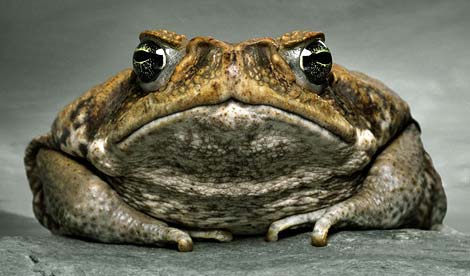
The cane toad has become one of the most hated pests in Australia. Photograph: Bob Elsdale/Getty Images
Introduced as part of a misguided attempt to control beetle infestation, the poisonous cane toad quickly supplanted its intended prey as one of the most destructive and hated creatures in Australia.
Now Queensland authorities believe the collective loathing in which they are held will galvanise residents into taking part in a mass cull on Saturday night.
Townsville council wants people to track down and bag up the toads, which breed rapidly, eat voraciously and kill most animals that dare to eat them.
The live animals should then be taken to a collection point the following day where they will be weighed and either frozen or gassed to death, with the carcasses turned into fertiliser.
Only unharmed animals will be accepted according to the rules of theToad Day Out event.
Toad Day Out organisers are offering prizes for people with the biggest toad and the highest total weight of toads. Goodies range from cane toad trophies – made of stuffed cane toads – to a gift certificate for a local resort.
Aware that an annual event may not be enough to satisfy local population control demands, the council offers advice on how to freeze the animals to death at home.
The Royal Society for the Prevention of Cruelty to Animals has applauded the effort – with one caveat. “We’re only supportive of the plan if the toads are killed humanely – in other words, they’re not hit with baseball bats or cricket bats and golf clubs,” said spokesman Michael Beatty.
Sweet Sober Winehouse @ 17
There Is Always Reason Somewhere
Natasha Richardson’s Story Saves Girl’s Life
By Ken Lee
Natasha Richardson’s after a skiing accident has spawned at least one happy ending: It inadvertently saved the life of a little girl.
 After 7-year-old Morgan McCracken of Mentor, Ohio, had been accidentally hit in the head by a baseball last week, she seemed fine for the following two days. “She had no symptoms,” her father Donald . “She went to school both days and got an A on her spelling test as usual. There were no issues whatsoever.”
But after he and wife Connie heard about Natasha Richardson’s tragedy on the news, they realized their daughter could be in grave danger. “Because of Natasha, we called the pediatrician immediately,” Donald said. “And by the time I got off the phone with him, Morgan was sobbing, her head hurt so much.”
After Morgan was helicoptered to a children’s hospital in Cleveland, the chief of pediatric neurosurgery, Dr. Alan Cohen, informed the McCrackens their daughter had the same injury that killed Richardson: an epidural hematoma.
“My heart sank. It just sank,” Donald says.
But now, after undergoing surgery and remaining hospitalized for five days, little Morgan is back home and doing just fine. “Dr. Cohen told us that if we hadn’t brought her in Thursday night, she never would have woken up,” says Donald.
Memoir as fact – or fiction
Memoir as fact – or fiction
Thu, Mar 19, 2009
James Frey acquired an unenviable literary infamy when large parts of his bestselling memoir were revealed to be fiction. He talks to Fiona McCann about resurrecting his career
 SO THIS IS the US’s most notorious writer? The man who “duped” Oprah, who, in her words, “betrayed millions of readers”? The man whose author pictures on the press release for his new book display him bare-chested and tattooed, proudly hoisting two middle fingers to the world? Can this man drinking iced water in the drawing room of Dublin’s Merrion Hotel, dressed in a buttoned-down shirt, beige pants and spotless white Adidas runners, truly be the bad boy of the American book world?
James Frey in person – quietly spoken, with a hint of a lisp – does not immediately fit my preconceptions of the author of A Million Tiny Pieces , a memoir about his recovery from addiction which was given the Oprah Winfrey imprimatur for inclusion in her lucrative book club. When the news emerged that Frey had exaggerated some events in the book and invented others, the chat-show queen requested an appearance on her show, where she dressed him down in front of millions of viewers. Soon after his public castigation, his literary manager dropped him, and his publishers pulled out of an agreed book deal.
Frey, who by that time had already published the follow-up, My Friend Leonard , and sold millions of books, was suddenly persona non grata. So what did he do? He wrote another book, one he describes as a “love letter” to Los Angeles, called Bright Shiny Morning . And just in case we were in any doubt, the first page elucidates that: “Nothing in this book should be considered accurate or reliable.”
He may appear diffident, initially, almost demure, but Frey is at pains to point out that this opening line is where “I lift my middle fingers to all my detractors and I say ‘come kiss my ass, boy’ ”.
The bad boy is back, with a book he says is “about what the American dream is in the 21st century”, a dream represented by Los Angeles itself, Bright Shiny Morning’s protagonist. Chasing, and in some cases living, this dream are two small-town kids looking for a new start, a homeless drunk with a conscience, the daughter of immigrant Mexicans working her way through college as a maid, and a successful film star with a secret. As characters, they’ve been decried as cliches, although, according to Frey, it all depends on their treatment.
“These are recognisable archetypes of the city, but nobody’s ever told the story of them, nobody’s every really taken them seriously,” he says. “I try to take them seriously, not treat them as cliches but as people who have stories and who have lives, and whose stories mean something.”
Their stories are spliced with the history, geography and vital statistics of the city they inhabit, along with lists of gang names, natural disasters and “fun facts” about LA, not all of which, it turns out, are facts at all.
“Some of them actually are fiction,” admits Frey. “Some of the history is just made up, and some of the statistics are just made up.”
Lies, damn lies indeed, yet observing the rules of one genre or another isn’t something that concerns this writer. “What matters is the story that’s being told,” he says with growing animation. “What matters is ‘Do I entertain a reader? Do I inform them? Do I change them in some way?’ ”
WHATEVER HE IS doing with Bright Shiny Morning has had critics at loggerheads, with reviews either unrestrainedly effusive or excoriating. Which is fine by Frey.
“What I’m not going to be cool with is if somebody reads one of my books and just says, ‘Meh, it’s okay’.” he says. “I want a strong reaction one way or another. If I can invoke great feeling, whether it’s positive or negative, then that’s good. That’s what art should do.”
And Frey is making art, as he sees it; not memoir, not fiction, but literature. “I don’t care about the labels. I write books, I tell stories,” he says. “I aspire to create literature, so, if anything, is a work of literature.”
Though he himself may categorise his output as literature, it has not always been received as such, to Frey’s evident delight. “Most of the writers I love weren’t embraced by the American literary establishment,” he says, naming Henry Miller, Jack Kerouac and Charles Bukowski among them. “They weren’t part of the high-minded literati, and I’m definitely not, and I’m perfectly comfortable living and working outside of it.”
Frey places himself within the tradition of such celebrated writers without a trace of self- consciousness. Undeterred by the fact that he is a rich thirtysomething with a wife, two kids and a “very normal life in New York city”, he clearly revels in the notion of his own notoriety.
“I’m comfortable in that space. If you look at the writers I love, all of them were considered during their lifetimes, while they were working. And I wanted to work within that tradition, so that’s the place I am. I’m happy there.”
It smacks of hubris, and he knows it. “People say I’m cocky,” he admits. “I don’t feel like I’m cocky, I don’t feel like I’m arrogant.” Even though he has just dropped his own name in a sentence with Bukowski, Baudelaire and Joyce? “I don’t say I’m Henry Miller or James Joyce or Norman Mailer,” he clarifies. “I say I’m busting my ass and working really hard to try to achieve what they achieved. We’ll see if I do it. We’ll see. I believe I can.”
No sign of doubt there, but plenty of defiance. “I’ve had a lot of bad times in my life, and I’ve survived them all. I’ve had hideous times personally, I’ve had hideous times professionally, and I’m still here, I’m still standing.”
Frey is clearly proud of how he has not only beaten his addictions and pieced his personal life back together, but taken on the queen of the American small screen and lived to tell more tales. “I’m still working, I’m still doing what I want, how I want, saying what I want, living how I want, you know. I’m still doing it.”
It’s hard not to admire Frey’s audacity, the cheek and chutzpah that kept him writing after being so publicly cast out. “I wasn’t going to give anybody the satisfaction of letting them think that they’d beaten me. I wasn’t going to give them the satisfaction of letting them think that whatever they had to say about me affected me or stopped me or hurt me. If anything, it was another challenge. It was ‘all right, they think I’m done, it’s time to prove them wrong’.”
It’s a challenge he clearly relishes, and although Frey’s self-championing as a challenger of the system is grating, it’s easy to understand why his ostracisation by the arbiters of bestsellerdom came as a relief.
“I can tell you when all the Oprah stuff was happening, I wasn’t comfortable being placed on this pedestal of ‘Recovery Superman’. I never wanted that,” he says. He has a point. “ A Million Little Pieces was designed to be a gob of spit in the face of the self-help industry. It attacked everything that that industry considers holy. And at a certain point it got co-opted by that and became a part of it, and I was horrified. I wasn’t happy that this work, this book that I considered a work of art, got turned into something it wasn’t. So when the controversy happened, I was happy that, although it was personally difficult to deal with, it placed the book back into the space it belongs in, which is literature, literary art.”
IT’S NOT HARD to imagine how unnerving it must have been to see a work in which he calls himself a criminal repeatedly being embraced by daytime television viewers across the US, yet there is something in Frey that is a little too in love with his banishment from the book clubs of the world.
“I wanted to be a guy who writes books that break boundaries and break rules and go into places that other writers haven’t gone,” he says, reminding me that Time magazine recently referred to him as “America’s most notorious author”. “I saw and I was like, ‘all right, it’s worked out’, ” he says with no small pride.
He may have come out fighting from the Oprah showdown, but he is eager to move beyond it. “I think it was a weird moment in America,” he says. “And I think it will be a part of my life, that chapter, but I don’t think it’s gonna be the only thing.”
Yet if the Oprah incident is truly behind him, how does he explain a passage in Bright Shiny Morning , only included in the paperback edition, where a character goes through a pointedly similar experience? In the pages in question, the character, referred to only in the third person, receives a telephone call from the host of the show in question: “What she told him directly contradicted all of her public statements . . . He taped everything.” It appears to be a blatant reference to his own experiences with Oprah Winfrey, or is Frey back to his old tricks again?
“I’m not going to get into specifics related to me and Oprah that haven’t been made public already,” he says. Frey is suddenly coy, or is this apparent circumspection simply another way of courting controversy? This is, after all, his chance to get a proper dig at the woman who pulled no punches when she had hers. So is he going to tell us the truth behind this particular story? “Not as long as that tape recorder is on.” So I turn it off.
Bright Shiny Morning , by James Frey, is now available in paperback, published by John Murray, £7.99
© 2009 The Irish Times