
Use #2,963 For One’s Makarov
The Batting Stance Guy
Meet Gar Ryness, the Batting Stance Guy

Ann Johansson for The New York Times
Gar Ryness has become a YouTube star for his imitations of major leaguers’ batting stances. Which three players is he imitating? Answers below.
Gar Ryness said he had the least marketable skill in the United States.
So when he and two friends took a hand-held camcorder into the backyard of his Los Angeles home last year, he hardly expected he would soon become a YouTube celebrity known as Batting Stance Guy.
Ryness has a singular talent: an ability to perform comically dead-on impressions of major league baseball hitters upon request. Little Leaguers have been known to try to imitate their favorite ballplayers. Ryness, 35, a married father of two, can do the starting lineups of all 30 teams.
Views of his YouTube videos number more than a million, and he appeared last year on several teams’ pregame shows. Sony also hired him to perform his impressions while wearing movement-tracking electrodes, helping programmers make the company’s MLB 2009: The Show video game look more realistic. Most recently, Ryness has made appearances on MLB Network’s team preview shows, displaying his encyclopedic knowledge of batters past and present. He has archived his body of work on a Web site, battingstanceguy.com.
Ryness never misses a habitual fidget or gesture, like David Wright’s ritual of wedging his bat in his armpit while adjusting his batting gloves. He does iconic stances, positioning his derrière the way Ken Griffey Jr. does before mimicking Griffey’s graceful swing and follow-through. Ryness even does impressions of batters taking pitches, like Derek Jeter’s way of sticking his head out and nearly stepping across home plate as he looks an outside pitch into the catcher’s glove.
1934 BMW R7

Federal Judge Rules It’s Okay For Americans To Play With Model Rockets Again
| APCP not an explosive, rules Judge Reggie B. Walton |
| Industry News by Planet News | |
| MONDAY, MARCH 16, 2009 | |
|
Walton’s order granted a summary judgment motion in favor of the plaintiffs TRA and NAR, denied the summary judgment motion of BATFE, and vacated the classification of Ammonium Perchlorate Composite Propellant (APCP) as an explosive.
[ click to continue reading judicial order at RocketryPlanet.com ] |
 WASHINGTON, District of Columbia USA — District Court Judge Reggie B. Walton for the District of Columbia today issued an order finding in favor of the Tripoli Rocketry Association and National Association of Rocketry vs. The U.S. Bureau of Alcohol, Tobacco, Firearms and Explosives. The decision followed a status hearing this past Friday in Washington.
Derivative Cool on Charcoal Gray

Death Is Punk
This Band Was Punk Before Punk Was Punk
Winooski, Vt.

ON an evening in late February at a club here called the Monkey House, there was a family reunion of sorts. As the band Rough Francis roared through a set of anthemic punk rock, Bobby Hackney leaned against the bar and beamed. Three of his sons — Bobby Jr., Julian and Urian — are in Rough Francis, but his smile wasn’t just about parental pride. It was about authorship too. Most of the songs Rough Francis played were written by Bobby Sr. and his brothers David and Dannis during their days in the mid-1970s as a Detroit power trio called Death.
The group’s music has been almost completely unheard since the band stopped performing more than three decades ago. But after all the years of silence, Death’s moment has finally arrived. It comes, however, nearly a decade too late for its founder and leader, David Hackney, who died of lung cancer in 2000. “David was convinced more than any of us that we were doing something totally revolutionary,” said Bobby Sr., 52.
Forgotten except by the most fervent punk rock record collectors — the band’s self-released 1976 single recently traded hands for the equivalent of $800 — Death would likely have remained lost in obscurity if not for the discovery last year of a 1974 demo tape in Bobby Sr.’s attic. Released last month by Drag City Records as “… For the Whole World to See,” Death’s newly unearthed recordings reveal a remarkable missing link between the high-energy hard rock of Detroit bands like the Stooges and MC5 from the late 1960s and early ’70s and the high-velocity assault of punk from its breakthrough years of 1976 and ’77. Death’s songs “Politicians in My Eyes,” “Keep On Knocking” and “Freakin Out” are scorching blasts of feral ur-punk, making the brothers unwitting artistic kin to their punk-pioneer contemporaries the Ramones, in New York; Rocket From the Tombs, in Cleveland; and the Saints, in Brisbane, Australia. They also preceded Bad Brains, the most celebrated African-American punk band, by almost five years.
Jack White of the White Stripes, who was raised in Detroit, said in an e-mail message: “The first time the stereo played ‘Politicians in My Eyes,’ I couldn’t believe what I was hearing. When I was told the history of the band and what year they recorded this music, it just didn’t make sense. Ahead of punk, and ahead of their time.”
Conjugating Banana
Ron Silver Gone
| RON SILVER DEAD
By DAVID K. LI
“He had been fighting esophageal cancer for two years and his family is making arrangements for a private service.” Friends of Silver first told Post columnist Cindy Adams of the native New Yorker’s death. The steely-eyed, blunt-talking Silver, 62, enjoyed a long career on the stage, TV and in movies, and most recently hosted a public affairs talk show on Sirius satellite radio. Silver might be best known for playing legal scholar Alan Dershowitz in “Reversal of Fortune,” about the successful appeal of Claus von Bulow’s conviction for putting his socialite wife into a permanent coma. |
 “Ron Silver died peacefully in his sleep with his family around him this morning,” said Robin Bronk, executive director of the Creative Coalition, which Silver helped create.
“I’m near an adult bookstore named Cindy’s
from The Tonight Show
James Frey’s BAD IDEA Interview
click to read this interview at BAD IDEA magazine
The BAD IDEA Interview: James Frey
 James Frey, author of A Million Little Pieces,My Friend Leonard and Bright Shiny Morning, is one of the most controversial writers of the noughties…. BAD IDEA caught up with him in Glasgow over the phone, to talk about everything from the nature of memoir to Christian intolerance, Oprah Winfrey to Barack Obama.
BAD IDEA: Since the controversy surrounding A Million Little Pieces, you’ve had a long time to reflect on the nature of memoir. How do you think people perceive it as a genre?
James Frey: Memoir is whatever you want it to be, it’s a book based on your life. Obviously I’m not a guy who believes it should be factually perfect, and frankly I don’t think any of them are. Any book that has a disclaimer in front of it means it’s not factually perfect, it means they made shit up, if they didn’t, they wouldn’t have a disclaimer, and 100% of them have disclaimers.
It also depends on what kind of book you want to write. I don’t think of my books as memoirs – I set out to write works of literature, and the tag “memoir” got slapped on the side of it by the publishers.
I think it depends on what you want to do. If you want to make a perfect history of your life, then make it factually accurate, if you want to tell an entertaining story and you want it to be readable, and you want to take some risks in terms of how it’s written, then just write the book you want to write, and fuck the rest of it.
 BI: Did you find it got co-opted as a self-help book?
JF: I don’t think anyone tried to sell my book as self-help, I wouldn’t have participated in doing that. If anything that book was designed to be a gob of spit in the face of the self-help industry. It counters everything they say, everything they hold holy it basically spits on.
BI: So was that your main impetus for writing, to rail against the self-help industry?
JF: My main impetus for writing was to write a book. I wanted to be a writer, I wanted to create literature. In creating that book, I thought of it in line with [Henry Miller’s]Tropic Of Cancer or [Jack Kerouac’s] On The Road, the work of Charles Bukowski, some of the work of Norman Mailer. I tried to write a book that took radical steps in terms of sentence construction and how pages were laid out, how paragraphs were built, how the story was told. I didn’t care about the factuality of it or not, and later everyone wants to pick it apart, and that’s fine if they do…
I draw parallels with fine art a lot, and when Picasso painted self-portraits in a Cubist style people didn’t freak out and say “My God! It’s not perfect!” When artists take liberties with visual art, people don’t freak out, but people freak out about this. But y’know, I’m happy that my books aren’t considered memoirs any more.
And I thought it was ironic that the media in the US picked my book apart while allowing every politician, including the one currently in office, to lie their fucking asses off pretty much every time they open their mouths.
BI: So do you get riled by other memoirs that haven’t had to print a disclaimer?
JF: Everyone. Every one.
I hate the disclaimer, but the disclaimer’s coming out of all the books. It’s already out of all the European editions, and comes out of the American edition in June.
 BI: After the revelations about the book came out, you appeared on Oprah, and you seemed penitent and apologetic about what happened. Do you still feel sorry for writing in a way that misled people?
JF: No, I’ve never apologised about how I wrote that book and I never will. I made some mistakes in the marketing of it and I said some things on TV talk shows I probably shouldn’t of, and I’ve apologised once, on a talk show. I haven’t apologised since and I won’t. It’s a book – people read it and it moves them and it affects them and it entertains them. Maybe it changes the way they think about books, the way they think about how things can be written, and that’s a good thing, and I don’t really care about the other stuff.
BI: Would you say you’re deliberately working in a grey area between memoir and fiction?
JF: I don’t think memoir and fiction, just in the grey area of what is truth. Something doesn’t have to be factually accurate to be true, and I think especially in America today if you pick up a newspaper and you think that it’s perfectly factually accurate then you’re kidding yourself. And I think so in the UK too, probably – how can you read a newspaper from a conservative point of view and from a liberal point of view, and read stories about the same thing and have them be radically different stories?
Truth is all subjectivity and perspective and I don’t see why people are shocked that that is bled into literature. We watch reality TV, and there’s nothing real about it. You watch a documentary and there isn’t necessarily any factually accurate presentation of anything, it’s a documentarian’s thesis and their effort to prove their thesis.
BI: There are TV shows like The Hills that work in the space between fact and fiction that are feted, and yet your books have got savaged. Do you get exasperated by that?
Yeah I do, I think it’s bullshit a lot of the time. All I can do is keep writing books and do what I do. I don’t talk a lot about A Million Little Pieces when I’m living my day-to-day life and I’ll talk about it this time and probably after this I won’t talk about it any more.
All I care about is that the book is still read, and it is, people still buy it, people still read it, and that’s what matters to me, not what someone on an American TV talk show has to say about me.
 BI: So what are you working on at the moment?
JF: I’m writing another book, my idea of what it would be like if the Messiah was walking the streets of New York City right now.
I’m still playing with the ideas of truth. People spout off about the Bible being true, but the idea that they are is a joke. The idea that these books that were written 40 to 120 years after this guy was alive are somehow perfectly factually accurate, and that tell these fantastical stories – the Earth created in 7 days, Moses parting the sea, I mean there are thousands of examples – are somehow true, to me it’s just laughable. So I’m writing a version of what the Bible would be like if it were written today.
I think if the Messiah were walking the streets right now most Christians would be revolted by him; most of the so called holy people would find him repugnant the way most people found Christ when he was alive. The dude didn’t get strung up on the cross because they loved him. He won’t be crucified [in the book] but he won’t meet a happy ending.
BI: Do you find a lot of hypocrisy in Christianity then?
JF: There are powerful hypocrisies in any major institution whether it’s religious whether it’s the media, whether its political institutions, there’s hypocrisies everywhere in the world. I mean, I’m a hypocrite, you’re a hypocrite, we’re all hypocrites in some way. But I’m going to go after Christian hypocrisy and Christian intolerance.
BI: Do you think there are still things in your own life that you want to write about?
JF: I won’t write anything about me where I’m the protagonist ever again. I’m just not interested in it right now; there are plenty of other things I’m interested in. There are plenty of other stories I want to tell or issues I want to tackle than writing about some version of myself.
BI: Would you ever try your hand at journalism, or non-fiction writing?
JF: Absolutely not, I’m not a journalist. I have no interest in it. I want to create pieces of literary art, I’m pretentious enough to believe that’s still possible and that it might still matter. I grew up and wanted to be a writer, a book writer. So that’s what I’m going to do. In journalism you’re constrained by a lot of rules. I mean, if you read a page of anything I’ve ever written I don’t follow formal rules or writing. I don’t use normal systems of grammar, normal systems of punctuation, I don’t use paragraph indentation, I don’t use quotation marks, I don’t set my words down the page like most other people do. The couple times I wrote for magazines they just fuck my shit up. They change it all to take every individual stamp I place on it away from it.
BI: How is the editing process for you? Writing in such a free style must leave you with a lot to cut out.
JF: A Million Little Pieces got cut, we cut about 70 or 80 pages out of it, but the last two books I’ve written have hardly been edited at all. I write very clean, I’m pretty precise the first time through.
BI: Does that come naturally to you?
JF: No, it’s very laborious. I try to make what I write read like it’s effortless, but it takes a lot of effort.
 BI: What do you think you’ve learnt about writing since you sat down to write your first book?
JF: I think that I’m a better writer than I was when I started, but again, “better” is just a word, it’s a subjective term. I’m just trying out different things, trying to tell a story in different ways, playing with structure, playing with larger architectural issues related with building a book. Before I wrote the first book I didn’t even know if I could do it, now that’s not even a question. It’s not “can I do it?”, it’s “what’s it going to be?” It’s not “will it get published?”, it’s “how will it be published?”
BI: That’s quite a luxurious position for a writer to be in.
JF: I mean, I feel really lucky that I get to write whatever I want, and that I have really supportive publishers, and that things have gone really well for me in many ways. When I sit down to actually write the book, I don’t really worry about those issues in the future, I worry about a word at a time and a sentence at a time and paragraph at a time and a page at a time, and I believe that if you worry about what you need to do at the moment then all the other shit will sort itself out when it needs to.
For sure I feel really fortunate I get to go what I do and travel and do interviews, I feel really fortunate that people read my books and are interested in them – it’s a great position of luxury. But when I’m at home the attitude is the same as it’s always been: I just try and write the best book I can.
BI: What other people or areas of society are in the back of your mind, that you might write a book about?
JF: I’ll probably write a book about American society in the 20th century, like a 1000-page book that spans most of the century. So about a lot of things – it would cover economics, race, class and politics.
My wife and I – one of our children died last summer, so I’ll probably write about death, and loss.
At some point I just want to write a detective book, sort of a perverted hard-boiled detective book, just because I like PI books. We’ll see, when I’m finished with this book I’ll start trying to figure out what the next one is.
BI: What about politics?
I don’t give a shit about politics, it has no weight on what I do.
Although I do think it’s hilarious that Obama’s [memoir] has been embellished and certainly no one cared about that. You can find stuff on the Internet about that if you really want…
* * *
James is appearing at Miller’s Academy in London tonight, at the ICA in London tomorrow, and then Waterstone’s in Dublin on Friday. Full details here.
Eric Simonoff to William Morris
Eric Simonoff joins WMA’s book division
Ex-Janklow & Nesbit lit agent wil serve as senior vp
March 12, 2009, 10:14 PM ET
 In a move that significantly bolsters its book business, WMA has brought Eric Simonoff on board as senior vp of the agency’s book division.
Simonoff — a literary agent and co-director of Janklow & Nesbit Associates, where he worked since 1991 — has a roster that includes three Pulitzer Prize winners, 17 New York Times best-selling authors and 14 New Yorker contributors.
Among those that Simonoff is bringing with him are Pulitzer Prize winners Jhumpa Lahiri (“Unaccustomed Earth”) and Stacy Schiff (“Cleopatra”) and best-selling authors Douglas Preston and Lincoln Child (“The Monster of Florence”), Bill O’Reilly (“A Bold Fresh Piece of Humanity”), Norah Vincent (“Self Made Man”), Ben Mezrich (“21: Bringing Down the House”) and James Frey (“Bright Shiny Morning”).
The move is quite a catch for WMA, which not only hopes to keep expanding its book department but will explore opportunities for Simonoff’s clients across its many divisions.
UK Tour Dates for James Frey
 Monday, 9th March, 19:30
Glasgow: Aye Write Festival
@ the Mitchell Library
Tickets: £7/ £6
Book tickets: click for tickets
or call: 0844 847 1683
Wednesday 11th March, 19:30
London: Miller’s Academy
@ 28a Hereford Road, London W2 5AJ
Tickets: members £30, non-members £50 – includes buffet supper & drinks for the evening
Book tickets: click for tickets
or call: 020 7229 5103
Thursday 12th March, 19:00
London: Institute of Contemporary Arts
@ 12 Carlton House Terrace, London SW1Y 5AH
Tickets: £10 / £9 Concessions / £8 ICA Members
Book tickets: click for tickets
or call: 020 7930 3647
Friday, 13th March, 18:30
Dublin: Waterstone’s in-store
@ Dawson Street, Dublin 2
Tickets: €4
Book tickets: click for tickets
or call: 01 679 1260
John Cephas Gone
John Cephas, the blues guitarist who died last week at age 78, planted sounds and emotions in my head that I never got over, not in the nearly 20 years since I saw him at a concert in Chicago with a touring group of steel-string guitar masters. I’d say there was a sweetness in his music, if “sweet” weren’t such a devalued word. The sweetness I’m thinking of is closer to whatever it is that provokes and prolongs happiness.

It was there in his smile and his voice, a honeyed baritone that was the opposite of the stereotypical bluesman’s growl. In songs like “Darkness on the Delta,” “John Henry” and “Hard Time Killing Floor Blues,” Mr. Cephas beckoned the listener. He opened an emotional door that you could find yourself aching to walk through.
It was only later that I, a total guitar nonexpert, learned how much of that appeal was rooted in technique. Mr. Cephas, a Virginian, played the Piedmont blues, an old East Coast style of finger picking, where the thumb plays the rhythm, the fingers take the melody and the syncopation is irresistible.
Mr. Cephas learned the style from a cousin and spent decades teaching it to others. He was well aware of its power. His obituary in The Times included this from a Washington Post interview: “You hear that wonderfully melodic, alternating thumb and finger, you just stop and say, ‘I want to go hear more of that!’ It’s instant emotional appeal, and people all over, wherever they heard it, they’re just drawn to it.”
I asked the guitarist and music scholar Ry Cooder about it. Finger-picking “done really well” has universal appeal, he said, no matter what the style. So that would explain my weakness not only for Mr. Cephas but also Joseph Spence, the great and strange Bahamian, and Gabby Pahinui, the Hawaiian slack key master, who I think could bring anyone to happy tears.
It’s sweetness matched with swing. “It happens when you get this rolling thing going,” Mr. Cooder said. “People feel comfortable. They like to hear the thumb-and-finger, thumb-and-finger. It’s buoyant. It suggests happiness, that all is well. Life is good, for a time. But only for a time. Why do you think they invented bars with music?”
Questions Questions
Frey Q&A.
James will be doing an online Q&A session in the UK on 11th March
Do you have a question for James?
If so, email it to frey@johnmurrays.co.uk
The best ones will be put to him, and a video of his answers will be posted here and elsewhere online shortly after
Deadline is 14.00 GMT [pls adjust for time zones!]
Interview with the Institute of Contemporary Arts
James Frey on Memoir at ICA
James Frey. Photo © Terry Richardson
On the 12 March 2009 at 7pm cc media will be filming the author, James Frey.
The memoir genre has never been so attractive to writers. But what is the use of memoir? Do we value memoir for its truth or its artfulness, and is the chief obligation of the memoirist to fidelity or to storytelling? James Frey is the author of A Million Little Pieces and Bright Shiny Morning. This evening he will be in conversation with Alex Clark, editor of Granta.
Check out the event here and buy tickets: http://www.ica.org.uk/James%20Frey%20on%20Memoir+19174.twl
Horton Foote Gone

The Authoritative Bergman

The Ingmar Bergman Archives
Wednesday, 29th October 2008
THE INGMAR BERGMAN ARCHIVES
Taschen, 592pp, £10
Like the crusader knight in Ingmar Bergman’s The Seventh Seal (1957), we all eventually lose our chess game with Death. And that includes Bergman himself, who passed away only last year, leaving an immense cinematic void as he did so. He bequeathed us 62 films, a good proportion of which are among the greatest and most enigmatic art works of the 20th century. We will, quite simply, never see their like again.
Taschen’s immense book, The Ingmar Bergman Archives, feels, then, like something of a final eulogy to the man and his art. If so, what an elegant and loving one it is. Each of Bergman’s films receives due attention, with essays, still photographs and new material from the director’s own archives. The package is rounded off with a DVD of the director’s home movies and a still from his masterwork, Fanny and Alexander (1982).
Perhaps the only thing that can do justice to Bergman’s remarkable life and career is the cinematic work itself. But Taschen’s hefty tome comes close. It is the most comprehensive book on the Swedish master currently available, and I doubt it will ever be surpassed.
Damn Kids
Very, very clever, Mr Jones. Very clever.

“Oh yeah, sure – I’ve read it. Newspeak and whatnot….”
Our guilty secrets: the books we only say we’ve read
• 65% in survey admit lying about classic novels, readers are also impatient and dog-ear the pages
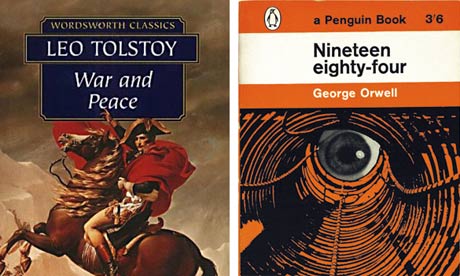
War and Peace and Nineteen Eighty-Four – guilty reading secrets? Photograph: Public Domain
“It was a bright cold day in April, and the clocks were striking thirteen.” Ring any bells? How about: “The hallway smelt of boiled cabbage and old rag mats.” Many will not have read the novel from which these are among the opening lines – but nearly half of us are happy to lie and say we have, a survey reveals today.
George Orwell’s Nineteen Eighty-Four comes top in a poll of the UK’s guilty reading secrets. Asked if they had ever claimed to read a book when they had not, 65% of respondents said yes and 42% said they had falsely claimed to have read Orwell’s classic in order to impress. This is followed by Tolstoy’s War and Peace (31%), James Joyce‘s Ulysses (25%) and the Bible (24%).
The poll, conducted to tie in with World Book Day today, also reveals that many of us are impatient readers – we skip to the end – and are not particularly bothered about how we treat the actual book – we turn the page to keep our place.
BLOOD and RAGE from Harper
Book Review By Jonathan Liu
Blood and Rage: A Cultural History of Terrorism
By Michael Burleigh
Harper, 577 pages, $29.99
Nearly a decade has passed since this country declared war on terror, and still, I’m afraid to report, the definitive history of modern terrorism remains to be written.

But that’s not to say it doesn’t exist. Whatever consolation it provides Michael Burleigh—or his American fans, who’ve waited over a year for the British historian’s latest to make it to our shores—the failures of Blood and Rage: A Cultural History of Terrorism are sins less of omission than questionable inclusion. If you could scrub the grime of sweat and snark off its pages, all 577 of them, you’d uncover a survey, perhaps a tenth shorter, of impressive scope and verve. Such an abridgement would demonstrate that 25 years in print, on television and behind lecterns have made Mr. Burleigh, above all else, a craftsman. It would show a master weaver at his hand loom, crossing disparate threads of fact and argument (the lack of original research and reliance on secondary sources become moot here) to form a single intricate fabric stretched across the long 20th century, from the discovery of “dynamite terrorism” among Irish-nationalist “Fenians” in the 1880s to the internecine rivalries besetting today’s various extant Al Qaedas.
A Treatment for nocturnal incontinence and to prevent masturbation.

Coffee and A Double D Cup
Topless Coffee Shop Drew 150 Applicants For 10 Positions
February 25, 2009 10:33 AM ET | Liz Wolgemuth
Vassalboro, Maine’s newest coffee shop is garnering national attention for something other than its $3 a cup coffee. At the Grand View Topless Coffee Shop, the waitresses are, well, topless.

You can read the local paper’s report here. The most interesting piece of news is not near the top of the story–it’s not the news that many local residents are unhappy, or that other locals are already stopping by (as many as 60 customers on Monday).
You’ll have to scroll to the bottom for the most stunning detail. The Kennebec Journal reports that the shop’s owner Donald Crabtree said that he interviewed 150 people for the positions, “and narrowed the field to 10.”
Further evidence that this is a rough job market.
The shop is located in what is described by a local government council as a “rural residential suburb”–population 4,500 or so. It opens at 6 a.m. to serve hot coffee and doughnuts.
One waitress explains her interest to the Journal:
Topless waitress Susie Wiley, 23, of Farmingdale, said she went for the job because it’s “something different” and said she’s worked in coffee shops since she was a teenager.
“I don’t think so, Jazmine.”
Two teen girls arrested for pimping young girls for prostitution
Thursday, February 26th 2009, 6:45 AM
 PHOENIX — Phoenix police say they have arrested two teenagers accused of pimping young girls for prostitution.
The teens are identified as Jazmine Finley and Tatiana Tye, both 16.
The Phoenix Police Vice Unit began investigating when Maryvale Precinct patrol officers gave detectives information on child prostitutes working the west Phoenix area.
Investigators say they found the suspects recruited at least five girls, ages 14 to 17, some of whom were from area high schools.
No prostitution crimes were committed on school grounds during the course of the investigation.
Easy Hot Soup For A Cold Hard Day

The Age Of Greed Not Bearing As Much Fruit
Valley citrus legacy getting squeezed
After years of sprawl, just a few groves remain
Between 1966 and 1972, Art Freeman planted more than 20,000 trees, transforming 240 acres of rocky desert along the Salt River in east Mesa into a lush citrus orchard. At the time, he was part of a booming industry in Arizona.
 Now, the citrus industry’s days are dwindling. Rising land values long have made it more profitable to build homes than to grow citrus, and once the economy recovers, it will be only a matter of time before the last commercial groves are a thing of the past.
Even in the face of the inevitable, people like Freeman are doing their best to hang on to the lifestyle they love. And in a way, they’re almost grateful for the extra time the troubled economy has bought for their farms.
Citrus farming isn’t an easy job. The hours are long. The work seemingly is never done.
During the intense summer heat, farmers get up in the middle of the night to irrigate trees. In winter, there’s always the danger of a hard freeze that can ruin the crop.
Despite the hardships, the Freeman family’s agricultural heritage passed from one generation to the next.
“It was a life that was just great. I loved it. I could put in 12 hours a day on a tractor,” Freeman said.
Freeman, 72, graduated from Arizona State University’s advanced officer training program and could have joined the Air Force, but the farm is where he feels at peace, and the farm is where he chose to stay.
Paul Harvey Gone
Broadcasting pioneer Paul Harvey dies at age of 90
CHICAGO March 1, 2009, 08:16 am ET · Paul Harvey, the news commentator and talk-radio pioneer whose staccato style made him one of the nation’s most familiar voices, died Saturday in Arizona, according to ABC Radio Networks. He was 90.
 Harvey died surrounded by family at a hospital in Phoenix, where he had a winter home, said Louis Adams, a spokesman for ABC Radio Networks, where Harvey worked for more than 50 years. No cause of death was immediately available.
Harvey had been forced off the air for several months in 2001 because of a virus that weakened a vocal cord. But he returned to work in Chicago and was still active as he passed his 90th birthday. His death comes less than a year after that of his wife and longtime producer, Lynne.
“My father and mother created from thin air what one day became radio and television news,” Paul Harvey Jr. said in a statement. “So in the past year, an industry has lost its godparents and today millions have lost a friend.”
Known for his resonant voice and trademark delivery of “The Rest of the Story,” Harvey had been heard nationally since 1951, when he began his “News and Comment” for ABC Radio Networks.
He became a heartland icon, delivering news and commentary with a distinctive Midwestern flavor. “Stand by for news!” he told his listeners. He was credited with inventing or popularizing terms such as “skyjacker,” “Reaganomics” and “guesstimate.”
The Lowest Price Is Of The Most Importance In These Times
Watch more metacafe videos on AOL Video
The Lost Generation In Reverse
Negrohead Mountain Renamed
A heightened profile for one of L.A.’s black pioneers

Mel Melcon / Los Angeles Times
L.A. County officials are recommending that Negrohead Mountain be named Ballard Mountain, in honor of John Ballard, a pioneering black settler in Agoura.
Early settlers in the Agoura area named Negrohead Mountain after John Ballard, a former slave who moved there in the 1880s. Now L.A. County wants to put Ballard’s actual name on the 2,031-foot peak.
By Bob Pool
February 24, 2009
Negrohead Mountain is an unlikely memorial to a former slave who made a name for himself at the western end of Los Angeles County. More than 120 years ago, pioneers in the Santa Monica Mountains named the peak for John Ballard, the first black man to settle in the hills above Malibu.
Ballard was a former Kentucky slave who had won his freedom and come to Los Angeles in 1859. In the sleepy, emerging city, he had a successful delivery service and quickly became a landowner. Soon he was active in civic affairs: He was a founder of the city’s first African Methodist Episcopal Church.
 The arrival of the railroad triggered a land boom in Los Angeles in the 1880s, boosting property values and bringing the city its first sense of class structure and the beginnings of segregation.
Ballard packed up his family and moved about 50 miles west to the snug valley in the middle of the Santa Monica range. He settled first on 160 acres — space that eventually doubled in size when one of his seven children, daughter Alice, claimed an adjoining plot.
Besides raising livestock and a few crops, Ballard collected firewood in the nearby mountains and sold it in Los Angeles.
He also worked at blacksmithing and other chores on the Russell Ranch, a sprawling cattle spread at what is now Westlake Village. He would travel by mule or buggy several miles through Triunfo Canyon to get there.
J.H. Russell, who had grown up on his family’s ranch and as a boy rode his horse to Ballard’s rickety cabin to mooch biscuits smothered with wild grapes preserved in honey by Ballard’s wife, remembered the scene well in his 1963 book, “Heads and Tails . . . and Odds and Ends.”
“The Ballard house was something to behold. It was built of willow poles, rocks, mud and Babcock Buggy signs (“Best on Earth”), Maier & Zobelein Lager Beer signs and any other kind of sign the old man picked up. Hardly a Sunday passed where there were not several buggies, spring wagons and loads of people going down the canyon to see the place,” he wrote.
Ballard was powerfully built — he could hoist 100-pound bags of barley with one hand — and traveled in a wagon pulled by five mules and “sometimes a cow or horse hitched up with the five,” Russell recounted.
[ click to continue reading at LATimes.com ]