
Cheadle Plays The Prince Of Darkness
First Look: Don Cheadle as Miles Davis in biopic ‘Miles Ahead’
By Nina Terrero
 Image Credit: Brian Douglas
Actor Don Cheadle’s obsession with Miles Davis began as a child with the jazz trumpeter’s album Porgy and Bess, a beloved staple of his family’s music collection.Now, Cheadle will make his feature film directorial debut with a crowdfunded biopic on Davis that will focus on the musician’s transition into music after a five-year hiatus—otherwise known as his “silent period”—and tumultuous relationship with first wife Frances Taylor Davis.
EW exclusive of the actor in character, Cheadle gave fans a first look at his interpretation of the icon during in the period leading up to his 1969 jazz-rock fusion recording In a Silent Way. “It’s surreal,” says the 49-year-old House of Lies actor, who in the photograph totes a trumpet and sports Davis’ trademark jheri-curled mullet.
The biopic—which will co-star Ewan McGregor, Michael Stuhlbarg and Emayatzy Corinealdi—begins shooting this week in Cincinnati after being in development for nearly a decade. Cheadle spoke to EW about the independent film—which he co-wrote—and shared details about how he was approached by the Davis family to profile the prodigious talent, why he turned to jazz heads to crowdsource funding, and explained why he’s set on making a movie that Davis himself “would want to star in.”
Argentavis magnificens Unseated
A newly declared species may be the largest flying bird to ever live
 An artist’s drawing of the newly named species Pelagornis sandersi shows the discovered bone fragments in white. The strikingly well-preserved specimen consisted of multiple wing and leg bones and a complete skull. (Liz Bradford)
By Rachel Feltman
When South Carolina construction workers came across the giant, winged fossil at the Charleston airport in 1983, they had to use a backhoe to pull the bird, which lived about 25 million years ago, up from the earth.
But if the bird was actually a brand-new species, researchers faced a big question: Could such a large bird, with a wingspan of 20 to 24 feet, actually get off the ground? After all, the larger the bird, the less likely its wings are able to lift it unaided.
The answer came from Dan Ksepka, paleontologist and science curator at the Bruce Museum in Greenwich, Conn. He modeled a probable method of flight for the long-extinct bird, named as a new species this week in the Proceedings of the National Academy of Sciences. If Ksepka’s simulations are correct, Pelagornis sandersi could be the largest airborne bird ever discovered.
The Revenge Of Frey
BEA 2014: Big Children’s Books at BEA
By Diane Roback, Carolyn Juris, John Sellers, and Matia Burnett

Jim Brosnan Gone
Jim Brosnan, Who Threw Literature a Curve, Dies at 84
 Jim Brosnan in Chicago in 1964. “The Long Season,” his groundbreaking 1960 book, began as a diary. Credit Associated Press
Jim Brosnan, who achieved modest baseball success as a relief pitcher but gained greater fame and consequence in the game by writing about it, died on June 29 in Park Ridge, Ill. He was 84.In 1959, Brosnan, who played nine years in the major leagues, kept a diary of his experience as a pitcher, first with the St. Louis Cardinals and later, after a trade, with the Cincinnati Reds. Published the next year as “The Long Season,” it was a new kind of sportswriting — candid, shrewd and highly literate, more interested in presenting the day-to-day lives and the actual personalities of the men who played the game than in maintaining the fiction of ballplayers as all-American heroes and role models.
Written with a slightly jaundiced eye — but only slightly — the book is often given credit for changing the nature of baseball writing, anticipating the literary reporting of Roger Angell, Roger Kahn and others; setting the stage for “Veeck — as in Wreck,” the vibrant memoir of Bill Veeck, the maverick owner of several teams; and predating by a decade Jim Bouton’s more celebrated, more rambunctious (and more salacious) pitcher’s diary, “Ball Four.”
Happy Independence Day

Giacomo Balla, Fireworks (sketch) (1915).
Photo: Wikipedia Commons.
Castaneda Confirmed
Psychedelic mushrooms put your brain in a “waking dream,” study finds
By Rachel Feltman
 A man displays dried mushrooms. Reuters/Elijah Nouvelage
Psychedelic mushrooms can do more than make you see the world in kaleidoscope. Research suggests they may have permanent, positive effects on the human brain.
In fact, a mind-altering compound found in some 200 species of mushroom is already being explored as a potential treatment for depression and anxiety. People who consume these mushrooms, after “trips” that can be a bit scary and unpleasant, report feeling more optimistic, less self-centered, and even happier for months after the fact.
But why do these trips change the way people see the world? According to a study published today in Human Brain Mapping, the mushroom compounds could be unlocking brain states usually only experienced when we dream, changes in activity that could help unlock permanent shifts in perspective.
The study examined brain activity in those who’d received injections of psilocybin, which gives “shrooms” their psychedelic punch. Despite a long history of mushroom use in spiritual practice, scientists have only recently begun to examine the brain activity of those using the compound, and this is the first study to attempt to relate the behavioral effects to biological changes.
Tim Howard Saves America
“Keep your arms in, kids!”
Most Insane Amusement Park Ever Returns
“Part of the fun was actually surviving the day”
“The Alpine Slide was essentially a giant track to rip people’s skin off, disguised as a children’s ride,” recalled a survivor.
Action Park, a death-tempting water park that operated from 1978 to 1996, returns this summer under its original ownership, on its original property.
Some laughed when the park’s hallmark rainbow logo replaced the Mountain Creek sign in Vernon, New Jersey on April Fool’s Day this year. But the timing was intentionally wry and the purchase was for real. Founder Gene Mulvihill’s son Andy has revamped and reopened Action Park as similarly to the original as he could legally manage. So, New Yorkers, get your teenage crew together and hit this place up, if it’s the last thing you ever do.
Nicknamed Accident Park and Class Action Park, the stomping grounds for teenage daredevils saw ten casualties during its prime. And five to ten patrons went to the emergency room per day, so that Action Park literally purchased additional ambulances for the town of Vernon to accommodate the demand rise, the Post reported.
But Action Park was a right of passage for daring teenagers, and nostalgia haunts those lucky enough to have once called the original a summer staple. “It was by far one of the most dangerous situations I’ve ever been in in my entire life,” a New Jersey native recalled fondly in a short documentary.
The old rides included an “utterly chaotic” wave pool and a ride called Cannonball Loop that was “almost physically impossible.”
Of course, none can forget the Alpine Slide, frequented by Jersey’s finest.“You have to take the ski lift to get up there,” former park patron Chris Gethard recalled, “so while you’re on the Alpine Slide you also have people just spitting at you. And you know that’s true because you tried to hit them with your spit on the way up.”
This summer the park will feature several of the old rides (with safety upgrades) plus a new million dollar Zero G water slide.
Founder Gene Mulvihill had his teenage kids operate the rides. “Everyone running the place seemed to be a combination of teenage and drunk or completely apathetic,” a regular recalled in the documentary. With Andy Mulvihill at the helm this summer, the exact same hands run the show.
According to the Post, deaths at the original park resulted from a kayak ride electrocution, drowning in wave pool suction and a heart attack in ice-cold water, to name a few. “When you got to the top of the lift you actually saw photographs of other people that had been maimed,” formerly fearless Seth Rogin explained, “with a sign that said keep your arms in, kids!”
Scenius
AMBIENT GENIUS
The working life of Brian Eno.
BY SASHA FRERE-JONES
In January, 1975, the musician Brian Eno and the painter Peter Schmidt released a set of flash cards they called “Oblique Strategies.” Friends since meeting at art school, in the late sixties, they had long shared guidelines that could pry apart an intellectual logjam, providing options when they couldn’t figure out how to move forward. The first edition consisted of a hundred and fifteen cards. They were black on one side with an aphorism or an instruction printed on the reverse. Eno’s first rule was “Honour thy error as a hidden intention.” Others included “Use non-musicians” and “Tape your mouth.” In “Brian Eno: Visual Music,” a monograph of his musical projects and visual art, Eno, who still uses the rules, says, “ ‘Oblique Strategies’ evolved from me being in a number of working situations when the panic of the situation—particularly in studios—tended to make me quickly forget that there were other ways of working and that there were tangential ways of attacking problems that were in many senses more interesting than the direct head-on approach.”
Eno is widely known for coining the term “ambient music,” and he produced a clutch of critically revered albums in the nineteen-seventies and eighties—by the Talking Heads, David Bowie, and U2, among others—but if I had to choose his greatest contribution to popular music it would be the idea that musicians do their best work when they have no idea what they’re doing. As he told Keyboard, in 1981, “Any constraint is part of the skeleton that you build the composition on—including your own incompetence.” The genius of Eno is in removing the idea of genius. His work is rooted in the power of collaboration within systems: instructions, rules, and self-imposed limits. His methods are a rebuke to the assumption that a project can be powered by one person’s intent, or that intent is even worth worrying about. To this end, Eno has come up with words like “scenius,” which describes the power generated by a group of artists who gather in one place at one time. (“Genius is individual, scenius is communal,” Eno told the Guardian, in 2010.) It suggests that the quality of works produced in a certain time and place is more indebted to the friction between the people on hand than to the work of any single artist.
Tucker Pukes Up Mama’s Wedding Ring
Diamond dog returns missing wedding ring
By Rose Heaphy

STEVENS POINT (WAOW) – A Stevens Point woman found a special surprise in an unlikely place.
Five years ago, Lois Matykowski lost her wedding ring. Matykowski had given up all hope finding it, until her dog, Tucker, led her to a shocking discovery.
Tucker is your typical mutt. He likes playing with his frisbee and rolling on the grass on a hot summer day. “You wouldn’t think he’s ten years old by the way he acts,” said Matykowski.
Like every pup, he likes getting into trouble. “He’s known in the family to be the food burglar,” said Matykowski.
Two weeks ago, Matykowski and her granddaughter were eating popsicles outside.
“After I turn around and look at my granddaughter and the popsicle is gone and there’s Tucker smacking his jaws,” she said. The “Food Burglar” had struck again, swallowing the popsicle whole.
But the snatched food soon came back up and two days later, Tucker started vomiting again. Only this time, it wasn’t a popsicle stick.
“I look in the paper towel and here is my wedding ring,” Matykowski said. “I kid you not. My wedding ring was in Tucker’s puke!”
“The lunatic, the lover, and the poet…”
Secrets of the Creative Brain
A leading neuroscientist who has spent decades studying creativity shares her research on where genius comes from, whether it is dependent on high IQ—and why it is so often accompanied by mental illness.
 Kyle Bean
As a psychiatrist and neuroscientist who studies creativity, I’ve had the pleasure of working with many gifted and high-profile subjects over the years, but Kurt Vonnegut—dear, funny, eccentric, lovable, tormented Kurt Vonnegut—will always be one of my favorites. Kurt was a faculty member at the Iowa Writers’ Workshop in the 1960s, and participated in the first big study I did as a member of the university’s psychiatry department. I was examining the anecdotal link between creativity and mental illness, and Kurt was an excellent case study.
He was intermittently depressed, but that was only the beginning. His mother had suffered from depression and committed suicide on Mother’s Day, when Kurt was 21 and home on military leave during World War II. His son, Mark, was originally diagnosed with schizophrenia but may actually have bipolar disorder. (Mark, who is a practicing physician, recounts his experiences in two books, The Eden Express and Just Like Someone Without Mental Illness Only More So, in which he reveals that many family members struggled with psychiatric problems. “My mother, my cousins, and my sisters weren’t doing so great,” he writes. “We had eating disorders, co-dependency, outstanding warrants, drug and alcohol problems, dating and employment problems, and other ‘issues.’ ”)
While mental illness clearly runs in the Vonnegut family, so, I found, does creativity. Kurt’s father was a gifted architect, and his older brother Bernard was a talented physical chemist and inventor who possessed 28 patents. Mark is a writer, and both of Kurt’s daughters are visual artists. Kurt’s work, of course, needs no introduction.
For many of my subjects from that first study—all writers associated with the Iowa Writers’ Workshop—mental illness and creativity went hand in hand. This link is not surprising. The archetype of the mad genius dates back to at least classical times, when Aristotle noted, “Those who have been eminent in philosophy, politics, poetry, and the arts have all had tendencies toward melancholia.” This pattern is a recurring theme in Shakespeare’s plays, such as when Theseus, in A Midsummer Night’s Dream, observes, “The lunatic, the lover, and the poet / Are of imagination all compact.” John Dryden made a similar point in a heroic couplet: “Great wits are sure to madness near allied, / And thin partitions do their bounds divide.”
Compared with many of history’s creative luminaries, Vonnegut, who died of natural causes, got off relatively easy. Among those who ended up losing their battles with mental illness through suicide are Virginia Woolf, Ernest Hemingway, Vincent van Gogh, John Berryman, Hart Crane, Mark Rothko, Diane Arbus, Anne Sexton, and Arshile Gorky.
“With that tush, who’d need to be literate?”
Olivia Wilde responds to GQ film critic claiming she is too hot to portray a writer: ‘Kiss my smart a–’

Olivia Wilde has a witty response for someone who claimed she couldn’t have beauty and brains.
The actress portrays a writer in the romantic thriller “Third Person,” but GQ film critic Tom Carson didn’t find her believable in the role due to her looks.
“She’s supposed to be a writer … but your belief in that won’t outlast (Olivia) Wilde scampering naked through hotel corridors,” Carson wrote in his review of the film. “With that tush, who’d need to be literate? Who’d want to?”
When Jezebel tweeted about Carson’s backhanded compliment, Wilde responded with acerbic humor.
“HA,” she tweeted Tuesday. “Kiss my smart a–, GQ.”
The Ugly Gone (at Age 98)
Custodial Revenge
Over 60 Artworks Trashed at Kunstakademie Düsseldorf
Alexander Forbes

A disgruntled janitor or group of janitors at the renowned Kunstakademie Düsseldorf (Düsseldorf Academy of Art) has destroyed over 60 artworks, the Rheinische Post (RP) reports. Mostly canvases, many of the pieces were slashed with a knife and stomped on to break their stretchers. They were then thrown in a dumpster in the academy’s courtyard.
Understandably, the students whose work was trashed are outraged. “The whole situation is extremely emotional,” their chosen representative, Sabrina Straub, told the RP. Many of the works that were destroyed had not yet been assessed by the students’ professors. Others were to be sold.
Considering the consistently illustrious careers of the academy’s alumni—among them some of Germany’s most expensive, such as Gerhard Richter, Joseph Beuys, Sigmar Polke, Günther Uecker, and Thomas Schütte, as well as recent star David Ostrowski—the long-term economic impact of the destruction could be in the millions. (For the perpetrator’s sake, we hope none of current-professor Peter Doig’s works happened to fall into the fray.)
The Kunstakademie Düsseldorf’s director, Rita McBride, was similarly floored by the incident. “It’s just terrible for the students,” she told the paper. “The works are irreplaceable.” However, in a letter to the academy’s student body the administration’s contrition was more measured. It read, “Relevant members of the janitorial staff have been spoken to about their flawed approach,” in this matter.
Felix Dennis Gone
Felix Dennis, the improbable magazine entrepreneur
By Matthew Engel
 Felix Dennis, center, with James Anderson, left, and Richard Neville, editors of Oz, after being found guilty of corrupting public morals in 1971. (United Press International)
Felix Dennis, whose death aged 67 was announced on Monday, was one of Britain’s most successful media entrepreneurs and by a long distance the most improbable. Reaction varied from amazement that he had lived as long as he did, to shock that such a seemingly unstoppable force had allowed a mere disease to get the better of him.
John Brown, a friend and business associate, compared him to Richard Branson in his willingness to court failure and, if it happened, shrug it off. “Felix had irrepressible energy, loads of ideas and faith in his own abilities. And he just charged ahead.”
He charged ahead out of the office too. Dennis had revelled in the Sixties lifestyle: “Free sex with no downside,” he would recall. “Women were walking down the street in miniskirts, in what looked like their underwear. It was almost too much for anyone to stand.” All his life there were a lot of cigarettes and whisky and wild, wild women – and drugs, including a spell as a crack addict. Some, however, thought that Dennis was inclined to overstate the quantity of drugs and sex, just a bit. He once claimed, in a newspaper interview, to have pushed a man over a cliff. And no one seemed to believe that at all.
He did find the time for a remarkably varied set of achievements. Dennis was a popular performance poet (particularly when he offered free wine from his cellar as well). He established the Heart of England Forest near his Warwickshire home, which now has more than 1m saplings. And he had a large, themed collection of bronze sculptures.
Giant German Vagina Engulfs Exchange Student
US student is rescued from giant vagina sculpture in Germany
More than 20 firefighters free exchange student from the artwork Chacán-Pi (Making Love) by Fernando de la Jara in Tübingen
by Philip Oltermann in Berlin
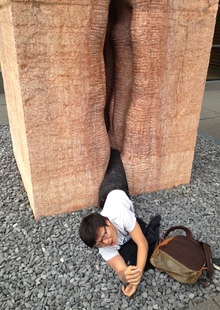 The student waits to be rescued. Photograph: Erick Guzman/Imgur
On Friday afternoon, a young American in Tübingen had to be rescued by 22 firefighters after getting trapped inside a giantsculpture of a vagina. The Chacán-Pi (Making Love) artwork by the Peruvian artist Fernando de la Jara has been outside Tübingen University’s institute for microbiology and virology since 2001 and had previously mainly attracted juvenile sniggers rather than adventurous explorers.
According to De la Jara, the 32-ton sculpture made out of red Veronese marble is meant to signify “the gateway to the world”.
Police confirmed that the firefighters turned midwives delivered the student “by hand and without the application of tools”.
INTERVIEW: Kenneth Anger
KENNETH ANGER

To describe Kenneth Anger as a “cult filmmaker” seems requisite but incomplete. The 87-year-old native Angeleno is indeed the writer and director of the surrealist shortsInauguration of the Pleasure Dome (1954-66), Scorpio Rising (1963), and Lucifer Rising (1970-81)—some of the wildest and most profoundly influential experimental films of the last century. But his salacious narrative history of the industry, Hollywood Babylon, originally published in 1960, is also kitsch-famous, a kind of gossip gospel in the land of holy celebrity. His film and video works are in the permanent collections of various museums of modern art. And he is also the most famous living practitioner of Thelema—the ritual-based doctrine dictated to Aleister Crowley by the spiritual messenger Aiwass.
Over the course of his multivalent career, Anger has worked with and befriended such artists as Marianne Faithfull (a collaborator on Lucifer Rising), the surrealist Jean Cocteau, guitar god Jimmy Page, sexologist Alfred Kinsey, and Tennessee Williams, as well as fellow Thelemite Marjorie Cameron—star of Pleasure Dome and onetime wife of Jet Propulsion Laboratory founder Jack Parsons. Anger is the godfather of homoerotic cinema, having made his pioneeringFireworks in 1947. He has been famously obscene (and charged as such for Fireworks in California), happily hallucinogenic (his Invocation of My Demon Brother from 1969 was famously evocative of an acid trip), and quite consciously provocative (see all). Inside the industry, he’s never found a place to rest—he has Lucifer tatted on his chest. And he’s seen UFOs—three times.
Painter and filmmaker—and something of a hell-raiser himself—Harmony Korine has long appreciated the work and legend of Anger, but the two have never really had the chance to speak. We thought they should, so in April, Korine called Anger from his home in Nashville to discover that his hero is still working outside of the mainstream, still a scabrous critic of Hollywood, and still speculating about that Malaysia Airlines flight.
Kubrick In The Hamster Wheel

Roach Coaches No More
Study: Food Trucks May Be Safer Than Restaurants
 Food trucks gather at Nathan Phillips Square in Toronto on April 2, 2014.Andrew Francis —Toronto Star/Getty Images
Food trucks in 7 cities performed better than or the same as restaurants on food safety inspection reports
Grabbing your lunch from a food truck may be a safer option than sitting down at a restaurant, according to a new study.
After examining over 260,000 food inspection reports, researchers from a public law interest firm in Virginia foundthat in each of the seven examined cities—Boston, Las Vegas, Los Angeles, Louisville, Miami, Seattle and Washington, D.C.—food trucks performed better than or as well as restaurants.
In every city except Seattle, food trucks averaged fewer sanitation violations than restaurants. In Seattle, the number of violations for food trucks was also lower but was not statistically significant, which means that food trucks and restaurants performed approximately the same. The study, called “Street Eats, Safe Eats,” looked at cities where food trucks and restaurants are obliged to follow the same health guidelines.
[ click to continue reading at TIME ]
Sprey Unleashed On The Turkey
The designer of the F-16 explains why the F-35 is such a crappy plane
by Casey Chan
According to the Pierre Sprey, co-designer of the F-16, the F35 is a turkey. Inherently, a terrible airplane. An airplane built for a dumb idea. A kludge that will fail time and time again. Just impossibly hopeless. And judging from the bajillion times the F-35 fleet has been grounded, well, he’s probably not wrong. It’s a trillion dollar failure. Watch Sprey eviscerate the F-35 in the video above.
Etna Erupts
Mt Etna eruption disrupts tourist flights to Sicily
Eruption of Mt Etna, Europe’s most active volcano, results in delays and disruptions for tourists trying to reach Sicily
By Nick Squires, Rome
Flights into and out of the Italian city of Catania have been disrupted by the eruption of Mt Etna, Europe’s most active volcano.
Catania airport remained open but two air space corridors were temporarily closed on Monday, resulting in delays and disruptions for tourists trying to reach Sicily.
The volcano, which looms over Catania, put on an impressive pyrotechnics display, belching molten lava and sending plumes of ash into the sky.
Most of the activity came from a crater on the south-east side of the mountain.
This latest eruption began on Sunday and was the first major activity this year.
Dominating the landscape in eastern Sicily between Catania and the popular tourist town of Taormina, Etna is one of the most active volcanoes in the world.
The fertile volcanic soils on its flanks support extensive agriculture, including vineyards and orchards.
KICKSTART Evan Kelman’s BANDITO
BANDITO is the coming-of-age epic tale of a young boy, who sneaks out to join his older brother on a life-changing semi-truck robbery.
[ click to pledge now ]
People Suck Ass
Poachers kill one of the world’s largest elephants in Kenya
Poachers hack the face and tusks off Satao, one of Kenya’s most famous elephants, as conservationists warn elephant poaching “is at least 10 times the official figures”
 Satao’s enormous tusks classed him among the largest elephants left alive in the world Photo: RICHARD MOLLER/TSAVO TRUST
By Zoe Flood, Nairobi
One of Africa’s last ‘great tuskers’, elephants with ivory weighing over 100lbs, has been poisoned to death by poachers in Kenya after years of adapting his behaviour to hide himself from humans.
The bull, named Satao and likely born in the late 1960s, succumbed to wounds from poison darts in a remote corner of Tsavo National Park where he had migrated to find fresh water after recent storms.
His carcass yesterday lay with its face and great tusks hacked off, four legs splayed where he fell with his last breath, left only for the vultures and the scavengers.
Conservationists told how he moved from bush to bush always keeping his ivory hidden amongst the foliage.
“I’m convinced he did that to hide his tusks from humans, he had an awareness that they were a danger to him,” said Mark Deeble, a British documentary filmmaker who has spent long periods of time filming Satao.
The elephant’s killing is the latest in a massive surge of poaching of the mammals for their ivory across Africa.
Richard Moller, of The Tsavo Trust, who had been monitoring Satao for several months confirmed that the elephant found dead on May 30 was indeed Satao, whom he called “an icon”.
“There is no doubt that Satao is dead, killed by an ivory poacher’s poisoned arrow to feed the seemingly insatiable demand for ivory in far off countries,” Mr Moller said.
“A great life lost so that someone far away can have a trinket on their mantelpiece.”
Poetry Is The Key – and Not The Money.
Poetry: Who Needs It?
By

GAINESVILLE, Fla. — WE live in the age of grace and the age of futility, the age of speed and the age of dullness. The way we live now is not poetic. We live prose, we breathe prose, and we drink, alas, prose. There is prose that does us no great harm, and that may even, in small doses, prove medicinal, the way snake oil cured everything by curing nothing. But to live continually in the natter of ill-written and ill-spoken prose is to become deaf to what language can do.
The dirty secret of poetry is that it is loved by some, loathed by many, and bought by almost no one. (Is this the silent majority? Well, once the “silent majority” meant the dead.) We now have a poetry month, and a poet laureate — the latest, Charles Wright, announced just last week — and poetry plastered in buses and subway cars like advertising placards. If the subway line won’t run it, the poet can always tweet it, so long as it’s only 20 words or so. We have all these ways of throwing poetry at the crowd, but the crowd is not composed of people who particularly want to read poetry — or who, having read a little poetry, are likely to buy the latest edition of “Paradise Lost.”
This is not a disaster. Most people are also unlikely to attend the ballet, or an evening with a chamber-music quartet, or the latest exhibition of Georges de La Tour. Poetry has long been a major art with a minor audience. Poets have always found it hard to make a living — at poetry, that is. The exceptions who discovered that a few sonnets could be turned into a bankroll might have made just as much money betting on the South Sea Bubble.
There are still those odd sorts, no doubt disturbed, and unsocial, and torturers of cats, who love poetry nevertheless. They come in ones or twos to the difficult monologues of Browning, or the shadowy quatrains of Emily Dickinson, or the awful but cheerful poems of Elizabeth Bishop, finding something there not in the novel or the pop song.
This is not a disaster. Most people are also unlikely to attend the ballet, or an evening with a chamber-music quartet, or the latest exhibition of Georges de La Tour. Poetry has long been a major art with a minor audience. Poets have always found it hard to make a living — at poetry, that is. The exceptions who discovered that a few sonnets could be turned into a bankroll might have made just as much money betting on the South Sea Bubble.
Supermensch
Supermensch: The Legend of Shep Gordon
By Brent Simon

A documentary about its titular talent manager, Supermensch: The Legend of Shep Gordon, directed by writer-actor Mike Myers, has the potential to be a slice of yawning, self-congratulatory star-fuckery of the highest order. After all, in addition to its famous director, it has plenty of recognizable celebrities who all line up to sing the praises of its subject. And yet, thanks to whip-smart pacing, this warm-hearted and unfussy nonfiction valentine emerges as an engaging portrait of a life less ordinary—a man who embraced and promulgated selflessness, even while, in his early days, indulging in druggy partying and frequently sporting a T-shirt that read, “No head, no backstage pass.”
Gordon looks like your average Florida retiree but sounds rather like the late Sydney Pollack, erudite and measured, except when his laugh—halfway between a chuckle and a goose’s honk—comes bursting forth. What helps further differentiate him is the fact that wild yarns trail him like a speedboat’s wake. A self-described social liberal who graduated from the University of Buffalo but quickly abandoned his dreams of becoming a probation officer, Gordon tells a story of occupational focusing so random and fanciful that it defies belief: a day after arriving in Los Angeles and taking a room at the Landmark Motor Hotel, he took some LSD, and later responded to the screams of a woman he thought was being sexually assaulted. She beat the crap out of him (turns out she was merely in the throes of ecstasy). The next day the duo apologized to one another, and since Gordon had a lot of marijuana, he shared it. The guy she was with suggested he become a manager. It turns out that woman and man were Janis Joplin and Jimi Hendrix, respectively, and within a week Gordon was managing Alice Cooper and Pink Floyd.
Though the latter relationship would only last nine days (Gordon freely admits he had no idea what he was doing), his relationship with shock-rocker Cooper would endure decades. Gordon was less interested in the music than the manipulation of the moment, ginning up controversy wherever they went—trying to get Cooper arrested for wearing see-through clothes, and insisting on wrapping the vinyl records of Cooper’s 1972 album School’s Out in panties. He saw the value in marketed rebellion, but Gordon also had a conscience. Later, working with Teddy Pendergrass and other African-American artists, he sought to break free from the constraints of the so-called “chitlin’ circuit,” in which artists were frequently stiffed performance fees.
Reading Kickbow Starter
Picking Up Indecent Pecans and All Kinds Of Things With Animals
THAD COCHRAN: I GREW UP DOING ‘ALL KINDS OF INDECENT THINGS WITH ANIMALS’
Sen. Thad Cochran (R-MS) provided his latest head-scratching comment in public, this time joking he engaged in illicit activities with animals as a child.
“[We’d] get back [to the Pine Belt-Hattiesburg area of Mississippi] as often as we could because it was fun—it was an adventure to be out there in the country and see what goes on,” Cochran said of his childhood and how parts of his family lived in the central part of the state. “Picking up pecans, from that to all kind of indecent things with animals.”
The audience laughed at that point, video published by the Jackson Clarion-Ledger shows. Cochran’s facial expressions did not change, nor did his stance or demeanor. “I know some of you know what that is,” he continued. “The whole point of the story is not just coming here to visit cousins and get to know aunts and uncles better, you absorb the culture and you know what’s important to people here. I feel very comfortable here and have an identity with this area of the state that’s different than any other.”
The Shawshank Rainbow
The Shawshank Residuals
How one of Hollywood’s great second acts keeps making money
By RUSSELL ADAMS
Bob Gunton is a character actor with 125 credits to his name, including several seasons of “24” and “Desperate Housewives” and a host of movie roles in films such as the Oscar-winning “Argo.” Vaguely familiar faces like his are common in the Los Angeles area where he lives, and nobody pays much attention. Many of his roles have been forgotten.
But every day, the 68-year-old actor says, he hears the whispers—from cabdrivers, waiters, the new bag boy at his neighborhood supermarket: “That’s the warden in ‘Shawshank.’ ”
He also still gets residual payments—not huge, but steady, close to six figures by the film’s 10th anniversary in 2004. Since then, he has continued to get “a very substantial income” long past the age when residuals usually dry up.
“I suspect my daughter, years from now, will still be getting checks,” he said.
Bob Welch (Reggie Jackson’s Daddy) Gone
Bob Welch, Pitching Ace and Prototype for Today’s Power Arms, Dies at 57
Bob Welch, a flame-throwing right-hander for the Los Angeles Dodgers and the Oakland A’s who overcame alcoholism to win 211 games, including 27 in 1990, a single-season total no other pitcher has reached in the past 40 years, died on Monday in Seal Beach, Calif. He was 57.
Welch played 17 seasons in the big leagues, from 1978 to 1994, was named to two All-Star teams, one in each league, and won the American League Cy Young Award in 1990. He was among the hardest throwers of his era, a rangy and athletic prototype of the so-called power arms who now flood the rotations and bullpens of major league teams, challenging opposing lineups with their 95-mile-per-hour fastballs.
His blistering fastball, and his poise, received an early showcase at the end of his rookie season with the Dodgers, when he was called in from the bullpen to protect a one-run lead with one out in the ninth inning of Game 2 of the 1978 World Series against the Yankees.
Two men were on base, and after getting Thurman Munson to fly out he faced Reggie Jackson, the Hall of Fame slugger who the year before had clinched the Series for the Yankees, also against the Dodgers, with three homers in Game 6.
In an at-bat that lasted more than five minutes and became one of baseball’s most famous showdowns, Welch, who was just 21, threw nine pitches, all fastballs, and with a 3-2 count blazed one on — or maybe just off — the inside corner. Jackson swung violently and missed, ending the game.
The Hole’s The Thing
Artist Enacts Origin of the World at Musée d’Orsay—And, Yes, That Means What You Think

On May 29 the Luxembourgian performance artist Deborah de Robertis visited Paris’s Musée d’Orsay, sat down in front of Gustave Courbet’s infamous 1866 painting L’Origine du monde (Origin of the World), and recreated the iconic image in the flesh. In a video of the piece, titled Mirror of Origin, the artist can be seen dressed in a gold sequin dress, exposing her vagina while the museum’s security guards crowding around her and usher cheering visitors out of the gallery. The artist was eventually taken away by police. The museum and two of its guards have filed sexual exhibitionism complaints against the artist.
“If you ignore the context, you could construe this performance as an act of exhibitionism, but what I did was not an impulsive act,” De Robertis told Luxemburger Wort. “There is a gap in art history, the absent point of view of the object of the gaze. In his realist painting, the painter shows the open legs, but the vagina remains closed. He does not reveal the hole, that is to say, the eye. I am not showing my vagina, but I am revealing what we do not see in the painting, the eye of the vagina, the black hole, this concealed eye, this chasm, which, beyond the flesh, refers to infinity, to the origin of the origin.”