
Photographer Hans-Peter Feldmann: Life for sale
Liz Jobey looks at German artist Hans-Peter Feldmann, whose latest book collates a myriad of images – beauty queens, horses, cigarette cards – into a bittersweet reflection on consumerism
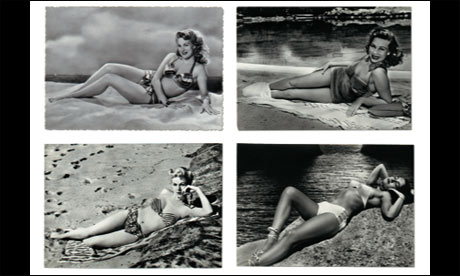
Striking a pose … a page from Hans-Peter Feldmann’s Album
In the late 1960s, the German artist Hans-Peter Feldmann produced a series of small books titled Bild (Picture) or Bilder (Pictures). Each book contained a number of black-and-white photographs of a particular subject – 14 mountains, 12 views of aircraft in the sky, 11 sets of women’s knees, six pictures of football players – and was titled accordingly. Each had “Feldmann” printed on the front cover in capitals, and though the women’s knees were credited to photographer Wolfgang Breurs, there was little else to identify the meaning of the pictures or the “author” of the books. In 1971 a portfolio of 10 books was published by the Galerie Paul Maenz in Cologne.
 In their bland depiction of ordinary objects, and in their serial groupings, they were reminiscent of the small books made a few years earlier by Ed Ruscha. In 1962 Ruscha had experimented with paintings and collages based on photographs he had taken on a road trip through Europe the year before. His subjects were ordinary scenes and objects from his travels, but once photographed, they took on a more significant role as specimens of everyday culture – apartment buildings, shop fronts, restaurants, signs, posters, a car, a motorbike, a pair of shoes.
Soon after he returned to California he made a set of photographs of household products, which he called Product Still Lifes. Ruscha recognised that photographs were inherently indexical: they allowed him to compare and contrast similar structures or objects when placed side to side. They also had a flat, deadpan quality that reflected the banality and standardisation of post-war American life. Soon Ruscha was laying out his pictures serially in what would become the first of his now famous set of books, Twenty-six Gasoline Stations, published in 1963. This small white paperback marked the advent of the contemporary artist’s book: it was cheaply produced, cheap to buy ($3 [£2] a copy) and, most importantly, it used photographs not as illustrations but as the visual expression of an idea.
In Düsseldorf, around the same time, Gerhard Richter began to use photographs as an aid to his paintings. “Do you know what was great?” he wrote in 1964, “Finding out that a stupid, ridiculous thing like copying a postcard could lead to a picture.”